
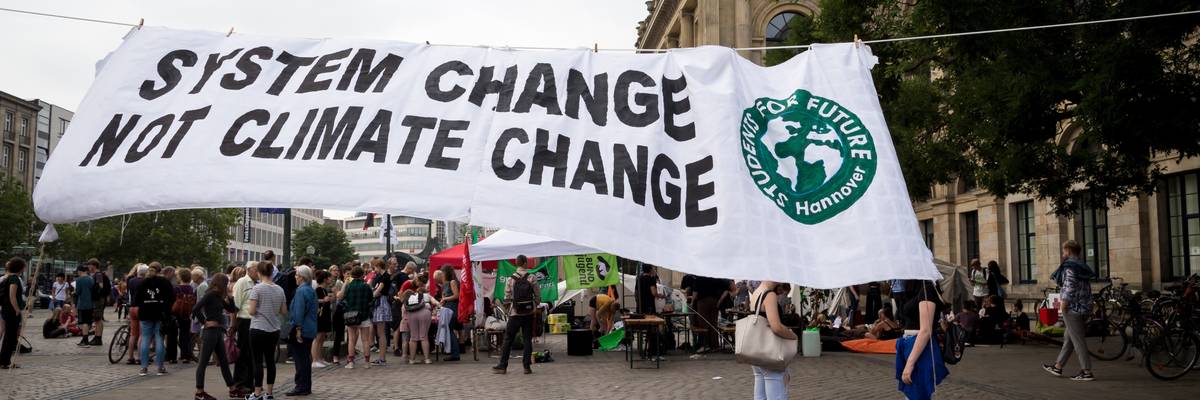
On Earth Overshoot Day, climate activists pointed out the exploitative use of the earth with a human chain and other activities in Hanover, Germany on July 29, 2019.
On Earth Overshoot Day, Campaigners Say 'Move the Date' by Fixing Broken Economic System
"We still have a chance to change the broken economic system that puts profit and overconsumption before people and nature," said Greenpeace International.
Campaigners and researchers who calculate "Earth Overshoot Day" each year called on policymakers to help "move the date" on Tuesday as they announced the planet has already reached the date when humanity has used more natural resources than the Earth can regenerate in a year.
August 2 marks 2023's Earth Overshoot Day—coming five days later than it did last year but months earlier than in 1971, when the day was first recorded by experts.
The date shows a clear trend towards overshoot days occurring closer to the beginning of the year, according to the Global Footprint Network (GFN).
The organization produces the estimate each year using data from the United Nations showing each country's ecological footprint and the Earth's ability to absorb waste and produce renewable resources, also known as its biocapacity,
Earth Overshoot Day is directly linked to the climate emergency and the effects of planetary heating, said GFN, as each country's ecological footprint includes its fossil fuel emissions.
"Persistent overshoot leads to ever more prominent symptoms including unusual heatwaves, forest fires, droughts, and floods with the risk of compromising food production," Steven Tebbe, CEO of the organization, told Euronews.
Slashing global emissions by 43% by the end of the decade would push back the date by 19 days each year between now and 2030, Euronews reported.
Cutting food waste in half would move the date back by 13 days, as would replacing 50% of all miles driven by cars with public transportation, biking, and walking.
With 70-80% of all people expected to live in urban areas by 2050, said GFN, "smart city planning and urban development strategies are instrumental to making sure there is enough biological regeneration to avoid excessive human demand that would erode it."
In one interactive feature called "Power of Possibility," the organization outlines dozens of specific solutions which could help humans conserve the world's resources each year, including:
- 15-minute cities, in which most of residents' needs can be met within a 15-minute bike ride or walk, which would move Earth Overshoot Day back by 11 days;
- The large-scale adoption of onshore wind turbines for energy production, which would move the date back by 10 days by 2050;
- The widespread use of insulating high-performance glass, which has mostly been limited to use in commercial buildings in high-income countries and could move the date back by 1.2 days; and
- The implementation of a Green New Deal "with the ambition level" of the European Union, which would move the date back by 42 days.
"The broken economic system is designed for the elite, but it can be redesigned to put people and nature at the forefront," said Greenpeace International. "We have the power to change the system."
We are at a crossroads
This country and this world are at a monumental crossroads. In a few short weeks, US voters will have an opportunity to beat back the forces of fascism and confront the billionaires who are rigging the economy, our media system, and our democracy, making it increasingly impossible for ordinary people to get by. We’re not just talking about the election. We’re talking about what must be done once these fascist elements are vanquished from power. We need a bolder set of solutions than what either major party has so far been willing to offer and a working-class movement ready to fight like hell for it. Trump didn't emerge from nowhere. The conditions that fueled MAGA authoritarianism were created by decades of radical neoliberal economic policies and a corrupt political system dominated by corporate interests. They slashed taxes on the super-rich, promising that the benefits would trickle down. They said giveaways to the corporate titans would make life more affordable for the rest of us. It was all bullshit. And when a bitter, betrayed populace searches for someone to blame, right-wing demagogues have little trouble finding scapegoats. People know when they're being lied to, but you won't hear any of this from the corporate media. Only independent journalism—powered and funded by people who believe in building a better world—can deliver truly trustworthy daily news. Our Fall Campaign is underway, and we need your help. To power our newsroom through the rest of the year, we need to raise $125,000 by midnight on October 31. So if you share our vision, please contribute whatever you can to sustain our work. |
Campaigners and researchers who calculate "Earth Overshoot Day" each year called on policymakers to help "move the date" on Tuesday as they announced the planet has already reached the date when humanity has used more natural resources than the Earth can regenerate in a year.
August 2 marks 2023's Earth Overshoot Day—coming five days later than it did last year but months earlier than in 1971, when the day was first recorded by experts.
The date shows a clear trend towards overshoot days occurring closer to the beginning of the year, according to the Global Footprint Network (GFN).
The organization produces the estimate each year using data from the United Nations showing each country's ecological footprint and the Earth's ability to absorb waste and produce renewable resources, also known as its biocapacity,
Earth Overshoot Day is directly linked to the climate emergency and the effects of planetary heating, said GFN, as each country's ecological footprint includes its fossil fuel emissions.
"Persistent overshoot leads to ever more prominent symptoms including unusual heatwaves, forest fires, droughts, and floods with the risk of compromising food production," Steven Tebbe, CEO of the organization, told Euronews.
Slashing global emissions by 43% by the end of the decade would push back the date by 19 days each year between now and 2030, Euronews reported.
Cutting food waste in half would move the date back by 13 days, as would replacing 50% of all miles driven by cars with public transportation, biking, and walking.
With 70-80% of all people expected to live in urban areas by 2050, said GFN, "smart city planning and urban development strategies are instrumental to making sure there is enough biological regeneration to avoid excessive human demand that would erode it."
In one interactive feature called "Power of Possibility," the organization outlines dozens of specific solutions which could help humans conserve the world's resources each year, including:
- 15-minute cities, in which most of residents' needs can be met within a 15-minute bike ride or walk, which would move Earth Overshoot Day back by 11 days;
- The large-scale adoption of onshore wind turbines for energy production, which would move the date back by 10 days by 2050;
- The widespread use of insulating high-performance glass, which has mostly been limited to use in commercial buildings in high-income countries and could move the date back by 1.2 days; and
- The implementation of a Green New Deal "with the ambition level" of the European Union, which would move the date back by 42 days.
"The broken economic system is designed for the elite, but it can be redesigned to put people and nature at the forefront," said Greenpeace International. "We have the power to change the system."
Campaigners and researchers who calculate "Earth Overshoot Day" each year called on policymakers to help "move the date" on Tuesday as they announced the planet has already reached the date when humanity has used more natural resources than the Earth can regenerate in a year.
August 2 marks 2023's Earth Overshoot Day—coming five days later than it did last year but months earlier than in 1971, when the day was first recorded by experts.
The date shows a clear trend towards overshoot days occurring closer to the beginning of the year, according to the Global Footprint Network (GFN).
The organization produces the estimate each year using data from the United Nations showing each country's ecological footprint and the Earth's ability to absorb waste and produce renewable resources, also known as its biocapacity,
Earth Overshoot Day is directly linked to the climate emergency and the effects of planetary heating, said GFN, as each country's ecological footprint includes its fossil fuel emissions.
"Persistent overshoot leads to ever more prominent symptoms including unusual heatwaves, forest fires, droughts, and floods with the risk of compromising food production," Steven Tebbe, CEO of the organization, told Euronews.
Slashing global emissions by 43% by the end of the decade would push back the date by 19 days each year between now and 2030, Euronews reported.
Cutting food waste in half would move the date back by 13 days, as would replacing 50% of all miles driven by cars with public transportation, biking, and walking.
With 70-80% of all people expected to live in urban areas by 2050, said GFN, "smart city planning and urban development strategies are instrumental to making sure there is enough biological regeneration to avoid excessive human demand that would erode it."
In one interactive feature called "Power of Possibility," the organization outlines dozens of specific solutions which could help humans conserve the world's resources each year, including:
- 15-minute cities, in which most of residents' needs can be met within a 15-minute bike ride or walk, which would move Earth Overshoot Day back by 11 days;
- The large-scale adoption of onshore wind turbines for energy production, which would move the date back by 10 days by 2050;
- The widespread use of insulating high-performance glass, which has mostly been limited to use in commercial buildings in high-income countries and could move the date back by 1.2 days; and
- The implementation of a Green New Deal "with the ambition level" of the European Union, which would move the date back by 42 days.
"The broken economic system is designed for the elite, but it can be redesigned to put people and nature at the forefront," said Greenpeace International. "We have the power to change the system."