

SUBSCRIBE TO OUR FREE NEWSLETTER
Daily news & progressive opinion—funded by the people, not the corporations—delivered straight to your inbox.
5
#000000
#FFFFFF
To donate by check, phone, or other method, see our More Ways to Give page.
Daily news & progressive opinion—funded by the people, not the corporations—delivered straight to your inbox.
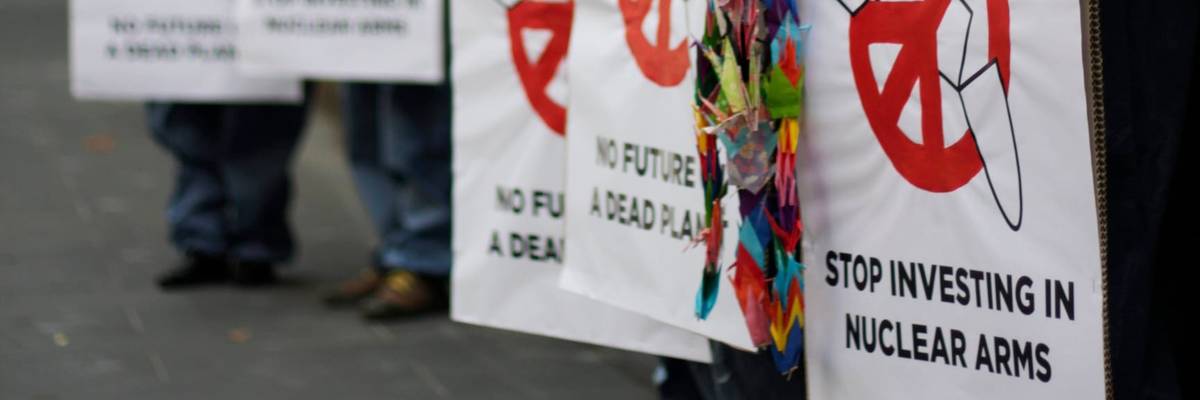
Protesters demand financial institutions stop investing in nukes in this photo posted on social media on November 21, 2021 by the International Campaign to Abolish Nuclear Weapons (ICAN).
"Many investors, given a choice, would not want to profit from companies that manufacture weapons of mass destruction," said As You Sow's Andrew Behar.
Amidst what the Bulletin of Atomic Scientists calls "an exceedingly dangerous nuclear situation" facing humanity today, the largest U.S. mutual funds—which manage the retirement and other savings of tens of millions of Americans—are profiting from investments in nuclear weapons, cluster munitions, and other banned or controversial arms, an analysis by a leading shareholder advocacy group revealed Tuesday.
Measured by dollars invested, the top 25 U.S. asset managers "all earn a D grade or worse, with significant investments in arms manufacturers and major military contractors, including companies involved with nuclear weapons and controversial weapons like cluster munitions, anti-personnel landmines, incendiary weapons, and depleted uranium," Berkeley, California-based As You Sow said in its new report.
Some of the largest corporate 401(k)s like American Funds, John Hancock Funds, and Franklin Templeton Investments were among the most heavily invested in these armaments, while "fund managers that focus on sustainable investing have less exposure to military weapons, on average."
"Nearly every retirement plan has nuclear and other controversial weapons embedded in their plan."
Seven funds profiled in the analysis—Eventide Funds, Ecofin, New Alternatives, Vert Asset Management, Aspiration Funds ,Thrivent, and Kayne Anderson—held no investments in the controversial weapons.
"Many investors, given a choice, would not want to profit from companies that manufacture weapons of mass destruction," As You Sow CEO Andrew Behar said in a statement. "Yet nearly every retirement plan has nuclear and other controversial weapons embedded in their plan. Our new ratings empower investors with the tools to know what they own so they can invest their money in alignment with their values."
As You Sow's mutual fund ratings are part of the group's Weapons Free Funds investment tool, "built to help responsible investors prioritize peace and people over war and violence."
Nuclear weapons, landmines, and cluster munitions are all banned under international law. However, the United States is not a signatory to any of the bans, and none of the world's nine nuclear powers have signed the landmark Treaty on the Prohibition of Nuclear Weapons.
Common Dreams reported last month that nuclear-armed nations spent $82.9 billion on their arsenals last year, with the United States accounting for more than half of the global total, according to the Nobel Prize-winning International Campaign to Abolish Nuclear Weapons.
Meanwhile, U.S. House Republicans last week blocked a bipartisan amendment to the 2024 National Defense Authorization Act that would have banned the export of cluster munitions. This, as the Biden administration was giving final approval to transfer cluster bombs to Ukraine's military—which, like its Russian enemy, has used the weapons during the ongoing war with devastating effects.
Dear Common Dreams reader, It’s been nearly 30 years since I co-founded Common Dreams with my late wife, Lina Newhouser. We had the radical notion that journalism should serve the public good, not corporate profits. It was clear to us from the outset what it would take to build such a project. No paid advertisements. No corporate sponsors. No millionaire publisher telling us what to think or do. Many people said we wouldn't last a year, but we proved those doubters wrong. Together with a tremendous team of journalists and dedicated staff, we built an independent media outlet free from the constraints of profits and corporate control. Our mission has always been simple: To inform. To inspire. To ignite change for the common good. Building Common Dreams was not easy. Our survival was never guaranteed. When you take on the most powerful forces—Wall Street greed, fossil fuel industry destruction, Big Tech lobbyists, and uber-rich oligarchs who have spent billions upon billions rigging the economy and democracy in their favor—the only bulwark you have is supporters who believe in your work. But here’s the urgent message from me today. It's never been this bad out there. And it's never been this hard to keep us going. At the very moment Common Dreams is most needed, the threats we face are intensifying. We need your support now more than ever. We don't accept corporate advertising and never will. We don't have a paywall because we don't think people should be blocked from critical news based on their ability to pay. Everything we do is funded by the donations of readers like you. When everyone does the little they can afford, we are strong. But if that support retreats or dries up, so do we. Will you donate now to make sure Common Dreams not only survives but thrives? —Craig Brown, Co-founder |
Amidst what the Bulletin of Atomic Scientists calls "an exceedingly dangerous nuclear situation" facing humanity today, the largest U.S. mutual funds—which manage the retirement and other savings of tens of millions of Americans—are profiting from investments in nuclear weapons, cluster munitions, and other banned or controversial arms, an analysis by a leading shareholder advocacy group revealed Tuesday.
Measured by dollars invested, the top 25 U.S. asset managers "all earn a D grade or worse, with significant investments in arms manufacturers and major military contractors, including companies involved with nuclear weapons and controversial weapons like cluster munitions, anti-personnel landmines, incendiary weapons, and depleted uranium," Berkeley, California-based As You Sow said in its new report.
Some of the largest corporate 401(k)s like American Funds, John Hancock Funds, and Franklin Templeton Investments were among the most heavily invested in these armaments, while "fund managers that focus on sustainable investing have less exposure to military weapons, on average."
"Nearly every retirement plan has nuclear and other controversial weapons embedded in their plan."
Seven funds profiled in the analysis—Eventide Funds, Ecofin, New Alternatives, Vert Asset Management, Aspiration Funds ,Thrivent, and Kayne Anderson—held no investments in the controversial weapons.
"Many investors, given a choice, would not want to profit from companies that manufacture weapons of mass destruction," As You Sow CEO Andrew Behar said in a statement. "Yet nearly every retirement plan has nuclear and other controversial weapons embedded in their plan. Our new ratings empower investors with the tools to know what they own so they can invest their money in alignment with their values."
As You Sow's mutual fund ratings are part of the group's Weapons Free Funds investment tool, "built to help responsible investors prioritize peace and people over war and violence."
Nuclear weapons, landmines, and cluster munitions are all banned under international law. However, the United States is not a signatory to any of the bans, and none of the world's nine nuclear powers have signed the landmark Treaty on the Prohibition of Nuclear Weapons.
Common Dreams reported last month that nuclear-armed nations spent $82.9 billion on their arsenals last year, with the United States accounting for more than half of the global total, according to the Nobel Prize-winning International Campaign to Abolish Nuclear Weapons.
Meanwhile, U.S. House Republicans last week blocked a bipartisan amendment to the 2024 National Defense Authorization Act that would have banned the export of cluster munitions. This, as the Biden administration was giving final approval to transfer cluster bombs to Ukraine's military—which, like its Russian enemy, has used the weapons during the ongoing war with devastating effects.
Amidst what the Bulletin of Atomic Scientists calls "an exceedingly dangerous nuclear situation" facing humanity today, the largest U.S. mutual funds—which manage the retirement and other savings of tens of millions of Americans—are profiting from investments in nuclear weapons, cluster munitions, and other banned or controversial arms, an analysis by a leading shareholder advocacy group revealed Tuesday.
Measured by dollars invested, the top 25 U.S. asset managers "all earn a D grade or worse, with significant investments in arms manufacturers and major military contractors, including companies involved with nuclear weapons and controversial weapons like cluster munitions, anti-personnel landmines, incendiary weapons, and depleted uranium," Berkeley, California-based As You Sow said in its new report.
Some of the largest corporate 401(k)s like American Funds, John Hancock Funds, and Franklin Templeton Investments were among the most heavily invested in these armaments, while "fund managers that focus on sustainable investing have less exposure to military weapons, on average."
"Nearly every retirement plan has nuclear and other controversial weapons embedded in their plan."
Seven funds profiled in the analysis—Eventide Funds, Ecofin, New Alternatives, Vert Asset Management, Aspiration Funds ,Thrivent, and Kayne Anderson—held no investments in the controversial weapons.
"Many investors, given a choice, would not want to profit from companies that manufacture weapons of mass destruction," As You Sow CEO Andrew Behar said in a statement. "Yet nearly every retirement plan has nuclear and other controversial weapons embedded in their plan. Our new ratings empower investors with the tools to know what they own so they can invest their money in alignment with their values."
As You Sow's mutual fund ratings are part of the group's Weapons Free Funds investment tool, "built to help responsible investors prioritize peace and people over war and violence."
Nuclear weapons, landmines, and cluster munitions are all banned under international law. However, the United States is not a signatory to any of the bans, and none of the world's nine nuclear powers have signed the landmark Treaty on the Prohibition of Nuclear Weapons.
Common Dreams reported last month that nuclear-armed nations spent $82.9 billion on their arsenals last year, with the United States accounting for more than half of the global total, according to the Nobel Prize-winning International Campaign to Abolish Nuclear Weapons.
Meanwhile, U.S. House Republicans last week blocked a bipartisan amendment to the 2024 National Defense Authorization Act that would have banned the export of cluster munitions. This, as the Biden administration was giving final approval to transfer cluster bombs to Ukraine's military—which, like its Russian enemy, has used the weapons during the ongoing war with devastating effects.

