SUBSCRIBE TO OUR FREE NEWSLETTER
Daily news & progressive opinion—funded by the people, not the corporations—delivered straight to your inbox.
5
#000000
#FFFFFF
To donate by check, phone, or other method, see our More Ways to Give page.
Daily news & progressive opinion—funded by the people, not the corporations—delivered straight to your inbox.
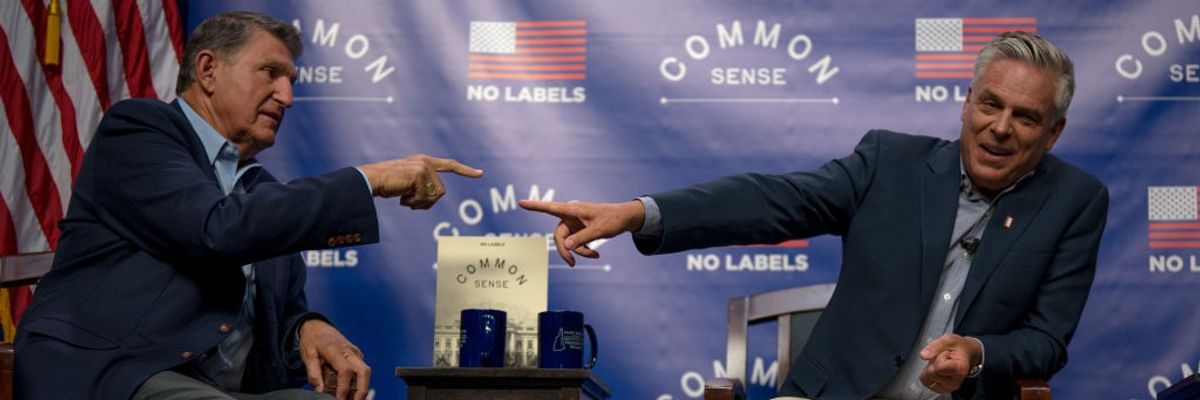
U.S. Sen. Joe Manchin III (D-W.Va.) (left) and former Repubican Utah Gov. Jon Huntsman (right) talk at a No Labels event in Manchester, New Hampshire on July 17, 2023.
One observer quipped that No Labels was calling it quits "to spend more time with their lobbyists."
Less than a month after No Labels announced it would nominate a "unity ticket" for the 2024 presidential election, the group said Thursday that it is abandoning its longshot third-party White House bid.
"No Labels has always said we would only offer our ballot line to a ticket if we could identify candidates with a credible path to winning the White House," the group said in a statement. "No such candidates emerged, so the responsible course of action is for us to stand down."
As Common Dreams reported last month, No Labels—whose own leader has admitted is "not in it to win it" but rather to "give people a choice"—has poured millions of dollars in dark money contributions into a quixotic run that critics like MoveOn executive director Rahna Epting warned could "swing the election to Donald Trump," the twice-impeached former Republican president and presumptive GOP nominee, 91 federal and state criminal charges notwithstanding.
No Labels had floated former Republican Maryland Gov. Larry Hogan and former South Carolina Gov. Nikki Haley, a failed 2024 GOP presidential contender, as possible "unity ticket" candidates. However, the group ultimately found no takers.
Top No Labels donors include billionaire and multimillionaire Trump supporters like Nelson Peltz, private equity executive Stephen Schwarzman of Blackstone, and former 20th Century Fox CEO James Murdoch. Louis Bacon, the billionaire CEO of hedge fund Moore Capital Management, donated $1 million each to No Labels and the Republican Party after giving the maximum allowable contribution to Sen. Kyrsten Sinema, formerly one of the conservative Democrats in Congress and now an Independent.
Even with all that financial backing, No Labels' path to the ballot has been dubious. MoveOn has urged states to investigate the group for allegedly misleading voters through deceptive canvassing methods that result in their disenfranchisement.
The U.S. two-party system has been criticized for monopolizing political power at the expense of democracy and voter choice by actively working to thwart all viable third-party and independent candidates. However, political pragmatists note what they say is the folly of running unwinnable races.
"Third-party candidates are the fools gold of this election," MoveOn said on social media, adding that neither No Labels nor conspiracy theorist Robert F. Kennedy "have ballot access in all 50 states and mathematically cannot win."
"They can only play spoiler," the group added.
However, while Democrats and Republicans often automatically gain ballot access, the two parties are largely behind state laws that create often insurmountable barriers for third-party and independent challengers.
Other progressives also welcomed the news of No Labels' withdrawal—but with a warning. Melanie D'Arrigo, executive director of the Campaign for New York Health, quipped on social media that No Labels was quitting "to spend more time with their lobbyists."
"Billionaires pump millions into No Labels, and in return, their politicians push policies that transfer wealth from the working-class back to billionaires," she added. "Just because they aren't running a presidential candidate doesn't mean they aren't still a serious threat to democracy."
Dear Common Dreams reader, It’s been nearly 30 years since I co-founded Common Dreams with my late wife, Lina Newhouser. We had the radical notion that journalism should serve the public good, not corporate profits. It was clear to us from the outset what it would take to build such a project. No paid advertisements. No corporate sponsors. No millionaire publisher telling us what to think or do. Many people said we wouldn't last a year, but we proved those doubters wrong. Together with a tremendous team of journalists and dedicated staff, we built an independent media outlet free from the constraints of profits and corporate control. Our mission has always been simple: To inform. To inspire. To ignite change for the common good. Building Common Dreams was not easy. Our survival was never guaranteed. When you take on the most powerful forces—Wall Street greed, fossil fuel industry destruction, Big Tech lobbyists, and uber-rich oligarchs who have spent billions upon billions rigging the economy and democracy in their favor—the only bulwark you have is supporters who believe in your work. But here’s the urgent message from me today. It's never been this bad out there. And it's never been this hard to keep us going. At the very moment Common Dreams is most needed, the threats we face are intensifying. We need your support now more than ever. We don't accept corporate advertising and never will. We don't have a paywall because we don't think people should be blocked from critical news based on their ability to pay. Everything we do is funded by the donations of readers like you. When everyone does the little they can afford, we are strong. But if that support retreats or dries up, so do we. Will you donate now to make sure Common Dreams not only survives but thrives? —Craig Brown, Co-founder |
Less than a month after No Labels announced it would nominate a "unity ticket" for the 2024 presidential election, the group said Thursday that it is abandoning its longshot third-party White House bid.
"No Labels has always said we would only offer our ballot line to a ticket if we could identify candidates with a credible path to winning the White House," the group said in a statement. "No such candidates emerged, so the responsible course of action is for us to stand down."
As Common Dreams reported last month, No Labels—whose own leader has admitted is "not in it to win it" but rather to "give people a choice"—has poured millions of dollars in dark money contributions into a quixotic run that critics like MoveOn executive director Rahna Epting warned could "swing the election to Donald Trump," the twice-impeached former Republican president and presumptive GOP nominee, 91 federal and state criminal charges notwithstanding.
No Labels had floated former Republican Maryland Gov. Larry Hogan and former South Carolina Gov. Nikki Haley, a failed 2024 GOP presidential contender, as possible "unity ticket" candidates. However, the group ultimately found no takers.
Top No Labels donors include billionaire and multimillionaire Trump supporters like Nelson Peltz, private equity executive Stephen Schwarzman of Blackstone, and former 20th Century Fox CEO James Murdoch. Louis Bacon, the billionaire CEO of hedge fund Moore Capital Management, donated $1 million each to No Labels and the Republican Party after giving the maximum allowable contribution to Sen. Kyrsten Sinema, formerly one of the conservative Democrats in Congress and now an Independent.
Even with all that financial backing, No Labels' path to the ballot has been dubious. MoveOn has urged states to investigate the group for allegedly misleading voters through deceptive canvassing methods that result in their disenfranchisement.
The U.S. two-party system has been criticized for monopolizing political power at the expense of democracy and voter choice by actively working to thwart all viable third-party and independent candidates. However, political pragmatists note what they say is the folly of running unwinnable races.
"Third-party candidates are the fools gold of this election," MoveOn said on social media, adding that neither No Labels nor conspiracy theorist Robert F. Kennedy "have ballot access in all 50 states and mathematically cannot win."
"They can only play spoiler," the group added.
However, while Democrats and Republicans often automatically gain ballot access, the two parties are largely behind state laws that create often insurmountable barriers for third-party and independent challengers.
Other progressives also welcomed the news of No Labels' withdrawal—but with a warning. Melanie D'Arrigo, executive director of the Campaign for New York Health, quipped on social media that No Labels was quitting "to spend more time with their lobbyists."
"Billionaires pump millions into No Labels, and in return, their politicians push policies that transfer wealth from the working-class back to billionaires," she added. "Just because they aren't running a presidential candidate doesn't mean they aren't still a serious threat to democracy."
Less than a month after No Labels announced it would nominate a "unity ticket" for the 2024 presidential election, the group said Thursday that it is abandoning its longshot third-party White House bid.
"No Labels has always said we would only offer our ballot line to a ticket if we could identify candidates with a credible path to winning the White House," the group said in a statement. "No such candidates emerged, so the responsible course of action is for us to stand down."
As Common Dreams reported last month, No Labels—whose own leader has admitted is "not in it to win it" but rather to "give people a choice"—has poured millions of dollars in dark money contributions into a quixotic run that critics like MoveOn executive director Rahna Epting warned could "swing the election to Donald Trump," the twice-impeached former Republican president and presumptive GOP nominee, 91 federal and state criminal charges notwithstanding.
No Labels had floated former Republican Maryland Gov. Larry Hogan and former South Carolina Gov. Nikki Haley, a failed 2024 GOP presidential contender, as possible "unity ticket" candidates. However, the group ultimately found no takers.
Top No Labels donors include billionaire and multimillionaire Trump supporters like Nelson Peltz, private equity executive Stephen Schwarzman of Blackstone, and former 20th Century Fox CEO James Murdoch. Louis Bacon, the billionaire CEO of hedge fund Moore Capital Management, donated $1 million each to No Labels and the Republican Party after giving the maximum allowable contribution to Sen. Kyrsten Sinema, formerly one of the conservative Democrats in Congress and now an Independent.
Even with all that financial backing, No Labels' path to the ballot has been dubious. MoveOn has urged states to investigate the group for allegedly misleading voters through deceptive canvassing methods that result in their disenfranchisement.
The U.S. two-party system has been criticized for monopolizing political power at the expense of democracy and voter choice by actively working to thwart all viable third-party and independent candidates. However, political pragmatists note what they say is the folly of running unwinnable races.
"Third-party candidates are the fools gold of this election," MoveOn said on social media, adding that neither No Labels nor conspiracy theorist Robert F. Kennedy "have ballot access in all 50 states and mathematically cannot win."
"They can only play spoiler," the group added.
However, while Democrats and Republicans often automatically gain ballot access, the two parties are largely behind state laws that create often insurmountable barriers for third-party and independent challengers.
Other progressives also welcomed the news of No Labels' withdrawal—but with a warning. Melanie D'Arrigo, executive director of the Campaign for New York Health, quipped on social media that No Labels was quitting "to spend more time with their lobbyists."
"Billionaires pump millions into No Labels, and in return, their politicians push policies that transfer wealth from the working-class back to billionaires," she added. "Just because they aren't running a presidential candidate doesn't mean they aren't still a serious threat to democracy."