
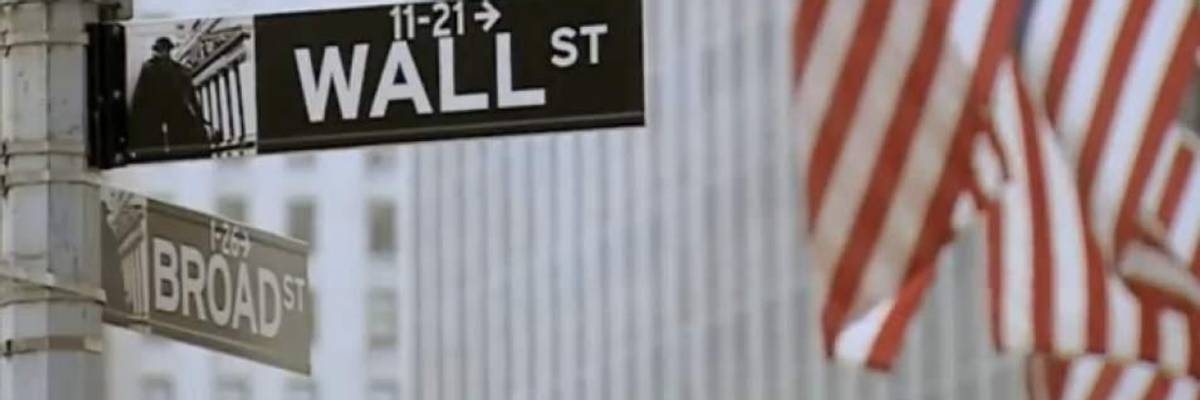
Voters back home -- and now their new representatives in Congress -- are seeing past the sheep's clothing to the Wall Street wolves within.(Photo: Phillipp/cc/flickr)
No Labels and the 'Problem Solvers' are Wolves of Wall Street in Sheep's Clothing
Political organizations hide their pro-finance politics under the cloak of bipartisanship while they rake in funding from corporate interests
Wall Street's money oozes into many dark crevices in Washington. The financial services industry pumped $2 billion into the 2015-16 election cycle and managed to easily outpace that amount during this year's midterm election. Other than the aggregate figures, there is much we don't know about the exact ways this money is used to influence our political systems. But from time to time, we do get a particularly vivid peek into how Wall Street cash distorts debates about policy.
For years, the group No Labels and its close partner, the bipartisan Problem Solvers Caucus, have quietly promoted policies that are wrapped in the mantle of bipartisanship and pitched as "non-ideological," while being in the pay of corporate interests. They produce reports, sponsor events, and weigh in on policy on behalf of unnamed corporate donors.
Even when Wall Street isn't directly funding specific activities, its pervasive funding helps get its talking points into conversations with members of Congress.
Even when Wall Street isn't directly funding specific activities, its pervasive funding helps get its talking points into conversations with members of Congress. At an orientation program run by Harvard University, former executives or lobbyists with Goldman Sachs, Bank of New York Mellon, and the private equity trade association were on the agenda as "experts" on Congress. The label fits in the way the Big Bad Wolf is an expert in porcine house construction.
Recently published internal documents blew the lid off how much of the money behind No Labels comes from Wall Street. Its donors include executives from major asset managers (Trian Fund Management), hedge funds (Oaktree Capital Management) and private equity (Apollo Global Management), among others. Donors pledged $4.8 million to the No Labels non-profit arm in 2017, and also sent industry money to PACs affiliated with the group.
Former Democratic senators Joe Lieberman and Evan Bayh, who both worked as industry lobbyists after leaving Congress, are affiliated with No Labels and the Problem Solvers Caucus. Rep. Mark Pocan, now a co-chair of the Progressive Caucus, has written with remarkable candor about being "duped" by both organizations when he first joined the House in 2012. Beneath the veneer of bipartisanship, Pocan soon discovered the true aim of both groups -- to import a pro-corporate agenda into Democratic politics.
No Labels has its fingerprints on efforts to keep Nancy Pelosi from returning to her former role as Speaker of the House, and on the attempt by Rep. Josh Gottheimer to fill the House Financial Services Committee with industry-friendly Democrats.
Deregulating Wall Street is simply not a popular message with voters. Americans of all parties consistently support curbs on Wall Street's influence in Washington.
Gottheimer is a New Jersey Democrat who has consistently voted with Wall Street. His mentor, 2008 Clinton campaign manager and Democratic insider Mark Penn, is married to Nancy Jacobson, the founder and face of No Labels. Gottheimer pitches members of Congress on the committee by telling them they can raise tons of campaign money from big banks. That pitch depends by its very nature on frustrating efforts by its new chair, Rep. Maxine Waters of California, to hold the industry and its friends in the Trump Administration accountable.
Deregulating Wall Street is simply not a popular message with voters. Americans of all parties consistently support curbs on Wall Street's influence in Washington. Poll after poll has shown this is true -- you can take it from our own survey, or the one released last week from Morning Consult, or even from research straight from the American Enterprise Institute and the Koch brothers.
So it's no wonder the bank lobby tries to make its argument under the cover of seemingly neutral organizations like the Problem Solvers' Caucus and their corporate-sponsored nonprofit friends. But voters back home -- and now their new representatives in Congress -- are seeing past the sheep's clothing to the Wall Street wolves within.
Headlines over the last few weeks have given us a glimpse of how Wall Street guarantees a return on their political investment. From dark money for new candidates to the swanky DC-based nonprofits and think tanks providing "services" like congressional orientations, from folksy ads with a bipartisan veneer to the more familiar traditional lobbying efforts: Wall Street runs a multi-pronged influence machine.
If the Democratic Party is going to be the party of the people -- and not the billionaires and financial interests that have dominated Washington for the past half-century -- seating progressive champions on the House Financial Services Committee is a great place to start.
Speaker Pelosi should send the message to the Democratic Caucus and the nation: the House Financial Services Committee is the public's watchdog, not a fundraising opportunity. Wall Street's "Problem Solvers" need not apply.
We are at a crossroads
This country and this world are at a monumental crossroads. In a few short weeks, US voters will have an opportunity to beat back the forces of fascism and confront the billionaires who are rigging the economy, our media system, and our democracy, making it increasingly impossible for ordinary people to get by. We’re not just talking about the election. We’re talking about what must be done once these fascist elements are vanquished from power. We need a bolder set of solutions than what either major party has so far been willing to offer and a working-class movement ready to fight like hell for it. Trump didn't emerge from nowhere. The conditions that fueled MAGA authoritarianism were created by decades of radical neoliberal economic policies and a corrupt political system dominated by corporate interests. They slashed taxes on the super-rich, promising that the benefits would trickle down. They said giveaways to the corporate titans would make life more affordable for the rest of us. It was all bullshit. And when a bitter, betrayed populace searches for someone to blame, right-wing demagogues have little trouble finding scapegoats. People know when they're being lied to, but you won't hear any of this from the corporate media. Only independent journalism—powered and funded by people who believe in building a better world—can deliver truly trustworthy daily news. Our Fall Campaign is underway, and we need your help. To power our newsroom through the rest of the year, we need to raise $125,000 by midnight on October 31. So if you share our vision, please contribute whatever you can to sustain our work. |
Wall Street's money oozes into many dark crevices in Washington. The financial services industry pumped $2 billion into the 2015-16 election cycle and managed to easily outpace that amount during this year's midterm election. Other than the aggregate figures, there is much we don't know about the exact ways this money is used to influence our political systems. But from time to time, we do get a particularly vivid peek into how Wall Street cash distorts debates about policy.
For years, the group No Labels and its close partner, the bipartisan Problem Solvers Caucus, have quietly promoted policies that are wrapped in the mantle of bipartisanship and pitched as "non-ideological," while being in the pay of corporate interests. They produce reports, sponsor events, and weigh in on policy on behalf of unnamed corporate donors.
Even when Wall Street isn't directly funding specific activities, its pervasive funding helps get its talking points into conversations with members of Congress.
Even when Wall Street isn't directly funding specific activities, its pervasive funding helps get its talking points into conversations with members of Congress. At an orientation program run by Harvard University, former executives or lobbyists with Goldman Sachs, Bank of New York Mellon, and the private equity trade association were on the agenda as "experts" on Congress. The label fits in the way the Big Bad Wolf is an expert in porcine house construction.
Recently published internal documents blew the lid off how much of the money behind No Labels comes from Wall Street. Its donors include executives from major asset managers (Trian Fund Management), hedge funds (Oaktree Capital Management) and private equity (Apollo Global Management), among others. Donors pledged $4.8 million to the No Labels non-profit arm in 2017, and also sent industry money to PACs affiliated with the group.
Former Democratic senators Joe Lieberman and Evan Bayh, who both worked as industry lobbyists after leaving Congress, are affiliated with No Labels and the Problem Solvers Caucus. Rep. Mark Pocan, now a co-chair of the Progressive Caucus, has written with remarkable candor about being "duped" by both organizations when he first joined the House in 2012. Beneath the veneer of bipartisanship, Pocan soon discovered the true aim of both groups -- to import a pro-corporate agenda into Democratic politics.
No Labels has its fingerprints on efforts to keep Nancy Pelosi from returning to her former role as Speaker of the House, and on the attempt by Rep. Josh Gottheimer to fill the House Financial Services Committee with industry-friendly Democrats.
Deregulating Wall Street is simply not a popular message with voters. Americans of all parties consistently support curbs on Wall Street's influence in Washington.
Gottheimer is a New Jersey Democrat who has consistently voted with Wall Street. His mentor, 2008 Clinton campaign manager and Democratic insider Mark Penn, is married to Nancy Jacobson, the founder and face of No Labels. Gottheimer pitches members of Congress on the committee by telling them they can raise tons of campaign money from big banks. That pitch depends by its very nature on frustrating efforts by its new chair, Rep. Maxine Waters of California, to hold the industry and its friends in the Trump Administration accountable.
Deregulating Wall Street is simply not a popular message with voters. Americans of all parties consistently support curbs on Wall Street's influence in Washington. Poll after poll has shown this is true -- you can take it from our own survey, or the one released last week from Morning Consult, or even from research straight from the American Enterprise Institute and the Koch brothers.
So it's no wonder the bank lobby tries to make its argument under the cover of seemingly neutral organizations like the Problem Solvers' Caucus and their corporate-sponsored nonprofit friends. But voters back home -- and now their new representatives in Congress -- are seeing past the sheep's clothing to the Wall Street wolves within.
Headlines over the last few weeks have given us a glimpse of how Wall Street guarantees a return on their political investment. From dark money for new candidates to the swanky DC-based nonprofits and think tanks providing "services" like congressional orientations, from folksy ads with a bipartisan veneer to the more familiar traditional lobbying efforts: Wall Street runs a multi-pronged influence machine.
If the Democratic Party is going to be the party of the people -- and not the billionaires and financial interests that have dominated Washington for the past half-century -- seating progressive champions on the House Financial Services Committee is a great place to start.
Speaker Pelosi should send the message to the Democratic Caucus and the nation: the House Financial Services Committee is the public's watchdog, not a fundraising opportunity. Wall Street's "Problem Solvers" need not apply.
- Who's Funding 'No Labels'? Pro-GOP Billionaires Opposed to Democracy ›
- Opinion | Who’s Buying the ‘No Labels’ Label? | Common Dreams ›
- Opinion | Don’t Fall for No Labels’ Trap | Common Dreams ›
- No Labels Picks 'Dangerous' Experiment Over US Democracy ›
- Dark Money-Backed 'No Labels' Drops Third-Party Presidential Bid ›
Wall Street's money oozes into many dark crevices in Washington. The financial services industry pumped $2 billion into the 2015-16 election cycle and managed to easily outpace that amount during this year's midterm election. Other than the aggregate figures, there is much we don't know about the exact ways this money is used to influence our political systems. But from time to time, we do get a particularly vivid peek into how Wall Street cash distorts debates about policy.
For years, the group No Labels and its close partner, the bipartisan Problem Solvers Caucus, have quietly promoted policies that are wrapped in the mantle of bipartisanship and pitched as "non-ideological," while being in the pay of corporate interests. They produce reports, sponsor events, and weigh in on policy on behalf of unnamed corporate donors.
Even when Wall Street isn't directly funding specific activities, its pervasive funding helps get its talking points into conversations with members of Congress.
Even when Wall Street isn't directly funding specific activities, its pervasive funding helps get its talking points into conversations with members of Congress. At an orientation program run by Harvard University, former executives or lobbyists with Goldman Sachs, Bank of New York Mellon, and the private equity trade association were on the agenda as "experts" on Congress. The label fits in the way the Big Bad Wolf is an expert in porcine house construction.
Recently published internal documents blew the lid off how much of the money behind No Labels comes from Wall Street. Its donors include executives from major asset managers (Trian Fund Management), hedge funds (Oaktree Capital Management) and private equity (Apollo Global Management), among others. Donors pledged $4.8 million to the No Labels non-profit arm in 2017, and also sent industry money to PACs affiliated with the group.
Former Democratic senators Joe Lieberman and Evan Bayh, who both worked as industry lobbyists after leaving Congress, are affiliated with No Labels and the Problem Solvers Caucus. Rep. Mark Pocan, now a co-chair of the Progressive Caucus, has written with remarkable candor about being "duped" by both organizations when he first joined the House in 2012. Beneath the veneer of bipartisanship, Pocan soon discovered the true aim of both groups -- to import a pro-corporate agenda into Democratic politics.
No Labels has its fingerprints on efforts to keep Nancy Pelosi from returning to her former role as Speaker of the House, and on the attempt by Rep. Josh Gottheimer to fill the House Financial Services Committee with industry-friendly Democrats.
Deregulating Wall Street is simply not a popular message with voters. Americans of all parties consistently support curbs on Wall Street's influence in Washington.
Gottheimer is a New Jersey Democrat who has consistently voted with Wall Street. His mentor, 2008 Clinton campaign manager and Democratic insider Mark Penn, is married to Nancy Jacobson, the founder and face of No Labels. Gottheimer pitches members of Congress on the committee by telling them they can raise tons of campaign money from big banks. That pitch depends by its very nature on frustrating efforts by its new chair, Rep. Maxine Waters of California, to hold the industry and its friends in the Trump Administration accountable.
Deregulating Wall Street is simply not a popular message with voters. Americans of all parties consistently support curbs on Wall Street's influence in Washington. Poll after poll has shown this is true -- you can take it from our own survey, or the one released last week from Morning Consult, or even from research straight from the American Enterprise Institute and the Koch brothers.
So it's no wonder the bank lobby tries to make its argument under the cover of seemingly neutral organizations like the Problem Solvers' Caucus and their corporate-sponsored nonprofit friends. But voters back home -- and now their new representatives in Congress -- are seeing past the sheep's clothing to the Wall Street wolves within.
Headlines over the last few weeks have given us a glimpse of how Wall Street guarantees a return on their political investment. From dark money for new candidates to the swanky DC-based nonprofits and think tanks providing "services" like congressional orientations, from folksy ads with a bipartisan veneer to the more familiar traditional lobbying efforts: Wall Street runs a multi-pronged influence machine.
If the Democratic Party is going to be the party of the people -- and not the billionaires and financial interests that have dominated Washington for the past half-century -- seating progressive champions on the House Financial Services Committee is a great place to start.
Speaker Pelosi should send the message to the Democratic Caucus and the nation: the House Financial Services Committee is the public's watchdog, not a fundraising opportunity. Wall Street's "Problem Solvers" need not apply.
- Who's Funding 'No Labels'? Pro-GOP Billionaires Opposed to Democracy ›
- Opinion | Who’s Buying the ‘No Labels’ Label? | Common Dreams ›
- Opinion | Don’t Fall for No Labels’ Trap | Common Dreams ›
- No Labels Picks 'Dangerous' Experiment Over US Democracy ›
- Dark Money-Backed 'No Labels' Drops Third-Party Presidential Bid ›