SUBSCRIBE TO OUR FREE NEWSLETTER
Daily news & progressive opinion—funded by the people, not the corporations—delivered straight to your inbox.
5
#000000
#FFFFFF
To donate by check, phone, or other method, see our More Ways to Give page.
Daily news & progressive opinion—funded by the people, not the corporations—delivered straight to your inbox.

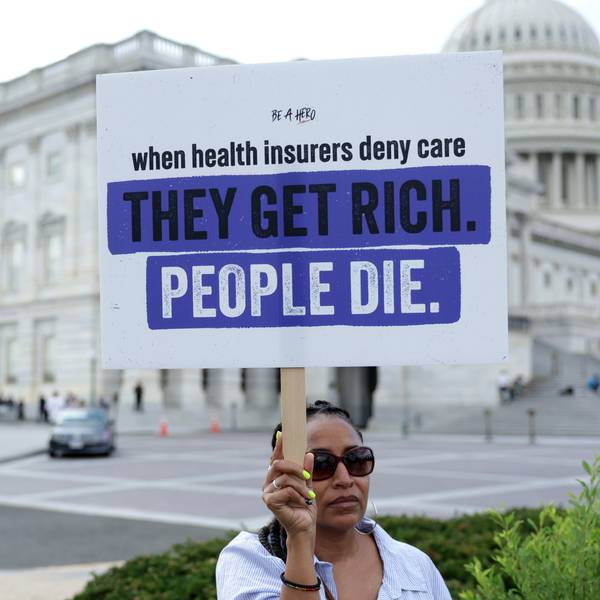
Advocates hold signs during a news conference on Medicare Advantage plans in front of the U.S. Capitol on July 25, 2023 in Washington, D.C.
The new report was released as allies of Republican nominee Donald Trump push to make privatized Medicare Advantage plans the default enrollment option for U.S. seniors.
An inspector general report published Thursday estimates that the U.S. federal government delivered around $7.5 billion in potentially improper payments to for-profit Medicare Advantage companies last year, a finding that came as allies of Republican nominee Donald Trump are pushing to make privatized MA plans the default enrollment option for the nation's seniors.
The new report from the Office of Inspector General (OIG) for the U.S. Department of Health and Human Services focuses specifically on health risk assessments (HRAs) and chart reviews, mechanisms that MA companies use to gauge enrollees' health and help determine the size of payments the insurers receive from the federal government.
The OIG report characterizes MA companies' use of HRAs and chart reviews as "questionable," noting that the program's insurers have a history of making patients appear sicker than they are to receive larger payments from Medicare.
"Diagnoses reported only on enrollees' HRAs and HRA-linked chart reviews, and not on any other 2022 service records, resulted in an estimated $7.5 billion in MA risk-adjusted payments for 2023," the report states. "The lack of any other follow-up visits, procedures, tests, or supplies for these diagnoses in the MA encounter data for 1.7 million MA enrollees raises concerns that either: (1) the diagnoses are inaccurate and thus the payments are improper or (2) enrollees did not receive needed care for serious conditions reported only on HRAs or HRA-linked chart reviews."
The report raises particular concern about the validity of HRAs and chart reviews conducted at patients' homes "because these tools are often administered by MA companies or their third-party vendors and not enrollees' own providers."
Last year, according to the OIG report, "in-home HRAs and HRA-linked chart reviews generated 63% of the estimated $7.5 billion in risk-adjusted payments."
"Any inaccurate diagnoses from these in-home HRAs and associated chart reviews may have resulted in overpayments to the MA companies," the report states. "For diagnoses that were accurate, enrollees may have gone without needed care."
Diane Archer, senior adviser on Medicare at the progressive advocacy group Social Security Works, told Common Dreams that "we need to stop paying MA insurers more for their sickest patients when they don't provide them with needed care."
"We need to penalize them in meaningful ways for ripping off taxpayers and harming their patients," said Archer. "We need to stop assuming that the insurers are managing people's care. They are overcharging the government and denying needed care, sometimes indiscriminately, to boost their profits."
"If Trump's plan takes effect, the number of Medicare Advantage policies UnitedHealth controls is expected to reach 15.6 million."
Medicare Advantage, a privately run program funded by the federal government, has faced growing scrutiny in recent years as enrollment in the program has surged. More than half of the Medicare-eligible population in the U.S. is enrolled in a Medicare Advantage plan, according to KFF, resulting in massive profits for insurance giants.
The new OIG report found that just 20 MA insurers—including UnitedHealth, Cigna, and Humana—accounted for 80% of the $7.5 billion in government payments stemming from HRAs and chart reviews last year.
"One top MA company, UnitedHealth Group, Inc., stood out from its peers, especially in its use of in-home HRAs and HRA-linked chart reviews to generate risk-adjusted payments," the report says.
UnitedHealth is one of the insurance behemoths that stands to benefit most from a plan crafted by Trump allies that would funnel more seniors into MA plans, which are notorious for denying necessary care and overcharging Medicare to the tune of tens of billions of dollars per year.
People's Action estimated in a report published last week that UnitedHealth could see its revenue from Medicare Advantage double to $274 billion annually if Trump wins next month's election and enacts Project 2025's proposal to make the privatized plans the default enrollment option for new Medicare beneficiaries.
Democratic nominee Kamala Harris, for her part, has called for an expansion of traditional Medicare to cover home health services as well as hearing and vision—benefits that are key selling points of MA plans.
Sulma Arias, executive director of People's Action, warned in an op-ed for Common Dreams on Thursday that Trump's "only plan for healthcare in a second term is to privatize."
"If Trump's plan takes effect, the number of Medicare Advantage policies UnitedHealth controls is expected to reach 15.6 million," Arias wrote. "One out of every three Medicare Advantage policyholders is denied care by private insurers like United every year. Under Trump's plan, UnitedHealth alone would deny care to as many as 5.2 million people."
"This ability to deny care," Arias added, "is what makes Medicare Advantage plans far more profitable to private insurers than any other plans they offer."
Dear Common Dreams reader, It’s been nearly 30 years since I co-founded Common Dreams with my late wife, Lina Newhouser. We had the radical notion that journalism should serve the public good, not corporate profits. It was clear to us from the outset what it would take to build such a project. No paid advertisements. No corporate sponsors. No millionaire publisher telling us what to think or do. Many people said we wouldn't last a year, but we proved those doubters wrong. Together with a tremendous team of journalists and dedicated staff, we built an independent media outlet free from the constraints of profits and corporate control. Our mission has always been simple: To inform. To inspire. To ignite change for the common good. Building Common Dreams was not easy. Our survival was never guaranteed. When you take on the most powerful forces—Wall Street greed, fossil fuel industry destruction, Big Tech lobbyists, and uber-rich oligarchs who have spent billions upon billions rigging the economy and democracy in their favor—the only bulwark you have is supporters who believe in your work. But here’s the urgent message from me today. It's never been this bad out there. And it's never been this hard to keep us going. At the very moment Common Dreams is most needed, the threats we face are intensifying. We need your support now more than ever. We don't accept corporate advertising and never will. We don't have a paywall because we don't think people should be blocked from critical news based on their ability to pay. Everything we do is funded by the donations of readers like you. When everyone does the little they can afford, we are strong. But if that support retreats or dries up, so do we. Will you donate now to make sure Common Dreams not only survives but thrives? —Craig Brown, Co-founder |
An inspector general report published Thursday estimates that the U.S. federal government delivered around $7.5 billion in potentially improper payments to for-profit Medicare Advantage companies last year, a finding that came as allies of Republican nominee Donald Trump are pushing to make privatized MA plans the default enrollment option for the nation's seniors.
The new report from the Office of Inspector General (OIG) for the U.S. Department of Health and Human Services focuses specifically on health risk assessments (HRAs) and chart reviews, mechanisms that MA companies use to gauge enrollees' health and help determine the size of payments the insurers receive from the federal government.
The OIG report characterizes MA companies' use of HRAs and chart reviews as "questionable," noting that the program's insurers have a history of making patients appear sicker than they are to receive larger payments from Medicare.
"Diagnoses reported only on enrollees' HRAs and HRA-linked chart reviews, and not on any other 2022 service records, resulted in an estimated $7.5 billion in MA risk-adjusted payments for 2023," the report states. "The lack of any other follow-up visits, procedures, tests, or supplies for these diagnoses in the MA encounter data for 1.7 million MA enrollees raises concerns that either: (1) the diagnoses are inaccurate and thus the payments are improper or (2) enrollees did not receive needed care for serious conditions reported only on HRAs or HRA-linked chart reviews."
The report raises particular concern about the validity of HRAs and chart reviews conducted at patients' homes "because these tools are often administered by MA companies or their third-party vendors and not enrollees' own providers."
Last year, according to the OIG report, "in-home HRAs and HRA-linked chart reviews generated 63% of the estimated $7.5 billion in risk-adjusted payments."
"Any inaccurate diagnoses from these in-home HRAs and associated chart reviews may have resulted in overpayments to the MA companies," the report states. "For diagnoses that were accurate, enrollees may have gone without needed care."
Diane Archer, senior adviser on Medicare at the progressive advocacy group Social Security Works, told Common Dreams that "we need to stop paying MA insurers more for their sickest patients when they don't provide them with needed care."
"We need to penalize them in meaningful ways for ripping off taxpayers and harming their patients," said Archer. "We need to stop assuming that the insurers are managing people's care. They are overcharging the government and denying needed care, sometimes indiscriminately, to boost their profits."
"If Trump's plan takes effect, the number of Medicare Advantage policies UnitedHealth controls is expected to reach 15.6 million."
Medicare Advantage, a privately run program funded by the federal government, has faced growing scrutiny in recent years as enrollment in the program has surged. More than half of the Medicare-eligible population in the U.S. is enrolled in a Medicare Advantage plan, according to KFF, resulting in massive profits for insurance giants.
The new OIG report found that just 20 MA insurers—including UnitedHealth, Cigna, and Humana—accounted for 80% of the $7.5 billion in government payments stemming from HRAs and chart reviews last year.
"One top MA company, UnitedHealth Group, Inc., stood out from its peers, especially in its use of in-home HRAs and HRA-linked chart reviews to generate risk-adjusted payments," the report says.
UnitedHealth is one of the insurance behemoths that stands to benefit most from a plan crafted by Trump allies that would funnel more seniors into MA plans, which are notorious for denying necessary care and overcharging Medicare to the tune of tens of billions of dollars per year.
People's Action estimated in a report published last week that UnitedHealth could see its revenue from Medicare Advantage double to $274 billion annually if Trump wins next month's election and enacts Project 2025's proposal to make the privatized plans the default enrollment option for new Medicare beneficiaries.
Democratic nominee Kamala Harris, for her part, has called for an expansion of traditional Medicare to cover home health services as well as hearing and vision—benefits that are key selling points of MA plans.
Sulma Arias, executive director of People's Action, warned in an op-ed for Common Dreams on Thursday that Trump's "only plan for healthcare in a second term is to privatize."
"If Trump's plan takes effect, the number of Medicare Advantage policies UnitedHealth controls is expected to reach 15.6 million," Arias wrote. "One out of every three Medicare Advantage policyholders is denied care by private insurers like United every year. Under Trump's plan, UnitedHealth alone would deny care to as many as 5.2 million people."
"This ability to deny care," Arias added, "is what makes Medicare Advantage plans far more profitable to private insurers than any other plans they offer."
An inspector general report published Thursday estimates that the U.S. federal government delivered around $7.5 billion in potentially improper payments to for-profit Medicare Advantage companies last year, a finding that came as allies of Republican nominee Donald Trump are pushing to make privatized MA plans the default enrollment option for the nation's seniors.
The new report from the Office of Inspector General (OIG) for the U.S. Department of Health and Human Services focuses specifically on health risk assessments (HRAs) and chart reviews, mechanisms that MA companies use to gauge enrollees' health and help determine the size of payments the insurers receive from the federal government.
The OIG report characterizes MA companies' use of HRAs and chart reviews as "questionable," noting that the program's insurers have a history of making patients appear sicker than they are to receive larger payments from Medicare.
"Diagnoses reported only on enrollees' HRAs and HRA-linked chart reviews, and not on any other 2022 service records, resulted in an estimated $7.5 billion in MA risk-adjusted payments for 2023," the report states. "The lack of any other follow-up visits, procedures, tests, or supplies for these diagnoses in the MA encounter data for 1.7 million MA enrollees raises concerns that either: (1) the diagnoses are inaccurate and thus the payments are improper or (2) enrollees did not receive needed care for serious conditions reported only on HRAs or HRA-linked chart reviews."
The report raises particular concern about the validity of HRAs and chart reviews conducted at patients' homes "because these tools are often administered by MA companies or their third-party vendors and not enrollees' own providers."
Last year, according to the OIG report, "in-home HRAs and HRA-linked chart reviews generated 63% of the estimated $7.5 billion in risk-adjusted payments."
"Any inaccurate diagnoses from these in-home HRAs and associated chart reviews may have resulted in overpayments to the MA companies," the report states. "For diagnoses that were accurate, enrollees may have gone without needed care."
Diane Archer, senior adviser on Medicare at the progressive advocacy group Social Security Works, told Common Dreams that "we need to stop paying MA insurers more for their sickest patients when they don't provide them with needed care."
"We need to penalize them in meaningful ways for ripping off taxpayers and harming their patients," said Archer. "We need to stop assuming that the insurers are managing people's care. They are overcharging the government and denying needed care, sometimes indiscriminately, to boost their profits."
"If Trump's plan takes effect, the number of Medicare Advantage policies UnitedHealth controls is expected to reach 15.6 million."
Medicare Advantage, a privately run program funded by the federal government, has faced growing scrutiny in recent years as enrollment in the program has surged. More than half of the Medicare-eligible population in the U.S. is enrolled in a Medicare Advantage plan, according to KFF, resulting in massive profits for insurance giants.
The new OIG report found that just 20 MA insurers—including UnitedHealth, Cigna, and Humana—accounted for 80% of the $7.5 billion in government payments stemming from HRAs and chart reviews last year.
"One top MA company, UnitedHealth Group, Inc., stood out from its peers, especially in its use of in-home HRAs and HRA-linked chart reviews to generate risk-adjusted payments," the report says.
UnitedHealth is one of the insurance behemoths that stands to benefit most from a plan crafted by Trump allies that would funnel more seniors into MA plans, which are notorious for denying necessary care and overcharging Medicare to the tune of tens of billions of dollars per year.
People's Action estimated in a report published last week that UnitedHealth could see its revenue from Medicare Advantage double to $274 billion annually if Trump wins next month's election and enacts Project 2025's proposal to make the privatized plans the default enrollment option for new Medicare beneficiaries.
Democratic nominee Kamala Harris, for her part, has called for an expansion of traditional Medicare to cover home health services as well as hearing and vision—benefits that are key selling points of MA plans.
Sulma Arias, executive director of People's Action, warned in an op-ed for Common Dreams on Thursday that Trump's "only plan for healthcare in a second term is to privatize."
"If Trump's plan takes effect, the number of Medicare Advantage policies UnitedHealth controls is expected to reach 15.6 million," Arias wrote. "One out of every three Medicare Advantage policyholders is denied care by private insurers like United every year. Under Trump's plan, UnitedHealth alone would deny care to as many as 5.2 million people."
"This ability to deny care," Arias added, "is what makes Medicare Advantage plans far more profitable to private insurers than any other plans they offer."