SUBSCRIBE TO OUR FREE NEWSLETTER
Daily news & progressive opinion—funded by the people, not the corporations—delivered straight to your inbox.
5
#000000
#FFFFFF
To donate by check, phone, or other method, see our More Ways to Give page.
Daily news & progressive opinion—funded by the people, not the corporations—delivered straight to your inbox.

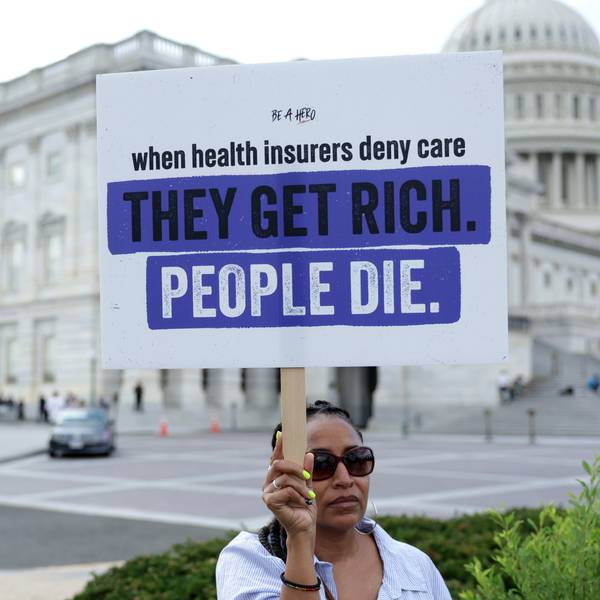
Advocates hold signs during a news conference on Medicare Advantage plans in front of the U.S. Capitol on July 25, 2023 in Washington, D.C.
"The time has come to declare MA a failed experiment," write the authors of a new paper.
A new academic analysis published Monday in JAMA Internal Medicine details the enormous sums that privatized Medicare Advantage plans have cost U.S. taxpayers in recent years and calls for the abolition of the program, which has been massively profitable for the insurance giants that dominate it.
Citing the nonpartisan Medicare Payment Advisory Commission, the paper notes that Medicare Advantage (MA) plans have overcharged the federal government to the tune of $612 billion since 2007—and $82 billion last year alone.
MA plans—now used by more than half of the eligible Medicare population—utilize a range of tactics to reap larger payments from the federal government, which provides insurers a lump sum for each Medicare Advantage patient. The size of the payment depends on the enrollee's health, which MA plans are notorious for portraying as worse than it is in order to receive heftier government payments.
"Paradoxically, despite those overpayments, MA plans spend 9% less on medical services than [fee-for-service] Medicare spends for comparable enrollees," reads the new study. "If MA plans pay for less care, where do the overpayments go? Some pay for supplementary benefits, although plans do not disclose how much they spend on them, and MA enrollees do not get significantly more dental care or incur lower out-of-pocket dental costs than those in FFS Medicare. Instead, overhead and profit eats up the lion's share."
The study's authors estimate that MA plans' overhead from 2007 to 2024 was $592 billion, which is "equivalent to 97% of taxpayers' $612 billion overpayments to them during that period."
"Medicare Advantage plans have, in effect, stolen hundreds of billions from taxpayers."
Dr. Adam Gaffney, an assistant professor of medicine at Harvard Medical School and the lead author of the new study, said in a statement that "Medicare Advantage is a bad deal for taxpayers."
"Money that could be used to eliminate all copayments or shore up Medicare's Trust Fund is instead lining insurers' pockets," said Gaffney. "And the private insurers keep Medicare Advantage enrollees from getting needed care by erecting bureaucratic hurdles like prior authorizations and payment denials."
Gaffney and study co-authors Drs. Stephanie Woolhandler and David Himmelstein—co-founders of Physicians for a National Health Program (PHNP)—argue based on their examination of Medicare Advantage's decadeslong history that "the time has come to declare MA a failed experiment and abolish it."
"Medicare Advantage plans have, in effect, stolen hundreds of billions from taxpayers," says David Himmelstein, a lecturer at Harvard Medical School and a research associate at the consumer advocacy group Public Citizen. "And the private plans' schemes also raise seniors' Part B Medicare premiums. Even seniors who don't choose to enroll in Medicare Advantage are subsidizing the private plans' profits."
The study's authors observe that the elimination of Medicare Advantage would allow the federal government to use the roughly $88 billion in estimated MA overpayments for the coming year to instead "upgrade benefits for all Medicare beneficiaries." Traditional Medicare typically does not cover dental, vision, or hearing services, which often leads people to choose MA plans.
"A smarter, thriftier way to expand benefits and lower out-of-pocket costs is possible for all Medicare beneficiaries, but first, we must eliminate MA and double down on traditional Medicare, covering all enrollees in an expanded and improved Medicare program," the analysis concludes. "That would be a good deal for patients and taxpayers."
Wendell Potter, a former insurance executive who has become a trenchant critic of Medicare Advantage, told Common Dreams that he agrees with the study's authors that MA "should be eliminated."
"Not only has it never saved taxpayers a dime since it was created during the George W. Bush administration, but it has cost us $592 billion over the last 17 years because of the high administrative costs inherent in the program and the way insurers have rigged the system to get paid excessively every year," said Potter, president of the Center for Health and Democracy.
"The program is so entrenched, and the companies have so much political influence over Democrats as well as Republicans through campaign contributions and lobbying, that eliminating the program will be a heavy lift, at least in the near term," Potter added. "That means that proposals to reform MA that address overpayments and abuses like prior authorization are essential and important for reform advocates to support."
This story has been updated to include comment from Wendell Potter.
Dear Common Dreams reader, It’s been nearly 30 years since I co-founded Common Dreams with my late wife, Lina Newhouser. We had the radical notion that journalism should serve the public good, not corporate profits. It was clear to us from the outset what it would take to build such a project. No paid advertisements. No corporate sponsors. No millionaire publisher telling us what to think or do. Many people said we wouldn't last a year, but we proved those doubters wrong. Together with a tremendous team of journalists and dedicated staff, we built an independent media outlet free from the constraints of profits and corporate control. Our mission has always been simple: To inform. To inspire. To ignite change for the common good. Building Common Dreams was not easy. Our survival was never guaranteed. When you take on the most powerful forces—Wall Street greed, fossil fuel industry destruction, Big Tech lobbyists, and uber-rich oligarchs who have spent billions upon billions rigging the economy and democracy in their favor—the only bulwark you have is supporters who believe in your work. But here’s the urgent message from me today. It's never been this bad out there. And it's never been this hard to keep us going. At the very moment Common Dreams is most needed, the threats we face are intensifying. We need your support now more than ever. We don't accept corporate advertising and never will. We don't have a paywall because we don't think people should be blocked from critical news based on their ability to pay. Everything we do is funded by the donations of readers like you. When everyone does the little they can afford, we are strong. But if that support retreats or dries up, so do we. Will you donate now to make sure Common Dreams not only survives but thrives? —Craig Brown, Co-founder |
A new academic analysis published Monday in JAMA Internal Medicine details the enormous sums that privatized Medicare Advantage plans have cost U.S. taxpayers in recent years and calls for the abolition of the program, which has been massively profitable for the insurance giants that dominate it.
Citing the nonpartisan Medicare Payment Advisory Commission, the paper notes that Medicare Advantage (MA) plans have overcharged the federal government to the tune of $612 billion since 2007—and $82 billion last year alone.
MA plans—now used by more than half of the eligible Medicare population—utilize a range of tactics to reap larger payments from the federal government, which provides insurers a lump sum for each Medicare Advantage patient. The size of the payment depends on the enrollee's health, which MA plans are notorious for portraying as worse than it is in order to receive heftier government payments.
"Paradoxically, despite those overpayments, MA plans spend 9% less on medical services than [fee-for-service] Medicare spends for comparable enrollees," reads the new study. "If MA plans pay for less care, where do the overpayments go? Some pay for supplementary benefits, although plans do not disclose how much they spend on them, and MA enrollees do not get significantly more dental care or incur lower out-of-pocket dental costs than those in FFS Medicare. Instead, overhead and profit eats up the lion's share."
The study's authors estimate that MA plans' overhead from 2007 to 2024 was $592 billion, which is "equivalent to 97% of taxpayers' $612 billion overpayments to them during that period."
"Medicare Advantage plans have, in effect, stolen hundreds of billions from taxpayers."
Dr. Adam Gaffney, an assistant professor of medicine at Harvard Medical School and the lead author of the new study, said in a statement that "Medicare Advantage is a bad deal for taxpayers."
"Money that could be used to eliminate all copayments or shore up Medicare's Trust Fund is instead lining insurers' pockets," said Gaffney. "And the private insurers keep Medicare Advantage enrollees from getting needed care by erecting bureaucratic hurdles like prior authorizations and payment denials."
Gaffney and study co-authors Drs. Stephanie Woolhandler and David Himmelstein—co-founders of Physicians for a National Health Program (PHNP)—argue based on their examination of Medicare Advantage's decadeslong history that "the time has come to declare MA a failed experiment and abolish it."
"Medicare Advantage plans have, in effect, stolen hundreds of billions from taxpayers," says David Himmelstein, a lecturer at Harvard Medical School and a research associate at the consumer advocacy group Public Citizen. "And the private plans' schemes also raise seniors' Part B Medicare premiums. Even seniors who don't choose to enroll in Medicare Advantage are subsidizing the private plans' profits."
The study's authors observe that the elimination of Medicare Advantage would allow the federal government to use the roughly $88 billion in estimated MA overpayments for the coming year to instead "upgrade benefits for all Medicare beneficiaries." Traditional Medicare typically does not cover dental, vision, or hearing services, which often leads people to choose MA plans.
"A smarter, thriftier way to expand benefits and lower out-of-pocket costs is possible for all Medicare beneficiaries, but first, we must eliminate MA and double down on traditional Medicare, covering all enrollees in an expanded and improved Medicare program," the analysis concludes. "That would be a good deal for patients and taxpayers."
Wendell Potter, a former insurance executive who has become a trenchant critic of Medicare Advantage, told Common Dreams that he agrees with the study's authors that MA "should be eliminated."
"Not only has it never saved taxpayers a dime since it was created during the George W. Bush administration, but it has cost us $592 billion over the last 17 years because of the high administrative costs inherent in the program and the way insurers have rigged the system to get paid excessively every year," said Potter, president of the Center for Health and Democracy.
"The program is so entrenched, and the companies have so much political influence over Democrats as well as Republicans through campaign contributions and lobbying, that eliminating the program will be a heavy lift, at least in the near term," Potter added. "That means that proposals to reform MA that address overpayments and abuses like prior authorization are essential and important for reform advocates to support."
This story has been updated to include comment from Wendell Potter.
A new academic analysis published Monday in JAMA Internal Medicine details the enormous sums that privatized Medicare Advantage plans have cost U.S. taxpayers in recent years and calls for the abolition of the program, which has been massively profitable for the insurance giants that dominate it.
Citing the nonpartisan Medicare Payment Advisory Commission, the paper notes that Medicare Advantage (MA) plans have overcharged the federal government to the tune of $612 billion since 2007—and $82 billion last year alone.
MA plans—now used by more than half of the eligible Medicare population—utilize a range of tactics to reap larger payments from the federal government, which provides insurers a lump sum for each Medicare Advantage patient. The size of the payment depends on the enrollee's health, which MA plans are notorious for portraying as worse than it is in order to receive heftier government payments.
"Paradoxically, despite those overpayments, MA plans spend 9% less on medical services than [fee-for-service] Medicare spends for comparable enrollees," reads the new study. "If MA plans pay for less care, where do the overpayments go? Some pay for supplementary benefits, although plans do not disclose how much they spend on them, and MA enrollees do not get significantly more dental care or incur lower out-of-pocket dental costs than those in FFS Medicare. Instead, overhead and profit eats up the lion's share."
The study's authors estimate that MA plans' overhead from 2007 to 2024 was $592 billion, which is "equivalent to 97% of taxpayers' $612 billion overpayments to them during that period."
"Medicare Advantage plans have, in effect, stolen hundreds of billions from taxpayers."
Dr. Adam Gaffney, an assistant professor of medicine at Harvard Medical School and the lead author of the new study, said in a statement that "Medicare Advantage is a bad deal for taxpayers."
"Money that could be used to eliminate all copayments or shore up Medicare's Trust Fund is instead lining insurers' pockets," said Gaffney. "And the private insurers keep Medicare Advantage enrollees from getting needed care by erecting bureaucratic hurdles like prior authorizations and payment denials."
Gaffney and study co-authors Drs. Stephanie Woolhandler and David Himmelstein—co-founders of Physicians for a National Health Program (PHNP)—argue based on their examination of Medicare Advantage's decadeslong history that "the time has come to declare MA a failed experiment and abolish it."
"Medicare Advantage plans have, in effect, stolen hundreds of billions from taxpayers," says David Himmelstein, a lecturer at Harvard Medical School and a research associate at the consumer advocacy group Public Citizen. "And the private plans' schemes also raise seniors' Part B Medicare premiums. Even seniors who don't choose to enroll in Medicare Advantage are subsidizing the private plans' profits."
The study's authors observe that the elimination of Medicare Advantage would allow the federal government to use the roughly $88 billion in estimated MA overpayments for the coming year to instead "upgrade benefits for all Medicare beneficiaries." Traditional Medicare typically does not cover dental, vision, or hearing services, which often leads people to choose MA plans.
"A smarter, thriftier way to expand benefits and lower out-of-pocket costs is possible for all Medicare beneficiaries, but first, we must eliminate MA and double down on traditional Medicare, covering all enrollees in an expanded and improved Medicare program," the analysis concludes. "That would be a good deal for patients and taxpayers."
Wendell Potter, a former insurance executive who has become a trenchant critic of Medicare Advantage, told Common Dreams that he agrees with the study's authors that MA "should be eliminated."
"Not only has it never saved taxpayers a dime since it was created during the George W. Bush administration, but it has cost us $592 billion over the last 17 years because of the high administrative costs inherent in the program and the way insurers have rigged the system to get paid excessively every year," said Potter, president of the Center for Health and Democracy.
"The program is so entrenched, and the companies have so much political influence over Democrats as well as Republicans through campaign contributions and lobbying, that eliminating the program will be a heavy lift, at least in the near term," Potter added. "That means that proposals to reform MA that address overpayments and abuses like prior authorization are essential and important for reform advocates to support."
This story has been updated to include comment from Wendell Potter.