SUBSCRIBE TO OUR FREE NEWSLETTER
Daily news & progressive opinion—funded by the people, not the corporations—delivered straight to your inbox.
5
#000000
#FFFFFF
To donate by check, phone, or other method, see our More Ways to Give page.
Daily news & progressive opinion—funded by the people, not the corporations—delivered straight to your inbox.
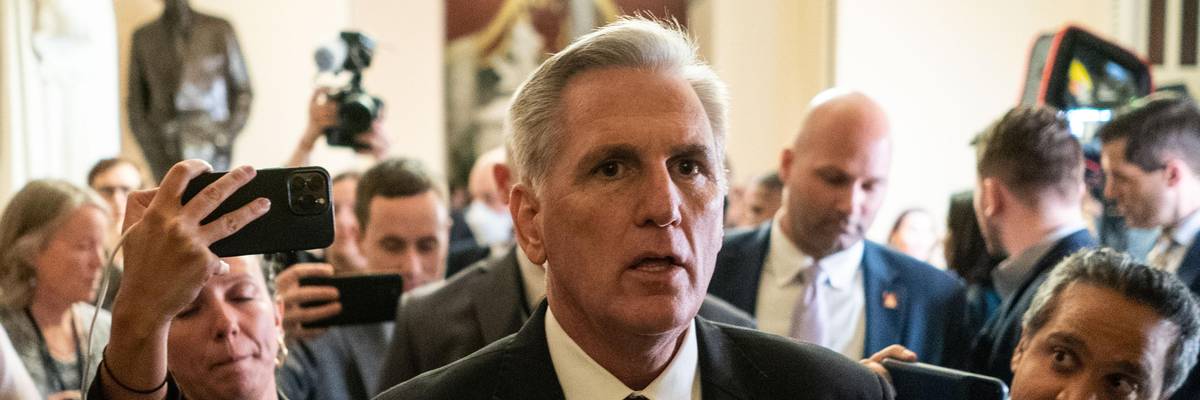
Rep. Kevin McCarthy (R-Calif.) walks to the House chamber on January 4, 2023 in Washington, D.C.
"These types of shady, backroom deals—which indebt our lawmakers to corporations and special interests—are corrupting our democracy," said Rep. Ro Khanna.
Why is a billionaire-funded super PAC aligned with Republican Rep. Kevin McCarthy playing a role in talks over who will become the next speaker of the House?
Democratic lawmakers and campaign finance watchdogs raised that question Wednesday after the Congressional Leadership Fund (CLF) and the Club for Growth—another right-wing organization bankrolled by billionaires—announced a deal under which CLF won't spend any money on "open-seat primaries in safe Republican districts," a key demand of McCarthy opponents who felt their preferred candidates have been snubbed by the deep-pocketed super PAC.
As Fortune reported Wednesday, "far-right lawmakers have complained that their preferred candidates for the House were being treated unfairly as the campaign fund put its resources elsewhere."
CLF spent nearly $260 million during the 2022 election cycle, including millions to help reelect Republicans who are trying to tank his speakership bid. The super PAC's top donors in the midterm cycle were banking scion Timothy Mellon, Blackstone CEO Stephen Schwarzman, and Citadel CEO Kenneth Griffin—all billionaires.
The deal between CLF and Club for Growth came as McCarthy continued his frantic efforts to cobble together the necessary 218 votes, offering a number of concessions to Republicans who have rejected the California lawmaker in six consecutive votes—and possibly more on Thursday.
Sen. Brian Schatz (D-Hawaii) was among those who raised concerns over CLF and Club for Growth's role in the ongoing speakership debacle.
"It is creepy that dark money super PACs are explicitly part of the negotiation regarding who becomes speaker of the United States House," the senator wrote on Twitter.
Federal law prohibits candidates from coordinating with super PACs, though the independence mandate is often flouted in practice. In a press release, CLF and Club for Growth insisted that "no one in Congress or their staff has directed or suggested CLF take any action here."
"Interesting that an independent super PAC that isn't supposed to coordinate with members of Congress comes to an agreement to benefit a specific member of Congress," responded Adam Smith, action fund director of End Citizens United.
Club for Growth, which bills itself as a "leading free-enterprise advocacy group" that promotes tax cuts and deregulation, originally opposed McCarthy's run for speaker, pushing him to agree to a number of concessions backed by far-right House Republicans.
But the organization, which has received funding from the Koch network and other right-wing forces, suggested Wednesday that it will support McCarthy if he upholds the concessions he has offered thus far.
"This agreement on super PACs fulfills a major concern we have pressed for," Club for Growth president David McIntosh said in a statement.
While the CLF-Club for Growth agreement was seen as a major victory for the anti-McCarthy faction, it's not clear whether it will be enough to end the impasse. The House is set to convene again Thursday at noon.
Rep. Ro Khanna (D-Calif.), a member of the Congressional Progressive Caucus, argued in a tweet Wednesday that "these types of shady, backroom deals—which indebt our lawmakers to corporations and special interests—are corrupting our democracy."
"This is why I started the bipartisan Congressional No PAC caucus and have never taken PAC money, and refuse to start," Khanna added.
Dear Common Dreams reader, It’s been nearly 30 years since I co-founded Common Dreams with my late wife, Lina Newhouser. We had the radical notion that journalism should serve the public good, not corporate profits. It was clear to us from the outset what it would take to build such a project. No paid advertisements. No corporate sponsors. No millionaire publisher telling us what to think or do. Many people said we wouldn't last a year, but we proved those doubters wrong. Together with a tremendous team of journalists and dedicated staff, we built an independent media outlet free from the constraints of profits and corporate control. Our mission has always been simple: To inform. To inspire. To ignite change for the common good. Building Common Dreams was not easy. Our survival was never guaranteed. When you take on the most powerful forces—Wall Street greed, fossil fuel industry destruction, Big Tech lobbyists, and uber-rich oligarchs who have spent billions upon billions rigging the economy and democracy in their favor—the only bulwark you have is supporters who believe in your work. But here’s the urgent message from me today. It's never been this bad out there. And it's never been this hard to keep us going. At the very moment Common Dreams is most needed, the threats we face are intensifying. We need your support now more than ever. We don't accept corporate advertising and never will. We don't have a paywall because we don't think people should be blocked from critical news based on their ability to pay. Everything we do is funded by the donations of readers like you. When everyone does the little they can afford, we are strong. But if that support retreats or dries up, so do we. Will you donate now to make sure Common Dreams not only survives but thrives? —Craig Brown, Co-founder |
Why is a billionaire-funded super PAC aligned with Republican Rep. Kevin McCarthy playing a role in talks over who will become the next speaker of the House?
Democratic lawmakers and campaign finance watchdogs raised that question Wednesday after the Congressional Leadership Fund (CLF) and the Club for Growth—another right-wing organization bankrolled by billionaires—announced a deal under which CLF won't spend any money on "open-seat primaries in safe Republican districts," a key demand of McCarthy opponents who felt their preferred candidates have been snubbed by the deep-pocketed super PAC.
As Fortune reported Wednesday, "far-right lawmakers have complained that their preferred candidates for the House were being treated unfairly as the campaign fund put its resources elsewhere."
CLF spent nearly $260 million during the 2022 election cycle, including millions to help reelect Republicans who are trying to tank his speakership bid. The super PAC's top donors in the midterm cycle were banking scion Timothy Mellon, Blackstone CEO Stephen Schwarzman, and Citadel CEO Kenneth Griffin—all billionaires.
The deal between CLF and Club for Growth came as McCarthy continued his frantic efforts to cobble together the necessary 218 votes, offering a number of concessions to Republicans who have rejected the California lawmaker in six consecutive votes—and possibly more on Thursday.
Sen. Brian Schatz (D-Hawaii) was among those who raised concerns over CLF and Club for Growth's role in the ongoing speakership debacle.
"It is creepy that dark money super PACs are explicitly part of the negotiation regarding who becomes speaker of the United States House," the senator wrote on Twitter.
Federal law prohibits candidates from coordinating with super PACs, though the independence mandate is often flouted in practice. In a press release, CLF and Club for Growth insisted that "no one in Congress or their staff has directed or suggested CLF take any action here."
"Interesting that an independent super PAC that isn't supposed to coordinate with members of Congress comes to an agreement to benefit a specific member of Congress," responded Adam Smith, action fund director of End Citizens United.
Club for Growth, which bills itself as a "leading free-enterprise advocacy group" that promotes tax cuts and deregulation, originally opposed McCarthy's run for speaker, pushing him to agree to a number of concessions backed by far-right House Republicans.
But the organization, which has received funding from the Koch network and other right-wing forces, suggested Wednesday that it will support McCarthy if he upholds the concessions he has offered thus far.
"This agreement on super PACs fulfills a major concern we have pressed for," Club for Growth president David McIntosh said in a statement.
While the CLF-Club for Growth agreement was seen as a major victory for the anti-McCarthy faction, it's not clear whether it will be enough to end the impasse. The House is set to convene again Thursday at noon.
Rep. Ro Khanna (D-Calif.), a member of the Congressional Progressive Caucus, argued in a tweet Wednesday that "these types of shady, backroom deals—which indebt our lawmakers to corporations and special interests—are corrupting our democracy."
"This is why I started the bipartisan Congressional No PAC caucus and have never taken PAC money, and refuse to start," Khanna added.
Why is a billionaire-funded super PAC aligned with Republican Rep. Kevin McCarthy playing a role in talks over who will become the next speaker of the House?
Democratic lawmakers and campaign finance watchdogs raised that question Wednesday after the Congressional Leadership Fund (CLF) and the Club for Growth—another right-wing organization bankrolled by billionaires—announced a deal under which CLF won't spend any money on "open-seat primaries in safe Republican districts," a key demand of McCarthy opponents who felt their preferred candidates have been snubbed by the deep-pocketed super PAC.
As Fortune reported Wednesday, "far-right lawmakers have complained that their preferred candidates for the House were being treated unfairly as the campaign fund put its resources elsewhere."
CLF spent nearly $260 million during the 2022 election cycle, including millions to help reelect Republicans who are trying to tank his speakership bid. The super PAC's top donors in the midterm cycle were banking scion Timothy Mellon, Blackstone CEO Stephen Schwarzman, and Citadel CEO Kenneth Griffin—all billionaires.
The deal between CLF and Club for Growth came as McCarthy continued his frantic efforts to cobble together the necessary 218 votes, offering a number of concessions to Republicans who have rejected the California lawmaker in six consecutive votes—and possibly more on Thursday.
Sen. Brian Schatz (D-Hawaii) was among those who raised concerns over CLF and Club for Growth's role in the ongoing speakership debacle.
"It is creepy that dark money super PACs are explicitly part of the negotiation regarding who becomes speaker of the United States House," the senator wrote on Twitter.
Federal law prohibits candidates from coordinating with super PACs, though the independence mandate is often flouted in practice. In a press release, CLF and Club for Growth insisted that "no one in Congress or their staff has directed or suggested CLF take any action here."
"Interesting that an independent super PAC that isn't supposed to coordinate with members of Congress comes to an agreement to benefit a specific member of Congress," responded Adam Smith, action fund director of End Citizens United.
Club for Growth, which bills itself as a "leading free-enterprise advocacy group" that promotes tax cuts and deregulation, originally opposed McCarthy's run for speaker, pushing him to agree to a number of concessions backed by far-right House Republicans.
But the organization, which has received funding from the Koch network and other right-wing forces, suggested Wednesday that it will support McCarthy if he upholds the concessions he has offered thus far.
"This agreement on super PACs fulfills a major concern we have pressed for," Club for Growth president David McIntosh said in a statement.
While the CLF-Club for Growth agreement was seen as a major victory for the anti-McCarthy faction, it's not clear whether it will be enough to end the impasse. The House is set to convene again Thursday at noon.
Rep. Ro Khanna (D-Calif.), a member of the Congressional Progressive Caucus, argued in a tweet Wednesday that "these types of shady, backroom deals—which indebt our lawmakers to corporations and special interests—are corrupting our democracy."
"This is why I started the bipartisan Congressional No PAC caucus and have never taken PAC money, and refuse to start," Khanna added.