

SUBSCRIBE TO OUR FREE NEWSLETTER
Daily news & progressive opinion—funded by the people, not the corporations—delivered straight to your inbox.
5
#000000
#FFFFFF
To donate by check, phone, or other method, see our More Ways to Give page.
Daily news & progressive opinion—funded by the people, not the corporations—delivered straight to your inbox.
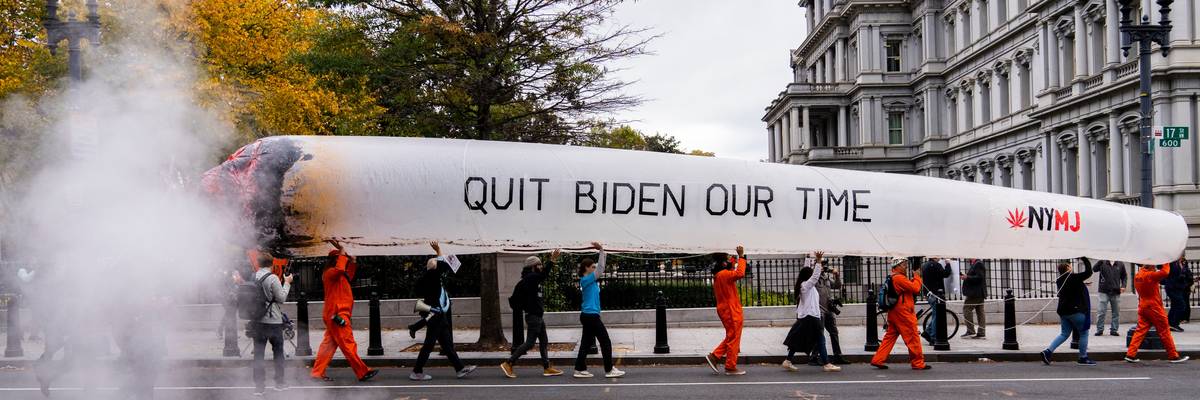
Cannabis activists carry a blow-up joint during an October 24, 2022 rally in Washington, D.C. to urge the Biden administration to release prisoners convicted of federal marijuana crimes.
"As more states have adopted legalization, public support for this policy has risen dramatically," said one campaigner. "Voters prefer legalization and regulation over the failed policy of marijuana prohibition."
A record 7 in 10 voting-age Americans think marijuana should be legal, according to Gallup polling published Wednesday, a day after voters in Ohio made it the 24th state to legalize adult recreational use of the plant.
After holding steady at 68% for three straight years, Gallup found that support for legalization rose to 70%, with 29% of respondents saying cannabis should not be legal and 1% undecided. That's a 12% increase in support from 2013 levels and a 36% rise from 2003. In 1969, when Gallup first asked Americans if marijuana should be legal, only 12% said "yes."
"There's no 'buyer's remorse' among the public when it comes to legalizing cannabis," Paul Armentano, deputy director at the National Organization for the Reform of Marijuana Laws (NORML), said in a statement. "As more states have adopted legalization, public support for this policy has risen dramatically. That's because these policies are largely working as intended and because voters prefer legalization and regulation over the failed policy of marijuana prohibition."
According to Gallup:
For the second straight year, majority support for legalization is found among all major subgroups, including by age, political party, and ideology. Self-identified conservatives were the last major subgroup to express majority support, reaching 51% in 2022. Republicans first gave marijuana majority-level backing in 2017.
As of today, support for legal marijuana use is highest among self-identified liberals (91%) and Democrats (87%) and lowest among conservatives (52%) and Republicans (55%). Support is inversely correlated with age, reaching 79% among 18- to 34-year-olds. However, even among the oldest age group, nearly two-thirds (64%) are in favor.
This widespread support for legal marijuana was evident on Tuesday as nearly 57% of voters in Ohio—a state that voted for former President Donald Trump in the last two elections and has a Republican governor—approved the legalization and regulation of marijuana for people age 21 and older, who are also allowed to grow up to six cannabis plants per person and 12 plants per residence. The measure imposes a 10% tax on cannabis sales.
"Marijuana is no longer a controversial issue," Tom Haren, spokesperson for the Coalition to Regulate Marijuana Like Alcohol, told Marijuana Moment. "Ohioans demonstrated this by passing State Issue 2 in a landslide."
Marijuana Policy Project interim executive director Matthew Schweich told MJBizDaily that the Ohio vote "shows that a cannabis legalization campaign can win anytime and anywhere."
"To achieve victory in a nonpresidential year in a red state shows just how strong public support for legalization has become," he added.
The rise in support for legal marijuana parallels "the rise in Americans' self-reported use of the drug," Gallup said, citing a July survey. "The percentage saying they personally smoke marijuana has risen 10 points to 17% since 2013, and the percentage who have ever tried it has increased 12 points to 50%."
Despite state-level gains—only 10 states have not legalized marijuana for recreational or medical use—cannabis remains strictly prohibited at the federal level, where the U.S. Drug Enforcement Administration (DEA) lists the plant as a Schedule I controlled substance.
Schedule I drugs, the DEA explains, have "no currently accepted medical use and a high potential for abuse," and in addition to cannabis include heroin, LSD, MDMA, and peyote. Far more dangerous substances than marijuana—including cocaine, methamphetamine, and fentanyl—are classified as Schedule II.
After granting a mass pardon last year to U.S. citizens and permanent residents convicted of simple federal marijuana possession, President Joe Biden ordered Attorney General Merrick Garland and Health and Human Services Secretary Xavier Becerra to initiate a review which resulted in an August recommendation by HHS to reclassify cannabis as Schedule III. Such a move would place the plant in the same category as codeine, ketamine, testosterone, and anabolic steroids.
"Just as it is intellectually dishonest to categorize cannabis in the same placement as heroin, it is equally disingenuous to treat cannabis in the same manner as anabolic steroids," Armentano said at the time. "The majority of Americans believe that cannabis ought to be legal and that its hazards to health are less significant than those associated with federally descheduled substances like alcohol and tobacco."
"Like those latter substances, we have long argued the cannabis plant should be removed from the Controlled Substances Act altogether," he added, "thereby proving state governments—rather than the federal government—the ability to regulate marijuana in the manner they see fit without violating federal law."
In the Democrat-controlled U.S. Senate, the bipartisan Secure and Fair Enforcement Regulation (SAFER) Banking Act—which would legally protect banks and credit unions that serve cannabis businesses—was approved by the Banking Committee in September.
Last week, a bipartisan group of U.S. House lawmakers reintroduced H.B. 6028, the States Reform Act, legislation led by Rep. Nancy Mace (R-S.C.) that would remove cannabis from the Controlled Substances Act, facilitate the expungement of certain marijuana-related offenses, and provide regulatory oversight for state-legal marijuana markets.
However, Republicans control the lower chamber, and new House Speaker Mike Johnson (R-La.) is a Christian fundamentalist who opposes marijuana on religious grounds. In recent years, Johnson has voted against legislation that would end federal prohibition, allow banks to work with state-legal cannabis businesses, and fund medical marijuana research.
Dear Common Dreams reader, It’s been nearly 30 years since I co-founded Common Dreams with my late wife, Lina Newhouser. We had the radical notion that journalism should serve the public good, not corporate profits. It was clear to us from the outset what it would take to build such a project. No paid advertisements. No corporate sponsors. No millionaire publisher telling us what to think or do. Many people said we wouldn't last a year, but we proved those doubters wrong. Together with a tremendous team of journalists and dedicated staff, we built an independent media outlet free from the constraints of profits and corporate control. Our mission has always been simple: To inform. To inspire. To ignite change for the common good. Building Common Dreams was not easy. Our survival was never guaranteed. When you take on the most powerful forces—Wall Street greed, fossil fuel industry destruction, Big Tech lobbyists, and uber-rich oligarchs who have spent billions upon billions rigging the economy and democracy in their favor—the only bulwark you have is supporters who believe in your work. But here’s the urgent message from me today. It's never been this bad out there. And it's never been this hard to keep us going. At the very moment Common Dreams is most needed, the threats we face are intensifying. We need your support now more than ever. We don't accept corporate advertising and never will. We don't have a paywall because we don't think people should be blocked from critical news based on their ability to pay. Everything we do is funded by the donations of readers like you. When everyone does the little they can afford, we are strong. But if that support retreats or dries up, so do we. Will you donate now to make sure Common Dreams not only survives but thrives? —Craig Brown, Co-founder |
A record 7 in 10 voting-age Americans think marijuana should be legal, according to Gallup polling published Wednesday, a day after voters in Ohio made it the 24th state to legalize adult recreational use of the plant.
After holding steady at 68% for three straight years, Gallup found that support for legalization rose to 70%, with 29% of respondents saying cannabis should not be legal and 1% undecided. That's a 12% increase in support from 2013 levels and a 36% rise from 2003. In 1969, when Gallup first asked Americans if marijuana should be legal, only 12% said "yes."
"There's no 'buyer's remorse' among the public when it comes to legalizing cannabis," Paul Armentano, deputy director at the National Organization for the Reform of Marijuana Laws (NORML), said in a statement. "As more states have adopted legalization, public support for this policy has risen dramatically. That's because these policies are largely working as intended and because voters prefer legalization and regulation over the failed policy of marijuana prohibition."
According to Gallup:
For the second straight year, majority support for legalization is found among all major subgroups, including by age, political party, and ideology. Self-identified conservatives were the last major subgroup to express majority support, reaching 51% in 2022. Republicans first gave marijuana majority-level backing in 2017.
As of today, support for legal marijuana use is highest among self-identified liberals (91%) and Democrats (87%) and lowest among conservatives (52%) and Republicans (55%). Support is inversely correlated with age, reaching 79% among 18- to 34-year-olds. However, even among the oldest age group, nearly two-thirds (64%) are in favor.
This widespread support for legal marijuana was evident on Tuesday as nearly 57% of voters in Ohio—a state that voted for former President Donald Trump in the last two elections and has a Republican governor—approved the legalization and regulation of marijuana for people age 21 and older, who are also allowed to grow up to six cannabis plants per person and 12 plants per residence. The measure imposes a 10% tax on cannabis sales.
"Marijuana is no longer a controversial issue," Tom Haren, spokesperson for the Coalition to Regulate Marijuana Like Alcohol, told Marijuana Moment. "Ohioans demonstrated this by passing State Issue 2 in a landslide."
Marijuana Policy Project interim executive director Matthew Schweich told MJBizDaily that the Ohio vote "shows that a cannabis legalization campaign can win anytime and anywhere."
"To achieve victory in a nonpresidential year in a red state shows just how strong public support for legalization has become," he added.
The rise in support for legal marijuana parallels "the rise in Americans' self-reported use of the drug," Gallup said, citing a July survey. "The percentage saying they personally smoke marijuana has risen 10 points to 17% since 2013, and the percentage who have ever tried it has increased 12 points to 50%."
Despite state-level gains—only 10 states have not legalized marijuana for recreational or medical use—cannabis remains strictly prohibited at the federal level, where the U.S. Drug Enforcement Administration (DEA) lists the plant as a Schedule I controlled substance.
Schedule I drugs, the DEA explains, have "no currently accepted medical use and a high potential for abuse," and in addition to cannabis include heroin, LSD, MDMA, and peyote. Far more dangerous substances than marijuana—including cocaine, methamphetamine, and fentanyl—are classified as Schedule II.
After granting a mass pardon last year to U.S. citizens and permanent residents convicted of simple federal marijuana possession, President Joe Biden ordered Attorney General Merrick Garland and Health and Human Services Secretary Xavier Becerra to initiate a review which resulted in an August recommendation by HHS to reclassify cannabis as Schedule III. Such a move would place the plant in the same category as codeine, ketamine, testosterone, and anabolic steroids.
"Just as it is intellectually dishonest to categorize cannabis in the same placement as heroin, it is equally disingenuous to treat cannabis in the same manner as anabolic steroids," Armentano said at the time. "The majority of Americans believe that cannabis ought to be legal and that its hazards to health are less significant than those associated with federally descheduled substances like alcohol and tobacco."
"Like those latter substances, we have long argued the cannabis plant should be removed from the Controlled Substances Act altogether," he added, "thereby proving state governments—rather than the federal government—the ability to regulate marijuana in the manner they see fit without violating federal law."
In the Democrat-controlled U.S. Senate, the bipartisan Secure and Fair Enforcement Regulation (SAFER) Banking Act—which would legally protect banks and credit unions that serve cannabis businesses—was approved by the Banking Committee in September.
Last week, a bipartisan group of U.S. House lawmakers reintroduced H.B. 6028, the States Reform Act, legislation led by Rep. Nancy Mace (R-S.C.) that would remove cannabis from the Controlled Substances Act, facilitate the expungement of certain marijuana-related offenses, and provide regulatory oversight for state-legal marijuana markets.
However, Republicans control the lower chamber, and new House Speaker Mike Johnson (R-La.) is a Christian fundamentalist who opposes marijuana on religious grounds. In recent years, Johnson has voted against legislation that would end federal prohibition, allow banks to work with state-legal cannabis businesses, and fund medical marijuana research.
A record 7 in 10 voting-age Americans think marijuana should be legal, according to Gallup polling published Wednesday, a day after voters in Ohio made it the 24th state to legalize adult recreational use of the plant.
After holding steady at 68% for three straight years, Gallup found that support for legalization rose to 70%, with 29% of respondents saying cannabis should not be legal and 1% undecided. That's a 12% increase in support from 2013 levels and a 36% rise from 2003. In 1969, when Gallup first asked Americans if marijuana should be legal, only 12% said "yes."
"There's no 'buyer's remorse' among the public when it comes to legalizing cannabis," Paul Armentano, deputy director at the National Organization for the Reform of Marijuana Laws (NORML), said in a statement. "As more states have adopted legalization, public support for this policy has risen dramatically. That's because these policies are largely working as intended and because voters prefer legalization and regulation over the failed policy of marijuana prohibition."
According to Gallup:
For the second straight year, majority support for legalization is found among all major subgroups, including by age, political party, and ideology. Self-identified conservatives were the last major subgroup to express majority support, reaching 51% in 2022. Republicans first gave marijuana majority-level backing in 2017.
As of today, support for legal marijuana use is highest among self-identified liberals (91%) and Democrats (87%) and lowest among conservatives (52%) and Republicans (55%). Support is inversely correlated with age, reaching 79% among 18- to 34-year-olds. However, even among the oldest age group, nearly two-thirds (64%) are in favor.
This widespread support for legal marijuana was evident on Tuesday as nearly 57% of voters in Ohio—a state that voted for former President Donald Trump in the last two elections and has a Republican governor—approved the legalization and regulation of marijuana for people age 21 and older, who are also allowed to grow up to six cannabis plants per person and 12 plants per residence. The measure imposes a 10% tax on cannabis sales.
"Marijuana is no longer a controversial issue," Tom Haren, spokesperson for the Coalition to Regulate Marijuana Like Alcohol, told Marijuana Moment. "Ohioans demonstrated this by passing State Issue 2 in a landslide."
Marijuana Policy Project interim executive director Matthew Schweich told MJBizDaily that the Ohio vote "shows that a cannabis legalization campaign can win anytime and anywhere."
"To achieve victory in a nonpresidential year in a red state shows just how strong public support for legalization has become," he added.
The rise in support for legal marijuana parallels "the rise in Americans' self-reported use of the drug," Gallup said, citing a July survey. "The percentage saying they personally smoke marijuana has risen 10 points to 17% since 2013, and the percentage who have ever tried it has increased 12 points to 50%."
Despite state-level gains—only 10 states have not legalized marijuana for recreational or medical use—cannabis remains strictly prohibited at the federal level, where the U.S. Drug Enforcement Administration (DEA) lists the plant as a Schedule I controlled substance.
Schedule I drugs, the DEA explains, have "no currently accepted medical use and a high potential for abuse," and in addition to cannabis include heroin, LSD, MDMA, and peyote. Far more dangerous substances than marijuana—including cocaine, methamphetamine, and fentanyl—are classified as Schedule II.
After granting a mass pardon last year to U.S. citizens and permanent residents convicted of simple federal marijuana possession, President Joe Biden ordered Attorney General Merrick Garland and Health and Human Services Secretary Xavier Becerra to initiate a review which resulted in an August recommendation by HHS to reclassify cannabis as Schedule III. Such a move would place the plant in the same category as codeine, ketamine, testosterone, and anabolic steroids.
"Just as it is intellectually dishonest to categorize cannabis in the same placement as heroin, it is equally disingenuous to treat cannabis in the same manner as anabolic steroids," Armentano said at the time. "The majority of Americans believe that cannabis ought to be legal and that its hazards to health are less significant than those associated with federally descheduled substances like alcohol and tobacco."
"Like those latter substances, we have long argued the cannabis plant should be removed from the Controlled Substances Act altogether," he added, "thereby proving state governments—rather than the federal government—the ability to regulate marijuana in the manner they see fit without violating federal law."
In the Democrat-controlled U.S. Senate, the bipartisan Secure and Fair Enforcement Regulation (SAFER) Banking Act—which would legally protect banks and credit unions that serve cannabis businesses—was approved by the Banking Committee in September.
Last week, a bipartisan group of U.S. House lawmakers reintroduced H.B. 6028, the States Reform Act, legislation led by Rep. Nancy Mace (R-S.C.) that would remove cannabis from the Controlled Substances Act, facilitate the expungement of certain marijuana-related offenses, and provide regulatory oversight for state-legal marijuana markets.
However, Republicans control the lower chamber, and new House Speaker Mike Johnson (R-La.) is a Christian fundamentalist who opposes marijuana on religious grounds. In recent years, Johnson has voted against legislation that would end federal prohibition, allow banks to work with state-legal cannabis businesses, and fund medical marijuana research.

