

SUBSCRIBE TO OUR FREE NEWSLETTER
Daily news & progressive opinion—funded by the people, not the corporations—delivered straight to your inbox.
5
#000000
#FFFFFF
To donate by check, phone, or other method, see our More Ways to Give page.
Daily news & progressive opinion—funded by the people, not the corporations—delivered straight to your inbox.
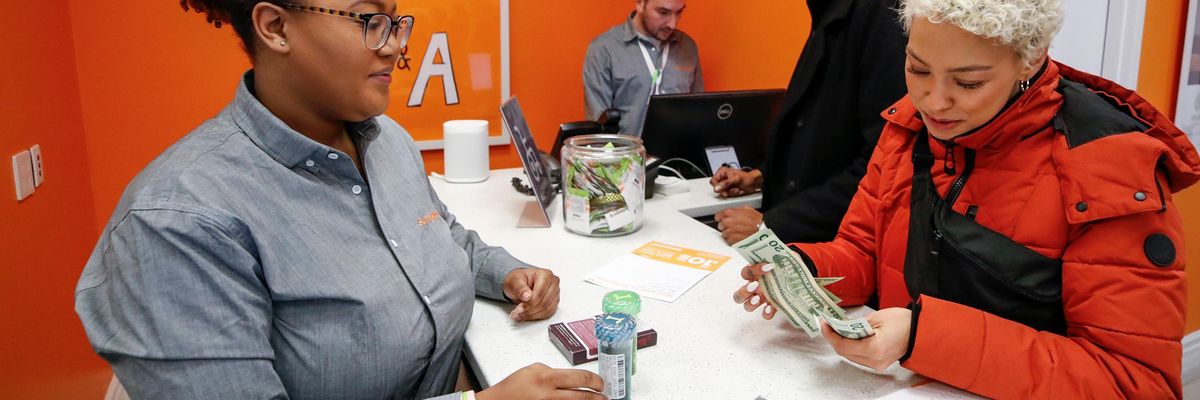
A customer makes a purchase at Sunnyside Cannabis Dispensary on January 1, 2020 in Chicago, Illinois.
"We've got momentum on our side," said Sen. Jeff Merkley. "Let's get this done to protect our legal cannabis businesses!"
The U.S. Senate Banking Committee on Wednesday brought major federal marijuana banking legislation closer to becoming law than ever, approving a bipartisan bill that advocates say is essential to the safety of legal recreational and medical marijuana businesses across the United States.
The committee voted 14-9 in favor of passing the Secure and Fair Enforcement Regulation (SAFER) Banking Act, which would legally protect banks and credit unions that provide services to cannabis operations and prohibit federal regulators from ordering financial institutions to close a business' account based on "reputational risk."
An earlier version of the bill passed in the U.S. House numerous times but was never advanced in the Senate under either Democratic or Republican control.
"We've got momentum on our side to finally pass the SAFER Banking Act," said Sen. Jeff Merkley (D-Ore.), who is sponsoring the legislation along with Senate Majority Leader Chuck Schumer (D-N.Y.) and Sens. Steve Daines (R-Mont.), Cynthia Lummis (R-Wyo.), and Kyrsten Sinema (I-Ariz.). "Let's get this done to protect our legal cannabis businesses!"
Only 12% of all U.S. banks and 5% of credit unions provide banking services to marijuana-related businesses, according to the U.S. Department of Treasury.
As Common Dreams reported, Mastercard announced in July that it would no longer offer services in the cannabis industry because marijuana is still criminalized at the federal level—even though annual national sales in the sector are projected to reach $57 billion by 2030 in states where cannabis is currently legalized.
NORML, which has advocated for marijuana decriminalization since 1970, noted on Wednesday that more than 70% of cannabis businesses report that a "lack of access to banking or investment capital" is their top challenge.
Without access to banking services, businesses are forced to make sales only in cash, which Merkley said is "an open invitation to robberies, muggings, money laundering, and organized crime."
"Forcing legal businesses to operate in all-cash is dangerous for our communities," said the senator.
NORML political director Morgan Fox called the newly advanced legislation "an improved version of the SAFE Banking Act."
"It allows state-licensed cannabis businesses to more easily access financial services, such as opening a simple bank account, and it provides entrepreneurs with greater access to lending and other services that are available to other legal businesses," said Fox.
Schumer called the passage of the bill out of the committee "a huge step," and said he is also working to include amendments to expunge people's marijuana-related criminal offenses in the final bill.
"Now is the time," said the senator.
Dear Common Dreams reader, It’s been nearly 30 years since I co-founded Common Dreams with my late wife, Lina Newhouser. We had the radical notion that journalism should serve the public good, not corporate profits. It was clear to us from the outset what it would take to build such a project. No paid advertisements. No corporate sponsors. No millionaire publisher telling us what to think or do. Many people said we wouldn't last a year, but we proved those doubters wrong. Together with a tremendous team of journalists and dedicated staff, we built an independent media outlet free from the constraints of profits and corporate control. Our mission has always been simple: To inform. To inspire. To ignite change for the common good. Building Common Dreams was not easy. Our survival was never guaranteed. When you take on the most powerful forces—Wall Street greed, fossil fuel industry destruction, Big Tech lobbyists, and uber-rich oligarchs who have spent billions upon billions rigging the economy and democracy in their favor—the only bulwark you have is supporters who believe in your work. But here’s the urgent message from me today. It's never been this bad out there. And it's never been this hard to keep us going. At the very moment Common Dreams is most needed, the threats we face are intensifying. We need your support now more than ever. We don't accept corporate advertising and never will. We don't have a paywall because we don't think people should be blocked from critical news based on their ability to pay. Everything we do is funded by the donations of readers like you. When everyone does the little they can afford, we are strong. But if that support retreats or dries up, so do we. Will you donate now to make sure Common Dreams not only survives but thrives? —Craig Brown, Co-founder |
The U.S. Senate Banking Committee on Wednesday brought major federal marijuana banking legislation closer to becoming law than ever, approving a bipartisan bill that advocates say is essential to the safety of legal recreational and medical marijuana businesses across the United States.
The committee voted 14-9 in favor of passing the Secure and Fair Enforcement Regulation (SAFER) Banking Act, which would legally protect banks and credit unions that provide services to cannabis operations and prohibit federal regulators from ordering financial institutions to close a business' account based on "reputational risk."
An earlier version of the bill passed in the U.S. House numerous times but was never advanced in the Senate under either Democratic or Republican control.
"We've got momentum on our side to finally pass the SAFER Banking Act," said Sen. Jeff Merkley (D-Ore.), who is sponsoring the legislation along with Senate Majority Leader Chuck Schumer (D-N.Y.) and Sens. Steve Daines (R-Mont.), Cynthia Lummis (R-Wyo.), and Kyrsten Sinema (I-Ariz.). "Let's get this done to protect our legal cannabis businesses!"
Only 12% of all U.S. banks and 5% of credit unions provide banking services to marijuana-related businesses, according to the U.S. Department of Treasury.
As Common Dreams reported, Mastercard announced in July that it would no longer offer services in the cannabis industry because marijuana is still criminalized at the federal level—even though annual national sales in the sector are projected to reach $57 billion by 2030 in states where cannabis is currently legalized.
NORML, which has advocated for marijuana decriminalization since 1970, noted on Wednesday that more than 70% of cannabis businesses report that a "lack of access to banking or investment capital" is their top challenge.
Without access to banking services, businesses are forced to make sales only in cash, which Merkley said is "an open invitation to robberies, muggings, money laundering, and organized crime."
"Forcing legal businesses to operate in all-cash is dangerous for our communities," said the senator.
NORML political director Morgan Fox called the newly advanced legislation "an improved version of the SAFE Banking Act."
"It allows state-licensed cannabis businesses to more easily access financial services, such as opening a simple bank account, and it provides entrepreneurs with greater access to lending and other services that are available to other legal businesses," said Fox.
Schumer called the passage of the bill out of the committee "a huge step," and said he is also working to include amendments to expunge people's marijuana-related criminal offenses in the final bill.
"Now is the time," said the senator.
The U.S. Senate Banking Committee on Wednesday brought major federal marijuana banking legislation closer to becoming law than ever, approving a bipartisan bill that advocates say is essential to the safety of legal recreational and medical marijuana businesses across the United States.
The committee voted 14-9 in favor of passing the Secure and Fair Enforcement Regulation (SAFER) Banking Act, which would legally protect banks and credit unions that provide services to cannabis operations and prohibit federal regulators from ordering financial institutions to close a business' account based on "reputational risk."
An earlier version of the bill passed in the U.S. House numerous times but was never advanced in the Senate under either Democratic or Republican control.
"We've got momentum on our side to finally pass the SAFER Banking Act," said Sen. Jeff Merkley (D-Ore.), who is sponsoring the legislation along with Senate Majority Leader Chuck Schumer (D-N.Y.) and Sens. Steve Daines (R-Mont.), Cynthia Lummis (R-Wyo.), and Kyrsten Sinema (I-Ariz.). "Let's get this done to protect our legal cannabis businesses!"
Only 12% of all U.S. banks and 5% of credit unions provide banking services to marijuana-related businesses, according to the U.S. Department of Treasury.
As Common Dreams reported, Mastercard announced in July that it would no longer offer services in the cannabis industry because marijuana is still criminalized at the federal level—even though annual national sales in the sector are projected to reach $57 billion by 2030 in states where cannabis is currently legalized.
NORML, which has advocated for marijuana decriminalization since 1970, noted on Wednesday that more than 70% of cannabis businesses report that a "lack of access to banking or investment capital" is their top challenge.
Without access to banking services, businesses are forced to make sales only in cash, which Merkley said is "an open invitation to robberies, muggings, money laundering, and organized crime."
"Forcing legal businesses to operate in all-cash is dangerous for our communities," said the senator.
NORML political director Morgan Fox called the newly advanced legislation "an improved version of the SAFE Banking Act."
"It allows state-licensed cannabis businesses to more easily access financial services, such as opening a simple bank account, and it provides entrepreneurs with greater access to lending and other services that are available to other legal businesses," said Fox.
Schumer called the passage of the bill out of the committee "a huge step," and said he is also working to include amendments to expunge people's marijuana-related criminal offenses in the final bill.
"Now is the time," said the senator.

