

SUBSCRIBE TO OUR FREE NEWSLETTER
Daily news & progressive opinion—funded by the people, not the corporations—delivered straight to your inbox.
5
#000000
#FFFFFF
To donate by check, phone, or other method, see our More Ways to Give page.
Daily news & progressive opinion—funded by the people, not the corporations—delivered straight to your inbox.
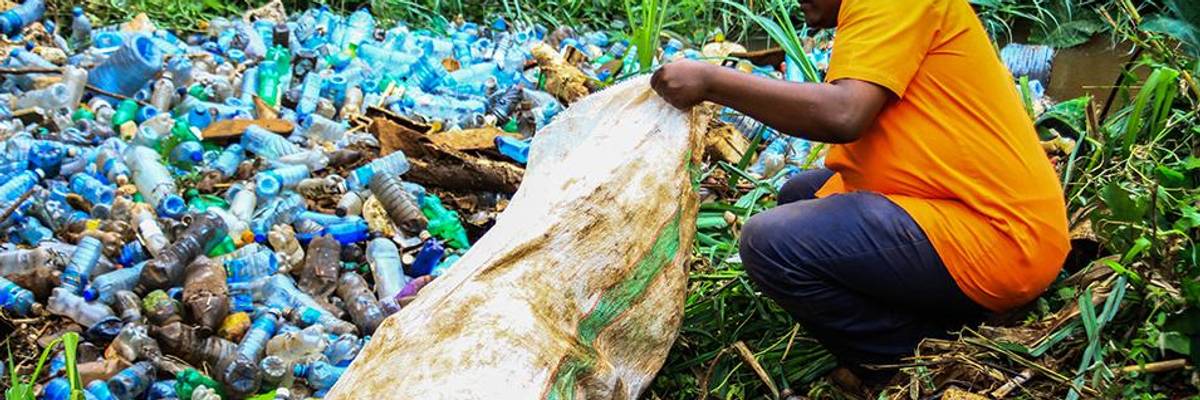
A volunteer removes plastic bottles and other trash polluting Ruaka River in Nairobi, Kenya.
"Whether the treaty includes plastic production cuts is not just a policy debate," said one expert. "It's a matter of survival."
As worldwide government officials, civil society groups, and activists prepare to head to Ottawa, Canada for the fourth session of global plastics treaty negotiations, climate advocates urged attendees to keep in mind the new findings of scientists who showed Thursday that plastic production—not waste—is the main driver of the synthetic substances' planet-heating emissions.
The federally funded Lawrence Berkeley National Laboratory in Berkeley, California released a paper showing that the greenhouse gas emissions of the plastics industry are equivalent to those of about 600 coal-fired power plants and are four times higher than those of the airline sector.
Lobbyists for the plastics industry, along with countries that are home to the world's biggest fossil fuel polluters, have pushed for a plastics treaty that centers waste management and a "circular economy" in which waste plastic is used indefinitely to produce new synthetic products.
But the Lawrence Berkeley scientists found that 75% of the greenhouse gas emissions caused by plastics are released before the plastic compounds are even created by the polymerization process.
"Plastics' impact on the climate starts with extraction," said the Global Alliance for Incinerator Alternatives (GAIA) in a policy brief on the lab's findings. "To fully capture, measure, evaluate, and address the impacts of plastic pollution, assessment, and regulatory controls must consider the complete lifecycle, beginning with extraction."
According to Lawrence Berkeley's research, if plastic production remains at its current level, it could burn through roughly one-fifth the planet's remaining carbon budget, pushing the Earth closer to planetary heating that exceeds 1.5°C.
"To avoid breaching the 1.5°C limit set by the Paris [climate] agreement," said GAIA, "primary plastic production must decrease by at least 12% to 17% per year, starting in 2024."
To achieve that goal, said the Center for Financial Accountability on Thursday, fossil fuel-producing countries must stop treating the global plastics treaty "as a waste management treaty."
"While global leaders are trying to negotiate a solution to the plastic crisis, the petrochemical industry is investing billions of dollars in making the problem rapidly worse," said GAIA science and policy director Neil Tangri, a senior fellow at University of California, Berkeley. "We need a global agreement to stop this cancerous growth, bring down plastic production, and usher in a world with less plastic and less pollution."
At the third session of the the Intergovernmental Negotiating Committee (INC-3) last year, 143 plastics industry lobbyists registered to attend, prompting advocates to call for their exclusion from future summits.
On Sunday, ahead of the meetings set to take place from April 23-29, the Break Free From Plastic movement is planning to march through Ottawa, to demand "strong conflict of interest policies that protect the treaty negotiations and its implementation from the vested interests of industries that are profiting" from the growing plastic pollution crisis.
The campaigners will also demand a negotiation process that respects the rights of Indigenous people, a treaty that supports "non-toxic reuse systems" and rejects a "circular economy" model, and limiting and reducing plastic production a "non-negotiable requirement to end plastic pollution."
Dr. Jorge Emmanuel, a co-author of GAIA's policy brief and a research fellow at Siliman University in the Philippines, said the climate impacts that have already hit his country illustrate the need for a strong global plastics treaty.
"The Philippines is on the frontlines of both climate change and plastic pollution," said Emmanuel. "Heatwaves, powerful typhoons, and flooding are getting worse, and the petrochemical industry has displaced our traditional systems with mountains of plastic that poison our communities."
"Whether the treaty includes plastic production cuts is not just a policy debate," he added. "It's a matter of survival."
Dear Common Dreams reader, It’s been nearly 30 years since I co-founded Common Dreams with my late wife, Lina Newhouser. We had the radical notion that journalism should serve the public good, not corporate profits. It was clear to us from the outset what it would take to build such a project. No paid advertisements. No corporate sponsors. No millionaire publisher telling us what to think or do. Many people said we wouldn't last a year, but we proved those doubters wrong. Together with a tremendous team of journalists and dedicated staff, we built an independent media outlet free from the constraints of profits and corporate control. Our mission has always been simple: To inform. To inspire. To ignite change for the common good. Building Common Dreams was not easy. Our survival was never guaranteed. When you take on the most powerful forces—Wall Street greed, fossil fuel industry destruction, Big Tech lobbyists, and uber-rich oligarchs who have spent billions upon billions rigging the economy and democracy in their favor—the only bulwark you have is supporters who believe in your work. But here’s the urgent message from me today. It's never been this bad out there. And it's never been this hard to keep us going. At the very moment Common Dreams is most needed, the threats we face are intensifying. We need your support now more than ever. We don't accept corporate advertising and never will. We don't have a paywall because we don't think people should be blocked from critical news based on their ability to pay. Everything we do is funded by the donations of readers like you. When everyone does the little they can afford, we are strong. But if that support retreats or dries up, so do we. Will you donate now to make sure Common Dreams not only survives but thrives? —Craig Brown, Co-founder |
As worldwide government officials, civil society groups, and activists prepare to head to Ottawa, Canada for the fourth session of global plastics treaty negotiations, climate advocates urged attendees to keep in mind the new findings of scientists who showed Thursday that plastic production—not waste—is the main driver of the synthetic substances' planet-heating emissions.
The federally funded Lawrence Berkeley National Laboratory in Berkeley, California released a paper showing that the greenhouse gas emissions of the plastics industry are equivalent to those of about 600 coal-fired power plants and are four times higher than those of the airline sector.
Lobbyists for the plastics industry, along with countries that are home to the world's biggest fossil fuel polluters, have pushed for a plastics treaty that centers waste management and a "circular economy" in which waste plastic is used indefinitely to produce new synthetic products.
But the Lawrence Berkeley scientists found that 75% of the greenhouse gas emissions caused by plastics are released before the plastic compounds are even created by the polymerization process.
"Plastics' impact on the climate starts with extraction," said the Global Alliance for Incinerator Alternatives (GAIA) in a policy brief on the lab's findings. "To fully capture, measure, evaluate, and address the impacts of plastic pollution, assessment, and regulatory controls must consider the complete lifecycle, beginning with extraction."
According to Lawrence Berkeley's research, if plastic production remains at its current level, it could burn through roughly one-fifth the planet's remaining carbon budget, pushing the Earth closer to planetary heating that exceeds 1.5°C.
"To avoid breaching the 1.5°C limit set by the Paris [climate] agreement," said GAIA, "primary plastic production must decrease by at least 12% to 17% per year, starting in 2024."
To achieve that goal, said the Center for Financial Accountability on Thursday, fossil fuel-producing countries must stop treating the global plastics treaty "as a waste management treaty."
"While global leaders are trying to negotiate a solution to the plastic crisis, the petrochemical industry is investing billions of dollars in making the problem rapidly worse," said GAIA science and policy director Neil Tangri, a senior fellow at University of California, Berkeley. "We need a global agreement to stop this cancerous growth, bring down plastic production, and usher in a world with less plastic and less pollution."
At the third session of the the Intergovernmental Negotiating Committee (INC-3) last year, 143 plastics industry lobbyists registered to attend, prompting advocates to call for their exclusion from future summits.
On Sunday, ahead of the meetings set to take place from April 23-29, the Break Free From Plastic movement is planning to march through Ottawa, to demand "strong conflict of interest policies that protect the treaty negotiations and its implementation from the vested interests of industries that are profiting" from the growing plastic pollution crisis.
The campaigners will also demand a negotiation process that respects the rights of Indigenous people, a treaty that supports "non-toxic reuse systems" and rejects a "circular economy" model, and limiting and reducing plastic production a "non-negotiable requirement to end plastic pollution."
Dr. Jorge Emmanuel, a co-author of GAIA's policy brief and a research fellow at Siliman University in the Philippines, said the climate impacts that have already hit his country illustrate the need for a strong global plastics treaty.
"The Philippines is on the frontlines of both climate change and plastic pollution," said Emmanuel. "Heatwaves, powerful typhoons, and flooding are getting worse, and the petrochemical industry has displaced our traditional systems with mountains of plastic that poison our communities."
"Whether the treaty includes plastic production cuts is not just a policy debate," he added. "It's a matter of survival."
As worldwide government officials, civil society groups, and activists prepare to head to Ottawa, Canada for the fourth session of global plastics treaty negotiations, climate advocates urged attendees to keep in mind the new findings of scientists who showed Thursday that plastic production—not waste—is the main driver of the synthetic substances' planet-heating emissions.
The federally funded Lawrence Berkeley National Laboratory in Berkeley, California released a paper showing that the greenhouse gas emissions of the plastics industry are equivalent to those of about 600 coal-fired power plants and are four times higher than those of the airline sector.
Lobbyists for the plastics industry, along with countries that are home to the world's biggest fossil fuel polluters, have pushed for a plastics treaty that centers waste management and a "circular economy" in which waste plastic is used indefinitely to produce new synthetic products.
But the Lawrence Berkeley scientists found that 75% of the greenhouse gas emissions caused by plastics are released before the plastic compounds are even created by the polymerization process.
"Plastics' impact on the climate starts with extraction," said the Global Alliance for Incinerator Alternatives (GAIA) in a policy brief on the lab's findings. "To fully capture, measure, evaluate, and address the impacts of plastic pollution, assessment, and regulatory controls must consider the complete lifecycle, beginning with extraction."
According to Lawrence Berkeley's research, if plastic production remains at its current level, it could burn through roughly one-fifth the planet's remaining carbon budget, pushing the Earth closer to planetary heating that exceeds 1.5°C.
"To avoid breaching the 1.5°C limit set by the Paris [climate] agreement," said GAIA, "primary plastic production must decrease by at least 12% to 17% per year, starting in 2024."
To achieve that goal, said the Center for Financial Accountability on Thursday, fossil fuel-producing countries must stop treating the global plastics treaty "as a waste management treaty."
"While global leaders are trying to negotiate a solution to the plastic crisis, the petrochemical industry is investing billions of dollars in making the problem rapidly worse," said GAIA science and policy director Neil Tangri, a senior fellow at University of California, Berkeley. "We need a global agreement to stop this cancerous growth, bring down plastic production, and usher in a world with less plastic and less pollution."
At the third session of the the Intergovernmental Negotiating Committee (INC-3) last year, 143 plastics industry lobbyists registered to attend, prompting advocates to call for their exclusion from future summits.
On Sunday, ahead of the meetings set to take place from April 23-29, the Break Free From Plastic movement is planning to march through Ottawa, to demand "strong conflict of interest policies that protect the treaty negotiations and its implementation from the vested interests of industries that are profiting" from the growing plastic pollution crisis.
The campaigners will also demand a negotiation process that respects the rights of Indigenous people, a treaty that supports "non-toxic reuse systems" and rejects a "circular economy" model, and limiting and reducing plastic production a "non-negotiable requirement to end plastic pollution."
Dr. Jorge Emmanuel, a co-author of GAIA's policy brief and a research fellow at Siliman University in the Philippines, said the climate impacts that have already hit his country illustrate the need for a strong global plastics treaty.
"The Philippines is on the frontlines of both climate change and plastic pollution," said Emmanuel. "Heatwaves, powerful typhoons, and flooding are getting worse, and the petrochemical industry has displaced our traditional systems with mountains of plastic that poison our communities."
"Whether the treaty includes plastic production cuts is not just a policy debate," he added. "It's a matter of survival."

