SUBSCRIBE TO OUR FREE NEWSLETTER
Daily news & progressive opinion—funded by the people, not the corporations—delivered straight to your inbox.
5
#000000
#FFFFFF
To donate by check, phone, or other method, see our More Ways to Give page.
Daily news & progressive opinion—funded by the people, not the corporations—delivered straight to your inbox.
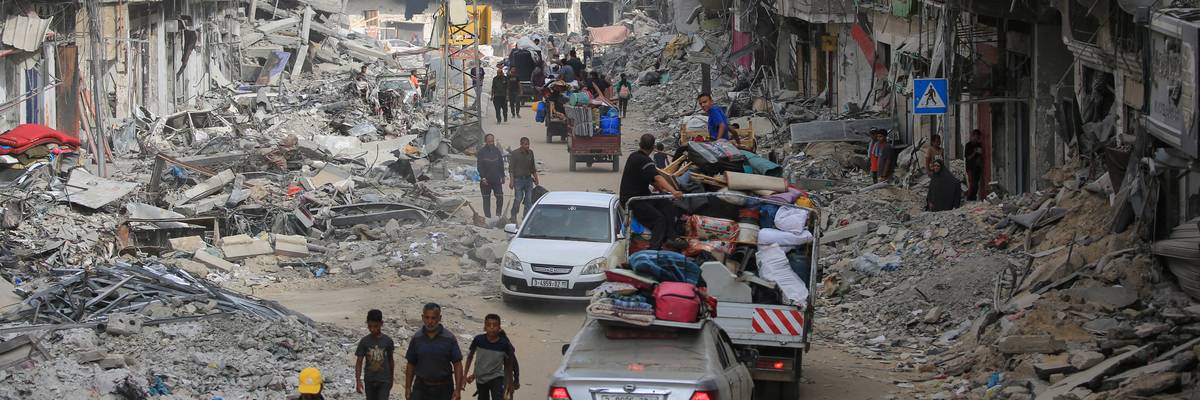
Displaced Palestinians from areas in east Khan Younis, Gaza flee after the Israel Defense Forces issued a new evacuation order for parts of the city on July 2, 2024.
"It means yet another day, week, chapter of misery for these hundreds of thousands of people," said one United Nations worker.
Hearing once again from the Israel Defense Forces that they must evacuate to a so-called "humanitarian zone," hundreds of thousands of Palestinian people in the southern Gaza city of Khan Younis on Tuesday were forced to search for safety ahead of a likely ground offensive in the city.
The United Nations Relief and Works Agency for Palestine Refugees in the Near East (UNRWA) said that roughly 250,000 people are living and seeking shelter in the evacuation zone—more than 10% of Gaza's population of 2.3 million.
The evacuation order, which was posted on social media on Monday, also includes nearby localities including al-Qarara and Bani Suhaila.
The IDF said after the order was announced that patients and healthcare providers at European Hospital, the largest operating medical facility in Gaza, were not required to evacuate, but the hospital director told the Associated Press that most had already been relocated.
"The hospital staff and the patients decided to already evacuate themselves," said Rik Peeperkorn, World Health Organization representative for the occupied Palestinian territories, in a press briefing. "We plea the European Gaza hospital will be spared, will be non-damaged."
Peeperkorn said three patients remained at the hospital.
Since Israel began its assault on Gaza and its near-total blockade on humanitarian aid in retaliation for a Hamas-led attack in October, the IDF has attacked hospitals across the enclave, even as they have served as shelters for forcibly displaced people.
The IDF has ordered evacuations from places including northern Gaza and the southern city of Rafah—only to bomb so-called "safe" zones after displacing people.
In late May, at least 46 people were killed when Israel bombed a tent encampment in a "humanitarian area" in Rafah after beginning a full-scale ground invasion of the city, where more than a million people had been displaced. At least 25 people were killed in another attack on an encampment in the area last month.
Sam Rose, a planning director for UNRWA, told Al Jazeera that the latest evacuation order put a quarter of a million people in a "harrowing, horrific, and incredibly difficult" situation.
"It means yet another day, week, chapter of misery for these hundreds of thousands of people," said Rose. "Most of them have been displaced several times. Some had just returned from Rafah where they were displaced a few weeks ago... They go without knowing precisely where they will end up because this evacuation order told people to go urgently—they know that if they don't go out within 24 hours the worst is to come."
Soon after the evacuation order, at least nine people were killed in an Israeli strike on a home near European Hospital in Khan Younis.
Rose noted that the coastal area of al-Mawasi, where many people will likely go, is "already so overcrowded. There is no room to pitch a tent, there is no water, no infrastructure, no sanitary services. Many spend the night in vehicles or they sleep on their donkey carts."
Louise Wateridge, a spokesperson for UNRWA, told The Washington Post that the forced displacement is taking place amid temperatures over 86°F "every day."
"Even the healthiest people will struggle to make a move in this heat with lack of food, with lack of water," she said. "And then where do they go? That's the next question."
Ahmed al-Najjar, a 26-year-old resident of the Bani Suhaila neighborhood, told Agence France Presse that with nowhere to flee, his family has been forced to stay in the area after first attempting to leave.
"We did not know where we would go and we do not have enough money to buy a new tent," he said. "We had to spend the night on the street and that has increased our stress. This morning we decided to go home again. There is nowhere else... Whatever happens, happens. We have nothing to lose now."
The IDF's apparent plan to expand its assault on Khan Younis came as The New York Times reported that security leaders in Israel are pushing for a cease-fire in Gaza, objecting to Prime Minister Benjamin Netanyahu's plan to continue the assault until Hamas is eliminated—an objective even some top Israeli military officials believe is impossible—and all Israeli hostages are released.
The Times reported that senior military officials believe a cease-fire is the "swiftest way" to free captives remaining in Gaza.
Dear Common Dreams reader, It’s been nearly 30 years since I co-founded Common Dreams with my late wife, Lina Newhouser. We had the radical notion that journalism should serve the public good, not corporate profits. It was clear to us from the outset what it would take to build such a project. No paid advertisements. No corporate sponsors. No millionaire publisher telling us what to think or do. Many people said we wouldn't last a year, but we proved those doubters wrong. Together with a tremendous team of journalists and dedicated staff, we built an independent media outlet free from the constraints of profits and corporate control. Our mission has always been simple: To inform. To inspire. To ignite change for the common good. Building Common Dreams was not easy. Our survival was never guaranteed. When you take on the most powerful forces—Wall Street greed, fossil fuel industry destruction, Big Tech lobbyists, and uber-rich oligarchs who have spent billions upon billions rigging the economy and democracy in their favor—the only bulwark you have is supporters who believe in your work. But here’s the urgent message from me today. It's never been this bad out there. And it's never been this hard to keep us going. At the very moment Common Dreams is most needed, the threats we face are intensifying. We need your support now more than ever. We don't accept corporate advertising and never will. We don't have a paywall because we don't think people should be blocked from critical news based on their ability to pay. Everything we do is funded by the donations of readers like you. When everyone does the little they can afford, we are strong. But if that support retreats or dries up, so do we. Will you donate now to make sure Common Dreams not only survives but thrives? —Craig Brown, Co-founder |
Hearing once again from the Israel Defense Forces that they must evacuate to a so-called "humanitarian zone," hundreds of thousands of Palestinian people in the southern Gaza city of Khan Younis on Tuesday were forced to search for safety ahead of a likely ground offensive in the city.
The United Nations Relief and Works Agency for Palestine Refugees in the Near East (UNRWA) said that roughly 250,000 people are living and seeking shelter in the evacuation zone—more than 10% of Gaza's population of 2.3 million.
The evacuation order, which was posted on social media on Monday, also includes nearby localities including al-Qarara and Bani Suhaila.
The IDF said after the order was announced that patients and healthcare providers at European Hospital, the largest operating medical facility in Gaza, were not required to evacuate, but the hospital director told the Associated Press that most had already been relocated.
"The hospital staff and the patients decided to already evacuate themselves," said Rik Peeperkorn, World Health Organization representative for the occupied Palestinian territories, in a press briefing. "We plea the European Gaza hospital will be spared, will be non-damaged."
Peeperkorn said three patients remained at the hospital.
Since Israel began its assault on Gaza and its near-total blockade on humanitarian aid in retaliation for a Hamas-led attack in October, the IDF has attacked hospitals across the enclave, even as they have served as shelters for forcibly displaced people.
The IDF has ordered evacuations from places including northern Gaza and the southern city of Rafah—only to bomb so-called "safe" zones after displacing people.
In late May, at least 46 people were killed when Israel bombed a tent encampment in a "humanitarian area" in Rafah after beginning a full-scale ground invasion of the city, where more than a million people had been displaced. At least 25 people were killed in another attack on an encampment in the area last month.
Sam Rose, a planning director for UNRWA, told Al Jazeera that the latest evacuation order put a quarter of a million people in a "harrowing, horrific, and incredibly difficult" situation.
"It means yet another day, week, chapter of misery for these hundreds of thousands of people," said Rose. "Most of them have been displaced several times. Some had just returned from Rafah where they were displaced a few weeks ago... They go without knowing precisely where they will end up because this evacuation order told people to go urgently—they know that if they don't go out within 24 hours the worst is to come."
Soon after the evacuation order, at least nine people were killed in an Israeli strike on a home near European Hospital in Khan Younis.
Rose noted that the coastal area of al-Mawasi, where many people will likely go, is "already so overcrowded. There is no room to pitch a tent, there is no water, no infrastructure, no sanitary services. Many spend the night in vehicles or they sleep on their donkey carts."
Louise Wateridge, a spokesperson for UNRWA, told The Washington Post that the forced displacement is taking place amid temperatures over 86°F "every day."
"Even the healthiest people will struggle to make a move in this heat with lack of food, with lack of water," she said. "And then where do they go? That's the next question."
Ahmed al-Najjar, a 26-year-old resident of the Bani Suhaila neighborhood, told Agence France Presse that with nowhere to flee, his family has been forced to stay in the area after first attempting to leave.
"We did not know where we would go and we do not have enough money to buy a new tent," he said. "We had to spend the night on the street and that has increased our stress. This morning we decided to go home again. There is nowhere else... Whatever happens, happens. We have nothing to lose now."
The IDF's apparent plan to expand its assault on Khan Younis came as The New York Times reported that security leaders in Israel are pushing for a cease-fire in Gaza, objecting to Prime Minister Benjamin Netanyahu's plan to continue the assault until Hamas is eliminated—an objective even some top Israeli military officials believe is impossible—and all Israeli hostages are released.
The Times reported that senior military officials believe a cease-fire is the "swiftest way" to free captives remaining in Gaza.
Hearing once again from the Israel Defense Forces that they must evacuate to a so-called "humanitarian zone," hundreds of thousands of Palestinian people in the southern Gaza city of Khan Younis on Tuesday were forced to search for safety ahead of a likely ground offensive in the city.
The United Nations Relief and Works Agency for Palestine Refugees in the Near East (UNRWA) said that roughly 250,000 people are living and seeking shelter in the evacuation zone—more than 10% of Gaza's population of 2.3 million.
The evacuation order, which was posted on social media on Monday, also includes nearby localities including al-Qarara and Bani Suhaila.
The IDF said after the order was announced that patients and healthcare providers at European Hospital, the largest operating medical facility in Gaza, were not required to evacuate, but the hospital director told the Associated Press that most had already been relocated.
"The hospital staff and the patients decided to already evacuate themselves," said Rik Peeperkorn, World Health Organization representative for the occupied Palestinian territories, in a press briefing. "We plea the European Gaza hospital will be spared, will be non-damaged."
Peeperkorn said three patients remained at the hospital.
Since Israel began its assault on Gaza and its near-total blockade on humanitarian aid in retaliation for a Hamas-led attack in October, the IDF has attacked hospitals across the enclave, even as they have served as shelters for forcibly displaced people.
The IDF has ordered evacuations from places including northern Gaza and the southern city of Rafah—only to bomb so-called "safe" zones after displacing people.
In late May, at least 46 people were killed when Israel bombed a tent encampment in a "humanitarian area" in Rafah after beginning a full-scale ground invasion of the city, where more than a million people had been displaced. At least 25 people were killed in another attack on an encampment in the area last month.
Sam Rose, a planning director for UNRWA, told Al Jazeera that the latest evacuation order put a quarter of a million people in a "harrowing, horrific, and incredibly difficult" situation.
"It means yet another day, week, chapter of misery for these hundreds of thousands of people," said Rose. "Most of them have been displaced several times. Some had just returned from Rafah where they were displaced a few weeks ago... They go without knowing precisely where they will end up because this evacuation order told people to go urgently—they know that if they don't go out within 24 hours the worst is to come."
Soon after the evacuation order, at least nine people were killed in an Israeli strike on a home near European Hospital in Khan Younis.
Rose noted that the coastal area of al-Mawasi, where many people will likely go, is "already so overcrowded. There is no room to pitch a tent, there is no water, no infrastructure, no sanitary services. Many spend the night in vehicles or they sleep on their donkey carts."
Louise Wateridge, a spokesperson for UNRWA, told The Washington Post that the forced displacement is taking place amid temperatures over 86°F "every day."
"Even the healthiest people will struggle to make a move in this heat with lack of food, with lack of water," she said. "And then where do they go? That's the next question."
Ahmed al-Najjar, a 26-year-old resident of the Bani Suhaila neighborhood, told Agence France Presse that with nowhere to flee, his family has been forced to stay in the area after first attempting to leave.
"We did not know where we would go and we do not have enough money to buy a new tent," he said. "We had to spend the night on the street and that has increased our stress. This morning we decided to go home again. There is nowhere else... Whatever happens, happens. We have nothing to lose now."
The IDF's apparent plan to expand its assault on Khan Younis came as The New York Times reported that security leaders in Israel are pushing for a cease-fire in Gaza, objecting to Prime Minister Benjamin Netanyahu's plan to continue the assault until Hamas is eliminated—an objective even some top Israeli military officials believe is impossible—and all Israeli hostages are released.
The Times reported that senior military officials believe a cease-fire is the "swiftest way" to free captives remaining in Gaza.