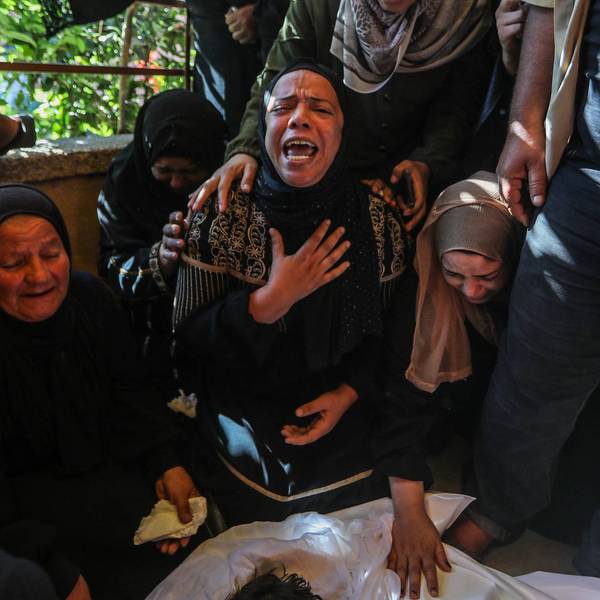
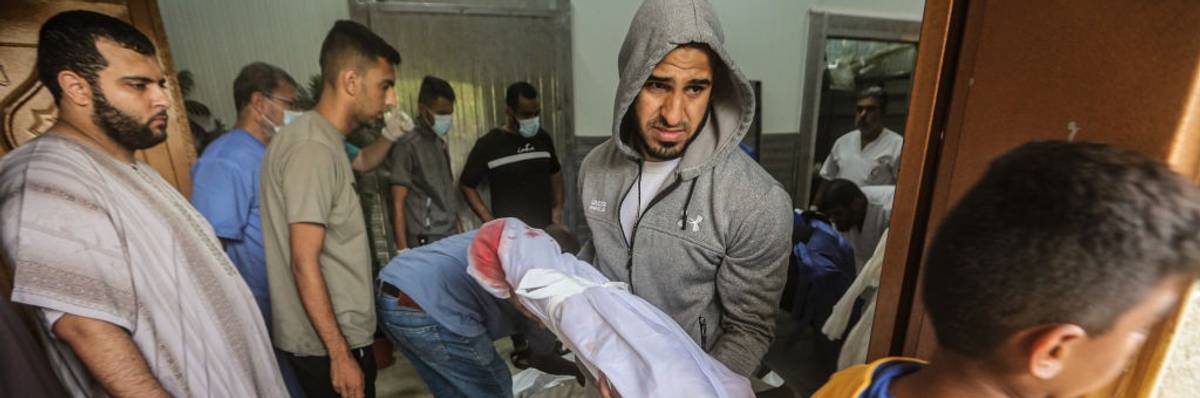
A man carries the body of a dead child at Nasser Hospital after Israeli air strikes on the city of Khan Yunis at dawn today.
'Dying, Dying, Dying': Israel Told Gazans to Flee South—Where It Continues to Bomb
"The situation is catastrophic, catastrophic, catastrophic," said the director of a UNRWA shelter in Khan Younis. "No words in the world can describe the situation we are in."
The Israeli military continued to pummel Gaza with airstrikes on Sunday, including residential neighborhoods in the south, as a top IDF commander said the bombing would now intensify ahead of an expected ground invasion.
Despite urging Palestinians and others caught in Gaza to flee the northern areas, bombings that claimed the lives of yet more civilians—including children—were reported in Khan Younis and the city of Rafah.
The attacks came hours after the IDF's Rear Adm Daniel Hagari called on Gaza’s residents to move south "for your own safety."
"The situation we are in now is unprecedented and cannot be described with words. No words in the world can describe the situation we are in." —Rawya Halas, Gaza Training College
"We will deepen our attacks to minimize the dangers to our forces in the next stages of the war," Hagari said, possibly hinting at the ground invasion. "We are going to increase the attacks, from today."
Graphic footage posted to social media showed wounded toddlers being transported for emergency healthcare after an Israeli airstrike in Khan Younis:
In an update on Saturday, the UN Office for the Coordination of Humanitarian Affairs (OCHA) said the number of those killed by Israeli airstrikes, citing Gaza Ministry of Health figures, had surpassed 4,300. Of those killed, said OCHA, 62% were children and women.
The ministry itself later on Saturday put out numbers that said 4,651 people have been killed, including 1,873 children.
In a video posted overnight from Khan Younis in southern Gaza, Rawya Halas, director of the Gaza Training College and head of the UNWRA shelter there, said the situation was "catastrophic, catastrophic, catastrophic."
"The situation we are in now is unprecedented and cannot be described with words. No words in the world can describe the situation we are in," Rawya added. "I beg you, save Gaza. It's dying, it's dying, it's dying. There are children, elderly and adults for whom I cannot provide. I am the UNRWA. I am the head of this shelter, and I can't offer them anything. Neither food nor water. There is nothing, nothing."
The OCHA estimates 1.4 million Palestinians in Gaza are now displaced and that 42% of the housing units in the territory have been damaged or totally destroyed by the IDF bombing campaign.
The Israeli military on Oct. 13 ordered all civilians in the north of the besieged Gaza Strip to evacuate towards the south ahead of an increased bombing campaign and a potential ground invasion by Israeli Defense Forces troops amassed on the border.
But even as critics noted at the time the order would be impossible to comply with for many and should be seen as the prelude to "mass atrocities," many Palestinians fled toward the south to seek refuge from the unrelenting assault and humanitarian crisis.
We are at a crossroads
This country and this world are at a monumental crossroads. In a few short weeks, US voters will have an opportunity to beat back the forces of fascism and confront the billionaires who are rigging the economy, our media system, and our democracy, making it increasingly impossible for ordinary people to get by. We’re not just talking about the election. We’re talking about what must be done once these fascist elements are vanquished from power. We need a bolder set of solutions than what either major party has so far been willing to offer and a working-class movement ready to fight like hell for it. Trump didn't emerge from nowhere. The conditions that fueled MAGA authoritarianism were created by decades of radical neoliberal economic policies and a corrupt political system dominated by corporate interests. They slashed taxes on the super-rich, promising that the benefits would trickle down. They said giveaways to the corporate titans would make life more affordable for the rest of us. It was all bullshit. And when a bitter, betrayed populace searches for someone to blame, right-wing demagogues have little trouble finding scapegoats. People know when they're being lied to, but you won't hear any of this from the corporate media. Only independent journalism—powered and funded by people who believe in building a better world—can deliver truly trustworthy daily news. Our Fall Campaign is underway, and we need your help. To power our newsroom through the rest of the year, we need to raise $125,000 by midnight on October 31. So if you share our vision, please contribute whatever you can to sustain our work. |
The Israeli military continued to pummel Gaza with airstrikes on Sunday, including residential neighborhoods in the south, as a top IDF commander said the bombing would now intensify ahead of an expected ground invasion.
Despite urging Palestinians and others caught in Gaza to flee the northern areas, bombings that claimed the lives of yet more civilians—including children—were reported in Khan Younis and the city of Rafah.
The attacks came hours after the IDF's Rear Adm Daniel Hagari called on Gaza’s residents to move south "for your own safety."
"The situation we are in now is unprecedented and cannot be described with words. No words in the world can describe the situation we are in." —Rawya Halas, Gaza Training College
"We will deepen our attacks to minimize the dangers to our forces in the next stages of the war," Hagari said, possibly hinting at the ground invasion. "We are going to increase the attacks, from today."
Graphic footage posted to social media showed wounded toddlers being transported for emergency healthcare after an Israeli airstrike in Khan Younis:
In an update on Saturday, the UN Office for the Coordination of Humanitarian Affairs (OCHA) said the number of those killed by Israeli airstrikes, citing Gaza Ministry of Health figures, had surpassed 4,300. Of those killed, said OCHA, 62% were children and women.
The ministry itself later on Saturday put out numbers that said 4,651 people have been killed, including 1,873 children.
In a video posted overnight from Khan Younis in southern Gaza, Rawya Halas, director of the Gaza Training College and head of the UNWRA shelter there, said the situation was "catastrophic, catastrophic, catastrophic."
"The situation we are in now is unprecedented and cannot be described with words. No words in the world can describe the situation we are in," Rawya added. "I beg you, save Gaza. It's dying, it's dying, it's dying. There are children, elderly and adults for whom I cannot provide. I am the UNRWA. I am the head of this shelter, and I can't offer them anything. Neither food nor water. There is nothing, nothing."
The OCHA estimates 1.4 million Palestinians in Gaza are now displaced and that 42% of the housing units in the territory have been damaged or totally destroyed by the IDF bombing campaign.
The Israeli military on Oct. 13 ordered all civilians in the north of the besieged Gaza Strip to evacuate towards the south ahead of an increased bombing campaign and a potential ground invasion by Israeli Defense Forces troops amassed on the border.
But even as critics noted at the time the order would be impossible to comply with for many and should be seen as the prelude to "mass atrocities," many Palestinians fled toward the south to seek refuge from the unrelenting assault and humanitarian crisis.
The Israeli military continued to pummel Gaza with airstrikes on Sunday, including residential neighborhoods in the south, as a top IDF commander said the bombing would now intensify ahead of an expected ground invasion.
Despite urging Palestinians and others caught in Gaza to flee the northern areas, bombings that claimed the lives of yet more civilians—including children—were reported in Khan Younis and the city of Rafah.
The attacks came hours after the IDF's Rear Adm Daniel Hagari called on Gaza’s residents to move south "for your own safety."
"The situation we are in now is unprecedented and cannot be described with words. No words in the world can describe the situation we are in." —Rawya Halas, Gaza Training College
"We will deepen our attacks to minimize the dangers to our forces in the next stages of the war," Hagari said, possibly hinting at the ground invasion. "We are going to increase the attacks, from today."
Graphic footage posted to social media showed wounded toddlers being transported for emergency healthcare after an Israeli airstrike in Khan Younis:
In an update on Saturday, the UN Office for the Coordination of Humanitarian Affairs (OCHA) said the number of those killed by Israeli airstrikes, citing Gaza Ministry of Health figures, had surpassed 4,300. Of those killed, said OCHA, 62% were children and women.
The ministry itself later on Saturday put out numbers that said 4,651 people have been killed, including 1,873 children.
In a video posted overnight from Khan Younis in southern Gaza, Rawya Halas, director of the Gaza Training College and head of the UNWRA shelter there, said the situation was "catastrophic, catastrophic, catastrophic."
"The situation we are in now is unprecedented and cannot be described with words. No words in the world can describe the situation we are in," Rawya added. "I beg you, save Gaza. It's dying, it's dying, it's dying. There are children, elderly and adults for whom I cannot provide. I am the UNRWA. I am the head of this shelter, and I can't offer them anything. Neither food nor water. There is nothing, nothing."
The OCHA estimates 1.4 million Palestinians in Gaza are now displaced and that 42% of the housing units in the territory have been damaged or totally destroyed by the IDF bombing campaign.
The Israeli military on Oct. 13 ordered all civilians in the north of the besieged Gaza Strip to evacuate towards the south ahead of an increased bombing campaign and a potential ground invasion by Israeli Defense Forces troops amassed on the border.
But even as critics noted at the time the order would be impossible to comply with for many and should be seen as the prelude to "mass atrocities," many Palestinians fled toward the south to seek refuge from the unrelenting assault and humanitarian crisis.