
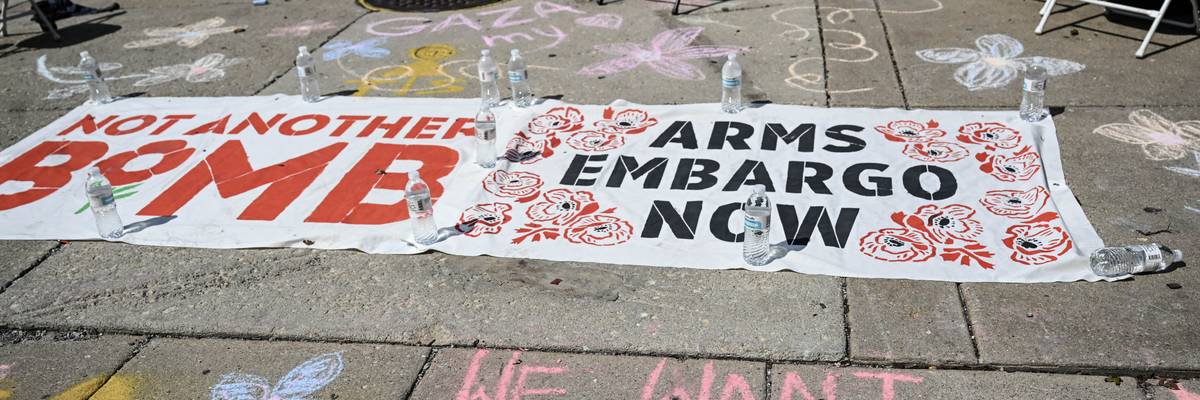
A banner calling for an arms embargo against Israel is pictured outside of the Democratic National Convention in Chicago on August 22, 2024.
'You Must Do Better': Harris Rebuked Over Failure to Change Course on Gaza
"Harris called for a cease-fire in Gaza, but she failed to commit to the change in policy that would secure a cease-fire: ending weapons transfers to Israel," said one Palestinian rights group.
During her speech Thursday night accepting the Democratic Party's 2024 nomination, Vice President Kamala Harris decried the "heartbreaking" suffering that Gazans are experiencing after 10 consecutive months of Israeli bombardment.
But Harris didn't acknowledge, let alone condemn, the central role the United States has played in fueling the humanitarian emergency in the Palestinian enclave, where civilians face indiscriminate bombings daily as well as famine and appalling disease outbreaks—including a possible polio epidemic.
Instead, Harris repeated a line that has become commonplace for the White House and its allies, declaring that "President [Joe] Biden and I are working around the clock" to secure a cease-fire in the Gaza Strip.
Nor did Harris explicitly denounce Israel's actions in Gaza, which have included atrocities committed with U.S. weaponry.
"Harris wanted to portray herself as strong and brave, but when she had to switch to passive voice ("What has happened in Gaza") to avoid calling out Israel's war crimes, she showed stunning cowardice," said Palestinian American political analyst Yousef Munayyer.
Declining to break with the administration in which she currently serves, the vice president did not express support for a policy shift that would pressure Israel's far-right government to accept a cease-fire agreement, such as an arms embargo of the kind supported by United Nations experts, leading human rights groups, and a majority of U.S. voters.
"I will always stand up for Israel's right to defend itself, and I will always ensure Israel has the ability to defend itself," said Harris, condemning the Hamas-led October 7 attack.
"If you really wanted a cease-fire, you'd just stop sending the weapons. It is that simple."
Abbas Alawieh, a co-founder of the Uncommitted National Movement, told Reuters following the vice president's speech that she did not deliver what was badly needed as the disaster in Gaza worsens by the minute: "courageous leadership that breaks from the current approach."
The IMEU Policy Project, an affiliate of the Institute for Middle East Understanding, echoed Alawieh's assessment, saying in a statement that "with Vice President Kamala Harris' nomination, the party had an opportunity to move in a new direction."
"Tonight Harris called for a cease-fire in Gaza, but she failed to commit to the change in policy that would secure a cease-fire: ending weapons transfers to Israel," the group said. "To be clear: There is no way to end this bloodshed while supplying Israel with billions of dollars in weapons as it indiscriminately bombs Palestinian families, schools, hospitals, refugee shelters, and places of worship."
"It must be noted that Harris' call for 'dignity, security, freedom, and self-determination' for the Palestinian people received thunderous applause," the organization added. "However, words are not enough. Democratic voters are increasingly united in their demand for a change in policy on Gaza and in support of Palestinian safety and freedom broadly; it is time for the Democratic Party leadership to catch up."
Denied a speaking slot on the convention stage, Palestinian American delegates and their allies made their voices heard in the hallways of Chicago's United Center and outside of the facility, where they held a sit-in to protest the DNC's rejection of their demands.
Calls for a Palestinian American speaker on the DNC stage drew broad support from Democratic lawmakers and their allies, including Chicago Mayor Brandon Johnson and the United Auto Workers.
Lily Greenberg Call, a Jewish Biden political appointee who resigned in May over the administration's Gaza policy, said late Thursday that she was "so sad and disappointed" that the DNC chose to "silence Palestinian American voices and exclude them from the convention stage."
"VP, I want you to win in November," Call added. "You must do better."
Layla Elabed, a co-founder of the Uncommitted National Movement and the sister of Rep. Rashida Tlaib (D-Mich.), said Thursday that "Michigan voters want to vote for Harris, but we need to shift policy."
"Many of us know the impact of U.S.-funded bombs firsthand," said Elabed.
Rep. Ilhan Omar (D-Minn.), one of the lawmakers who showed solidarity with uncommitted delegates as they staged a sit-in outside of the DNC earlier this week, clearly articulated the U.S. Palestinian rights movement's position during a press conference on Wednesday, a day before Harris took the stage in Chicago.
"If you really wanted a cease-fire, you'd just stop sending the weapons," said Omar. "It is that simple."
We are at a crossroads
This country and this world are at a monumental crossroads. In a few short weeks, US voters will have an opportunity to beat back the forces of fascism and confront the billionaires who are rigging the economy, our media system, and our democracy, making it increasingly impossible for ordinary people to get by. We’re not just talking about the election. We’re talking about what must be done once these fascist elements are vanquished from power. We need a bolder set of solutions than what either major party has so far been willing to offer and a working-class movement ready to fight like hell for it. Trump didn't emerge from nowhere. The conditions that fueled MAGA authoritarianism were created by decades of radical neoliberal economic policies and a corrupt political system dominated by corporate interests. They slashed taxes on the super-rich, promising that the benefits would trickle down. They said giveaways to the corporate titans would make life more affordable for the rest of us. It was all bullshit. And when a bitter, betrayed populace searches for someone to blame, right-wing demagogues have little trouble finding scapegoats. People know when they're being lied to, but you won't hear any of this from the corporate media. Only independent journalism—powered and funded by people who believe in building a better world—can deliver truly trustworthy daily news. Our Fall Campaign is underway, and we need your help. To power our newsroom through the rest of the year, we need to raise $125,000 by midnight on October 31. So if you share our vision, please contribute whatever you can to sustain our work. |
During her speech Thursday night accepting the Democratic Party's 2024 nomination, Vice President Kamala Harris decried the "heartbreaking" suffering that Gazans are experiencing after 10 consecutive months of Israeli bombardment.
But Harris didn't acknowledge, let alone condemn, the central role the United States has played in fueling the humanitarian emergency in the Palestinian enclave, where civilians face indiscriminate bombings daily as well as famine and appalling disease outbreaks—including a possible polio epidemic.
Instead, Harris repeated a line that has become commonplace for the White House and its allies, declaring that "President [Joe] Biden and I are working around the clock" to secure a cease-fire in the Gaza Strip.
Nor did Harris explicitly denounce Israel's actions in Gaza, which have included atrocities committed with U.S. weaponry.
"Harris wanted to portray herself as strong and brave, but when she had to switch to passive voice ("What has happened in Gaza") to avoid calling out Israel's war crimes, she showed stunning cowardice," said Palestinian American political analyst Yousef Munayyer.
Declining to break with the administration in which she currently serves, the vice president did not express support for a policy shift that would pressure Israel's far-right government to accept a cease-fire agreement, such as an arms embargo of the kind supported by United Nations experts, leading human rights groups, and a majority of U.S. voters.
"I will always stand up for Israel's right to defend itself, and I will always ensure Israel has the ability to defend itself," said Harris, condemning the Hamas-led October 7 attack.
"If you really wanted a cease-fire, you'd just stop sending the weapons. It is that simple."
Abbas Alawieh, a co-founder of the Uncommitted National Movement, told Reuters following the vice president's speech that she did not deliver what was badly needed as the disaster in Gaza worsens by the minute: "courageous leadership that breaks from the current approach."
The IMEU Policy Project, an affiliate of the Institute for Middle East Understanding, echoed Alawieh's assessment, saying in a statement that "with Vice President Kamala Harris' nomination, the party had an opportunity to move in a new direction."
"Tonight Harris called for a cease-fire in Gaza, but she failed to commit to the change in policy that would secure a cease-fire: ending weapons transfers to Israel," the group said. "To be clear: There is no way to end this bloodshed while supplying Israel with billions of dollars in weapons as it indiscriminately bombs Palestinian families, schools, hospitals, refugee shelters, and places of worship."
"It must be noted that Harris' call for 'dignity, security, freedom, and self-determination' for the Palestinian people received thunderous applause," the organization added. "However, words are not enough. Democratic voters are increasingly united in their demand for a change in policy on Gaza and in support of Palestinian safety and freedom broadly; it is time for the Democratic Party leadership to catch up."
Denied a speaking slot on the convention stage, Palestinian American delegates and their allies made their voices heard in the hallways of Chicago's United Center and outside of the facility, where they held a sit-in to protest the DNC's rejection of their demands.
Calls for a Palestinian American speaker on the DNC stage drew broad support from Democratic lawmakers and their allies, including Chicago Mayor Brandon Johnson and the United Auto Workers.
Lily Greenberg Call, a Jewish Biden political appointee who resigned in May over the administration's Gaza policy, said late Thursday that she was "so sad and disappointed" that the DNC chose to "silence Palestinian American voices and exclude them from the convention stage."
"VP, I want you to win in November," Call added. "You must do better."
Layla Elabed, a co-founder of the Uncommitted National Movement and the sister of Rep. Rashida Tlaib (D-Mich.), said Thursday that "Michigan voters want to vote for Harris, but we need to shift policy."
"Many of us know the impact of U.S.-funded bombs firsthand," said Elabed.
Rep. Ilhan Omar (D-Minn.), one of the lawmakers who showed solidarity with uncommitted delegates as they staged a sit-in outside of the DNC earlier this week, clearly articulated the U.S. Palestinian rights movement's position during a press conference on Wednesday, a day before Harris took the stage in Chicago.
"If you really wanted a cease-fire, you'd just stop sending the weapons," said Omar. "It is that simple."
- 'Let Palestine Speak': Uncommitted Shares Speech the DNC Won't Allow ›
- 'History Is Watching': Gaza Doctors Urge Harris to Back Israel Arms Embargo at Democratic Convention ›
- Tlaib Says She Is 'Ashamed of Our Country Looking Away' as Gaza Faces Polio Crisis | Common Dreams ›
- Opinion | Forging Peace in Gaza Would Also Help Harris Defeat Trump | Common Dreams ›
- Opinion | We Can't Endorse Harris, But We Oppose Trump and Voting Third-Party Is a Mistake | Common Dreams ›
- 'Damning' New Poll Shows Price Kamala Harris Paid for Backing Israeli Genocide in Gaza | Common Dreams ›
- Opinion | Will the DNC End Their Complicity in Israeli Genocide or Double Down? | Common Dreams ›
During her speech Thursday night accepting the Democratic Party's 2024 nomination, Vice President Kamala Harris decried the "heartbreaking" suffering that Gazans are experiencing after 10 consecutive months of Israeli bombardment.
But Harris didn't acknowledge, let alone condemn, the central role the United States has played in fueling the humanitarian emergency in the Palestinian enclave, where civilians face indiscriminate bombings daily as well as famine and appalling disease outbreaks—including a possible polio epidemic.
Instead, Harris repeated a line that has become commonplace for the White House and its allies, declaring that "President [Joe] Biden and I are working around the clock" to secure a cease-fire in the Gaza Strip.
Nor did Harris explicitly denounce Israel's actions in Gaza, which have included atrocities committed with U.S. weaponry.
"Harris wanted to portray herself as strong and brave, but when she had to switch to passive voice ("What has happened in Gaza") to avoid calling out Israel's war crimes, she showed stunning cowardice," said Palestinian American political analyst Yousef Munayyer.
Declining to break with the administration in which she currently serves, the vice president did not express support for a policy shift that would pressure Israel's far-right government to accept a cease-fire agreement, such as an arms embargo of the kind supported by United Nations experts, leading human rights groups, and a majority of U.S. voters.
"I will always stand up for Israel's right to defend itself, and I will always ensure Israel has the ability to defend itself," said Harris, condemning the Hamas-led October 7 attack.
"If you really wanted a cease-fire, you'd just stop sending the weapons. It is that simple."
Abbas Alawieh, a co-founder of the Uncommitted National Movement, told Reuters following the vice president's speech that she did not deliver what was badly needed as the disaster in Gaza worsens by the minute: "courageous leadership that breaks from the current approach."
The IMEU Policy Project, an affiliate of the Institute for Middle East Understanding, echoed Alawieh's assessment, saying in a statement that "with Vice President Kamala Harris' nomination, the party had an opportunity to move in a new direction."
"Tonight Harris called for a cease-fire in Gaza, but she failed to commit to the change in policy that would secure a cease-fire: ending weapons transfers to Israel," the group said. "To be clear: There is no way to end this bloodshed while supplying Israel with billions of dollars in weapons as it indiscriminately bombs Palestinian families, schools, hospitals, refugee shelters, and places of worship."
"It must be noted that Harris' call for 'dignity, security, freedom, and self-determination' for the Palestinian people received thunderous applause," the organization added. "However, words are not enough. Democratic voters are increasingly united in their demand for a change in policy on Gaza and in support of Palestinian safety and freedom broadly; it is time for the Democratic Party leadership to catch up."
Denied a speaking slot on the convention stage, Palestinian American delegates and their allies made their voices heard in the hallways of Chicago's United Center and outside of the facility, where they held a sit-in to protest the DNC's rejection of their demands.
Calls for a Palestinian American speaker on the DNC stage drew broad support from Democratic lawmakers and their allies, including Chicago Mayor Brandon Johnson and the United Auto Workers.
Lily Greenberg Call, a Jewish Biden political appointee who resigned in May over the administration's Gaza policy, said late Thursday that she was "so sad and disappointed" that the DNC chose to "silence Palestinian American voices and exclude them from the convention stage."
"VP, I want you to win in November," Call added. "You must do better."
Layla Elabed, a co-founder of the Uncommitted National Movement and the sister of Rep. Rashida Tlaib (D-Mich.), said Thursday that "Michigan voters want to vote for Harris, but we need to shift policy."
"Many of us know the impact of U.S.-funded bombs firsthand," said Elabed.
Rep. Ilhan Omar (D-Minn.), one of the lawmakers who showed solidarity with uncommitted delegates as they staged a sit-in outside of the DNC earlier this week, clearly articulated the U.S. Palestinian rights movement's position during a press conference on Wednesday, a day before Harris took the stage in Chicago.
"If you really wanted a cease-fire, you'd just stop sending the weapons," said Omar. "It is that simple."
- 'Let Palestine Speak': Uncommitted Shares Speech the DNC Won't Allow ›
- 'History Is Watching': Gaza Doctors Urge Harris to Back Israel Arms Embargo at Democratic Convention ›
- Tlaib Says She Is 'Ashamed of Our Country Looking Away' as Gaza Faces Polio Crisis | Common Dreams ›
- Opinion | Forging Peace in Gaza Would Also Help Harris Defeat Trump | Common Dreams ›
- Opinion | We Can't Endorse Harris, But We Oppose Trump and Voting Third-Party Is a Mistake | Common Dreams ›
- 'Damning' New Poll Shows Price Kamala Harris Paid for Backing Israeli Genocide in Gaza | Common Dreams ›
- Opinion | Will the DNC End Their Complicity in Israeli Genocide or Double Down? | Common Dreams ›