

SUBSCRIBE TO OUR FREE NEWSLETTER
Daily news & progressive opinion—funded by the people, not the corporations—delivered straight to your inbox.
5
#000000
#FFFFFF
To donate by check, phone, or other method, see our More Ways to Give page.
Daily news & progressive opinion—funded by the people, not the corporations—delivered straight to your inbox.
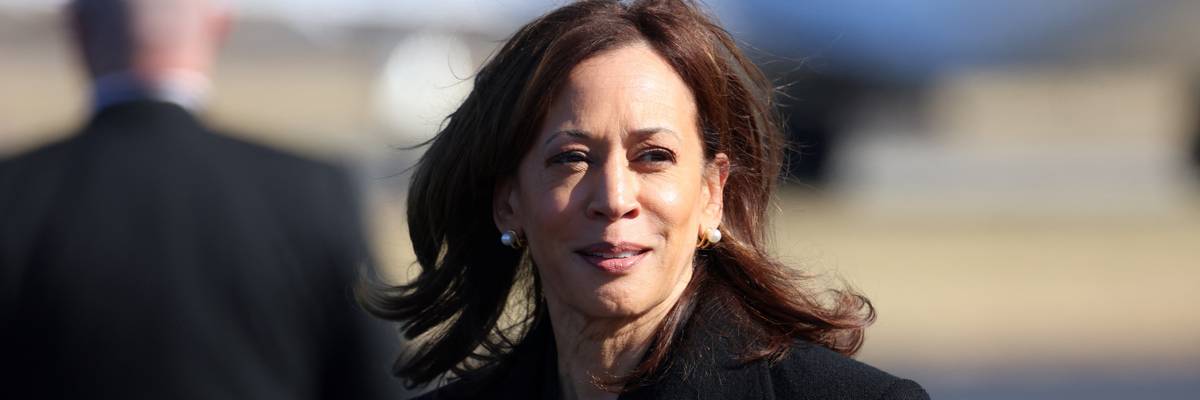
U.S. Vice President and Democratic presidential candidate Kamala Harris arrives at Philadelphia International Airport in Philadelphia on October 23, 2024.
"I do not know any economist who thinks Trump would be a good president, or who thinks he would be good for the economy," said one of the signatories.
Recipients of the prestigious Nobel Prize for economics said in a letter Thursday that Vice President Kamala Harris, the Democratic presidential nominee, has outlined an economic agenda that would be "more sustainable and more equitable" than the policies proposed by Republican contender Donald Trump.
Spearheaded by 2001 Nobel Prize winner Joseph Stiglitz, the letter was signed by 23 economists—more than half of the living U.S.-based recipients of the award.
The signatories, including Claudia Goldin, Simon Johnson, and Richard H. Thaler, wrote that what the two candidates have said, "combined with what they've done in the past, gives us a clear picture of alternative economic visions, policies, and practices."
Harris has been applauded since launching her campaign in July for unveiling numerous proposals aimed at easing economic burdens for working families. She has called for the first-ever federal ban on price gouging in food industries; an expansion of Medicare that would provide relief to 37 million people who currently provide unpaid eldercare to family members; an extension of Medicare's prescription drug price cap to all Americans; and an expansion of the child tax credit.
"Harris's economic agenda will improve our nation's health, investment, sustainability, resilience, employment opportunities, and fairness and be vastly superior to the counterproductive economic agenda of Donald Trump," wrote the economists.
The signatories particularly took issue with Trump's plan to impose high tariffs on goods and "regressive tax cuts for corporations and individuals."
His proposals "will lead to higher prices, larger deficits, and greater inequality," the economists wrote.
Trump's tariffs would raise consumer prices by $2,500 to $3,000 per year, according to EPI Action, the advocacy arm of the Economic Policy Institute.
"I do not know any economist who thinks Trump would be a good president, or who thinks he would be good for the economy," said Thaler on social media.
The former president has also said he would extend his 2017 tax cuts, the vast majority of which benefited wealthy corporations and individuals. The Institute on Taxation and Economic Policy said in analysis of his tax proposals earlier this month that the richest 4% of Americans would see significant tax cuts under a Trump administration, and all other groups would see a tax increase.
"Among the most important determinants of economic success are the rule of law and economic and political certainty, and Trump threatens all of these. By contrast, Harris has emphasized policies that strengthen the middle class, enhance competition, and promote entrepreneurship," wrote the economists. "On issue after issue, Harris's economic agenda will do far more than Donald Trump's to increase the economic strength and well-being of our nation and its people."
Dear Common Dreams reader, It’s been nearly 30 years since I co-founded Common Dreams with my late wife, Lina Newhouser. We had the radical notion that journalism should serve the public good, not corporate profits. It was clear to us from the outset what it would take to build such a project. No paid advertisements. No corporate sponsors. No millionaire publisher telling us what to think or do. Many people said we wouldn't last a year, but we proved those doubters wrong. Together with a tremendous team of journalists and dedicated staff, we built an independent media outlet free from the constraints of profits and corporate control. Our mission has always been simple: To inform. To inspire. To ignite change for the common good. Building Common Dreams was not easy. Our survival was never guaranteed. When you take on the most powerful forces—Wall Street greed, fossil fuel industry destruction, Big Tech lobbyists, and uber-rich oligarchs who have spent billions upon billions rigging the economy and democracy in their favor—the only bulwark you have is supporters who believe in your work. But here’s the urgent message from me today. It's never been this bad out there. And it's never been this hard to keep us going. At the very moment Common Dreams is most needed, the threats we face are intensifying. We need your support now more than ever. We don't accept corporate advertising and never will. We don't have a paywall because we don't think people should be blocked from critical news based on their ability to pay. Everything we do is funded by the donations of readers like you. When everyone does the little they can afford, we are strong. But if that support retreats or dries up, so do we. Will you donate now to make sure Common Dreams not only survives but thrives? —Craig Brown, Co-founder |
Recipients of the prestigious Nobel Prize for economics said in a letter Thursday that Vice President Kamala Harris, the Democratic presidential nominee, has outlined an economic agenda that would be "more sustainable and more equitable" than the policies proposed by Republican contender Donald Trump.
Spearheaded by 2001 Nobel Prize winner Joseph Stiglitz, the letter was signed by 23 economists—more than half of the living U.S.-based recipients of the award.
The signatories, including Claudia Goldin, Simon Johnson, and Richard H. Thaler, wrote that what the two candidates have said, "combined with what they've done in the past, gives us a clear picture of alternative economic visions, policies, and practices."
Harris has been applauded since launching her campaign in July for unveiling numerous proposals aimed at easing economic burdens for working families. She has called for the first-ever federal ban on price gouging in food industries; an expansion of Medicare that would provide relief to 37 million people who currently provide unpaid eldercare to family members; an extension of Medicare's prescription drug price cap to all Americans; and an expansion of the child tax credit.
"Harris's economic agenda will improve our nation's health, investment, sustainability, resilience, employment opportunities, and fairness and be vastly superior to the counterproductive economic agenda of Donald Trump," wrote the economists.
The signatories particularly took issue with Trump's plan to impose high tariffs on goods and "regressive tax cuts for corporations and individuals."
His proposals "will lead to higher prices, larger deficits, and greater inequality," the economists wrote.
Trump's tariffs would raise consumer prices by $2,500 to $3,000 per year, according to EPI Action, the advocacy arm of the Economic Policy Institute.
"I do not know any economist who thinks Trump would be a good president, or who thinks he would be good for the economy," said Thaler on social media.
The former president has also said he would extend his 2017 tax cuts, the vast majority of which benefited wealthy corporations and individuals. The Institute on Taxation and Economic Policy said in analysis of his tax proposals earlier this month that the richest 4% of Americans would see significant tax cuts under a Trump administration, and all other groups would see a tax increase.
"Among the most important determinants of economic success are the rule of law and economic and political certainty, and Trump threatens all of these. By contrast, Harris has emphasized policies that strengthen the middle class, enhance competition, and promote entrepreneurship," wrote the economists. "On issue after issue, Harris's economic agenda will do far more than Donald Trump's to increase the economic strength and well-being of our nation and its people."
Recipients of the prestigious Nobel Prize for economics said in a letter Thursday that Vice President Kamala Harris, the Democratic presidential nominee, has outlined an economic agenda that would be "more sustainable and more equitable" than the policies proposed by Republican contender Donald Trump.
Spearheaded by 2001 Nobel Prize winner Joseph Stiglitz, the letter was signed by 23 economists—more than half of the living U.S.-based recipients of the award.
The signatories, including Claudia Goldin, Simon Johnson, and Richard H. Thaler, wrote that what the two candidates have said, "combined with what they've done in the past, gives us a clear picture of alternative economic visions, policies, and practices."
Harris has been applauded since launching her campaign in July for unveiling numerous proposals aimed at easing economic burdens for working families. She has called for the first-ever federal ban on price gouging in food industries; an expansion of Medicare that would provide relief to 37 million people who currently provide unpaid eldercare to family members; an extension of Medicare's prescription drug price cap to all Americans; and an expansion of the child tax credit.
"Harris's economic agenda will improve our nation's health, investment, sustainability, resilience, employment opportunities, and fairness and be vastly superior to the counterproductive economic agenda of Donald Trump," wrote the economists.
The signatories particularly took issue with Trump's plan to impose high tariffs on goods and "regressive tax cuts for corporations and individuals."
His proposals "will lead to higher prices, larger deficits, and greater inequality," the economists wrote.
Trump's tariffs would raise consumer prices by $2,500 to $3,000 per year, according to EPI Action, the advocacy arm of the Economic Policy Institute.
"I do not know any economist who thinks Trump would be a good president, or who thinks he would be good for the economy," said Thaler on social media.
The former president has also said he would extend his 2017 tax cuts, the vast majority of which benefited wealthy corporations and individuals. The Institute on Taxation and Economic Policy said in analysis of his tax proposals earlier this month that the richest 4% of Americans would see significant tax cuts under a Trump administration, and all other groups would see a tax increase.
"Among the most important determinants of economic success are the rule of law and economic and political certainty, and Trump threatens all of these. By contrast, Harris has emphasized policies that strengthen the middle class, enhance competition, and promote entrepreneurship," wrote the economists. "On issue after issue, Harris's economic agenda will do far more than Donald Trump's to increase the economic strength and well-being of our nation and its people."

