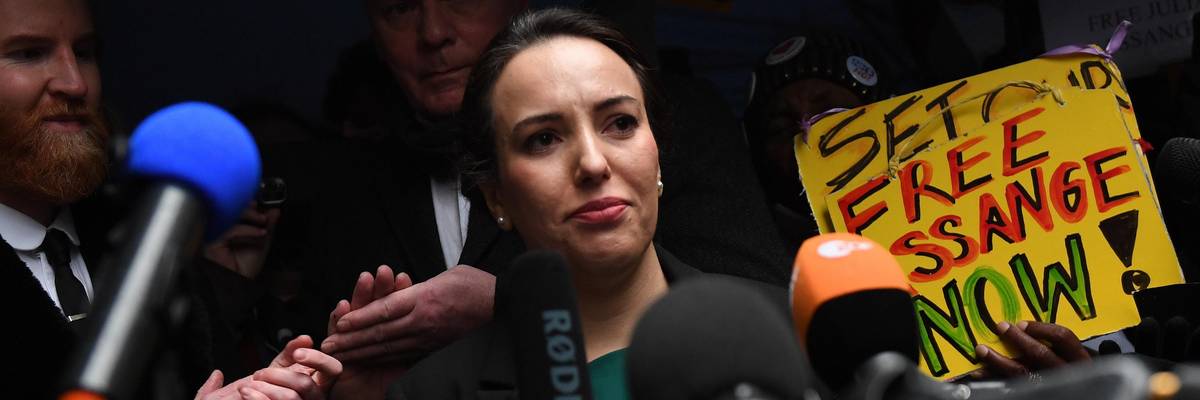
Stella Assange speaks to the media outside the Old Bailey on January 4, 2021 in London.
Wife Says 'Day X' Hearing for Julian Assange 'Will Determine if He Lives or Dies'
"This could very well be the final hearing for Julian," said Stella Assange on the eve of the critical U.K. High Court session.
Stella Assange, the wife of Julian Assange, said Monday that the jailed WikiLeaks founder will likely die if he is extradited from Britain to the United States, where he could imprisoned for the rest of his life for publishing classified documents including numerous files exposing U.S. war crimes.
Assange's final appeal is scheduled to be heard on Tuesday by the U.K. High Court. The Australian publisher's supporters are calling it "Day X," and his wife told the BBC that it "could very well be the final hearing for Julian."
"There's no possibility for further appeal in this jurisdiction," she explained, adding that Assange could still seek an emergency injunction from the European Court of Human Rights.
Assange said her husband—who is 52 years old and suffers from physical and mental health problems including heart and respiratory issues—is very weak and "in a very difficult place."
"This case will determine if he lives or dies, essentially," she asserted.
Imprisoned in London's notorious Belmarsh Prison since April 2019, Assange could be sentenced to as many as 175 years behind bars if convicted of all the Espionage Act and Computer Fraud and Abuse Act charges against him.
WikiLeaks published a series of document dumps inculding "Collateral Murder" video—which shows a U.S. Army helicopter crew killing a group of Iraqi civilians—the Afghan War Diary, and the Iraq War Logs, which revealed American and allied war crimes.
In 2016, The United Nations Working Group on Arbitrary Detention found that Assange had been arbitrarily deprived of his freedom since his first arrest on December 7, 2010, including house arrest, imprisonment in London, and nearly seven years of political asylum in the Ecuadorian Embassy in the British capital.
Nils Melzer, the U.N.'s top torture official from 2016 to 2022, repeatedly said that Assange's treatment amounted to torture.
Alice Jill Edwards, the current U.N. special rapporteur on torture, is imploring the U.K. government to decline Assange's transfer to the U.S. because she says his health is likely to be "irreparably damaged" by extradition. Edwards cited conditions in U.S. prisons including the use of prolonged solitary confinement and excessive sentences as causes for concern.
Countless human rights defenders, press freedom advocates, and elected officials around the world have called on the U.S. to drop charges against Assange and for the U.K. to refuse his extradition.
"All eyes are on the U.K. High Court during this fateful hearing, but it remains to be seen whether the British judiciary can deliver some form of justice by preventing Assange's extradition at this late stage," Rebecca Vincent, campaigns director at Reporters Without Borders, said in a statement Monday.
"Regardless, none of this is inevitable—it remains within the U.S. government's power to bring this judicial tragedy to an end by dropping its 13-year-old case against Assange and ceasing this endless persecution," Vincent continued. "No one should face such treatment for publishing information in the public interest."
"It's time to protect journalism, press freedom, and all of our right to know," she added. "It's time to free Assange now."
We are at a crossroads
This country and this world are at a monumental crossroads. In a few short weeks, US voters will have an opportunity to beat back the forces of fascism and confront the billionaires who are rigging the economy, our media system, and our democracy, making it increasingly impossible for ordinary people to get by. We’re not just talking about the election. We’re talking about what must be done once these fascist elements are vanquished from power. We need a bolder set of solutions than what either major party has so far been willing to offer and a working-class movement ready to fight like hell for it. Trump didn't emerge from nowhere. The conditions that fueled MAGA authoritarianism were created by decades of radical neoliberal economic policies and a corrupt political system dominated by corporate interests. They slashed taxes on the super-rich, promising that the benefits would trickle down. They said giveaways to the corporate titans would make life more affordable for the rest of us. It was all bullshit. And when a bitter, betrayed populace searches for someone to blame, right-wing demagogues have little trouble finding scapegoats. People know when they're being lied to, but you won't hear any of this from the corporate media. Only independent journalism—powered and funded by people who believe in building a better world—can deliver truly trustworthy daily news. Our Fall Campaign is underway, and we need your help. To power our newsroom through the rest of the year, we need to raise $125,000 by midnight on October 31. So if you share our vision, please contribute whatever you can to sustain our work. |
Stella Assange, the wife of Julian Assange, said Monday that the jailed WikiLeaks founder will likely die if he is extradited from Britain to the United States, where he could imprisoned for the rest of his life for publishing classified documents including numerous files exposing U.S. war crimes.
Assange's final appeal is scheduled to be heard on Tuesday by the U.K. High Court. The Australian publisher's supporters are calling it "Day X," and his wife told the BBC that it "could very well be the final hearing for Julian."
"There's no possibility for further appeal in this jurisdiction," she explained, adding that Assange could still seek an emergency injunction from the European Court of Human Rights.
Assange said her husband—who is 52 years old and suffers from physical and mental health problems including heart and respiratory issues—is very weak and "in a very difficult place."
"This case will determine if he lives or dies, essentially," she asserted.
Imprisoned in London's notorious Belmarsh Prison since April 2019, Assange could be sentenced to as many as 175 years behind bars if convicted of all the Espionage Act and Computer Fraud and Abuse Act charges against him.
WikiLeaks published a series of document dumps inculding "Collateral Murder" video—which shows a U.S. Army helicopter crew killing a group of Iraqi civilians—the Afghan War Diary, and the Iraq War Logs, which revealed American and allied war crimes.
In 2016, The United Nations Working Group on Arbitrary Detention found that Assange had been arbitrarily deprived of his freedom since his first arrest on December 7, 2010, including house arrest, imprisonment in London, and nearly seven years of political asylum in the Ecuadorian Embassy in the British capital.
Nils Melzer, the U.N.'s top torture official from 2016 to 2022, repeatedly said that Assange's treatment amounted to torture.
Alice Jill Edwards, the current U.N. special rapporteur on torture, is imploring the U.K. government to decline Assange's transfer to the U.S. because she says his health is likely to be "irreparably damaged" by extradition. Edwards cited conditions in U.S. prisons including the use of prolonged solitary confinement and excessive sentences as causes for concern.
Countless human rights defenders, press freedom advocates, and elected officials around the world have called on the U.S. to drop charges against Assange and for the U.K. to refuse his extradition.
"All eyes are on the U.K. High Court during this fateful hearing, but it remains to be seen whether the British judiciary can deliver some form of justice by preventing Assange's extradition at this late stage," Rebecca Vincent, campaigns director at Reporters Without Borders, said in a statement Monday.
"Regardless, none of this is inevitable—it remains within the U.S. government's power to bring this judicial tragedy to an end by dropping its 13-year-old case against Assange and ceasing this endless persecution," Vincent continued. "No one should face such treatment for publishing information in the public interest."
"It's time to protect journalism, press freedom, and all of our right to know," she added. "It's time to free Assange now."
- Progressives to Put US War Crimes on Trial and Demand Freedom for Julian Assange ›
- 'Journalism Is Not a Crime': Outrage as Judge Approves Assange Extradition to US ›
- US Lawmakers Implore DOJ to Drop 'Unprecedented' Charges Against Julian Assange ›
- Days Before Extradition Hearing, Australian Parliament Tells US to Drop Assange Case ›
- 'Drop the Charges,' Says Amnesty Ahead of Key Julian Assange Hearing ›
- 'Weasel Words': Julian Assange's Wife Slams US Assurances to UK | Common Dreams ›
Stella Assange, the wife of Julian Assange, said Monday that the jailed WikiLeaks founder will likely die if he is extradited from Britain to the United States, where he could imprisoned for the rest of his life for publishing classified documents including numerous files exposing U.S. war crimes.
Assange's final appeal is scheduled to be heard on Tuesday by the U.K. High Court. The Australian publisher's supporters are calling it "Day X," and his wife told the BBC that it "could very well be the final hearing for Julian."
"There's no possibility for further appeal in this jurisdiction," she explained, adding that Assange could still seek an emergency injunction from the European Court of Human Rights.
Assange said her husband—who is 52 years old and suffers from physical and mental health problems including heart and respiratory issues—is very weak and "in a very difficult place."
"This case will determine if he lives or dies, essentially," she asserted.
Imprisoned in London's notorious Belmarsh Prison since April 2019, Assange could be sentenced to as many as 175 years behind bars if convicted of all the Espionage Act and Computer Fraud and Abuse Act charges against him.
WikiLeaks published a series of document dumps inculding "Collateral Murder" video—which shows a U.S. Army helicopter crew killing a group of Iraqi civilians—the Afghan War Diary, and the Iraq War Logs, which revealed American and allied war crimes.
In 2016, The United Nations Working Group on Arbitrary Detention found that Assange had been arbitrarily deprived of his freedom since his first arrest on December 7, 2010, including house arrest, imprisonment in London, and nearly seven years of political asylum in the Ecuadorian Embassy in the British capital.
Nils Melzer, the U.N.'s top torture official from 2016 to 2022, repeatedly said that Assange's treatment amounted to torture.
Alice Jill Edwards, the current U.N. special rapporteur on torture, is imploring the U.K. government to decline Assange's transfer to the U.S. because she says his health is likely to be "irreparably damaged" by extradition. Edwards cited conditions in U.S. prisons including the use of prolonged solitary confinement and excessive sentences as causes for concern.
Countless human rights defenders, press freedom advocates, and elected officials around the world have called on the U.S. to drop charges against Assange and for the U.K. to refuse his extradition.
"All eyes are on the U.K. High Court during this fateful hearing, but it remains to be seen whether the British judiciary can deliver some form of justice by preventing Assange's extradition at this late stage," Rebecca Vincent, campaigns director at Reporters Without Borders, said in a statement Monday.
"Regardless, none of this is inevitable—it remains within the U.S. government's power to bring this judicial tragedy to an end by dropping its 13-year-old case against Assange and ceasing this endless persecution," Vincent continued. "No one should face such treatment for publishing information in the public interest."
"It's time to protect journalism, press freedom, and all of our right to know," she added. "It's time to free Assange now."
- Progressives to Put US War Crimes on Trial and Demand Freedom for Julian Assange ›
- 'Journalism Is Not a Crime': Outrage as Judge Approves Assange Extradition to US ›
- US Lawmakers Implore DOJ to Drop 'Unprecedented' Charges Against Julian Assange ›
- Days Before Extradition Hearing, Australian Parliament Tells US to Drop Assange Case ›
- 'Drop the Charges,' Says Amnesty Ahead of Key Julian Assange Hearing ›
- 'Weasel Words': Julian Assange's Wife Slams US Assurances to UK | Common Dreams ›