SUBSCRIBE TO OUR FREE NEWSLETTER
Daily news & progressive opinion—funded by the people, not the corporations—delivered straight to your inbox.
5
#000000
#FFFFFF
To donate by check, phone, or other method, see our More Ways to Give page.
Daily news & progressive opinion—funded by the people, not the corporations—delivered straight to your inbox.
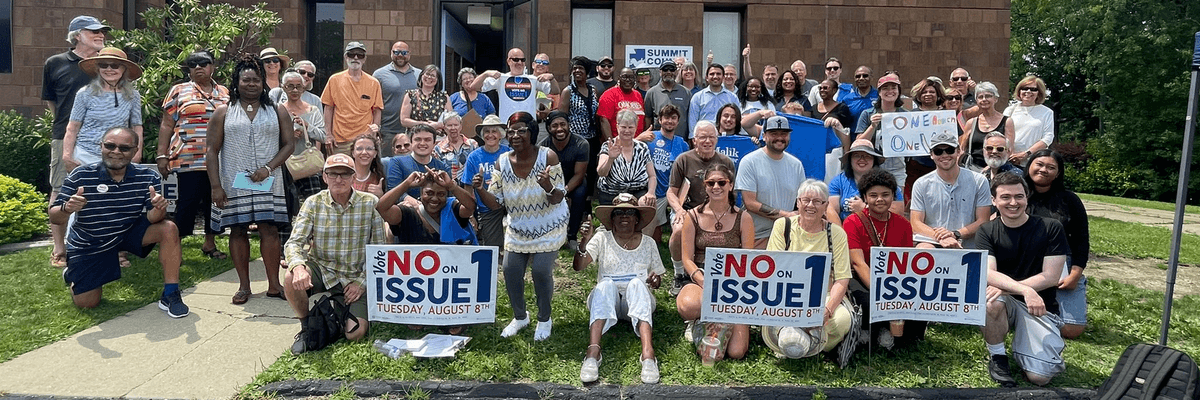
Organizers pose for a photo as they rally in opposition to Issue 1, a measure on ballots in Tuesday's special election in Ohio which would raise the threshold needed to amend the state constitution.
"Preserve your voice and protect our democracy," said one Democratic lawmaker. "Vote NO on August 8th to ensure fairness and equity in the democratic process."
Recent polling in Ohio has shown that a majority of residents disapprove of a proposed measure that will be on ballots across the state in a special election on Tuesday, but abortion rights advocates have spent recent days warning voters that failing to block the proposal could have major repercussions for reproductive freedom in the state.
In the special election, Ohioans will be asked their position on Issue 1, which if approved would raise the threshold for passing new constitutional amendments to 60% rather than a simple majority.
Issue 1 needs just a simple majority to pass.
The outcome of Tuesday's election will determine how many votes will be needed to pass a referendum in November's general election, which will determine whether to codify the right to abortion care in the Ohio Constitution.
If Issue 1 passes, the state will also require signatures from all 88 counties in the state rather than the current requirement of 44 counties, making it harder for supporters of a referendum to secure a place for it on ballots, and would give organizers only one chance to collect enough signatures instead of allowing for extensions if they don't meet the requirement on the first try.
U.S. Rep. Emilia Sykes (D-Ohio) is among the lawmakers who have joined advocacy groups in recent weeks in canvassing and promoting get-out-the-vote efforts to ensure the August 8 special election does not go unnoticed by Ohioans.
"We all want the freedom to make decisions that affect our lives," said Sykes on social media late last month. "Issue 1 ends majority rule and the principle of 'one person, one vote.'"
In Canton last week, Sykes joined a rally sponsored by the Ohio Education Association, Planned Parenthood Advocates of Ohio (PPAO), and other groups that organized a "parade to the polls" to encourage reproductive rights supporters to vote early in the election.
Polls suggest that the constitutional amendment would easily pass if the state continues its current "majority rules" system for passing constitutional amendments, as nearly 58% of Ohioans have said they support amending the document to enshrine a right to reproductive healthcare. Organizers last month collected more than 495,000 signatures in support of including the proposed constitutional amendment on the November ballot, far surpassing the required 413,446 signatures.
"Majority rule allows for collective decision-making, fostering inclusivity, and reflecting the broader interests of the people," Sykes tweeted last week. "Let's embrace this principle and work together towards a stronger, more equitable future. Vote no on Issue 1!"
The progressive advocacy group Swing Left said Saturday that Republican lawmakers in the state—and right-wing billionaires that have supported the push to pass Issue 1—are counting on low voter turnout to ensure the measure passes. The group has organized numerous phone-banking and door-knocking events in recent weeks.
As Common Dreams reported last month, Illinois-based billionaire Richard Uihlein has donated $17.6 million since 2014 to the Foundation for Government Accountability, which has lobbied for higher thresholds to pass constitutional amendments in several states including Ohio.
The special election was permitted to go forward after a ruling by the Ohio Supreme Court's right-wing majority in June.
By defeating Issue 1, said PPAO last week, voters can help "stop special interests from ending majority rule" in the state.
Heartland Signal reported late last month that voters had already set a record pace for early voting in the special election, with 116,000 people casting their ballots in person in the first week of voting and 38,000 turning in absentee ballots.
By comparison, a total of 138,000 people cast early votes in the May 2022 Republican Senate primaries in the state.
"Election Day is approaching," said Sykes on social media Saturday. "Preserve your voice and protect our democracy. Vote NO on August 8th to ensure fairness and equity in the democratic process."
"Every vote counts," she added, "and together, we can uphold the principles that make our system strong."
Dear Common Dreams reader, It’s been nearly 30 years since I co-founded Common Dreams with my late wife, Lina Newhouser. We had the radical notion that journalism should serve the public good, not corporate profits. It was clear to us from the outset what it would take to build such a project. No paid advertisements. No corporate sponsors. No millionaire publisher telling us what to think or do. Many people said we wouldn't last a year, but we proved those doubters wrong. Together with a tremendous team of journalists and dedicated staff, we built an independent media outlet free from the constraints of profits and corporate control. Our mission has always been simple: To inform. To inspire. To ignite change for the common good. Building Common Dreams was not easy. Our survival was never guaranteed. When you take on the most powerful forces—Wall Street greed, fossil fuel industry destruction, Big Tech lobbyists, and uber-rich oligarchs who have spent billions upon billions rigging the economy and democracy in their favor—the only bulwark you have is supporters who believe in your work. But here’s the urgent message from me today. It's never been this bad out there. And it's never been this hard to keep us going. At the very moment Common Dreams is most needed, the threats we face are intensifying. We need your support now more than ever. We don't accept corporate advertising and never will. We don't have a paywall because we don't think people should be blocked from critical news based on their ability to pay. Everything we do is funded by the donations of readers like you. When everyone does the little they can afford, we are strong. But if that support retreats or dries up, so do we. Will you donate now to make sure Common Dreams not only survives but thrives? —Craig Brown, Co-founder |
Recent polling in Ohio has shown that a majority of residents disapprove of a proposed measure that will be on ballots across the state in a special election on Tuesday, but abortion rights advocates have spent recent days warning voters that failing to block the proposal could have major repercussions for reproductive freedom in the state.
In the special election, Ohioans will be asked their position on Issue 1, which if approved would raise the threshold for passing new constitutional amendments to 60% rather than a simple majority.
Issue 1 needs just a simple majority to pass.
The outcome of Tuesday's election will determine how many votes will be needed to pass a referendum in November's general election, which will determine whether to codify the right to abortion care in the Ohio Constitution.
If Issue 1 passes, the state will also require signatures from all 88 counties in the state rather than the current requirement of 44 counties, making it harder for supporters of a referendum to secure a place for it on ballots, and would give organizers only one chance to collect enough signatures instead of allowing for extensions if they don't meet the requirement on the first try.
U.S. Rep. Emilia Sykes (D-Ohio) is among the lawmakers who have joined advocacy groups in recent weeks in canvassing and promoting get-out-the-vote efforts to ensure the August 8 special election does not go unnoticed by Ohioans.
"We all want the freedom to make decisions that affect our lives," said Sykes on social media late last month. "Issue 1 ends majority rule and the principle of 'one person, one vote.'"
In Canton last week, Sykes joined a rally sponsored by the Ohio Education Association, Planned Parenthood Advocates of Ohio (PPAO), and other groups that organized a "parade to the polls" to encourage reproductive rights supporters to vote early in the election.
Polls suggest that the constitutional amendment would easily pass if the state continues its current "majority rules" system for passing constitutional amendments, as nearly 58% of Ohioans have said they support amending the document to enshrine a right to reproductive healthcare. Organizers last month collected more than 495,000 signatures in support of including the proposed constitutional amendment on the November ballot, far surpassing the required 413,446 signatures.
"Majority rule allows for collective decision-making, fostering inclusivity, and reflecting the broader interests of the people," Sykes tweeted last week. "Let's embrace this principle and work together towards a stronger, more equitable future. Vote no on Issue 1!"
The progressive advocacy group Swing Left said Saturday that Republican lawmakers in the state—and right-wing billionaires that have supported the push to pass Issue 1—are counting on low voter turnout to ensure the measure passes. The group has organized numerous phone-banking and door-knocking events in recent weeks.
As Common Dreams reported last month, Illinois-based billionaire Richard Uihlein has donated $17.6 million since 2014 to the Foundation for Government Accountability, which has lobbied for higher thresholds to pass constitutional amendments in several states including Ohio.
The special election was permitted to go forward after a ruling by the Ohio Supreme Court's right-wing majority in June.
By defeating Issue 1, said PPAO last week, voters can help "stop special interests from ending majority rule" in the state.
Heartland Signal reported late last month that voters had already set a record pace for early voting in the special election, with 116,000 people casting their ballots in person in the first week of voting and 38,000 turning in absentee ballots.
By comparison, a total of 138,000 people cast early votes in the May 2022 Republican Senate primaries in the state.
"Election Day is approaching," said Sykes on social media Saturday. "Preserve your voice and protect our democracy. Vote NO on August 8th to ensure fairness and equity in the democratic process."
"Every vote counts," she added, "and together, we can uphold the principles that make our system strong."
Recent polling in Ohio has shown that a majority of residents disapprove of a proposed measure that will be on ballots across the state in a special election on Tuesday, but abortion rights advocates have spent recent days warning voters that failing to block the proposal could have major repercussions for reproductive freedom in the state.
In the special election, Ohioans will be asked their position on Issue 1, which if approved would raise the threshold for passing new constitutional amendments to 60% rather than a simple majority.
Issue 1 needs just a simple majority to pass.
The outcome of Tuesday's election will determine how many votes will be needed to pass a referendum in November's general election, which will determine whether to codify the right to abortion care in the Ohio Constitution.
If Issue 1 passes, the state will also require signatures from all 88 counties in the state rather than the current requirement of 44 counties, making it harder for supporters of a referendum to secure a place for it on ballots, and would give organizers only one chance to collect enough signatures instead of allowing for extensions if they don't meet the requirement on the first try.
U.S. Rep. Emilia Sykes (D-Ohio) is among the lawmakers who have joined advocacy groups in recent weeks in canvassing and promoting get-out-the-vote efforts to ensure the August 8 special election does not go unnoticed by Ohioans.
"We all want the freedom to make decisions that affect our lives," said Sykes on social media late last month. "Issue 1 ends majority rule and the principle of 'one person, one vote.'"
In Canton last week, Sykes joined a rally sponsored by the Ohio Education Association, Planned Parenthood Advocates of Ohio (PPAO), and other groups that organized a "parade to the polls" to encourage reproductive rights supporters to vote early in the election.
Polls suggest that the constitutional amendment would easily pass if the state continues its current "majority rules" system for passing constitutional amendments, as nearly 58% of Ohioans have said they support amending the document to enshrine a right to reproductive healthcare. Organizers last month collected more than 495,000 signatures in support of including the proposed constitutional amendment on the November ballot, far surpassing the required 413,446 signatures.
"Majority rule allows for collective decision-making, fostering inclusivity, and reflecting the broader interests of the people," Sykes tweeted last week. "Let's embrace this principle and work together towards a stronger, more equitable future. Vote no on Issue 1!"
The progressive advocacy group Swing Left said Saturday that Republican lawmakers in the state—and right-wing billionaires that have supported the push to pass Issue 1—are counting on low voter turnout to ensure the measure passes. The group has organized numerous phone-banking and door-knocking events in recent weeks.
As Common Dreams reported last month, Illinois-based billionaire Richard Uihlein has donated $17.6 million since 2014 to the Foundation for Government Accountability, which has lobbied for higher thresholds to pass constitutional amendments in several states including Ohio.
The special election was permitted to go forward after a ruling by the Ohio Supreme Court's right-wing majority in June.
By defeating Issue 1, said PPAO last week, voters can help "stop special interests from ending majority rule" in the state.
Heartland Signal reported late last month that voters had already set a record pace for early voting in the special election, with 116,000 people casting their ballots in person in the first week of voting and 38,000 turning in absentee ballots.
By comparison, a total of 138,000 people cast early votes in the May 2022 Republican Senate primaries in the state.
"Election Day is approaching," said Sykes on social media Saturday. "Preserve your voice and protect our democracy. Vote NO on August 8th to ensure fairness and equity in the democratic process."
"Every vote counts," she added, "and together, we can uphold the principles that make our system strong."