SUBSCRIBE TO OUR FREE NEWSLETTER
Daily news & progressive opinion—funded by the people, not the corporations—delivered straight to your inbox.
5
#000000
#FFFFFF
To donate by check, phone, or other method, see our More Ways to Give page.
Daily news & progressive opinion—funded by the people, not the corporations—delivered straight to your inbox.
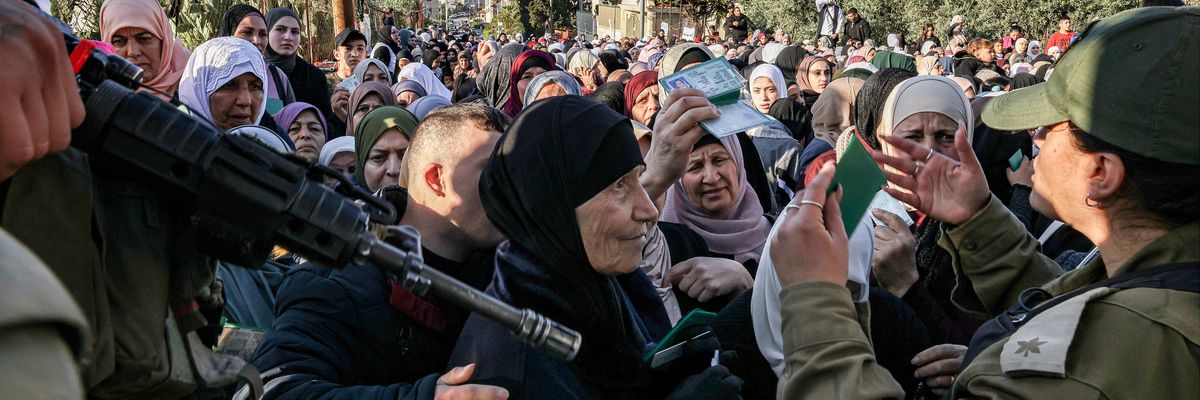
Israeli troops direct Palestinians queueing at an Israeli checkpoint in Bethlehem in the occupied West Bank on April 14, 2023.
"Decades of injustice will finally face scrutiny," said U.N. human rights official Francesca Albanese ahead of next week's Hague hearings on the legal consequences of Israel's illegal occupation.
More than 50 countries are set to participate in next week's hearings at the International Court of Justice focusing on Israel's illegal 57-year occupation of Palestine, a forum that follows the Hague tribunal's finding last month that Israel is "plausibly" committing genocide in occupied Gaza.
The ICJ—also known as the World Court—will hold a week of hearings on the legal consequences of Israel's occupation of Palestine, which dates to the Israeli conquest of the West Bank, East Jerusalem, Gaza Strip, Syrian Golan Heights, and Egyptian Sinai Peninsula during the 1967 Six-Day War.
"The International Court of Justice is set for the first time to broadly consider the legal consequences of Israel's nearly six-decades-long occupation and mistreatment of the Palestinian people," Human Rights Watch senior legal adviser Clive Baldwin said in a statement. "Governments that are presenting their arguments to the court should seize these landmark hearings to highlight the grave abuses Israeli authorities are committing against Palestinians, including the crimes against humanity of apartheid and persecution."
The West Bank, East Jerusalem, and Golan Heights remain under Israeli military occupation six decades after their conquest. The United Nations—to which the ICJ belongs—and many international NGOs contend that, despite removing its troops and settlers from Gaza two decades ago, Israel continues to occupy Gaza by controlling the besieged enclave's airspace, territorial waters, and the entry and exit of people and goods.
Since the October 7 Hamas-led attacks on Israel, the Israeli Defense Forces (IDF) have killed or wounded more than 100,000 Palestinians in Gaza while forcibly displacing around 90% of the population. Numerous Israeli leaders have called for the renewed physical occupation, Jewish resettlement, and ethnic cleansing of the strip.
During the current assault on Gaza, occupation forces have also killed at least 388 Palestinians, including 99 children, in the West Bank, according to U.N. human rights officials.
Israeli settlers have for decades been steadily colonizing the occupied territories under the protection of the IDF, while ethnically cleansing Palestinians whose lands and homes they steal.
Next week's hearings come on the heels of the ICJ's provisional ruling last month in a case led by South Africa—which will be the first nation after Palestine to present at next week's hearing—that Israel is "plausibly" committing genocide in Gaza. The tribunal ordered Israel to "take all measures within its power" to adhere to its obligations under Article II of the Genocide Convention.
Earlier this week, South Africa urgently appealed to the ICJ to act amid the looming threat of an Israeli ground invasion of Rafah. More than 1.5 million Palestinians, most of them refugees ordered to flee to the south of Gaza by invading Israeli forces, are crammed into what is now one of the world's most densely populated places.
On Friday, the ICJ declined to take any additional action against Israel, while reiterating that the "perilous situation" in Rafah "demands immediate and effective implementation of the provisional measures indicated by the court" in last month's ruling.
Dear Common Dreams reader, It’s been nearly 30 years since I co-founded Common Dreams with my late wife, Lina Newhouser. We had the radical notion that journalism should serve the public good, not corporate profits. It was clear to us from the outset what it would take to build such a project. No paid advertisements. No corporate sponsors. No millionaire publisher telling us what to think or do. Many people said we wouldn't last a year, but we proved those doubters wrong. Together with a tremendous team of journalists and dedicated staff, we built an independent media outlet free from the constraints of profits and corporate control. Our mission has always been simple: To inform. To inspire. To ignite change for the common good. Building Common Dreams was not easy. Our survival was never guaranteed. When you take on the most powerful forces—Wall Street greed, fossil fuel industry destruction, Big Tech lobbyists, and uber-rich oligarchs who have spent billions upon billions rigging the economy and democracy in their favor—the only bulwark you have is supporters who believe in your work. But here’s the urgent message from me today. It's never been this bad out there. And it's never been this hard to keep us going. At the very moment Common Dreams is most needed, the threats we face are intensifying. We need your support now more than ever. We don't accept corporate advertising and never will. We don't have a paywall because we don't think people should be blocked from critical news based on their ability to pay. Everything we do is funded by the donations of readers like you. When everyone does the little they can afford, we are strong. But if that support retreats or dries up, so do we. Will you donate now to make sure Common Dreams not only survives but thrives? —Craig Brown, Co-founder |
More than 50 countries are set to participate in next week's hearings at the International Court of Justice focusing on Israel's illegal 57-year occupation of Palestine, a forum that follows the Hague tribunal's finding last month that Israel is "plausibly" committing genocide in occupied Gaza.
The ICJ—also known as the World Court—will hold a week of hearings on the legal consequences of Israel's occupation of Palestine, which dates to the Israeli conquest of the West Bank, East Jerusalem, Gaza Strip, Syrian Golan Heights, and Egyptian Sinai Peninsula during the 1967 Six-Day War.
"The International Court of Justice is set for the first time to broadly consider the legal consequences of Israel's nearly six-decades-long occupation and mistreatment of the Palestinian people," Human Rights Watch senior legal adviser Clive Baldwin said in a statement. "Governments that are presenting their arguments to the court should seize these landmark hearings to highlight the grave abuses Israeli authorities are committing against Palestinians, including the crimes against humanity of apartheid and persecution."
The West Bank, East Jerusalem, and Golan Heights remain under Israeli military occupation six decades after their conquest. The United Nations—to which the ICJ belongs—and many international NGOs contend that, despite removing its troops and settlers from Gaza two decades ago, Israel continues to occupy Gaza by controlling the besieged enclave's airspace, territorial waters, and the entry and exit of people and goods.
Since the October 7 Hamas-led attacks on Israel, the Israeli Defense Forces (IDF) have killed or wounded more than 100,000 Palestinians in Gaza while forcibly displacing around 90% of the population. Numerous Israeli leaders have called for the renewed physical occupation, Jewish resettlement, and ethnic cleansing of the strip.
During the current assault on Gaza, occupation forces have also killed at least 388 Palestinians, including 99 children, in the West Bank, according to U.N. human rights officials.
Israeli settlers have for decades been steadily colonizing the occupied territories under the protection of the IDF, while ethnically cleansing Palestinians whose lands and homes they steal.
Next week's hearings come on the heels of the ICJ's provisional ruling last month in a case led by South Africa—which will be the first nation after Palestine to present at next week's hearing—that Israel is "plausibly" committing genocide in Gaza. The tribunal ordered Israel to "take all measures within its power" to adhere to its obligations under Article II of the Genocide Convention.
Earlier this week, South Africa urgently appealed to the ICJ to act amid the looming threat of an Israeli ground invasion of Rafah. More than 1.5 million Palestinians, most of them refugees ordered to flee to the south of Gaza by invading Israeli forces, are crammed into what is now one of the world's most densely populated places.
On Friday, the ICJ declined to take any additional action against Israel, while reiterating that the "perilous situation" in Rafah "demands immediate and effective implementation of the provisional measures indicated by the court" in last month's ruling.
More than 50 countries are set to participate in next week's hearings at the International Court of Justice focusing on Israel's illegal 57-year occupation of Palestine, a forum that follows the Hague tribunal's finding last month that Israel is "plausibly" committing genocide in occupied Gaza.
The ICJ—also known as the World Court—will hold a week of hearings on the legal consequences of Israel's occupation of Palestine, which dates to the Israeli conquest of the West Bank, East Jerusalem, Gaza Strip, Syrian Golan Heights, and Egyptian Sinai Peninsula during the 1967 Six-Day War.
"The International Court of Justice is set for the first time to broadly consider the legal consequences of Israel's nearly six-decades-long occupation and mistreatment of the Palestinian people," Human Rights Watch senior legal adviser Clive Baldwin said in a statement. "Governments that are presenting their arguments to the court should seize these landmark hearings to highlight the grave abuses Israeli authorities are committing against Palestinians, including the crimes against humanity of apartheid and persecution."
The West Bank, East Jerusalem, and Golan Heights remain under Israeli military occupation six decades after their conquest. The United Nations—to which the ICJ belongs—and many international NGOs contend that, despite removing its troops and settlers from Gaza two decades ago, Israel continues to occupy Gaza by controlling the besieged enclave's airspace, territorial waters, and the entry and exit of people and goods.
Since the October 7 Hamas-led attacks on Israel, the Israeli Defense Forces (IDF) have killed or wounded more than 100,000 Palestinians in Gaza while forcibly displacing around 90% of the population. Numerous Israeli leaders have called for the renewed physical occupation, Jewish resettlement, and ethnic cleansing of the strip.
During the current assault on Gaza, occupation forces have also killed at least 388 Palestinians, including 99 children, in the West Bank, according to U.N. human rights officials.
Israeli settlers have for decades been steadily colonizing the occupied territories under the protection of the IDF, while ethnically cleansing Palestinians whose lands and homes they steal.
Next week's hearings come on the heels of the ICJ's provisional ruling last month in a case led by South Africa—which will be the first nation after Palestine to present at next week's hearing—that Israel is "plausibly" committing genocide in Gaza. The tribunal ordered Israel to "take all measures within its power" to adhere to its obligations under Article II of the Genocide Convention.
Earlier this week, South Africa urgently appealed to the ICJ to act amid the looming threat of an Israeli ground invasion of Rafah. More than 1.5 million Palestinians, most of them refugees ordered to flee to the south of Gaza by invading Israeli forces, are crammed into what is now one of the world's most densely populated places.
On Friday, the ICJ declined to take any additional action against Israel, while reiterating that the "perilous situation" in Rafah "demands immediate and effective implementation of the provisional measures indicated by the court" in last month's ruling.