SUBSCRIBE TO OUR FREE NEWSLETTER
Daily news & progressive opinion—funded by the people, not the corporations—delivered straight to your inbox.
5
#000000
#FFFFFF
To donate by check, phone, or other method, see our More Ways to Give page.
Daily news & progressive opinion—funded by the people, not the corporations—delivered straight to your inbox.
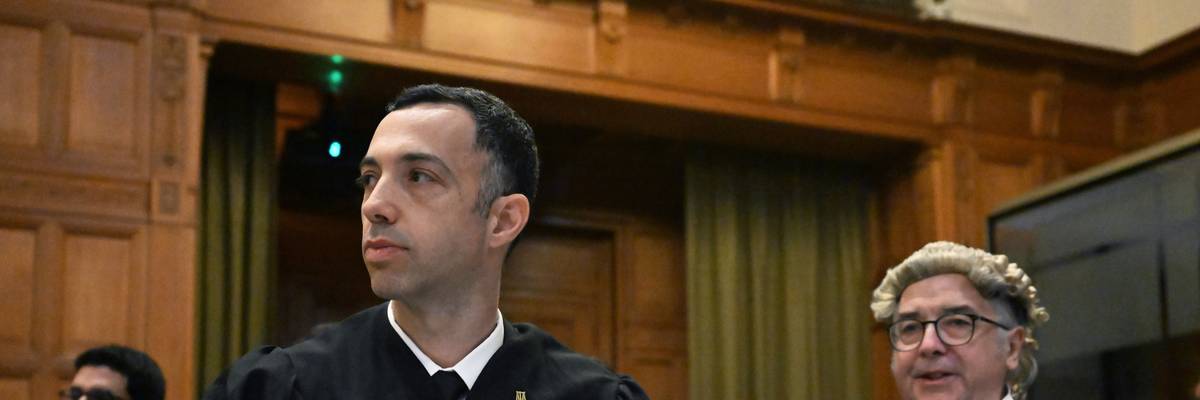
Israeli representatives attend a hearing at the International Court of Justice regarding South Africa's genocide case on January 12, 2024, in the Hague, Netherlands.
"The court only needs to look at the statements in South Africa's submission—with the ranking and authority of those making them—and ask whether they plausibly reach the level of intent required for genocide," said one expert on state crime.
Faced with a detailed documentation of statements made by top-level Israeli officials about their intent to "destroy" Gaza residents and "flatten" the enclave, legal experts observed that attorneys representing Israel on Friday at the International Court of Justice appeared to simply ignore the mounting evidence that the government is committing a genocide.
Thomas MacManus, a state crime lecturer at Queen Mary University of London, said the ICJ, which has held two hearings this week regarding South Africa's lawsuit accusing Israel of genocidal violence and intent in Gaza since it began its bombardment in October, likely noticed a "massive disconnect" between Israel's claim that it is trying to protect civilian lives with the reality on the ground.
The hearing on Friday was underway as Al Jazeera reported that nine Palestinians, including children and at least one infant, were killed in an Israeli strike on a home in Rafah—just a few of the 23,708 who have been confirmed dead in Israel's assault.
Yet Malcolm Shaw, a British professor of international law who helped defend Israel, focused his remarks on the country's claim that it goes to great lengths to protect civilians and asserted that the numerous statements of genocidal intent catalogued by South Africa were taken out of context.
"I think the court will find it very difficult to add these two things," MacManus told Al Jazeera, referring to the statements compiled by South Africa and Shaw's claim that Israel has the "most moral army in the world" and "does everything to avoid harming the uninvolved."
"The court only needs to look at the statements in South Africa's submission—with the ranking and authority of those making them—and ask whether they plausibly reach the level of intent required for genocide," said MacManus. "I think the court will have to do that."
Independent journalist Sam Husseini noted that Taj Becker, legal adviser to the Israeli Foreign Ministry, opened his remarks with a reference to Raphael Lemkin, the Polish lawyer who coined the term "genocide" in the 1940s and helped establish it as an international crime.
The Lemkin Institute for Genocide Prevention has for three months called on the International Criminal Court to indict Israeli Prime Minister for genocidal acts, and said Friday that Becker's words rang "hollow" considering "the overwhelming evidence" documented by South Africa.
South Africa's 84-page complaint to the ICJ includes direct quotes from officials including Israeli President Isaac Herzog, who said "an entire nation," not just Hamas, was responsible for the group's attack on southern Israel on October 7, and Defense Minister Yoav Gallant, who said the Israel Defense Forces "will eliminate everything" in Gaza.
Yet as Step Vaessen of Al Jazeera reported, "the argument by Israel was that [genocidal intent] was clearly not government policy."
On Democracy Now!, Center for Constitutional Rights staff attorney Diala Shamas pointed out that the Israeli defense team also focused largely on the question of whether the ICJ, the top judicial body of the United Nations, has the authority to rule on South Africa's case and to grant the country's request for an binding injunction that would force Israel to stop its bombardment.
Israel's arguments, said Shamas, boiled down to, "'You can't be here and you can't do anything about it, and... Everything we do is self-defense [against Hamas.]'"
The defense amounted to "a complete deflection, never at any point addressing the incredibly powerful arguments laid out yesterday at a hearing for three hours by the South Africa legal team," added Shamas.
Ammar Hijazi, a Palestinian Foreign Ministry official, told reporters outside the court that Israel was not "able to provide any solid arguments on the basis of fact and law."
"What Israel has provided today are many of the already debunked lies," said Hijazi, noting that the legal team repeated false claims that Hamas has used hospitals in Gaza as military bases, making them legitimate targets for Israel. "We think that what the Israeli team today has [provided] is the exact thing that South Africa came to the court for—and that is, nothing at all justifies genocide."
Dear Common Dreams reader, It’s been nearly 30 years since I co-founded Common Dreams with my late wife, Lina Newhouser. We had the radical notion that journalism should serve the public good, not corporate profits. It was clear to us from the outset what it would take to build such a project. No paid advertisements. No corporate sponsors. No millionaire publisher telling us what to think or do. Many people said we wouldn't last a year, but we proved those doubters wrong. Together with a tremendous team of journalists and dedicated staff, we built an independent media outlet free from the constraints of profits and corporate control. Our mission has always been simple: To inform. To inspire. To ignite change for the common good. Building Common Dreams was not easy. Our survival was never guaranteed. When you take on the most powerful forces—Wall Street greed, fossil fuel industry destruction, Big Tech lobbyists, and uber-rich oligarchs who have spent billions upon billions rigging the economy and democracy in their favor—the only bulwark you have is supporters who believe in your work. But here’s the urgent message from me today. It's never been this bad out there. And it's never been this hard to keep us going. At the very moment Common Dreams is most needed, the threats we face are intensifying. We need your support now more than ever. We don't accept corporate advertising and never will. We don't have a paywall because we don't think people should be blocked from critical news based on their ability to pay. Everything we do is funded by the donations of readers like you. When everyone does the little they can afford, we are strong. But if that support retreats or dries up, so do we. Will you donate now to make sure Common Dreams not only survives but thrives? —Craig Brown, Co-founder |
Faced with a detailed documentation of statements made by top-level Israeli officials about their intent to "destroy" Gaza residents and "flatten" the enclave, legal experts observed that attorneys representing Israel on Friday at the International Court of Justice appeared to simply ignore the mounting evidence that the government is committing a genocide.
Thomas MacManus, a state crime lecturer at Queen Mary University of London, said the ICJ, which has held two hearings this week regarding South Africa's lawsuit accusing Israel of genocidal violence and intent in Gaza since it began its bombardment in October, likely noticed a "massive disconnect" between Israel's claim that it is trying to protect civilian lives with the reality on the ground.
The hearing on Friday was underway as Al Jazeera reported that nine Palestinians, including children and at least one infant, were killed in an Israeli strike on a home in Rafah—just a few of the 23,708 who have been confirmed dead in Israel's assault.
Yet Malcolm Shaw, a British professor of international law who helped defend Israel, focused his remarks on the country's claim that it goes to great lengths to protect civilians and asserted that the numerous statements of genocidal intent catalogued by South Africa were taken out of context.
"I think the court will find it very difficult to add these two things," MacManus told Al Jazeera, referring to the statements compiled by South Africa and Shaw's claim that Israel has the "most moral army in the world" and "does everything to avoid harming the uninvolved."
"The court only needs to look at the statements in South Africa's submission—with the ranking and authority of those making them—and ask whether they plausibly reach the level of intent required for genocide," said MacManus. "I think the court will have to do that."
Independent journalist Sam Husseini noted that Taj Becker, legal adviser to the Israeli Foreign Ministry, opened his remarks with a reference to Raphael Lemkin, the Polish lawyer who coined the term "genocide" in the 1940s and helped establish it as an international crime.
The Lemkin Institute for Genocide Prevention has for three months called on the International Criminal Court to indict Israeli Prime Minister for genocidal acts, and said Friday that Becker's words rang "hollow" considering "the overwhelming evidence" documented by South Africa.
South Africa's 84-page complaint to the ICJ includes direct quotes from officials including Israeli President Isaac Herzog, who said "an entire nation," not just Hamas, was responsible for the group's attack on southern Israel on October 7, and Defense Minister Yoav Gallant, who said the Israel Defense Forces "will eliminate everything" in Gaza.
Yet as Step Vaessen of Al Jazeera reported, "the argument by Israel was that [genocidal intent] was clearly not government policy."
On Democracy Now!, Center for Constitutional Rights staff attorney Diala Shamas pointed out that the Israeli defense team also focused largely on the question of whether the ICJ, the top judicial body of the United Nations, has the authority to rule on South Africa's case and to grant the country's request for an binding injunction that would force Israel to stop its bombardment.
Israel's arguments, said Shamas, boiled down to, "'You can't be here and you can't do anything about it, and... Everything we do is self-defense [against Hamas.]'"
The defense amounted to "a complete deflection, never at any point addressing the incredibly powerful arguments laid out yesterday at a hearing for three hours by the South Africa legal team," added Shamas.
Ammar Hijazi, a Palestinian Foreign Ministry official, told reporters outside the court that Israel was not "able to provide any solid arguments on the basis of fact and law."
"What Israel has provided today are many of the already debunked lies," said Hijazi, noting that the legal team repeated false claims that Hamas has used hospitals in Gaza as military bases, making them legitimate targets for Israel. "We think that what the Israeli team today has [provided] is the exact thing that South Africa came to the court for—and that is, nothing at all justifies genocide."
Faced with a detailed documentation of statements made by top-level Israeli officials about their intent to "destroy" Gaza residents and "flatten" the enclave, legal experts observed that attorneys representing Israel on Friday at the International Court of Justice appeared to simply ignore the mounting evidence that the government is committing a genocide.
Thomas MacManus, a state crime lecturer at Queen Mary University of London, said the ICJ, which has held two hearings this week regarding South Africa's lawsuit accusing Israel of genocidal violence and intent in Gaza since it began its bombardment in October, likely noticed a "massive disconnect" between Israel's claim that it is trying to protect civilian lives with the reality on the ground.
The hearing on Friday was underway as Al Jazeera reported that nine Palestinians, including children and at least one infant, were killed in an Israeli strike on a home in Rafah—just a few of the 23,708 who have been confirmed dead in Israel's assault.
Yet Malcolm Shaw, a British professor of international law who helped defend Israel, focused his remarks on the country's claim that it goes to great lengths to protect civilians and asserted that the numerous statements of genocidal intent catalogued by South Africa were taken out of context.
"I think the court will find it very difficult to add these two things," MacManus told Al Jazeera, referring to the statements compiled by South Africa and Shaw's claim that Israel has the "most moral army in the world" and "does everything to avoid harming the uninvolved."
"The court only needs to look at the statements in South Africa's submission—with the ranking and authority of those making them—and ask whether they plausibly reach the level of intent required for genocide," said MacManus. "I think the court will have to do that."
Independent journalist Sam Husseini noted that Taj Becker, legal adviser to the Israeli Foreign Ministry, opened his remarks with a reference to Raphael Lemkin, the Polish lawyer who coined the term "genocide" in the 1940s and helped establish it as an international crime.
The Lemkin Institute for Genocide Prevention has for three months called on the International Criminal Court to indict Israeli Prime Minister for genocidal acts, and said Friday that Becker's words rang "hollow" considering "the overwhelming evidence" documented by South Africa.
South Africa's 84-page complaint to the ICJ includes direct quotes from officials including Israeli President Isaac Herzog, who said "an entire nation," not just Hamas, was responsible for the group's attack on southern Israel on October 7, and Defense Minister Yoav Gallant, who said the Israel Defense Forces "will eliminate everything" in Gaza.
Yet as Step Vaessen of Al Jazeera reported, "the argument by Israel was that [genocidal intent] was clearly not government policy."
On Democracy Now!, Center for Constitutional Rights staff attorney Diala Shamas pointed out that the Israeli defense team also focused largely on the question of whether the ICJ, the top judicial body of the United Nations, has the authority to rule on South Africa's case and to grant the country's request for an binding injunction that would force Israel to stop its bombardment.
Israel's arguments, said Shamas, boiled down to, "'You can't be here and you can't do anything about it, and... Everything we do is self-defense [against Hamas.]'"
The defense amounted to "a complete deflection, never at any point addressing the incredibly powerful arguments laid out yesterday at a hearing for three hours by the South Africa legal team," added Shamas.
Ammar Hijazi, a Palestinian Foreign Ministry official, told reporters outside the court that Israel was not "able to provide any solid arguments on the basis of fact and law."
"What Israel has provided today are many of the already debunked lies," said Hijazi, noting that the legal team repeated false claims that Hamas has used hospitals in Gaza as military bases, making them legitimate targets for Israel. "We think that what the Israeli team today has [provided] is the exact thing that South Africa came to the court for—and that is, nothing at all justifies genocide."