SUBSCRIBE TO OUR FREE NEWSLETTER
Daily news & progressive opinion—funded by the people, not the corporations—delivered straight to your inbox.
5
#000000
#FFFFFF
To donate by check, phone, or other method, see our More Ways to Give page.
Daily news & progressive opinion—funded by the people, not the corporations—delivered straight to your inbox.
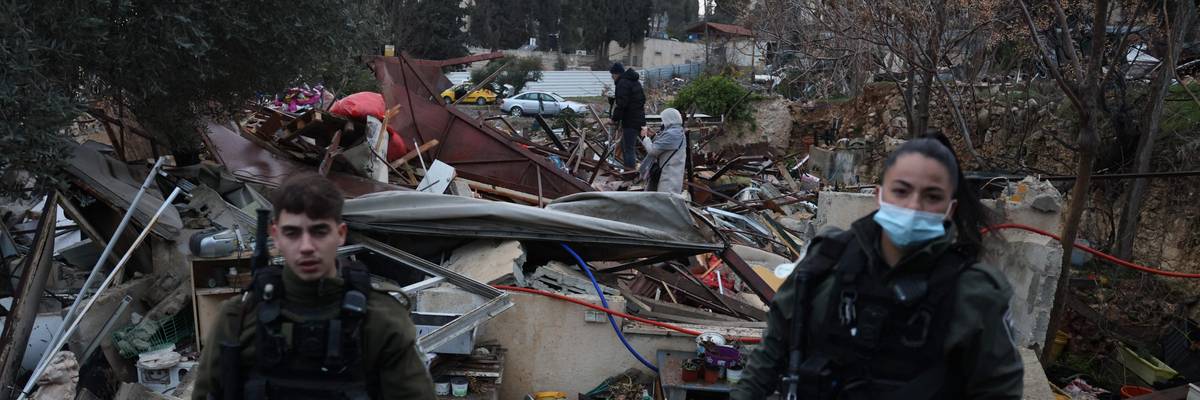
Israeli occupation forces stand by the ruins of the Salhiya family home in East Jerusalem's Sheikh Jarrah neighborhood after it was demolished on January 19, 2022. (Photo: Menahem Kahana/AFP via Getty Images)
Governments around the world on Wednesday joined human rights advocates in condemning Israeli authorities' forced expulsion of a Palestinian family and the demolition of their longtime home in the Sheikh Jarrah neighborhood of occupied East Jerusalem, with regional leaders accusing Israel of ethnic cleansing.
"This crime is part of policies of persecution, racism, and ethnic cleansing against Indigenous landowners in favor of settlers."
Following a two-day standoff, Israeli occupation forces stormed two houses belonging to the Salhiya family in the pre-dawn hours Wednesday and forcefully evicted 15 people, many of them children, while attacking and arresting some of the residents, The Palestine Chronicle reports.
Israeli forces then fired rubber-coated steel bullets at journalists and supporters of the family who were gathered outside the home before razing the houses with bulldozers, leaving the Salhiyas homeless and their belongings ruined and scattered on the ground.
Later on Wednesday, Palestinian Authority Prime Minister Mohammad Shtayyeh condemned the forced removal and home demolition, saying that "this crime is part of policies of persecution, racism, and ethnic cleansing against Indigenous landowners in favor of settlers."
Arab League Palestine affairs representative Said Abu Ali called the Israeli government's actions a "war crime and ethnic cleansing."
The regional leaders echoed the words of Mahmoud Salhiya, who said following his family's expulsion: "This is ethnic cleansing. It's my turn now, but next it will be the rest of the neighbors."
Salhiya explained that his family had owned and lived in the home since they were expelled from the village of Ain Karem by attacking Jewish militias during the 1948 Nakba ethnic cleansing campaign carried out to seize as much land as possible for the nascent state of Israel. Israeli forces subsequently conquered East Jerusalem--along with the West Bank, Gaza, and Syrian Golan Heights--during the 1967 Six-Day War, and effectively annexed Sheikh Jarrah in 1980.
"We have been expelled from our homeland again and again," Salhiya said, according to Middle East Eye. "We are already dead. We are dead inside. We have been dead since 1948."
Israeli authorities claim the home was illegally built in the 1990s, that the Salhiyas are squatters, and that the rightful Arab owners of the property--who officials declined to name--will be compensated.
"These illegal buildings had been preventing the construction of a school which can benefit the children of the entire Sheikh Jarrah community," the city of Jerusalem and Israeli police said in a joint statement, according to the Associated Press.
Other international officials condemned the expulsion and demolition, but in softer language than the Arab leaders.
Speaking Wednesday at the quarterly United Nations Security Council "Open Debate on the Situation in the Middle East," Linda Thomas-Greenfield, the United States ambassador to the U.N., said that "to make progress, both Israel and the Palestinian Authority must refrain from unilateral steps that exacerbate tensions and undercut efforts to advance a negotiated two-state solution."
"That includes annexations of territory, settlement activity, demolitions, and evictions--like what we saw in Sheikh Jarrah--incitement to violence, and providing compensation for individuals imprisoned for acts of terrorism."
Addressing the same forum, Norwegian diplomat Tor Wennesland, the U.N. special coordinator for the Middle East peace process, called on Israeli authorities "to end the displacement and eviction of Palestinians, in line with its obligations under international law, and to approve additional plans that would enable Palestinian communities to build legally and address their development needs."
Indonesian Foreign Ministry spokesperson Teuku Faizasyah said: "We condemn the forced evictions of the Palestinian family from their home in the occupied territories. It is a violation of international law and human rights."
"We condemn the forced evictions of the Palestinian family from their home in the occupied territories. It is a violation of international law and human rights."
The Turkish Foreign Ministry said in a statement that the expulsion and demolition "contravene international law and human rights."
"Israel's unilateral practices, which erode the demographic and legal status of Jerusalem, undermine the vision of a two-state solution and the ground for lasting peace," the ministry added.
In a joint statement, the foreign ministries of France, Germany, Italy, and Spain called on the Israeli government to "permanently halt eviction and demolition" in East Jerusalem, actions that the ministries said "contribute to fueling tensions on the ground."
The European ministries also said they are "deeply concerned" by Israel's "decision to advance plans for the construction of hundreds of new housing units in East Jerusalem, including between Givat HaMatos and Har Homa."
Since 1967, Israeli forces have expelled hundreds of thousands of Palestinians from the West Bank and East Jerusalem. According to the Israeli human rights group B'Tselem, more than 620,000 Israelis now live in over 200 illegal and exclusively Jewish settlements built on previously Palestinian land.
"The new housing units would further disconnect the West Bank from East Jerusalem," the Europeans' statement continued. "This decision directly threatens the viability of a future Palestinian state. Israeli settlements are in clear violation of international law and stand in the way of a just, lasting, and comprehensive peace between Israelis and Palestinians."
Dear Common Dreams reader, It’s been nearly 30 years since I co-founded Common Dreams with my late wife, Lina Newhouser. We had the radical notion that journalism should serve the public good, not corporate profits. It was clear to us from the outset what it would take to build such a project. No paid advertisements. No corporate sponsors. No millionaire publisher telling us what to think or do. Many people said we wouldn't last a year, but we proved those doubters wrong. Together with a tremendous team of journalists and dedicated staff, we built an independent media outlet free from the constraints of profits and corporate control. Our mission has always been simple: To inform. To inspire. To ignite change for the common good. Building Common Dreams was not easy. Our survival was never guaranteed. When you take on the most powerful forces—Wall Street greed, fossil fuel industry destruction, Big Tech lobbyists, and uber-rich oligarchs who have spent billions upon billions rigging the economy and democracy in their favor—the only bulwark you have is supporters who believe in your work. But here’s the urgent message from me today. It's never been this bad out there. And it's never been this hard to keep us going. At the very moment Common Dreams is most needed, the threats we face are intensifying. We need your support now more than ever. We don't accept corporate advertising and never will. We don't have a paywall because we don't think people should be blocked from critical news based on their ability to pay. Everything we do is funded by the donations of readers like you. When everyone does the little they can afford, we are strong. But if that support retreats or dries up, so do we. Will you donate now to make sure Common Dreams not only survives but thrives? —Craig Brown, Co-founder |
Governments around the world on Wednesday joined human rights advocates in condemning Israeli authorities' forced expulsion of a Palestinian family and the demolition of their longtime home in the Sheikh Jarrah neighborhood of occupied East Jerusalem, with regional leaders accusing Israel of ethnic cleansing.
"This crime is part of policies of persecution, racism, and ethnic cleansing against Indigenous landowners in favor of settlers."
Following a two-day standoff, Israeli occupation forces stormed two houses belonging to the Salhiya family in the pre-dawn hours Wednesday and forcefully evicted 15 people, many of them children, while attacking and arresting some of the residents, The Palestine Chronicle reports.
Israeli forces then fired rubber-coated steel bullets at journalists and supporters of the family who were gathered outside the home before razing the houses with bulldozers, leaving the Salhiyas homeless and their belongings ruined and scattered on the ground.
Later on Wednesday, Palestinian Authority Prime Minister Mohammad Shtayyeh condemned the forced removal and home demolition, saying that "this crime is part of policies of persecution, racism, and ethnic cleansing against Indigenous landowners in favor of settlers."
Arab League Palestine affairs representative Said Abu Ali called the Israeli government's actions a "war crime and ethnic cleansing."
The regional leaders echoed the words of Mahmoud Salhiya, who said following his family's expulsion: "This is ethnic cleansing. It's my turn now, but next it will be the rest of the neighbors."
Salhiya explained that his family had owned and lived in the home since they were expelled from the village of Ain Karem by attacking Jewish militias during the 1948 Nakba ethnic cleansing campaign carried out to seize as much land as possible for the nascent state of Israel. Israeli forces subsequently conquered East Jerusalem--along with the West Bank, Gaza, and Syrian Golan Heights--during the 1967 Six-Day War, and effectively annexed Sheikh Jarrah in 1980.
"We have been expelled from our homeland again and again," Salhiya said, according to Middle East Eye. "We are already dead. We are dead inside. We have been dead since 1948."
Israeli authorities claim the home was illegally built in the 1990s, that the Salhiyas are squatters, and that the rightful Arab owners of the property--who officials declined to name--will be compensated.
"These illegal buildings had been preventing the construction of a school which can benefit the children of the entire Sheikh Jarrah community," the city of Jerusalem and Israeli police said in a joint statement, according to the Associated Press.
Other international officials condemned the expulsion and demolition, but in softer language than the Arab leaders.
Speaking Wednesday at the quarterly United Nations Security Council "Open Debate on the Situation in the Middle East," Linda Thomas-Greenfield, the United States ambassador to the U.N., said that "to make progress, both Israel and the Palestinian Authority must refrain from unilateral steps that exacerbate tensions and undercut efforts to advance a negotiated two-state solution."
"That includes annexations of territory, settlement activity, demolitions, and evictions--like what we saw in Sheikh Jarrah--incitement to violence, and providing compensation for individuals imprisoned for acts of terrorism."
Addressing the same forum, Norwegian diplomat Tor Wennesland, the U.N. special coordinator for the Middle East peace process, called on Israeli authorities "to end the displacement and eviction of Palestinians, in line with its obligations under international law, and to approve additional plans that would enable Palestinian communities to build legally and address their development needs."
Indonesian Foreign Ministry spokesperson Teuku Faizasyah said: "We condemn the forced evictions of the Palestinian family from their home in the occupied territories. It is a violation of international law and human rights."
"We condemn the forced evictions of the Palestinian family from their home in the occupied territories. It is a violation of international law and human rights."
The Turkish Foreign Ministry said in a statement that the expulsion and demolition "contravene international law and human rights."
"Israel's unilateral practices, which erode the demographic and legal status of Jerusalem, undermine the vision of a two-state solution and the ground for lasting peace," the ministry added.
In a joint statement, the foreign ministries of France, Germany, Italy, and Spain called on the Israeli government to "permanently halt eviction and demolition" in East Jerusalem, actions that the ministries said "contribute to fueling tensions on the ground."
The European ministries also said they are "deeply concerned" by Israel's "decision to advance plans for the construction of hundreds of new housing units in East Jerusalem, including between Givat HaMatos and Har Homa."
Since 1967, Israeli forces have expelled hundreds of thousands of Palestinians from the West Bank and East Jerusalem. According to the Israeli human rights group B'Tselem, more than 620,000 Israelis now live in over 200 illegal and exclusively Jewish settlements built on previously Palestinian land.
"The new housing units would further disconnect the West Bank from East Jerusalem," the Europeans' statement continued. "This decision directly threatens the viability of a future Palestinian state. Israeli settlements are in clear violation of international law and stand in the way of a just, lasting, and comprehensive peace between Israelis and Palestinians."
Governments around the world on Wednesday joined human rights advocates in condemning Israeli authorities' forced expulsion of a Palestinian family and the demolition of their longtime home in the Sheikh Jarrah neighborhood of occupied East Jerusalem, with regional leaders accusing Israel of ethnic cleansing.
"This crime is part of policies of persecution, racism, and ethnic cleansing against Indigenous landowners in favor of settlers."
Following a two-day standoff, Israeli occupation forces stormed two houses belonging to the Salhiya family in the pre-dawn hours Wednesday and forcefully evicted 15 people, many of them children, while attacking and arresting some of the residents, The Palestine Chronicle reports.
Israeli forces then fired rubber-coated steel bullets at journalists and supporters of the family who were gathered outside the home before razing the houses with bulldozers, leaving the Salhiyas homeless and their belongings ruined and scattered on the ground.
Later on Wednesday, Palestinian Authority Prime Minister Mohammad Shtayyeh condemned the forced removal and home demolition, saying that "this crime is part of policies of persecution, racism, and ethnic cleansing against Indigenous landowners in favor of settlers."
Arab League Palestine affairs representative Said Abu Ali called the Israeli government's actions a "war crime and ethnic cleansing."
The regional leaders echoed the words of Mahmoud Salhiya, who said following his family's expulsion: "This is ethnic cleansing. It's my turn now, but next it will be the rest of the neighbors."
Salhiya explained that his family had owned and lived in the home since they were expelled from the village of Ain Karem by attacking Jewish militias during the 1948 Nakba ethnic cleansing campaign carried out to seize as much land as possible for the nascent state of Israel. Israeli forces subsequently conquered East Jerusalem--along with the West Bank, Gaza, and Syrian Golan Heights--during the 1967 Six-Day War, and effectively annexed Sheikh Jarrah in 1980.
"We have been expelled from our homeland again and again," Salhiya said, according to Middle East Eye. "We are already dead. We are dead inside. We have been dead since 1948."
Israeli authorities claim the home was illegally built in the 1990s, that the Salhiyas are squatters, and that the rightful Arab owners of the property--who officials declined to name--will be compensated.
"These illegal buildings had been preventing the construction of a school which can benefit the children of the entire Sheikh Jarrah community," the city of Jerusalem and Israeli police said in a joint statement, according to the Associated Press.
Other international officials condemned the expulsion and demolition, but in softer language than the Arab leaders.
Speaking Wednesday at the quarterly United Nations Security Council "Open Debate on the Situation in the Middle East," Linda Thomas-Greenfield, the United States ambassador to the U.N., said that "to make progress, both Israel and the Palestinian Authority must refrain from unilateral steps that exacerbate tensions and undercut efforts to advance a negotiated two-state solution."
"That includes annexations of territory, settlement activity, demolitions, and evictions--like what we saw in Sheikh Jarrah--incitement to violence, and providing compensation for individuals imprisoned for acts of terrorism."
Addressing the same forum, Norwegian diplomat Tor Wennesland, the U.N. special coordinator for the Middle East peace process, called on Israeli authorities "to end the displacement and eviction of Palestinians, in line with its obligations under international law, and to approve additional plans that would enable Palestinian communities to build legally and address their development needs."
Indonesian Foreign Ministry spokesperson Teuku Faizasyah said: "We condemn the forced evictions of the Palestinian family from their home in the occupied territories. It is a violation of international law and human rights."
"We condemn the forced evictions of the Palestinian family from their home in the occupied territories. It is a violation of international law and human rights."
The Turkish Foreign Ministry said in a statement that the expulsion and demolition "contravene international law and human rights."
"Israel's unilateral practices, which erode the demographic and legal status of Jerusalem, undermine the vision of a two-state solution and the ground for lasting peace," the ministry added.
In a joint statement, the foreign ministries of France, Germany, Italy, and Spain called on the Israeli government to "permanently halt eviction and demolition" in East Jerusalem, actions that the ministries said "contribute to fueling tensions on the ground."
The European ministries also said they are "deeply concerned" by Israel's "decision to advance plans for the construction of hundreds of new housing units in East Jerusalem, including between Givat HaMatos and Har Homa."
Since 1967, Israeli forces have expelled hundreds of thousands of Palestinians from the West Bank and East Jerusalem. According to the Israeli human rights group B'Tselem, more than 620,000 Israelis now live in over 200 illegal and exclusively Jewish settlements built on previously Palestinian land.
"The new housing units would further disconnect the West Bank from East Jerusalem," the Europeans' statement continued. "This decision directly threatens the viability of a future Palestinian state. Israeli settlements are in clear violation of international law and stand in the way of a just, lasting, and comprehensive peace between Israelis and Palestinians."