SUBSCRIBE TO OUR FREE NEWSLETTER
Daily news & progressive opinion—funded by the people, not the corporations—delivered straight to your inbox.
5
#000000
#FFFFFF
To donate by check, phone, or other method, see our More Ways to Give page.
Daily news & progressive opinion—funded by the people, not the corporations—delivered straight to your inbox.
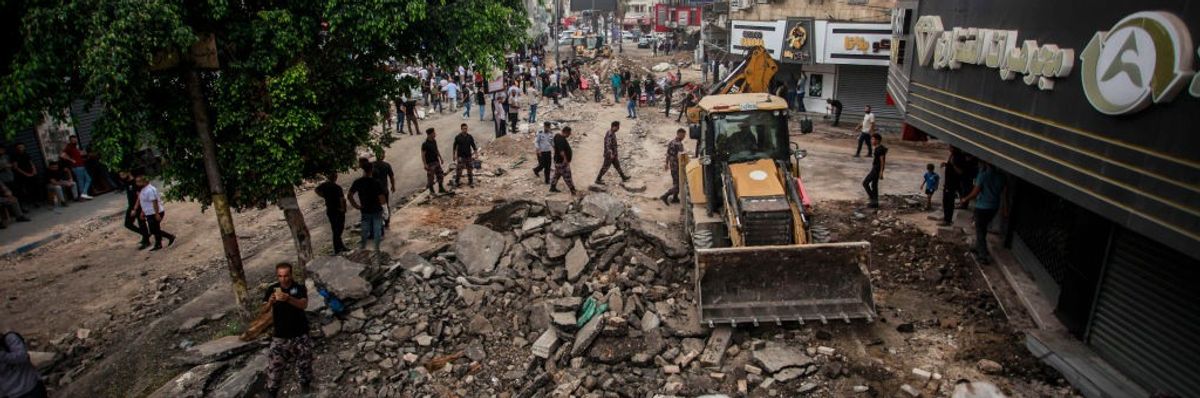
Palestinians walk around the damage in Jenin's city center after an Israeli military raid in the occupied West Bank on September 6, 2024.
"We watched their bulldozers tear up streets, demolish businesses, pharmacies, schools," said one local leader. "They even bulldozed the town soccer field, and a tree in the middle of a road."
As the world watched Israel's assaults on Lebanon and the Gaza Strip, The New York Times on Wednesday also directed attention to the West Bank, detailing how "Israeli military bulldozers tore up mile after mile" of Jenin and Tulkarm in recent weeks.
While "nearly nightly raids" by the Israel Defense Forces (IDF) "have become the norm" in the West Bank since the Hamas-led October 7 attack, the military last month "launched one of its most extensive and deadliest raids" in the illegally occupied Palestinian territory in years, the newspaper reported, citing videos and interviews with residents.
"We watched their bulldozers tear up streets, demolish businesses, pharmacies, schools. They even bulldozed the town soccer field, and a tree in the middle of a road," said Kamal Abu al-Rub, governor of Jenin. "What was the point of all of this?"
In addition to ground operations in the West Bank, the IDF has increased airstrikes that critics say run afoul of international law. The military defended the strikes and told the Times that in recent raids, troops found weapon stockpiles and killed or arrested dozens of militants—but also caused some "unavoidable harm to certain civilian structures."
In response to videos included in the reporting, freelance journalist Pete Tucker accused Israeli soldiers of "methodically laying waste to" the West Bank.
Malini Ranganathan, an associate professor at American University's School of International Service, said on social media that "Israel's criminality knows no limits. IDF bulldozers have been obliterating the West Bank, even tearing up roundabouts."
Israeli forces have damaged homes, shops, and roads along with internet, electricity, phone, water, and sewage lines in the West Bank. Emergency crews have been unable to respond to hundreds of calls per day, because they can't reach people in need.
"They are imposing conditions, materially and psychologically, that make people feel: Gaza is coming to you," Al Haq director Shawan Jabarin told the Times. "There is a feeling among Palestinians across the West Bank that what is coming is very bad—that it will be a plan to kill and expel us."
Since the October 7 attack on Israel that killed more than 1,100 people, Israeli forces have slaughtered at least 41,455 Palestinians in Gaza and 716 in the West Bank. Across the Palestinian territories, over 100,000 others have been injured over the past year. The bloodshed led to an ongoing genocide case at the International Court of Justice (ICJ).
The ICJ in July issued a nonbinding advisory opinion that Israel's decadeslong occupation of Gaza and the West Bank, including East Jerusalem, is illegal and must end "as rapidly as possible." Instead, Israel has ramped up attacks on not only the Palestinian territories, but also Lebanon, home to the political and paramilitary group Hezbollah.
This week's bombing campaign in Lebanon—which has killed at least 569 people—sparked fresh calls for the Biden administration to finally cut off weapons to Israel, as did the new reporting from the Times, which has been accused of pro-Israel bias in its coverage of the assault on Gaza.
Meanwhile, Israeli destruction in the West Bank continues. The International Middle East Media Center reported that "on Wednesday, Israeli soldiers invaded the town of Beit Ula, west of Hebron in the occupied West Bank's southern part, [and] bulldozed over 20 dunams of land, uprooting more than 600 fruit-bearing trees, and demolishing several agricultural structures and wells."
Dear Common Dreams reader, It’s been nearly 30 years since I co-founded Common Dreams with my late wife, Lina Newhouser. We had the radical notion that journalism should serve the public good, not corporate profits. It was clear to us from the outset what it would take to build such a project. No paid advertisements. No corporate sponsors. No millionaire publisher telling us what to think or do. Many people said we wouldn't last a year, but we proved those doubters wrong. Together with a tremendous team of journalists and dedicated staff, we built an independent media outlet free from the constraints of profits and corporate control. Our mission has always been simple: To inform. To inspire. To ignite change for the common good. Building Common Dreams was not easy. Our survival was never guaranteed. When you take on the most powerful forces—Wall Street greed, fossil fuel industry destruction, Big Tech lobbyists, and uber-rich oligarchs who have spent billions upon billions rigging the economy and democracy in their favor—the only bulwark you have is supporters who believe in your work. But here’s the urgent message from me today. It's never been this bad out there. And it's never been this hard to keep us going. At the very moment Common Dreams is most needed, the threats we face are intensifying. We need your support now more than ever. We don't accept corporate advertising and never will. We don't have a paywall because we don't think people should be blocked from critical news based on their ability to pay. Everything we do is funded by the donations of readers like you. When everyone does the little they can afford, we are strong. But if that support retreats or dries up, so do we. Will you donate now to make sure Common Dreams not only survives but thrives? —Craig Brown, Co-founder |
As the world watched Israel's assaults on Lebanon and the Gaza Strip, The New York Times on Wednesday also directed attention to the West Bank, detailing how "Israeli military bulldozers tore up mile after mile" of Jenin and Tulkarm in recent weeks.
While "nearly nightly raids" by the Israel Defense Forces (IDF) "have become the norm" in the West Bank since the Hamas-led October 7 attack, the military last month "launched one of its most extensive and deadliest raids" in the illegally occupied Palestinian territory in years, the newspaper reported, citing videos and interviews with residents.
"We watched their bulldozers tear up streets, demolish businesses, pharmacies, schools. They even bulldozed the town soccer field, and a tree in the middle of a road," said Kamal Abu al-Rub, governor of Jenin. "What was the point of all of this?"
In addition to ground operations in the West Bank, the IDF has increased airstrikes that critics say run afoul of international law. The military defended the strikes and told the Times that in recent raids, troops found weapon stockpiles and killed or arrested dozens of militants—but also caused some "unavoidable harm to certain civilian structures."
In response to videos included in the reporting, freelance journalist Pete Tucker accused Israeli soldiers of "methodically laying waste to" the West Bank.
Malini Ranganathan, an associate professor at American University's School of International Service, said on social media that "Israel's criminality knows no limits. IDF bulldozers have been obliterating the West Bank, even tearing up roundabouts."
Israeli forces have damaged homes, shops, and roads along with internet, electricity, phone, water, and sewage lines in the West Bank. Emergency crews have been unable to respond to hundreds of calls per day, because they can't reach people in need.
"They are imposing conditions, materially and psychologically, that make people feel: Gaza is coming to you," Al Haq director Shawan Jabarin told the Times. "There is a feeling among Palestinians across the West Bank that what is coming is very bad—that it will be a plan to kill and expel us."
Since the October 7 attack on Israel that killed more than 1,100 people, Israeli forces have slaughtered at least 41,455 Palestinians in Gaza and 716 in the West Bank. Across the Palestinian territories, over 100,000 others have been injured over the past year. The bloodshed led to an ongoing genocide case at the International Court of Justice (ICJ).
The ICJ in July issued a nonbinding advisory opinion that Israel's decadeslong occupation of Gaza and the West Bank, including East Jerusalem, is illegal and must end "as rapidly as possible." Instead, Israel has ramped up attacks on not only the Palestinian territories, but also Lebanon, home to the political and paramilitary group Hezbollah.
This week's bombing campaign in Lebanon—which has killed at least 569 people—sparked fresh calls for the Biden administration to finally cut off weapons to Israel, as did the new reporting from the Times, which has been accused of pro-Israel bias in its coverage of the assault on Gaza.
Meanwhile, Israeli destruction in the West Bank continues. The International Middle East Media Center reported that "on Wednesday, Israeli soldiers invaded the town of Beit Ula, west of Hebron in the occupied West Bank's southern part, [and] bulldozed over 20 dunams of land, uprooting more than 600 fruit-bearing trees, and demolishing several agricultural structures and wells."
As the world watched Israel's assaults on Lebanon and the Gaza Strip, The New York Times on Wednesday also directed attention to the West Bank, detailing how "Israeli military bulldozers tore up mile after mile" of Jenin and Tulkarm in recent weeks.
While "nearly nightly raids" by the Israel Defense Forces (IDF) "have become the norm" in the West Bank since the Hamas-led October 7 attack, the military last month "launched one of its most extensive and deadliest raids" in the illegally occupied Palestinian territory in years, the newspaper reported, citing videos and interviews with residents.
"We watched their bulldozers tear up streets, demolish businesses, pharmacies, schools. They even bulldozed the town soccer field, and a tree in the middle of a road," said Kamal Abu al-Rub, governor of Jenin. "What was the point of all of this?"
In addition to ground operations in the West Bank, the IDF has increased airstrikes that critics say run afoul of international law. The military defended the strikes and told the Times that in recent raids, troops found weapon stockpiles and killed or arrested dozens of militants—but also caused some "unavoidable harm to certain civilian structures."
In response to videos included in the reporting, freelance journalist Pete Tucker accused Israeli soldiers of "methodically laying waste to" the West Bank.
Malini Ranganathan, an associate professor at American University's School of International Service, said on social media that "Israel's criminality knows no limits. IDF bulldozers have been obliterating the West Bank, even tearing up roundabouts."
Israeli forces have damaged homes, shops, and roads along with internet, electricity, phone, water, and sewage lines in the West Bank. Emergency crews have been unable to respond to hundreds of calls per day, because they can't reach people in need.
"They are imposing conditions, materially and psychologically, that make people feel: Gaza is coming to you," Al Haq director Shawan Jabarin told the Times. "There is a feeling among Palestinians across the West Bank that what is coming is very bad—that it will be a plan to kill and expel us."
Since the October 7 attack on Israel that killed more than 1,100 people, Israeli forces have slaughtered at least 41,455 Palestinians in Gaza and 716 in the West Bank. Across the Palestinian territories, over 100,000 others have been injured over the past year. The bloodshed led to an ongoing genocide case at the International Court of Justice (ICJ).
The ICJ in July issued a nonbinding advisory opinion that Israel's decadeslong occupation of Gaza and the West Bank, including East Jerusalem, is illegal and must end "as rapidly as possible." Instead, Israel has ramped up attacks on not only the Palestinian territories, but also Lebanon, home to the political and paramilitary group Hezbollah.
This week's bombing campaign in Lebanon—which has killed at least 569 people—sparked fresh calls for the Biden administration to finally cut off weapons to Israel, as did the new reporting from the Times, which has been accused of pro-Israel bias in its coverage of the assault on Gaza.
Meanwhile, Israeli destruction in the West Bank continues. The International Middle East Media Center reported that "on Wednesday, Israeli soldiers invaded the town of Beit Ula, west of Hebron in the occupied West Bank's southern part, [and] bulldozed over 20 dunams of land, uprooting more than 600 fruit-bearing trees, and demolishing several agricultural structures and wells."