SUBSCRIBE TO OUR FREE NEWSLETTER
Daily news & progressive opinion—funded by the people, not the corporations—delivered straight to your inbox.
5
#000000
#FFFFFF
To donate by check, phone, or other method, see our More Ways to Give page.
Daily news & progressive opinion—funded by the people, not the corporations—delivered straight to your inbox.
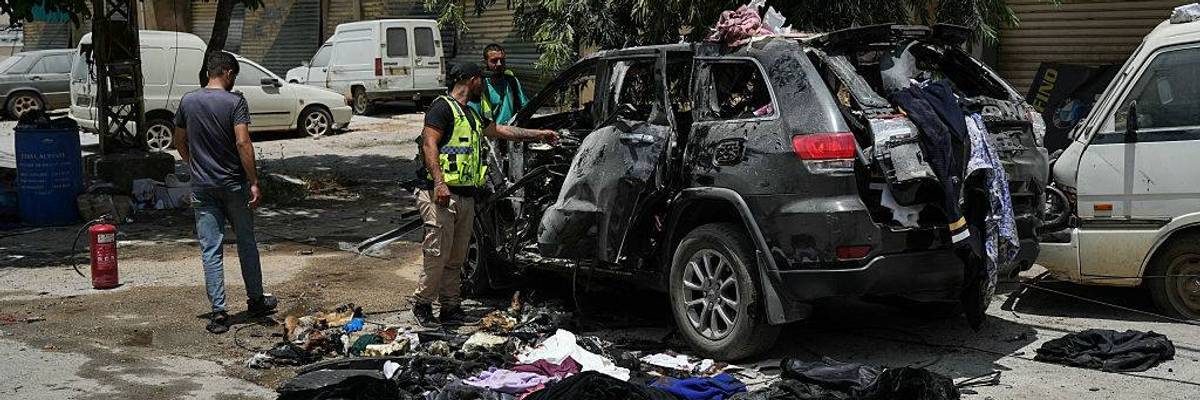
First responders inspect the wreckage of a car reportedly targeted by an Israeli strike in Nabatieh on July 6, 2026.
"How many more families will have to pull the body parts of their children from the rubble before this devastating cycle of war crimes ends?"
Amnesty International on Thursday demanded a war crimes investigation into Israeli airstrikes in southern Lebanon, which the human rights watchdog described as "wiping out families."
The strikes in question took place in March and killed 24 civilians, including 12 children, in neighborhoods in the cities of Tyre, Saida, and Nabatieh.
Amnesty said it has gathered enough evidence to reasonably conclude that Israeli forces violated international law by failing to distinguish between civilian and military targets when conducting the campaign.
The human rights group said it reached these conclusions after conducting more than a dozen on-the-ground interviews with survivors, relatives of victims, and paramedics who were called to the scene after the strikes. Additionally, the group analyzed satellite photos along with videos of the strikes posted on social media.
One survivor, a retired Lebanese man named Hussein Saleh, said that the strike in his neighborhood in Tyre killed his wife, their two children, his sister-in-law and her five-year-old daughter, and two other relatives.
Moussa Chaalan, a paramedic who arrived on the scene after the attack, told Amnesty "there was nothing left of the house" when they got there.
"The body parts were scattered as far as 200 meters away from the impact site," Chaalan added.
Mohamad Taqi, 54, told Amnesty that Israel's strike in the Saida district killed seven family members, including his 78-year-old mother, Zeinab Nasser, and his 12-year-old daughter Zahraa.
"In the bedroom where the missile hit, I couldn’t find a trace of Zeinab and Zahraa," Taqi said. "The paramedics later found their body parts and they gathered them. When I lost hope of finding them alive, I went to the hospital. I was injured in my head, eye, and face."
Kristine Beckerle, deputy regional director for the Middle East and North Africa at Amnesty International, said the international community needed to impose consequences on Israel for what she described as "a callous disregard for civilian lives."
"Within the space of just a week, the Israeli military obliterated entire families, including a dozen children, in Lebanon," said Beckerle. "How many more families will have to pull the body parts of their children from the rubble before this devastating cycle of war crimes ends? The international community must act now: states must impose an immediate comprehensive arms embargo on Israel and use universal and extraterritorial jurisdiction to investigate and prosecute those responsible."
Beckerle added that the three attacks investigated by Amnesty "are part of a well-documented pattern of unlawful Israeli attacks carried out in Lebanon, amidst a total vacuum of accountability."
Dear Common Dreams reader, It’s been nearly 30 years since I co-founded Common Dreams with my late wife, Lina Newhouser. We had the radical notion that journalism should serve the public good, not corporate profits. It was clear to us from the outset what it would take to build such a project. No paid advertisements. No corporate sponsors. No millionaire publisher telling us what to think or do. Many people said we wouldn't last a year, but we proved those doubters wrong. Together with a tremendous team of journalists and dedicated staff, we built an independent media outlet free from the constraints of profits and corporate control. Our mission has always been simple: To inform. To inspire. To ignite change for the common good. Building Common Dreams was not easy. Our survival was never guaranteed. When you take on the most powerful forces—Wall Street greed, fossil fuel industry destruction, Big Tech lobbyists, and uber-rich oligarchs who have spent billions upon billions rigging the economy and democracy in their favor—the only bulwark you have is supporters who believe in your work. But here’s the urgent message from me today. It's never been this bad out there. And it's never been this hard to keep us going. At the very moment Common Dreams is most needed, the threats we face are intensifying. We need your support now more than ever. We don't accept corporate advertising and never will. We don't have a paywall because we don't think people should be blocked from critical news based on their ability to pay. Everything we do is funded by the donations of readers like you. When everyone does the little they can afford, we are strong. But if that support retreats or dries up, so do we. Will you donate now to make sure Common Dreams not only survives but thrives? —Craig Brown, Co-founder |
Amnesty International on Thursday demanded a war crimes investigation into Israeli airstrikes in southern Lebanon, which the human rights watchdog described as "wiping out families."
The strikes in question took place in March and killed 24 civilians, including 12 children, in neighborhoods in the cities of Tyre, Saida, and Nabatieh.
Amnesty said it has gathered enough evidence to reasonably conclude that Israeli forces violated international law by failing to distinguish between civilian and military targets when conducting the campaign.
The human rights group said it reached these conclusions after conducting more than a dozen on-the-ground interviews with survivors, relatives of victims, and paramedics who were called to the scene after the strikes. Additionally, the group analyzed satellite photos along with videos of the strikes posted on social media.
One survivor, a retired Lebanese man named Hussein Saleh, said that the strike in his neighborhood in Tyre killed his wife, their two children, his sister-in-law and her five-year-old daughter, and two other relatives.
Moussa Chaalan, a paramedic who arrived on the scene after the attack, told Amnesty "there was nothing left of the house" when they got there.
"The body parts were scattered as far as 200 meters away from the impact site," Chaalan added.
Mohamad Taqi, 54, told Amnesty that Israel's strike in the Saida district killed seven family members, including his 78-year-old mother, Zeinab Nasser, and his 12-year-old daughter Zahraa.
"In the bedroom where the missile hit, I couldn’t find a trace of Zeinab and Zahraa," Taqi said. "The paramedics later found their body parts and they gathered them. When I lost hope of finding them alive, I went to the hospital. I was injured in my head, eye, and face."
Kristine Beckerle, deputy regional director for the Middle East and North Africa at Amnesty International, said the international community needed to impose consequences on Israel for what she described as "a callous disregard for civilian lives."
"Within the space of just a week, the Israeli military obliterated entire families, including a dozen children, in Lebanon," said Beckerle. "How many more families will have to pull the body parts of their children from the rubble before this devastating cycle of war crimes ends? The international community must act now: states must impose an immediate comprehensive arms embargo on Israel and use universal and extraterritorial jurisdiction to investigate and prosecute those responsible."
Beckerle added that the three attacks investigated by Amnesty "are part of a well-documented pattern of unlawful Israeli attacks carried out in Lebanon, amidst a total vacuum of accountability."
Amnesty International on Thursday demanded a war crimes investigation into Israeli airstrikes in southern Lebanon, which the human rights watchdog described as "wiping out families."
The strikes in question took place in March and killed 24 civilians, including 12 children, in neighborhoods in the cities of Tyre, Saida, and Nabatieh.
Amnesty said it has gathered enough evidence to reasonably conclude that Israeli forces violated international law by failing to distinguish between civilian and military targets when conducting the campaign.
The human rights group said it reached these conclusions after conducting more than a dozen on-the-ground interviews with survivors, relatives of victims, and paramedics who were called to the scene after the strikes. Additionally, the group analyzed satellite photos along with videos of the strikes posted on social media.
One survivor, a retired Lebanese man named Hussein Saleh, said that the strike in his neighborhood in Tyre killed his wife, their two children, his sister-in-law and her five-year-old daughter, and two other relatives.
Moussa Chaalan, a paramedic who arrived on the scene after the attack, told Amnesty "there was nothing left of the house" when they got there.
"The body parts were scattered as far as 200 meters away from the impact site," Chaalan added.
Mohamad Taqi, 54, told Amnesty that Israel's strike in the Saida district killed seven family members, including his 78-year-old mother, Zeinab Nasser, and his 12-year-old daughter Zahraa.
"In the bedroom where the missile hit, I couldn’t find a trace of Zeinab and Zahraa," Taqi said. "The paramedics later found their body parts and they gathered them. When I lost hope of finding them alive, I went to the hospital. I was injured in my head, eye, and face."
Kristine Beckerle, deputy regional director for the Middle East and North Africa at Amnesty International, said the international community needed to impose consequences on Israel for what she described as "a callous disregard for civilian lives."
"Within the space of just a week, the Israeli military obliterated entire families, including a dozen children, in Lebanon," said Beckerle. "How many more families will have to pull the body parts of their children from the rubble before this devastating cycle of war crimes ends? The international community must act now: states must impose an immediate comprehensive arms embargo on Israel and use universal and extraterritorial jurisdiction to investigate and prosecute those responsible."
Beckerle added that the three attacks investigated by Amnesty "are part of a well-documented pattern of unlawful Israeli attacks carried out in Lebanon, amidst a total vacuum of accountability."