SUBSCRIBE TO OUR FREE NEWSLETTER
Daily news & progressive opinion—funded by the people, not the corporations—delivered straight to your inbox.
5
#000000
#FFFFFF
To donate by check, phone, or other method, see our More Ways to Give page.
Daily news & progressive opinion—funded by the people, not the corporations—delivered straight to your inbox.
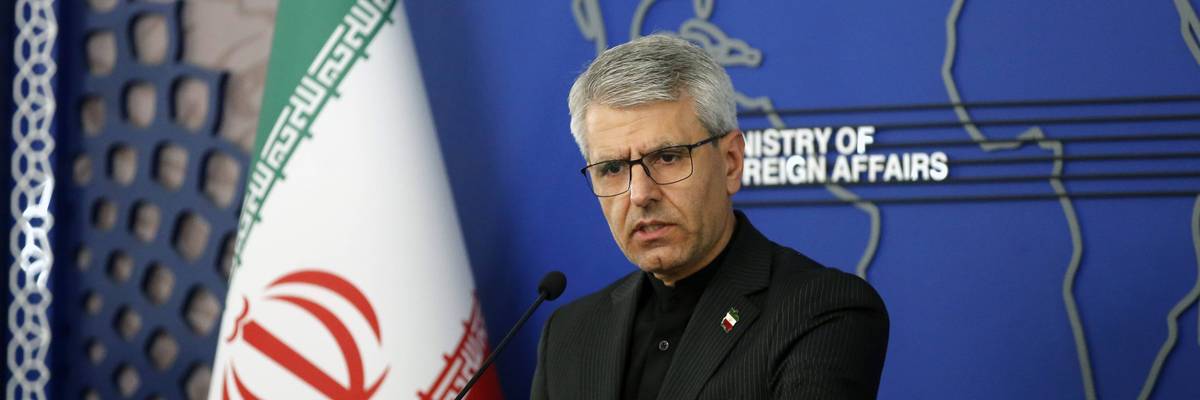
Esmail Baghaei, a spokesperson for the Iran's Foreign Ministry, attends a press conference in Tehran on May 4, 2026.
A spokesperson for Iran's Foreign Ministry slammed the leadership of the European Union for "blaming Iran for exercising its right to self-defense against US aggression launched from bases in neighboring countries."
Iran's government on Monday condemned the European Union's response to Iranian attacks on US military installations in the Middle East as "a masterclass in selective moral outrage" as the Trump administration launched new strikes against Iran over the weekend, with peace talks still at an impasse.
Esmaeil Baqaei, a spokesperson for the Iranian Foreign Ministry, accused EU leaders of "blaming Iran for exercising its right to self-defense against US aggression launched from bases in neighboring countries," referring to Iran's attacks on US air bases in Kuwait. Baqaei said Iran's strikes "against those bases and assets that are used to launch unlawful attacks against Iran are a lawful exercise of self-defense."
"The EU must remain faithful to the rule of law and the principles of the UN Charter that it has long claimed to uphold. It must stop appeasing aggressors while blaming those who respond to unlawful attacks," Baqaei added. "States have an established legal obligation not to allow their territory or assets to be used for invading other countries."
Baqaei's statement came in response to remarks from a European Commission spokesperson condemning an Iranian attack on a US air base in Kuwait last week, calling it a violation of Kuwait's sovereignty. The attack reportedly injured at least four US servicemembers and several American contractors.
The Iranian military said it targeted another US air base on Sunday in response to new attacks by the Trump administration, which launched its illegal war against Iran in late February. While Iran did not specify the location of its target, Kuwait said late Sunday that its "air defenses are currently confronting hostile missile and drone attacks."
The Iranian attacks followed the US military's announcement that it carried out strikes on "Iranian radar and command and control sites for drones" over the weekend. The US Central Command (CENTCOM) described the attacks as "self-defense strikes" and as a "measured and deliberate response" to "aggressive Iranian actions."
Brian Finucane, a senior adviser to the US Program at the International Crisis Group, wrote in response to CENTCOM's statement that "this administration’s use of the terms 'aggression' and 'self-defense' [is] thoroughly in 'war is peace' territory."
The US military also attacked a Gambia-flagged commercial ship in the Gulf of Oman over the weekend, enforcing a Trump administration naval blockade that Iran has condemned as illegal and said must be lifted as part of any peace agreement.
CBS News reported Saturday that "the broad strokes" of a peace deal under consideration "include a 60-day cessation of violence, along with clauses that call for reopening the strait and a framework to reopen negotiations on Iran's nuclear program."
"Multiple sources told CBS that the arrangement also involves the potential of waivers or sanctions relief to Iran that could allow it to access billions in frozen assets depending on the progress of the diplomacy," the outlet added.
Mohammad Bagher Ghalibaf, Iran's top negotiator, said early Monday that the Trump administration's naval blockade and Israel's "escalation of war crimes in Lebanon" represent "clear evidence of US noncompliance with the ceasefire."
"Every choice has a price, and the bill comes due," he added. "It will all fall into place."
US President Donald Trump, meanwhile, wrote on his social media platform that "Iran really wants to make a deal, and it will be a good one for the USA and those that are with us."
"Just sit back and relax, it will all work out well in the end," Trump declared.
Dear Common Dreams reader, It’s been nearly 30 years since I co-founded Common Dreams with my late wife, Lina Newhouser. We had the radical notion that journalism should serve the public good, not corporate profits. It was clear to us from the outset what it would take to build such a project. No paid advertisements. No corporate sponsors. No millionaire publisher telling us what to think or do. Many people said we wouldn't last a year, but we proved those doubters wrong. Together with a tremendous team of journalists and dedicated staff, we built an independent media outlet free from the constraints of profits and corporate control. Our mission has always been simple: To inform. To inspire. To ignite change for the common good. Building Common Dreams was not easy. Our survival was never guaranteed. When you take on the most powerful forces—Wall Street greed, fossil fuel industry destruction, Big Tech lobbyists, and uber-rich oligarchs who have spent billions upon billions rigging the economy and democracy in their favor—the only bulwark you have is supporters who believe in your work. But here’s the urgent message from me today. It's never been this bad out there. And it's never been this hard to keep us going. At the very moment Common Dreams is most needed, the threats we face are intensifying. We need your support now more than ever. We don't accept corporate advertising and never will. We don't have a paywall because we don't think people should be blocked from critical news based on their ability to pay. Everything we do is funded by the donations of readers like you. When everyone does the little they can afford, we are strong. But if that support retreats or dries up, so do we. Will you donate now to make sure Common Dreams not only survives but thrives? —Craig Brown, Co-founder |
Iran's government on Monday condemned the European Union's response to Iranian attacks on US military installations in the Middle East as "a masterclass in selective moral outrage" as the Trump administration launched new strikes against Iran over the weekend, with peace talks still at an impasse.
Esmaeil Baqaei, a spokesperson for the Iranian Foreign Ministry, accused EU leaders of "blaming Iran for exercising its right to self-defense against US aggression launched from bases in neighboring countries," referring to Iran's attacks on US air bases in Kuwait. Baqaei said Iran's strikes "against those bases and assets that are used to launch unlawful attacks against Iran are a lawful exercise of self-defense."
"The EU must remain faithful to the rule of law and the principles of the UN Charter that it has long claimed to uphold. It must stop appeasing aggressors while blaming those who respond to unlawful attacks," Baqaei added. "States have an established legal obligation not to allow their territory or assets to be used for invading other countries."
Baqaei's statement came in response to remarks from a European Commission spokesperson condemning an Iranian attack on a US air base in Kuwait last week, calling it a violation of Kuwait's sovereignty. The attack reportedly injured at least four US servicemembers and several American contractors.
The Iranian military said it targeted another US air base on Sunday in response to new attacks by the Trump administration, which launched its illegal war against Iran in late February. While Iran did not specify the location of its target, Kuwait said late Sunday that its "air defenses are currently confronting hostile missile and drone attacks."
The Iranian attacks followed the US military's announcement that it carried out strikes on "Iranian radar and command and control sites for drones" over the weekend. The US Central Command (CENTCOM) described the attacks as "self-defense strikes" and as a "measured and deliberate response" to "aggressive Iranian actions."
Brian Finucane, a senior adviser to the US Program at the International Crisis Group, wrote in response to CENTCOM's statement that "this administration’s use of the terms 'aggression' and 'self-defense' [is] thoroughly in 'war is peace' territory."
The US military also attacked a Gambia-flagged commercial ship in the Gulf of Oman over the weekend, enforcing a Trump administration naval blockade that Iran has condemned as illegal and said must be lifted as part of any peace agreement.
CBS News reported Saturday that "the broad strokes" of a peace deal under consideration "include a 60-day cessation of violence, along with clauses that call for reopening the strait and a framework to reopen negotiations on Iran's nuclear program."
"Multiple sources told CBS that the arrangement also involves the potential of waivers or sanctions relief to Iran that could allow it to access billions in frozen assets depending on the progress of the diplomacy," the outlet added.
Mohammad Bagher Ghalibaf, Iran's top negotiator, said early Monday that the Trump administration's naval blockade and Israel's "escalation of war crimes in Lebanon" represent "clear evidence of US noncompliance with the ceasefire."
"Every choice has a price, and the bill comes due," he added. "It will all fall into place."
US President Donald Trump, meanwhile, wrote on his social media platform that "Iran really wants to make a deal, and it will be a good one for the USA and those that are with us."
"Just sit back and relax, it will all work out well in the end," Trump declared.
Iran's government on Monday condemned the European Union's response to Iranian attacks on US military installations in the Middle East as "a masterclass in selective moral outrage" as the Trump administration launched new strikes against Iran over the weekend, with peace talks still at an impasse.
Esmaeil Baqaei, a spokesperson for the Iranian Foreign Ministry, accused EU leaders of "blaming Iran for exercising its right to self-defense against US aggression launched from bases in neighboring countries," referring to Iran's attacks on US air bases in Kuwait. Baqaei said Iran's strikes "against those bases and assets that are used to launch unlawful attacks against Iran are a lawful exercise of self-defense."
"The EU must remain faithful to the rule of law and the principles of the UN Charter that it has long claimed to uphold. It must stop appeasing aggressors while blaming those who respond to unlawful attacks," Baqaei added. "States have an established legal obligation not to allow their territory or assets to be used for invading other countries."
Baqaei's statement came in response to remarks from a European Commission spokesperson condemning an Iranian attack on a US air base in Kuwait last week, calling it a violation of Kuwait's sovereignty. The attack reportedly injured at least four US servicemembers and several American contractors.
The Iranian military said it targeted another US air base on Sunday in response to new attacks by the Trump administration, which launched its illegal war against Iran in late February. While Iran did not specify the location of its target, Kuwait said late Sunday that its "air defenses are currently confronting hostile missile and drone attacks."
The Iranian attacks followed the US military's announcement that it carried out strikes on "Iranian radar and command and control sites for drones" over the weekend. The US Central Command (CENTCOM) described the attacks as "self-defense strikes" and as a "measured and deliberate response" to "aggressive Iranian actions."
Brian Finucane, a senior adviser to the US Program at the International Crisis Group, wrote in response to CENTCOM's statement that "this administration’s use of the terms 'aggression' and 'self-defense' [is] thoroughly in 'war is peace' territory."
The US military also attacked a Gambia-flagged commercial ship in the Gulf of Oman over the weekend, enforcing a Trump administration naval blockade that Iran has condemned as illegal and said must be lifted as part of any peace agreement.
CBS News reported Saturday that "the broad strokes" of a peace deal under consideration "include a 60-day cessation of violence, along with clauses that call for reopening the strait and a framework to reopen negotiations on Iran's nuclear program."
"Multiple sources told CBS that the arrangement also involves the potential of waivers or sanctions relief to Iran that could allow it to access billions in frozen assets depending on the progress of the diplomacy," the outlet added.
Mohammad Bagher Ghalibaf, Iran's top negotiator, said early Monday that the Trump administration's naval blockade and Israel's "escalation of war crimes in Lebanon" represent "clear evidence of US noncompliance with the ceasefire."
"Every choice has a price, and the bill comes due," he added. "It will all fall into place."
US President Donald Trump, meanwhile, wrote on his social media platform that "Iran really wants to make a deal, and it will be a good one for the USA and those that are with us."
"Just sit back and relax, it will all work out well in the end," Trump declared.