SUBSCRIBE TO OUR FREE NEWSLETTER
Daily news & progressive opinion—funded by the people, not the corporations—delivered straight to your inbox.
5
#000000
#FFFFFF
To donate by check, phone, or other method, see our More Ways to Give page.
Daily news & progressive opinion—funded by the people, not the corporations—delivered straight to your inbox.
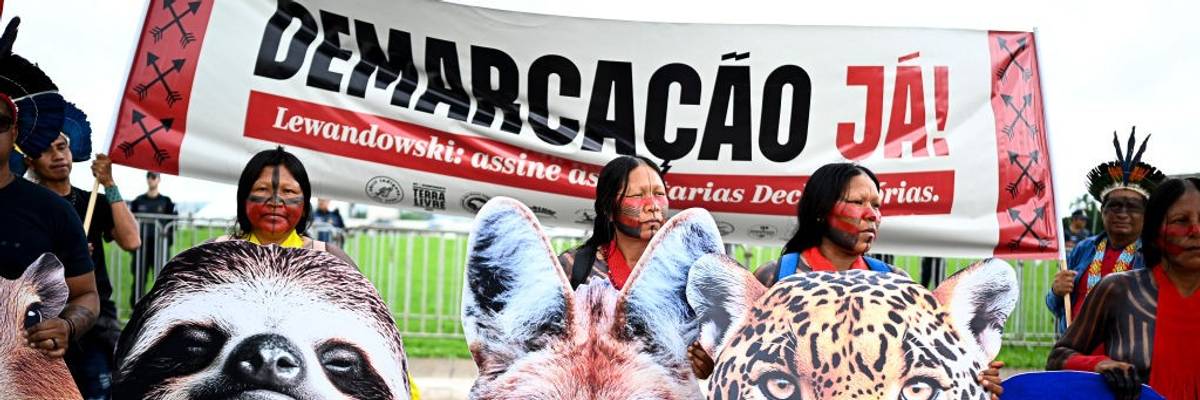
Indigenous Brazilians rally in the capital Brasília on October 30, 2024 under a banner reading "Demarcation Now!"
"We are fighting for life," said one Indigenous leader. "We do not want our land to be exploited, we want to continue living in harmony with nature."
Thousands of Indigenous Brazilians rallied and marched in the capital Brasília and staged demonstrations in at least five states on Wednesday in a bid to block a proposed constitutional amendment that critics say could halt or even reverse the process of demarcating native lands.
Constitutional Amendment Proposal (PEC) 48 was introduced in September 2023 by federal Sen. Hiran Gonçalves of the right-wing Progressives party. The amendment would constitutionally enshrine a thesis backed by the country's powerful agribusiness sector under which Indigenous land claims made after October 5, 1988—the date Brazil's current constitution was adopted—would be invalidated.
Many Indigenous Brazilians call the proposal the "PEC of death." The Articulation of the Indigenous Peoples of Brazil (APIB), the country's leading nongovernmental Indian advocacy group, says the amendment "is an agribusiness and anti-Indigenous proposal as it violates the original right of peoples to their ancestral territory, already recognized by the 1988 constitution, which PEC 48 seeks to alter."
"The measure also ignores the violence and persecutions that Indigenous peoples have faced for over 500 years, especially during the military dictatorship, which prevented many peoples from being in their territories on that exact date in 1988," APIB added, referring to the U.S.-backed regime that ruled through terror and torture from 1964-85 and in whose army former far-right Brazilian President Jair Bolsnaro—a big supporter of PEC 48—proudly served.
On September 21, 2023, Brazil's Supreme Federal Tribunal ruled 9-2 that the Temporal Framework thesis is unconstitutional. On the same day, both houses of Brazil's Congress approved PL 2903, which contained provisions to codify the Temporal Framework.
Leftist Brazilian President Luiz Inácio Lula da Silva subsequently issued a veto for parts of the bill dealing with the Temporal Framework and other provisions that abolished Indigenous peoples' right to free, prior, and informed consultation; made it easier to intrude upon Indigenous lands; and would have banned the expansion of previously demarcated Indigenous lands.
However, right-wing Brazilian lawmakers overruled Lula's veto in December 2023. Despite being declared unconstitutional, lawmakers passed Law 14.701, which codified the Temporal Framework and was subsequently challenged in multiple lawsuits. In April 2024, the Supreme Federal Tribunal suspended these cases and suggested a process of mediation and conciliation between Indigenous people and agribusiness interests. That process began in August.
In a Wednesday interview with Agência Brasil, APIC executive coordinator Alberto Terena of the Terena Indigenous community said that PEC 48 "is a threat against our demarcated lands" that will exacerbate the planetary climate emergency.
"As soon as we stop protecting the environment, the climate crisis will be even worse," he argued. "Indigenous lands are the territories with the greatest preservation of the environment, the greatest biodiversity. We are fighting for life. We do not want our land to be exploited, we want to continue living in harmony with nature."
The demonstrations in Brazil came as a United Nations biodiversity summit (COP16) is underway in neighboring Colombia. Indigenous rights advocates reported that Amazon defender Txai Suruí, one of Brazil's best-known Indigenous activists, was accosted at COP16 after speaking out against the Temporal Framework.
Takakpe Tapayuna Metuktire of the Raoni Institute, which promotes Indigenous rights and sustainability, told g1 that the Temporal Framework is a death decree for us and our children."
Brian O'Donnell, head of the international advocacy group Campaign for Nature, said in a statement Thursday that "if the world is to maintain its important cultural diversity, or achieve its biodiversity and climate goals, Indigenous peoples' territories must be recognized and secured."
"We are outraged by the assault on Indigenous territories and the disenfranchisement of Indigenous people," O'Donnell added. "Their rights to their ancestral lands must be secured. We stand in solidarity with Indigenous people in Brazil and around the world, who are calling for this ill-conceived set of policies to be scrapped and for world leaders to recognize the territorial rights of Indigenous peoples."
In addition to the Brasília rally and march, Indigenous-led demonstrations saw road blockages and other actions across the country of 200 million inhabitants. Protests took place in the states of São Paulo, Santa Catarina, Rio Grande do Sul, Maranhão, and Roraima.
"We will not stop our mobilization as long as there is this assault on our rights," said Terena. "This march is not only in the streets, but in Congress and other government agencies... We want the constitution to be respected within this country."
Dear Common Dreams reader, It’s been nearly 30 years since I co-founded Common Dreams with my late wife, Lina Newhouser. We had the radical notion that journalism should serve the public good, not corporate profits. It was clear to us from the outset what it would take to build such a project. No paid advertisements. No corporate sponsors. No millionaire publisher telling us what to think or do. Many people said we wouldn't last a year, but we proved those doubters wrong. Together with a tremendous team of journalists and dedicated staff, we built an independent media outlet free from the constraints of profits and corporate control. Our mission has always been simple: To inform. To inspire. To ignite change for the common good. Building Common Dreams was not easy. Our survival was never guaranteed. When you take on the most powerful forces—Wall Street greed, fossil fuel industry destruction, Big Tech lobbyists, and uber-rich oligarchs who have spent billions upon billions rigging the economy and democracy in their favor—the only bulwark you have is supporters who believe in your work. But here’s the urgent message from me today. It's never been this bad out there. And it's never been this hard to keep us going. At the very moment Common Dreams is most needed, the threats we face are intensifying. We need your support now more than ever. We don't accept corporate advertising and never will. We don't have a paywall because we don't think people should be blocked from critical news based on their ability to pay. Everything we do is funded by the donations of readers like you. When everyone does the little they can afford, we are strong. But if that support retreats or dries up, so do we. Will you donate now to make sure Common Dreams not only survives but thrives? —Craig Brown, Co-founder |
Thousands of Indigenous Brazilians rallied and marched in the capital Brasília and staged demonstrations in at least five states on Wednesday in a bid to block a proposed constitutional amendment that critics say could halt or even reverse the process of demarcating native lands.
Constitutional Amendment Proposal (PEC) 48 was introduced in September 2023 by federal Sen. Hiran Gonçalves of the right-wing Progressives party. The amendment would constitutionally enshrine a thesis backed by the country's powerful agribusiness sector under which Indigenous land claims made after October 5, 1988—the date Brazil's current constitution was adopted—would be invalidated.
Many Indigenous Brazilians call the proposal the "PEC of death." The Articulation of the Indigenous Peoples of Brazil (APIB), the country's leading nongovernmental Indian advocacy group, says the amendment "is an agribusiness and anti-Indigenous proposal as it violates the original right of peoples to their ancestral territory, already recognized by the 1988 constitution, which PEC 48 seeks to alter."
"The measure also ignores the violence and persecutions that Indigenous peoples have faced for over 500 years, especially during the military dictatorship, which prevented many peoples from being in their territories on that exact date in 1988," APIB added, referring to the U.S.-backed regime that ruled through terror and torture from 1964-85 and in whose army former far-right Brazilian President Jair Bolsnaro—a big supporter of PEC 48—proudly served.
On September 21, 2023, Brazil's Supreme Federal Tribunal ruled 9-2 that the Temporal Framework thesis is unconstitutional. On the same day, both houses of Brazil's Congress approved PL 2903, which contained provisions to codify the Temporal Framework.
Leftist Brazilian President Luiz Inácio Lula da Silva subsequently issued a veto for parts of the bill dealing with the Temporal Framework and other provisions that abolished Indigenous peoples' right to free, prior, and informed consultation; made it easier to intrude upon Indigenous lands; and would have banned the expansion of previously demarcated Indigenous lands.
However, right-wing Brazilian lawmakers overruled Lula's veto in December 2023. Despite being declared unconstitutional, lawmakers passed Law 14.701, which codified the Temporal Framework and was subsequently challenged in multiple lawsuits. In April 2024, the Supreme Federal Tribunal suspended these cases and suggested a process of mediation and conciliation between Indigenous people and agribusiness interests. That process began in August.
In a Wednesday interview with Agência Brasil, APIC executive coordinator Alberto Terena of the Terena Indigenous community said that PEC 48 "is a threat against our demarcated lands" that will exacerbate the planetary climate emergency.
"As soon as we stop protecting the environment, the climate crisis will be even worse," he argued. "Indigenous lands are the territories with the greatest preservation of the environment, the greatest biodiversity. We are fighting for life. We do not want our land to be exploited, we want to continue living in harmony with nature."
The demonstrations in Brazil came as a United Nations biodiversity summit (COP16) is underway in neighboring Colombia. Indigenous rights advocates reported that Amazon defender Txai Suruí, one of Brazil's best-known Indigenous activists, was accosted at COP16 after speaking out against the Temporal Framework.
Takakpe Tapayuna Metuktire of the Raoni Institute, which promotes Indigenous rights and sustainability, told g1 that the Temporal Framework is a death decree for us and our children."
Brian O'Donnell, head of the international advocacy group Campaign for Nature, said in a statement Thursday that "if the world is to maintain its important cultural diversity, or achieve its biodiversity and climate goals, Indigenous peoples' territories must be recognized and secured."
"We are outraged by the assault on Indigenous territories and the disenfranchisement of Indigenous people," O'Donnell added. "Their rights to their ancestral lands must be secured. We stand in solidarity with Indigenous people in Brazil and around the world, who are calling for this ill-conceived set of policies to be scrapped and for world leaders to recognize the territorial rights of Indigenous peoples."
In addition to the Brasília rally and march, Indigenous-led demonstrations saw road blockages and other actions across the country of 200 million inhabitants. Protests took place in the states of São Paulo, Santa Catarina, Rio Grande do Sul, Maranhão, and Roraima.
"We will not stop our mobilization as long as there is this assault on our rights," said Terena. "This march is not only in the streets, but in Congress and other government agencies... We want the constitution to be respected within this country."
Thousands of Indigenous Brazilians rallied and marched in the capital Brasília and staged demonstrations in at least five states on Wednesday in a bid to block a proposed constitutional amendment that critics say could halt or even reverse the process of demarcating native lands.
Constitutional Amendment Proposal (PEC) 48 was introduced in September 2023 by federal Sen. Hiran Gonçalves of the right-wing Progressives party. The amendment would constitutionally enshrine a thesis backed by the country's powerful agribusiness sector under which Indigenous land claims made after October 5, 1988—the date Brazil's current constitution was adopted—would be invalidated.
Many Indigenous Brazilians call the proposal the "PEC of death." The Articulation of the Indigenous Peoples of Brazil (APIB), the country's leading nongovernmental Indian advocacy group, says the amendment "is an agribusiness and anti-Indigenous proposal as it violates the original right of peoples to their ancestral territory, already recognized by the 1988 constitution, which PEC 48 seeks to alter."
"The measure also ignores the violence and persecutions that Indigenous peoples have faced for over 500 years, especially during the military dictatorship, which prevented many peoples from being in their territories on that exact date in 1988," APIB added, referring to the U.S.-backed regime that ruled through terror and torture from 1964-85 and in whose army former far-right Brazilian President Jair Bolsnaro—a big supporter of PEC 48—proudly served.
On September 21, 2023, Brazil's Supreme Federal Tribunal ruled 9-2 that the Temporal Framework thesis is unconstitutional. On the same day, both houses of Brazil's Congress approved PL 2903, which contained provisions to codify the Temporal Framework.
Leftist Brazilian President Luiz Inácio Lula da Silva subsequently issued a veto for parts of the bill dealing with the Temporal Framework and other provisions that abolished Indigenous peoples' right to free, prior, and informed consultation; made it easier to intrude upon Indigenous lands; and would have banned the expansion of previously demarcated Indigenous lands.
However, right-wing Brazilian lawmakers overruled Lula's veto in December 2023. Despite being declared unconstitutional, lawmakers passed Law 14.701, which codified the Temporal Framework and was subsequently challenged in multiple lawsuits. In April 2024, the Supreme Federal Tribunal suspended these cases and suggested a process of mediation and conciliation between Indigenous people and agribusiness interests. That process began in August.
In a Wednesday interview with Agência Brasil, APIC executive coordinator Alberto Terena of the Terena Indigenous community said that PEC 48 "is a threat against our demarcated lands" that will exacerbate the planetary climate emergency.
"As soon as we stop protecting the environment, the climate crisis will be even worse," he argued. "Indigenous lands are the territories with the greatest preservation of the environment, the greatest biodiversity. We are fighting for life. We do not want our land to be exploited, we want to continue living in harmony with nature."
The demonstrations in Brazil came as a United Nations biodiversity summit (COP16) is underway in neighboring Colombia. Indigenous rights advocates reported that Amazon defender Txai Suruí, one of Brazil's best-known Indigenous activists, was accosted at COP16 after speaking out against the Temporal Framework.
Takakpe Tapayuna Metuktire of the Raoni Institute, which promotes Indigenous rights and sustainability, told g1 that the Temporal Framework is a death decree for us and our children."
Brian O'Donnell, head of the international advocacy group Campaign for Nature, said in a statement Thursday that "if the world is to maintain its important cultural diversity, or achieve its biodiversity and climate goals, Indigenous peoples' territories must be recognized and secured."
"We are outraged by the assault on Indigenous territories and the disenfranchisement of Indigenous people," O'Donnell added. "Their rights to their ancestral lands must be secured. We stand in solidarity with Indigenous people in Brazil and around the world, who are calling for this ill-conceived set of policies to be scrapped and for world leaders to recognize the territorial rights of Indigenous peoples."
In addition to the Brasília rally and march, Indigenous-led demonstrations saw road blockages and other actions across the country of 200 million inhabitants. Protests took place in the states of São Paulo, Santa Catarina, Rio Grande do Sul, Maranhão, and Roraima.
"We will not stop our mobilization as long as there is this assault on our rights," said Terena. "This march is not only in the streets, but in Congress and other government agencies... We want the constitution to be respected within this country."