SUBSCRIBE TO OUR FREE NEWSLETTER
Daily news & progressive opinion—funded by the people, not the corporations—delivered straight to your inbox.
5
#000000
#FFFFFF
To donate by check, phone, or other method, see our More Ways to Give page.
Daily news & progressive opinion—funded by the people, not the corporations—delivered straight to your inbox.
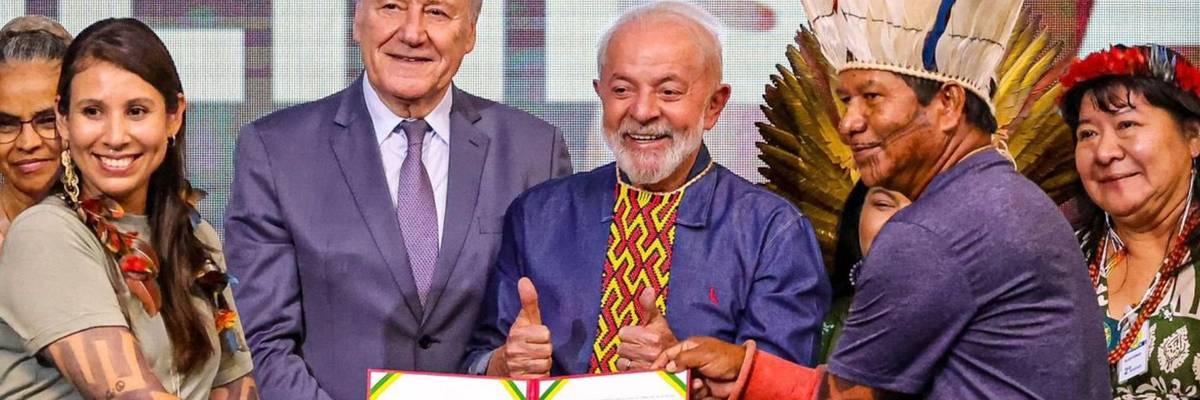
Brazilian President Luiz Inácio Lula da Silva (center, with thumbs up) poses for a photo with Indigenous and government leaders after signing decrees demarcating tribal lands, on April 18, 2024 in Brasília.
"This is revolting for us Indigenous peoples to have had so much faith in the government's commitments to our rights and the demarcation of our territories," said one Indigenous leader.
Friday is Indigenous Peoples Day in Brazil, and tribal leaders and activists used the occasion to criticize the left-wing government of Brazilian President Luiz Inácio Lula da Silva for falling short on promises to safeguard native land rights.
On Thursday, the Brazilian government announced the demarcation of Aldeia Velha, land of the Pataxó people, in the northeastern state of Bahia, as well as the territory of the Karajá people in Cacique Fontoura, Mato Grosso.
"Since the beginning of the current government, 10 areas have been regularized out of a total of 14 routed for approval," the government said in a statement. "The act reaffirms the focus of the federal government on the protection and respect of Indigenous peoples."
However, Indigenous peoples were anticipating the demarcation of six new territories. Lula acknowledged their disappointment.
"I know you are apprehensive and expected the demarcation of six Indigenous lands. But now we only announce two. And I'm being real with you," he said.
"Some of this missing land is occupied either by farmers or peasants," the president explained. "We cannot arrive without giving these people an alternative. Some governors asked for time to resolve, in a negotiated manner, the eviction of these territories so that we can demarcate them."
"The definition of these lands is already ready. What we do not want is to promise you today, and tomorrow you read in the newspaper, that a contrary decision was made," Lula added. "The frustration would be greater."
But the frustration was already there—and growing.
"This is revolting for us Indigenous peoples to have had so much faith in the government's commitments to our rights and the demarcation of our territories," Alessandra Korap Munduruku, a member of the Munduruku people and a 2023 winner of the prestigious Goldman Environmental Prize, told Amazon Watch in a statement published Friday.
"We hear all of these discussions about environmental and climate protection, but without support for Indigenous peoples on the front lines, suffering serious attacks and threats. Lula cannot speak about fighting climate change without fulfilling his duty to demarcate our lands," she added.
Articulation of Indigenous Peoples of Brazil (APIB), an umbrella group, said in a statement earlier this week that "the most serious thing is that the Lula government is tarnishing its historical trajectory."
"Since campaigning for his first term in 2002, the president has committed to demarcating Indigenous lands, but he was one of the governments that demarcated the least," the group contended. "And now, like other old and conservative governments, in the name of the country's progress and economic development, [Lula's government] undermines the basis of Indigenous peoples' existence, becoming hostage to the market, the powerbrokers, agribusiness, evangelicals, and the military."
APIB demanded that Lula "put an end to the criminal organizations that intimidate our people and communities, persecute and murder our leaders" and "dedicate farms for agrarian reform and demarcate our lands, which have been invaded and plundered for centuries by the invaders who arrived here 524 years ago and their current descendants."
Thousands of Indigenous peoples from throughout Brazil are expected to rally in the capital Brasília next week for the Terra Livre—or Free Land, camp—the country's largest annual native mobilization. Two years ago, Lula, then a presidential candidate, told Terra Livre attendees that he would end illegal mining on Indigenous lands. Despite a crackdown that resulted in an initial dramatic drop in illicit mineral extraction on Indigenous lands, illegal miners have returned with a vengeance in places including land belonging to the Yanomami people.
Criticism of Lula's demarcation process and the Brazilian government's Indigenous rights record came from outside Brazil as well.
" Human rights defenders are under extreme threat in Brazil. The federal government knows this but has so far failed to put the structures in place to provide them with better protection and tackle the root causes of the risks they face," Mary Lawlor, the United Nations special rapporteur on the situation of human rights defenders, in a Friday statement after an official visit to Brazil.
"Land is also the key to the protection of these defenders," she continued. "When I asked them what they thought would protect them they were clear: removal of invaders and demarcation now; accountability for environmental crimes. This for them is what collective protection, which is what is needed, means."
"There must be demarcation and titling," Lawlor added. "There can be no more delay."
Dear Common Dreams reader, It’s been nearly 30 years since I co-founded Common Dreams with my late wife, Lina Newhouser. We had the radical notion that journalism should serve the public good, not corporate profits. It was clear to us from the outset what it would take to build such a project. No paid advertisements. No corporate sponsors. No millionaire publisher telling us what to think or do. Many people said we wouldn't last a year, but we proved those doubters wrong. Together with a tremendous team of journalists and dedicated staff, we built an independent media outlet free from the constraints of profits and corporate control. Our mission has always been simple: To inform. To inspire. To ignite change for the common good. Building Common Dreams was not easy. Our survival was never guaranteed. When you take on the most powerful forces—Wall Street greed, fossil fuel industry destruction, Big Tech lobbyists, and uber-rich oligarchs who have spent billions upon billions rigging the economy and democracy in their favor—the only bulwark you have is supporters who believe in your work. But here’s the urgent message from me today. It's never been this bad out there. And it's never been this hard to keep us going. At the very moment Common Dreams is most needed, the threats we face are intensifying. We need your support now more than ever. We don't accept corporate advertising and never will. We don't have a paywall because we don't think people should be blocked from critical news based on their ability to pay. Everything we do is funded by the donations of readers like you. When everyone does the little they can afford, we are strong. But if that support retreats or dries up, so do we. Will you donate now to make sure Common Dreams not only survives but thrives? —Craig Brown, Co-founder |
Friday is Indigenous Peoples Day in Brazil, and tribal leaders and activists used the occasion to criticize the left-wing government of Brazilian President Luiz Inácio Lula da Silva for falling short on promises to safeguard native land rights.
On Thursday, the Brazilian government announced the demarcation of Aldeia Velha, land of the Pataxó people, in the northeastern state of Bahia, as well as the territory of the Karajá people in Cacique Fontoura, Mato Grosso.
"Since the beginning of the current government, 10 areas have been regularized out of a total of 14 routed for approval," the government said in a statement. "The act reaffirms the focus of the federal government on the protection and respect of Indigenous peoples."
However, Indigenous peoples were anticipating the demarcation of six new territories. Lula acknowledged their disappointment.
"I know you are apprehensive and expected the demarcation of six Indigenous lands. But now we only announce two. And I'm being real with you," he said.
"Some of this missing land is occupied either by farmers or peasants," the president explained. "We cannot arrive without giving these people an alternative. Some governors asked for time to resolve, in a negotiated manner, the eviction of these territories so that we can demarcate them."
"The definition of these lands is already ready. What we do not want is to promise you today, and tomorrow you read in the newspaper, that a contrary decision was made," Lula added. "The frustration would be greater."
But the frustration was already there—and growing.
"This is revolting for us Indigenous peoples to have had so much faith in the government's commitments to our rights and the demarcation of our territories," Alessandra Korap Munduruku, a member of the Munduruku people and a 2023 winner of the prestigious Goldman Environmental Prize, told Amazon Watch in a statement published Friday.
"We hear all of these discussions about environmental and climate protection, but without support for Indigenous peoples on the front lines, suffering serious attacks and threats. Lula cannot speak about fighting climate change without fulfilling his duty to demarcate our lands," she added.
Articulation of Indigenous Peoples of Brazil (APIB), an umbrella group, said in a statement earlier this week that "the most serious thing is that the Lula government is tarnishing its historical trajectory."
"Since campaigning for his first term in 2002, the president has committed to demarcating Indigenous lands, but he was one of the governments that demarcated the least," the group contended. "And now, like other old and conservative governments, in the name of the country's progress and economic development, [Lula's government] undermines the basis of Indigenous peoples' existence, becoming hostage to the market, the powerbrokers, agribusiness, evangelicals, and the military."
APIB demanded that Lula "put an end to the criminal organizations that intimidate our people and communities, persecute and murder our leaders" and "dedicate farms for agrarian reform and demarcate our lands, which have been invaded and plundered for centuries by the invaders who arrived here 524 years ago and their current descendants."
Thousands of Indigenous peoples from throughout Brazil are expected to rally in the capital Brasília next week for the Terra Livre—or Free Land, camp—the country's largest annual native mobilization. Two years ago, Lula, then a presidential candidate, told Terra Livre attendees that he would end illegal mining on Indigenous lands. Despite a crackdown that resulted in an initial dramatic drop in illicit mineral extraction on Indigenous lands, illegal miners have returned with a vengeance in places including land belonging to the Yanomami people.
Criticism of Lula's demarcation process and the Brazilian government's Indigenous rights record came from outside Brazil as well.
" Human rights defenders are under extreme threat in Brazil. The federal government knows this but has so far failed to put the structures in place to provide them with better protection and tackle the root causes of the risks they face," Mary Lawlor, the United Nations special rapporteur on the situation of human rights defenders, in a Friday statement after an official visit to Brazil.
"Land is also the key to the protection of these defenders," she continued. "When I asked them what they thought would protect them they were clear: removal of invaders and demarcation now; accountability for environmental crimes. This for them is what collective protection, which is what is needed, means."
"There must be demarcation and titling," Lawlor added. "There can be no more delay."
Friday is Indigenous Peoples Day in Brazil, and tribal leaders and activists used the occasion to criticize the left-wing government of Brazilian President Luiz Inácio Lula da Silva for falling short on promises to safeguard native land rights.
On Thursday, the Brazilian government announced the demarcation of Aldeia Velha, land of the Pataxó people, in the northeastern state of Bahia, as well as the territory of the Karajá people in Cacique Fontoura, Mato Grosso.
"Since the beginning of the current government, 10 areas have been regularized out of a total of 14 routed for approval," the government said in a statement. "The act reaffirms the focus of the federal government on the protection and respect of Indigenous peoples."
However, Indigenous peoples were anticipating the demarcation of six new territories. Lula acknowledged their disappointment.
"I know you are apprehensive and expected the demarcation of six Indigenous lands. But now we only announce two. And I'm being real with you," he said.
"Some of this missing land is occupied either by farmers or peasants," the president explained. "We cannot arrive without giving these people an alternative. Some governors asked for time to resolve, in a negotiated manner, the eviction of these territories so that we can demarcate them."
"The definition of these lands is already ready. What we do not want is to promise you today, and tomorrow you read in the newspaper, that a contrary decision was made," Lula added. "The frustration would be greater."
But the frustration was already there—and growing.
"This is revolting for us Indigenous peoples to have had so much faith in the government's commitments to our rights and the demarcation of our territories," Alessandra Korap Munduruku, a member of the Munduruku people and a 2023 winner of the prestigious Goldman Environmental Prize, told Amazon Watch in a statement published Friday.
"We hear all of these discussions about environmental and climate protection, but without support for Indigenous peoples on the front lines, suffering serious attacks and threats. Lula cannot speak about fighting climate change without fulfilling his duty to demarcate our lands," she added.
Articulation of Indigenous Peoples of Brazil (APIB), an umbrella group, said in a statement earlier this week that "the most serious thing is that the Lula government is tarnishing its historical trajectory."
"Since campaigning for his first term in 2002, the president has committed to demarcating Indigenous lands, but he was one of the governments that demarcated the least," the group contended. "And now, like other old and conservative governments, in the name of the country's progress and economic development, [Lula's government] undermines the basis of Indigenous peoples' existence, becoming hostage to the market, the powerbrokers, agribusiness, evangelicals, and the military."
APIB demanded that Lula "put an end to the criminal organizations that intimidate our people and communities, persecute and murder our leaders" and "dedicate farms for agrarian reform and demarcate our lands, which have been invaded and plundered for centuries by the invaders who arrived here 524 years ago and their current descendants."
Thousands of Indigenous peoples from throughout Brazil are expected to rally in the capital Brasília next week for the Terra Livre—or Free Land, camp—the country's largest annual native mobilization. Two years ago, Lula, then a presidential candidate, told Terra Livre attendees that he would end illegal mining on Indigenous lands. Despite a crackdown that resulted in an initial dramatic drop in illicit mineral extraction on Indigenous lands, illegal miners have returned with a vengeance in places including land belonging to the Yanomami people.
Criticism of Lula's demarcation process and the Brazilian government's Indigenous rights record came from outside Brazil as well.
" Human rights defenders are under extreme threat in Brazil. The federal government knows this but has so far failed to put the structures in place to provide them with better protection and tackle the root causes of the risks they face," Mary Lawlor, the United Nations special rapporteur on the situation of human rights defenders, in a Friday statement after an official visit to Brazil.
"Land is also the key to the protection of these defenders," she continued. "When I asked them what they thought would protect them they were clear: removal of invaders and demarcation now; accountability for environmental crimes. This for them is what collective protection, which is what is needed, means."
"There must be demarcation and titling," Lawlor added. "There can be no more delay."