

SUBSCRIBE TO OUR FREE NEWSLETTER
Daily news & progressive opinion—funded by the people, not the corporations—delivered straight to your inbox.
5
#000000
#FFFFFF
To donate by check, phone, or other method, see our More Ways to Give page.
Daily news & progressive opinion—funded by the people, not the corporations—delivered straight to your inbox.
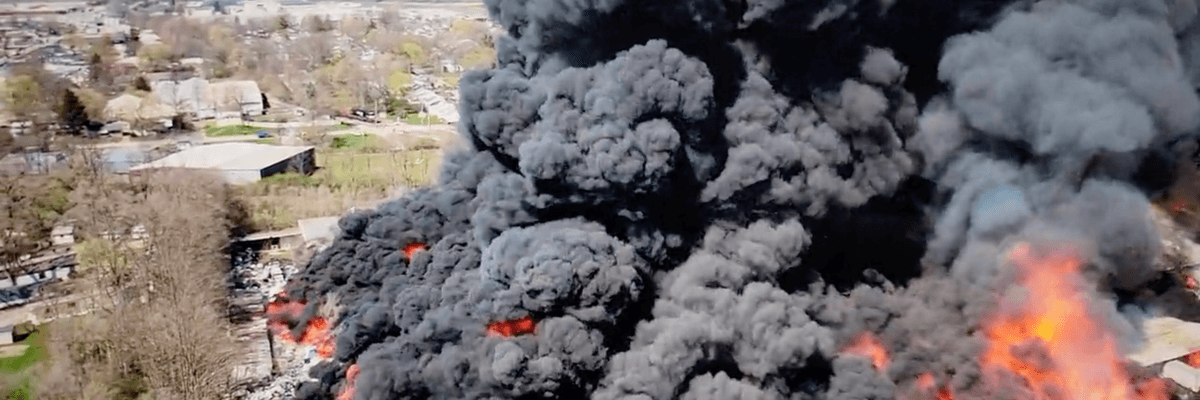
Huge clouds of black smoke from a fire that began on April 11, 2023 are seen at a plastics factory in Richmond, Indiana.
"There is a host of different chemicals that plastics give off when they're on fire, and it's concerning," said the state fire marshal.
Officials in the city of Richmond, Indiana said Wednesday that a fire that broke out at a plastics facility Tuesday is expected to continue burning for several days, sending huge plumes of black smoke—that doubtlessly contain toxins—into the environment there.
Authorities have not released the name of the business owner or company, but The New York Times reported that the complex was formerly owned by Hoffco/Comet Industries, which produced garden and lawn motors before closing in 2009. The facility is now used to store large amounts of plastic for resale and recycling.
"The smoke is definitely toxic," said Indiana State Fire Marshal Steve Jones in a news briefing on Tuesday. "There is a host of different chemicals that plastics give off when they're on fire, and it's concerning."
About 2,000 people in a half-mile radius of the blaze were ordered to evacuate the area Tuesday, and officials don't know when the order will be lifted. The Richmond Community School District cancelled classes for the entire town on Wednesday.
The smoke was drifting toward the east and northeast on Tuesday, and Richmond residents whose homes are in the path of the smoke were advised to "shelter in place, turn off HVAC units, keep windows and doors closed, and bring pets inside."
The U.S. Environmental Protection Agency (EPA) and Indiana Department of Environmental Management began taking air samples in the area on Tuesday to help determine what toxins have been released from the fire.
Chemicals that can be released from plastic when it burns include dioxins, furans, mercury, and polychlorinated biphenyls (PCBs). Dioxins, furans, and PCBs have similar toxicity levels, according to the Centers for Disease Control and Prevention (CDC), which says that "people who have been unintentionally exposed to large amounts of these chemicals have developed a skin condition called chloracne, liver problems, and elevated blood lipids."
Animals exposed to the chemicals in lab studies have developed cancers and reproductive problems.
Exposure to high amounts of mercury can rapidly cause serious lung damage, and low concentrations can cause "neurological disturbances, memory problems, skin rash, and kidney abnormalities," according to the CDC.
Richmond Fire Chief Tim Brown told CNN that firefighters who arrived at the scene Tuesday afternoon found a semitrailer behind the facility engulfed in flames that spread to piles of plastic on the property and to several buildings in the 14-acre complex.
"We knew it wasn't a matter of if, it was a matter of when this was going to happen," he said at the press briefing.
Richmond Mayor Dave Snow told the Associated Press that the owner had been "under a city order to clean up and remediate that site," but had not obeyed the order.
Philadelphia Inquirer columnist Will Bunch argued that the disaster would not have happened without the fossil fuel industry "foisting plastics on the world as its 'Plan B' to sustain its profitability."
"Worldwide production of plastic has nearly doubled since the start of the 21st century, as oil and gas giants look for profitable uses of their fossil fuels while a climate-change-weary world looks increasingly to transition toward wind or solar power or electric cars," Bunch wrote late last month after several environmental disasters threatened drinking water and the environment in communities across Pennsylvania.
Dear Common Dreams reader, It’s been nearly 30 years since I co-founded Common Dreams with my late wife, Lina Newhouser. We had the radical notion that journalism should serve the public good, not corporate profits. It was clear to us from the outset what it would take to build such a project. No paid advertisements. No corporate sponsors. No millionaire publisher telling us what to think or do. Many people said we wouldn't last a year, but we proved those doubters wrong. Together with a tremendous team of journalists and dedicated staff, we built an independent media outlet free from the constraints of profits and corporate control. Our mission has always been simple: To inform. To inspire. To ignite change for the common good. Building Common Dreams was not easy. Our survival was never guaranteed. When you take on the most powerful forces—Wall Street greed, fossil fuel industry destruction, Big Tech lobbyists, and uber-rich oligarchs who have spent billions upon billions rigging the economy and democracy in their favor—the only bulwark you have is supporters who believe in your work. But here’s the urgent message from me today. It's never been this bad out there. And it's never been this hard to keep us going. At the very moment Common Dreams is most needed, the threats we face are intensifying. We need your support now more than ever. We don't accept corporate advertising and never will. We don't have a paywall because we don't think people should be blocked from critical news based on their ability to pay. Everything we do is funded by the donations of readers like you. When everyone does the little they can afford, we are strong. But if that support retreats or dries up, so do we. Will you donate now to make sure Common Dreams not only survives but thrives? —Craig Brown, Co-founder |
Officials in the city of Richmond, Indiana said Wednesday that a fire that broke out at a plastics facility Tuesday is expected to continue burning for several days, sending huge plumes of black smoke—that doubtlessly contain toxins—into the environment there.
Authorities have not released the name of the business owner or company, but The New York Times reported that the complex was formerly owned by Hoffco/Comet Industries, which produced garden and lawn motors before closing in 2009. The facility is now used to store large amounts of plastic for resale and recycling.
"The smoke is definitely toxic," said Indiana State Fire Marshal Steve Jones in a news briefing on Tuesday. "There is a host of different chemicals that plastics give off when they're on fire, and it's concerning."
About 2,000 people in a half-mile radius of the blaze were ordered to evacuate the area Tuesday, and officials don't know when the order will be lifted. The Richmond Community School District cancelled classes for the entire town on Wednesday.
The smoke was drifting toward the east and northeast on Tuesday, and Richmond residents whose homes are in the path of the smoke were advised to "shelter in place, turn off HVAC units, keep windows and doors closed, and bring pets inside."
The U.S. Environmental Protection Agency (EPA) and Indiana Department of Environmental Management began taking air samples in the area on Tuesday to help determine what toxins have been released from the fire.
Chemicals that can be released from plastic when it burns include dioxins, furans, mercury, and polychlorinated biphenyls (PCBs). Dioxins, furans, and PCBs have similar toxicity levels, according to the Centers for Disease Control and Prevention (CDC), which says that "people who have been unintentionally exposed to large amounts of these chemicals have developed a skin condition called chloracne, liver problems, and elevated blood lipids."
Animals exposed to the chemicals in lab studies have developed cancers and reproductive problems.
Exposure to high amounts of mercury can rapidly cause serious lung damage, and low concentrations can cause "neurological disturbances, memory problems, skin rash, and kidney abnormalities," according to the CDC.
Richmond Fire Chief Tim Brown told CNN that firefighters who arrived at the scene Tuesday afternoon found a semitrailer behind the facility engulfed in flames that spread to piles of plastic on the property and to several buildings in the 14-acre complex.
"We knew it wasn't a matter of if, it was a matter of when this was going to happen," he said at the press briefing.
Richmond Mayor Dave Snow told the Associated Press that the owner had been "under a city order to clean up and remediate that site," but had not obeyed the order.
Philadelphia Inquirer columnist Will Bunch argued that the disaster would not have happened without the fossil fuel industry "foisting plastics on the world as its 'Plan B' to sustain its profitability."
"Worldwide production of plastic has nearly doubled since the start of the 21st century, as oil and gas giants look for profitable uses of their fossil fuels while a climate-change-weary world looks increasingly to transition toward wind or solar power or electric cars," Bunch wrote late last month after several environmental disasters threatened drinking water and the environment in communities across Pennsylvania.
Officials in the city of Richmond, Indiana said Wednesday that a fire that broke out at a plastics facility Tuesday is expected to continue burning for several days, sending huge plumes of black smoke—that doubtlessly contain toxins—into the environment there.
Authorities have not released the name of the business owner or company, but The New York Times reported that the complex was formerly owned by Hoffco/Comet Industries, which produced garden and lawn motors before closing in 2009. The facility is now used to store large amounts of plastic for resale and recycling.
"The smoke is definitely toxic," said Indiana State Fire Marshal Steve Jones in a news briefing on Tuesday. "There is a host of different chemicals that plastics give off when they're on fire, and it's concerning."
About 2,000 people in a half-mile radius of the blaze were ordered to evacuate the area Tuesday, and officials don't know when the order will be lifted. The Richmond Community School District cancelled classes for the entire town on Wednesday.
The smoke was drifting toward the east and northeast on Tuesday, and Richmond residents whose homes are in the path of the smoke were advised to "shelter in place, turn off HVAC units, keep windows and doors closed, and bring pets inside."
The U.S. Environmental Protection Agency (EPA) and Indiana Department of Environmental Management began taking air samples in the area on Tuesday to help determine what toxins have been released from the fire.
Chemicals that can be released from plastic when it burns include dioxins, furans, mercury, and polychlorinated biphenyls (PCBs). Dioxins, furans, and PCBs have similar toxicity levels, according to the Centers for Disease Control and Prevention (CDC), which says that "people who have been unintentionally exposed to large amounts of these chemicals have developed a skin condition called chloracne, liver problems, and elevated blood lipids."
Animals exposed to the chemicals in lab studies have developed cancers and reproductive problems.
Exposure to high amounts of mercury can rapidly cause serious lung damage, and low concentrations can cause "neurological disturbances, memory problems, skin rash, and kidney abnormalities," according to the CDC.
Richmond Fire Chief Tim Brown told CNN that firefighters who arrived at the scene Tuesday afternoon found a semitrailer behind the facility engulfed in flames that spread to piles of plastic on the property and to several buildings in the 14-acre complex.
"We knew it wasn't a matter of if, it was a matter of when this was going to happen," he said at the press briefing.
Richmond Mayor Dave Snow told the Associated Press that the owner had been "under a city order to clean up and remediate that site," but had not obeyed the order.
Philadelphia Inquirer columnist Will Bunch argued that the disaster would not have happened without the fossil fuel industry "foisting plastics on the world as its 'Plan B' to sustain its profitability."
"Worldwide production of plastic has nearly doubled since the start of the 21st century, as oil and gas giants look for profitable uses of their fossil fuels while a climate-change-weary world looks increasingly to transition toward wind or solar power or electric cars," Bunch wrote late last month after several environmental disasters threatened drinking water and the environment in communities across Pennsylvania.

