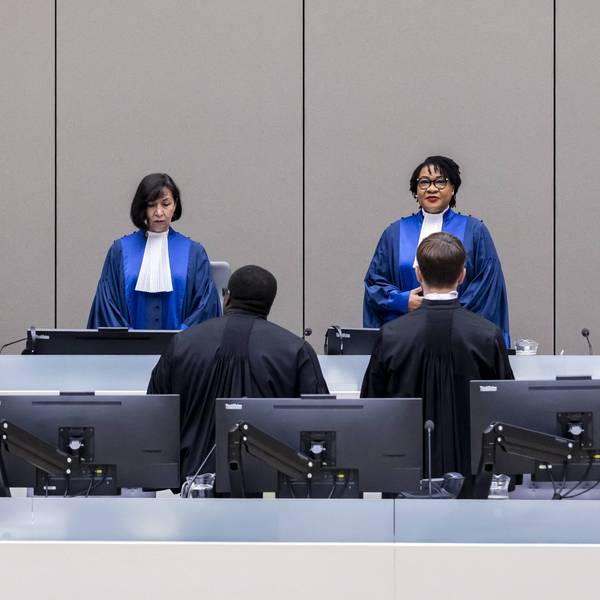

International Criminal Court Prosecutor Karim Khan delivers an address before Venezuela's National Assembly in Caracas on April 22, 2024.
80+ Groups Urge Congress, Trump to Reconsider Sanctions on ICC
"It would be a terrible irony if a tool designed to penalize gross violators of human rights could instead contribute to their continued impunity."
Scores of advocacy groups on Monday published a joint open letter decrying proposed U.S. legislation targeting the International Criminal Court with sanctions in retaliation for the tribunal's recent issuance of arrest warrants for Israeli leaders accused of war crimes and crimes against humanity in Gaza.
The Washington Working Group on the International Criminal Court published the letter—which has been signed by over 80 groups as of Monday afternoon—stressing that "the ICC performs a vital role in international affairs by investigating the worst international crimes that shock the collective conscience of humanity and investigating those accused of committing those crimes."
"The positive role of the ICC has been recognized through previous bipartisan support."
"It does so in a manner that protects the due process rights of the accused, the sovereignty of states, including the United States, and the rights of victims," the letter asserts. "As has been widely observed, supporting the work of the court is in the interest of the United States, and sanctioning it, conversely, undermines important U.S. interests."
"The positive role of the ICC has been recognized through previous bipartisan support for investigations into war crimes allegedly perpetrated by Russian officials in the Ukraine conflict... attempts to bring justice for the victims of gross human rights violations in Myanmar, and as a pathway to accountability for perpetrators of atrocities in Sudan," the letter adds.
On Friday far-right Congressmen Chip Roy (R-Texas) and Brian Mast (R-Fla.) introduced H.R. 23, the Illegitimate Court Counteraction Act, which would "impose sanctions with respect to the International Criminal Court engaged in any effort to investigate, arrest, detain, or prosecute any protected person of the United States and its allies."
The bill, which was fast-tracked by the 119th House rules package, was initially approved last June by the Republican-controlled lower chamber with the support of 42 Democratic lawmakers. However, the measure failed to pass the Democrat-controlled Senate. Republicans now control both houses of Congress.
"As human rights, legal, and faith-based organizations, the foundations of civil society, as well as individuals who have dedicated their careers to these causes, we decry attempts to attack an independent judicial institution and urge the 119th Congress and incoming administration to reconsider this misguided position," the letter's signers asserted.
Signatories include the ACLU, Al Haq, Amnesty International USA, Center for Constitutional Rights, Democracy for the Arab World Now, Human Rights Watch, Pax Christi USA, Peace Action, Physicians for Human Rights, and Veterans for Peace.
In November, the ICC issued arrest warrants for Israeli Prime Minister Benjamin Netanyahu, his former Defense Minister Yoav Gallant, and Hamas leader Mohammed Diab Ibrahim Al-Masri.
Outgoing Democratic President Joe Biden and Republican President-elect Donald Trump have both condemned the ICC's effort to arrest Israeli leaders, although Biden has spoken out against H.R. 23.
Rep. Mike Waltz (R-Fla.), Trump's pick for national security adviser, is a vocal supporter of Israel's 15-month assault on Gaza, which has left more than 165,000 Palestinians dead, wounded, or missing. Waltz, who supports the sanctions bill, threatened a "strong response" to the tribunal's warrants.
The United States—which provides Israel with tens of billions of dollars in
armed aid and diplomatic cover—has reportedly worked with Israel to thwart the ICC's effort to arrest Israeli leaders.
Neither Israel or the U.S. are signatories to the
Rome Statute, the treaty underpinning the ICC. However, Palestine is a party to the treaty, and nonsignatories can be held liable for crimes committed there.
The U.S. has a decadeslong history of antagonism toward the ICC. Under the American Service Members' Protection Act—Bush administration-era legislation also known as the Hague Invasion Act—the president is authorized to use "all means necessary and appropriate" including military intervention to secure the release of American or allied personnel held by or on behalf of the ICC.
In 2019, Trump revoked the U.S. visa of then-ICC Prosecutor Fatou Bensouda for trying to investigate alleged war crimes committed by American forces in Afghanistan. The following year, the Trump administration sanctioned Bensouda and Phakiso Mochochoko, the court's prosecution jurisdiction division director at the time.
"At an historical moment when the global rule of law is under attack from multiple fronts, institutions like the International Criminal Court are needed more than ever to advance human rights protections and the universal goal of preventing future atrocities and advancing justice for victims," the new letter's signers argued.
"Instead, sanctions send a signal that could embolden authoritarian regimes and others with reason to fear accountability who seek to evade justice," the letter continues. "It is essential that the United States answer any allegation of wrongdoing in a manner that does not betray the cause of global justice, abandon international cooperation, or compromise support for human dignity and rights."
"It would be a terrible irony if a tool designed to penalize gross violators of human rights could instead contribute to their continued impunity," the letter concludes. "We urge other governments, members of Congress, and advocates for victims everywhere to raise their voices to oppose attacks on the independence and autonomy of international judicial institutions like the ICC. We invite allies of justice to join us in standing against these destructive measures."
We are at a crossroads
This country and this world are at a monumental crossroads. In a few short weeks, US voters will have an opportunity to beat back the forces of fascism and confront the billionaires who are rigging the economy, our media system, and our democracy, making it increasingly impossible for ordinary people to get by. We’re not just talking about the election. We’re talking about what must be done once these fascist elements are vanquished from power. We need a bolder set of solutions than what either major party has so far been willing to offer and a working-class movement ready to fight like hell for it. Trump didn't emerge from nowhere. The conditions that fueled MAGA authoritarianism were created by decades of radical neoliberal economic policies and a corrupt political system dominated by corporate interests. They slashed taxes on the super-rich, promising that the benefits would trickle down. They said giveaways to the corporate titans would make life more affordable for the rest of us. It was all bullshit. And when a bitter, betrayed populace searches for someone to blame, right-wing demagogues have little trouble finding scapegoats. People know when they're being lied to, but you won't hear any of this from the corporate media. Only independent journalism—powered and funded by people who believe in building a better world—can deliver truly trustworthy daily news. Our Fall Campaign is underway, and we need your help. To power our newsroom through the rest of the year, we need to raise $125,000 by midnight on October 31. So if you share our vision, please contribute whatever you can to sustain our work. |
Scores of advocacy groups on Monday published a joint open letter decrying proposed U.S. legislation targeting the International Criminal Court with sanctions in retaliation for the tribunal's recent issuance of arrest warrants for Israeli leaders accused of war crimes and crimes against humanity in Gaza.
The Washington Working Group on the International Criminal Court published the letter—which has been signed by over 80 groups as of Monday afternoon—stressing that "the ICC performs a vital role in international affairs by investigating the worst international crimes that shock the collective conscience of humanity and investigating those accused of committing those crimes."
"The positive role of the ICC has been recognized through previous bipartisan support."
"It does so in a manner that protects the due process rights of the accused, the sovereignty of states, including the United States, and the rights of victims," the letter asserts. "As has been widely observed, supporting the work of the court is in the interest of the United States, and sanctioning it, conversely, undermines important U.S. interests."
"The positive role of the ICC has been recognized through previous bipartisan support for investigations into war crimes allegedly perpetrated by Russian officials in the Ukraine conflict... attempts to bring justice for the victims of gross human rights violations in Myanmar, and as a pathway to accountability for perpetrators of atrocities in Sudan," the letter adds.
On Friday far-right Congressmen Chip Roy (R-Texas) and Brian Mast (R-Fla.) introduced H.R. 23, the Illegitimate Court Counteraction Act, which would "impose sanctions with respect to the International Criminal Court engaged in any effort to investigate, arrest, detain, or prosecute any protected person of the United States and its allies."
The bill, which was fast-tracked by the 119th House rules package, was initially approved last June by the Republican-controlled lower chamber with the support of 42 Democratic lawmakers. However, the measure failed to pass the Democrat-controlled Senate. Republicans now control both houses of Congress.
"As human rights, legal, and faith-based organizations, the foundations of civil society, as well as individuals who have dedicated their careers to these causes, we decry attempts to attack an independent judicial institution and urge the 119th Congress and incoming administration to reconsider this misguided position," the letter's signers asserted.
Signatories include the ACLU, Al Haq, Amnesty International USA, Center for Constitutional Rights, Democracy for the Arab World Now, Human Rights Watch, Pax Christi USA, Peace Action, Physicians for Human Rights, and Veterans for Peace.
In November, the ICC issued arrest warrants for Israeli Prime Minister Benjamin Netanyahu, his former Defense Minister Yoav Gallant, and Hamas leader Mohammed Diab Ibrahim Al-Masri.
Outgoing Democratic President Joe Biden and Republican President-elect Donald Trump have both condemned the ICC's effort to arrest Israeli leaders, although Biden has spoken out against H.R. 23.
Rep. Mike Waltz (R-Fla.), Trump's pick for national security adviser, is a vocal supporter of Israel's 15-month assault on Gaza, which has left more than 165,000 Palestinians dead, wounded, or missing. Waltz, who supports the sanctions bill, threatened a "strong response" to the tribunal's warrants.
The United States—which provides Israel with tens of billions of dollars in
armed aid and diplomatic cover—has reportedly worked with Israel to thwart the ICC's effort to arrest Israeli leaders.
Neither Israel or the U.S. are signatories to the
Rome Statute, the treaty underpinning the ICC. However, Palestine is a party to the treaty, and nonsignatories can be held liable for crimes committed there.
The U.S. has a decadeslong history of antagonism toward the ICC. Under the American Service Members' Protection Act—Bush administration-era legislation also known as the Hague Invasion Act—the president is authorized to use "all means necessary and appropriate" including military intervention to secure the release of American or allied personnel held by or on behalf of the ICC.
In 2019, Trump revoked the U.S. visa of then-ICC Prosecutor Fatou Bensouda for trying to investigate alleged war crimes committed by American forces in Afghanistan. The following year, the Trump administration sanctioned Bensouda and Phakiso Mochochoko, the court's prosecution jurisdiction division director at the time.
"At an historical moment when the global rule of law is under attack from multiple fronts, institutions like the International Criminal Court are needed more than ever to advance human rights protections and the universal goal of preventing future atrocities and advancing justice for victims," the new letter's signers argued.
"Instead, sanctions send a signal that could embolden authoritarian regimes and others with reason to fear accountability who seek to evade justice," the letter continues. "It is essential that the United States answer any allegation of wrongdoing in a manner that does not betray the cause of global justice, abandon international cooperation, or compromise support for human dignity and rights."
"It would be a terrible irony if a tool designed to penalize gross violators of human rights could instead contribute to their continued impunity," the letter concludes. "We urge other governments, members of Congress, and advocates for victims everywhere to raise their voices to oppose attacks on the independence and autonomy of international judicial institutions like the ICC. We invite allies of justice to join us in standing against these destructive measures."
- GOP Senators Threaten ICC: 'Target Israel and We Will Target You' ›
- Former ICC Prosecutor Says Both Israel and Hamas Guilty of Genocide ›
- Trump Sanctions on ICC Decried as 'Lawless Israel First' Policy | Common Dreams ›
- ICC Condemns Trump Sanctions as UN Human Rights Office Demands Reversal | Common Dreams ›
- Human Rights Defenders File Suit Over Trump's 'Unconstitutional' ICC Sanctions | Common Dreams ›
- Opinion | Sanctions Against Israel Are Long Overdue | Common Dreams ›