SUBSCRIBE TO OUR FREE NEWSLETTER
Daily news & progressive opinion—funded by the people, not the corporations—delivered straight to your inbox.
5
#000000
#FFFFFF
To donate by check, phone, or other method, see our More Ways to Give page.
Daily news & progressive opinion—funded by the people, not the corporations—delivered straight to your inbox.
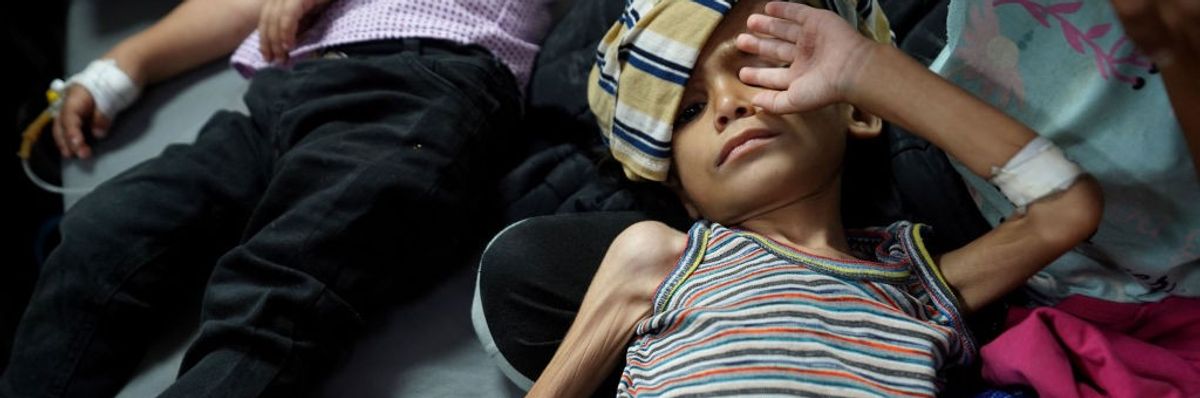
Children receive malnourishment treatment at Al-Aqsa Martyrs Hospital in Deir al-Balah in the central Gaza Strip on May 30, 2024, amid Israel's ongoing assault on the besieged enclave.
"The international community must apply relentless pressure to achieve a cease-fire and ensure sustained humanitarian access now," said one advocate.
More than 1 in 5 people in the Gaza Strip are "facing catastrophic levels of food insecurity" amid Israel's relentless assault and siege against the Palestinian territory, according to a draft report set to be published Tuesday by the United Nations' hunger monitoring system.
The latest Integrated Food Security Phase Classification (IPC) Acute Food Insecurity Special Snapshot—which was previewed by various news agencies—says that more than 495,000 Gazans—who already face "an extreme lack of food, starvation, and exhaustion"—are expected to suffer the highest level of starvation over the coming months.
The draft report states that while a sharp increase in food aid in northern Gaza in March and April can be credited with "likely averting a famine," the situation is "deteriorating again following renewed hostilities."
"A high risk of famine persists across the whole of the Gaza Strip as long as conflict continues and humanitarian access is restricted," IPC noted.
The IPC draft report also says more than half of all Gaza households had to sell or swap clothing in order to obtain food, and that the majority of Gazan families often "do not have any food to eat in the house, and over 20% go entire days and nights without eating."
"The population cannot endure these hardships any longer."
Kate Phillips-Barrasso, vice president of global policy and advocacy at Mercy Corps, an Oregon-based humanitarian NGO, told The Guardian that "people are enduring subhuman conditions resorting to desperate measures like boiling weeds, eating animal feed, and exchanging clothes for money to stave off hunger and keep their children alive."
"The humanitarian situation is deteriorating rapidly, and the specter of famine continues to hang over Gaza," she added. "The international community must apply relentless pressure to achieve a cease-fire and ensure sustained humanitarian access now. The population cannot endure these hardships any longer."
Although the IPC stopped short of the rare step of declaring a famine in Gaza, it warned that "the recent trajectory is negative and highly unstable."
"Should this continue, the improvements seen in April could be rapidly reversed," the agency added.
The IPC's famine review panel previously said there is not enough data to make a determination on whether there is a famine in Gaza since research was being blocked by "conflict and humanitarian access constraints."
The Geneva-based group Euro-Mediterranean Human Rights Monitor said Monday that "the Famine Review Committee's inability to declare the current food situation in the Gaza Strip to be a famine does not negate the existence of famine in the strip, as pockets of famine are forming and spreading among different age groups, particularly children, and there is a noticeable increase in deaths from hunger, malnutrition, and related diseases."
"The committee's failure to declare the existence of a famine is solely related to its inability to provide certain technical information because of illegal Israeli restrictions and policies that aim to conceal evidence related to the crimes it commits and prevent criminal investigations into them by independent U.N. and international committees, particularly by preventing these committees from entering the strip," the group added.
U.N. World Food Program Executive Director Cindy McCain said last month that "full-blown famine" had taken hold in Gaza and was spreading south. According to Gaza officials, at least 40 people—mostly children—have died from malnutrition and dehydration during the 262-day Israeli onslaught. Almost all of the victims are from northern Gaza.
Israel began bombing, and later invaded, Gaza after Hamas-led attacks left more than 1,100 Israelis and others dead and over 240 others kidnapped on October 7. At least some of the victims were killed by Israeli forces in so-called "friendly fire" incidents, according to Israeli and international media reports.
Since then, Israeli forces have killed at least 37,626 Palestinians—most of them women and children—in Gaza, while wounding over 86,000 others, according to Palestinian and international agencies. At least 11,000 people, including over 4,000 children, are missing and presumed dead and buried beneath the rubble of hundreds of thousands of bombed-out homes and other buildings.
Michael Fakhri, the United Nations special rapporteur on the right to food and a law professor at the University of Oregon, said in late February that Israel is committing genocide by intentionally starving Gazans. Israel's siege—and Israeli attacks on humanitarian aid shipments, workers, and recipients—are being reviewed by the International Court of Justice as part of a South Africa-led genocide case backed by over 30 countries and regional blocs.
Dear Common Dreams reader, It’s been nearly 30 years since I co-founded Common Dreams with my late wife, Lina Newhouser. We had the radical notion that journalism should serve the public good, not corporate profits. It was clear to us from the outset what it would take to build such a project. No paid advertisements. No corporate sponsors. No millionaire publisher telling us what to think or do. Many people said we wouldn't last a year, but we proved those doubters wrong. Together with a tremendous team of journalists and dedicated staff, we built an independent media outlet free from the constraints of profits and corporate control. Our mission has always been simple: To inform. To inspire. To ignite change for the common good. Building Common Dreams was not easy. Our survival was never guaranteed. When you take on the most powerful forces—Wall Street greed, fossil fuel industry destruction, Big Tech lobbyists, and uber-rich oligarchs who have spent billions upon billions rigging the economy and democracy in their favor—the only bulwark you have is supporters who believe in your work. But here’s the urgent message from me today. It's never been this bad out there. And it's never been this hard to keep us going. At the very moment Common Dreams is most needed, the threats we face are intensifying. We need your support now more than ever. We don't accept corporate advertising and never will. We don't have a paywall because we don't think people should be blocked from critical news based on their ability to pay. Everything we do is funded by the donations of readers like you. When everyone does the little they can afford, we are strong. But if that support retreats or dries up, so do we. Will you donate now to make sure Common Dreams not only survives but thrives? —Craig Brown, Co-founder |
More than 1 in 5 people in the Gaza Strip are "facing catastrophic levels of food insecurity" amid Israel's relentless assault and siege against the Palestinian territory, according to a draft report set to be published Tuesday by the United Nations' hunger monitoring system.
The latest Integrated Food Security Phase Classification (IPC) Acute Food Insecurity Special Snapshot—which was previewed by various news agencies—says that more than 495,000 Gazans—who already face "an extreme lack of food, starvation, and exhaustion"—are expected to suffer the highest level of starvation over the coming months.
The draft report states that while a sharp increase in food aid in northern Gaza in March and April can be credited with "likely averting a famine," the situation is "deteriorating again following renewed hostilities."
"A high risk of famine persists across the whole of the Gaza Strip as long as conflict continues and humanitarian access is restricted," IPC noted.
The IPC draft report also says more than half of all Gaza households had to sell or swap clothing in order to obtain food, and that the majority of Gazan families often "do not have any food to eat in the house, and over 20% go entire days and nights without eating."
"The population cannot endure these hardships any longer."
Kate Phillips-Barrasso, vice president of global policy and advocacy at Mercy Corps, an Oregon-based humanitarian NGO, told The Guardian that "people are enduring subhuman conditions resorting to desperate measures like boiling weeds, eating animal feed, and exchanging clothes for money to stave off hunger and keep their children alive."
"The humanitarian situation is deteriorating rapidly, and the specter of famine continues to hang over Gaza," she added. "The international community must apply relentless pressure to achieve a cease-fire and ensure sustained humanitarian access now. The population cannot endure these hardships any longer."
Although the IPC stopped short of the rare step of declaring a famine in Gaza, it warned that "the recent trajectory is negative and highly unstable."
"Should this continue, the improvements seen in April could be rapidly reversed," the agency added.
The IPC's famine review panel previously said there is not enough data to make a determination on whether there is a famine in Gaza since research was being blocked by "conflict and humanitarian access constraints."
The Geneva-based group Euro-Mediterranean Human Rights Monitor said Monday that "the Famine Review Committee's inability to declare the current food situation in the Gaza Strip to be a famine does not negate the existence of famine in the strip, as pockets of famine are forming and spreading among different age groups, particularly children, and there is a noticeable increase in deaths from hunger, malnutrition, and related diseases."
"The committee's failure to declare the existence of a famine is solely related to its inability to provide certain technical information because of illegal Israeli restrictions and policies that aim to conceal evidence related to the crimes it commits and prevent criminal investigations into them by independent U.N. and international committees, particularly by preventing these committees from entering the strip," the group added.
U.N. World Food Program Executive Director Cindy McCain said last month that "full-blown famine" had taken hold in Gaza and was spreading south. According to Gaza officials, at least 40 people—mostly children—have died from malnutrition and dehydration during the 262-day Israeli onslaught. Almost all of the victims are from northern Gaza.
Israel began bombing, and later invaded, Gaza after Hamas-led attacks left more than 1,100 Israelis and others dead and over 240 others kidnapped on October 7. At least some of the victims were killed by Israeli forces in so-called "friendly fire" incidents, according to Israeli and international media reports.
Since then, Israeli forces have killed at least 37,626 Palestinians—most of them women and children—in Gaza, while wounding over 86,000 others, according to Palestinian and international agencies. At least 11,000 people, including over 4,000 children, are missing and presumed dead and buried beneath the rubble of hundreds of thousands of bombed-out homes and other buildings.
Michael Fakhri, the United Nations special rapporteur on the right to food and a law professor at the University of Oregon, said in late February that Israel is committing genocide by intentionally starving Gazans. Israel's siege—and Israeli attacks on humanitarian aid shipments, workers, and recipients—are being reviewed by the International Court of Justice as part of a South Africa-led genocide case backed by over 30 countries and regional blocs.
More than 1 in 5 people in the Gaza Strip are "facing catastrophic levels of food insecurity" amid Israel's relentless assault and siege against the Palestinian territory, according to a draft report set to be published Tuesday by the United Nations' hunger monitoring system.
The latest Integrated Food Security Phase Classification (IPC) Acute Food Insecurity Special Snapshot—which was previewed by various news agencies—says that more than 495,000 Gazans—who already face "an extreme lack of food, starvation, and exhaustion"—are expected to suffer the highest level of starvation over the coming months.
The draft report states that while a sharp increase in food aid in northern Gaza in March and April can be credited with "likely averting a famine," the situation is "deteriorating again following renewed hostilities."
"A high risk of famine persists across the whole of the Gaza Strip as long as conflict continues and humanitarian access is restricted," IPC noted.
The IPC draft report also says more than half of all Gaza households had to sell or swap clothing in order to obtain food, and that the majority of Gazan families often "do not have any food to eat in the house, and over 20% go entire days and nights without eating."
"The population cannot endure these hardships any longer."
Kate Phillips-Barrasso, vice president of global policy and advocacy at Mercy Corps, an Oregon-based humanitarian NGO, told The Guardian that "people are enduring subhuman conditions resorting to desperate measures like boiling weeds, eating animal feed, and exchanging clothes for money to stave off hunger and keep their children alive."
"The humanitarian situation is deteriorating rapidly, and the specter of famine continues to hang over Gaza," she added. "The international community must apply relentless pressure to achieve a cease-fire and ensure sustained humanitarian access now. The population cannot endure these hardships any longer."
Although the IPC stopped short of the rare step of declaring a famine in Gaza, it warned that "the recent trajectory is negative and highly unstable."
"Should this continue, the improvements seen in April could be rapidly reversed," the agency added.
The IPC's famine review panel previously said there is not enough data to make a determination on whether there is a famine in Gaza since research was being blocked by "conflict and humanitarian access constraints."
The Geneva-based group Euro-Mediterranean Human Rights Monitor said Monday that "the Famine Review Committee's inability to declare the current food situation in the Gaza Strip to be a famine does not negate the existence of famine in the strip, as pockets of famine are forming and spreading among different age groups, particularly children, and there is a noticeable increase in deaths from hunger, malnutrition, and related diseases."
"The committee's failure to declare the existence of a famine is solely related to its inability to provide certain technical information because of illegal Israeli restrictions and policies that aim to conceal evidence related to the crimes it commits and prevent criminal investigations into them by independent U.N. and international committees, particularly by preventing these committees from entering the strip," the group added.
U.N. World Food Program Executive Director Cindy McCain said last month that "full-blown famine" had taken hold in Gaza and was spreading south. According to Gaza officials, at least 40 people—mostly children—have died from malnutrition and dehydration during the 262-day Israeli onslaught. Almost all of the victims are from northern Gaza.
Israel began bombing, and later invaded, Gaza after Hamas-led attacks left more than 1,100 Israelis and others dead and over 240 others kidnapped on October 7. At least some of the victims were killed by Israeli forces in so-called "friendly fire" incidents, according to Israeli and international media reports.
Since then, Israeli forces have killed at least 37,626 Palestinians—most of them women and children—in Gaza, while wounding over 86,000 others, according to Palestinian and international agencies. At least 11,000 people, including over 4,000 children, are missing and presumed dead and buried beneath the rubble of hundreds of thousands of bombed-out homes and other buildings.
Michael Fakhri, the United Nations special rapporteur on the right to food and a law professor at the University of Oregon, said in late February that Israel is committing genocide by intentionally starving Gazans. Israel's siege—and Israeli attacks on humanitarian aid shipments, workers, and recipients—are being reviewed by the International Court of Justice as part of a South Africa-led genocide case backed by over 30 countries and regional blocs.