SUBSCRIBE TO OUR FREE NEWSLETTER
Daily news & progressive opinion—funded by the people, not the corporations—delivered straight to your inbox.
5
#000000
#FFFFFF
To donate by check, phone, or other method, see our More Ways to Give page.
Daily news & progressive opinion—funded by the people, not the corporations—delivered straight to your inbox.
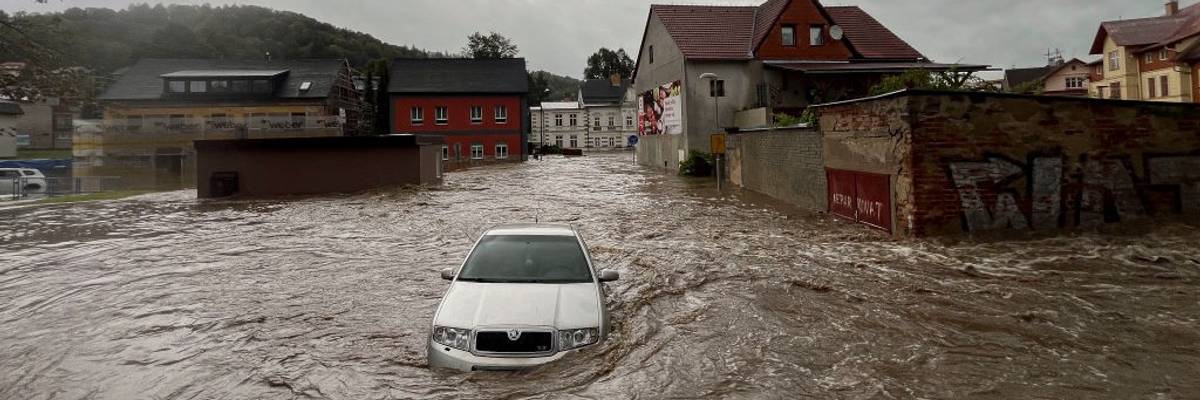
A car became trapped in floodwaters in Jesenik, Czech Republic, on September 15, 2024.
"This is definitely what we will see much more of in the future."
The record-setting rainfall that hit Central Europe in mid September was made roughly twice as likely and 7% more severe by climate change, according to an analysis released Wednesday.
The 36-page study, conducted by scientists affiliated with World Weather Attribution (WWA), looked at the causes of the extreme rain that peaked from September 12 until September 15. Called Storm Boris, it hit many countries including Poland, Austria, and the Czech Republic, and set off flooding that killed at least 24 people.
The authors, whose work wasn't peer reviewed, warned that Storm Boris was a sign of what's to come.
"This is definitely what we will see much more of in the future," Friederike Otto, a climate scientist at Imperial College London and co-author of the study, told the BBC.
"[It] is the absolute fingerprint signature of climate change... that records are broken by such a large margin."
The floods that killed 24 people in Central Europe were caused by rainfall made twice as likely and at least 7% heavier by climate change 📈🌧️
Floods will become more destructive and costly with further fossil fuel warming.
Our analysis was published this morning 🧵 https://t.co/0rJjYuYnUt
— World Weather Attribution (@WWAttribution) September 25, 2024
The heavy rainfall was caused by a Vb (pronounced "five-b") depression that "forms when cold polar air flows from the north over the Alps, meeting very warm air in Southern Europe," according to a WWA statement that accompanied the study.
The damage came partly from the fact that the storm lingered for many days, with rain falling on saturated ground and overflowing bodies of water. The WWA scientists didn't determine if the duration was affected by climate change; however, in general, the affect of climate change on the jet stream, which normally helps push weather patterns through the continent quickly, could play a role in causing storms to linger, experts say.
"These types of blocking situations and meandering jet stream-induced situations are increasing in frequency," Hayley Fowler, a climate scientist at Newcastle University who wasn't involved in the study, told NPR.
Other factors in the Stom Boris disaster were more clearly influenced by a warmer planet. The most basic and straightforward factor is that hotter air can hold more water—for each degree celsius that the Earth heats up, the atmosphere can hold about 7% more water, so there's more that can turn into rain.
The WWA study's key findings—a roughly twofold increase in the likelihood of Storm Boris and a 7% increase in intensity caused by climate change—may in fact be underestimates. The findings are "too conservative," the study says.
The analysis does contain good news: European authorities were more prepared for this storm than they had been in the past, likely saving dozens of lives.
Far more people died during extreme flooding episodes in the region in 1997 and 2002—more than 100, in each case—even though the rainfall in those events was less severe and didn't cover such a large area. Governments have since invested in forecasting, early warning systems, and flood defenses like levees. The city of Vienna has been particularly strong on flood preparations, and its investments paid off when Storm Boris did little damage there.
Otto, the co-author, said on social media that early warning systems worked well but flood defenses are, in general, still being put up "way too slowly." She said addressing the climate crisis would pay off in many ways for people on the continent.
"All Europeans need to know that tackling it will make their lives so much better—ending fossil fuels creates jobs, lowers energy bills, makes cities healthier places to live, and reduces the risk of killer floods," she said.
Many observers had assumed that climate change played a role in the flooding before the WWA analysis was released. On September 16, Greenpeace called for fossil fuel companies to pay for the damage caused by extreme weather events. The type of attribution science conducted by WWA helps strengthen the case for accountability, advocates say.
Dear Common Dreams reader, It’s been nearly 30 years since I co-founded Common Dreams with my late wife, Lina Newhouser. We had the radical notion that journalism should serve the public good, not corporate profits. It was clear to us from the outset what it would take to build such a project. No paid advertisements. No corporate sponsors. No millionaire publisher telling us what to think or do. Many people said we wouldn't last a year, but we proved those doubters wrong. Together with a tremendous team of journalists and dedicated staff, we built an independent media outlet free from the constraints of profits and corporate control. Our mission has always been simple: To inform. To inspire. To ignite change for the common good. Building Common Dreams was not easy. Our survival was never guaranteed. When you take on the most powerful forces—Wall Street greed, fossil fuel industry destruction, Big Tech lobbyists, and uber-rich oligarchs who have spent billions upon billions rigging the economy and democracy in their favor—the only bulwark you have is supporters who believe in your work. But here’s the urgent message from me today. It's never been this bad out there. And it's never been this hard to keep us going. At the very moment Common Dreams is most needed, the threats we face are intensifying. We need your support now more than ever. We don't accept corporate advertising and never will. We don't have a paywall because we don't think people should be blocked from critical news based on their ability to pay. Everything we do is funded by the donations of readers like you. When everyone does the little they can afford, we are strong. But if that support retreats or dries up, so do we. Will you donate now to make sure Common Dreams not only survives but thrives? —Craig Brown, Co-founder |
The record-setting rainfall that hit Central Europe in mid September was made roughly twice as likely and 7% more severe by climate change, according to an analysis released Wednesday.
The 36-page study, conducted by scientists affiliated with World Weather Attribution (WWA), looked at the causes of the extreme rain that peaked from September 12 until September 15. Called Storm Boris, it hit many countries including Poland, Austria, and the Czech Republic, and set off flooding that killed at least 24 people.
The authors, whose work wasn't peer reviewed, warned that Storm Boris was a sign of what's to come.
"This is definitely what we will see much more of in the future," Friederike Otto, a climate scientist at Imperial College London and co-author of the study, told the BBC.
"[It] is the absolute fingerprint signature of climate change... that records are broken by such a large margin."
The floods that killed 24 people in Central Europe were caused by rainfall made twice as likely and at least 7% heavier by climate change 📈🌧️
Floods will become more destructive and costly with further fossil fuel warming.
Our analysis was published this morning 🧵 https://t.co/0rJjYuYnUt
— World Weather Attribution (@WWAttribution) September 25, 2024
The heavy rainfall was caused by a Vb (pronounced "five-b") depression that "forms when cold polar air flows from the north over the Alps, meeting very warm air in Southern Europe," according to a WWA statement that accompanied the study.
The damage came partly from the fact that the storm lingered for many days, with rain falling on saturated ground and overflowing bodies of water. The WWA scientists didn't determine if the duration was affected by climate change; however, in general, the affect of climate change on the jet stream, which normally helps push weather patterns through the continent quickly, could play a role in causing storms to linger, experts say.
"These types of blocking situations and meandering jet stream-induced situations are increasing in frequency," Hayley Fowler, a climate scientist at Newcastle University who wasn't involved in the study, told NPR.
Other factors in the Stom Boris disaster were more clearly influenced by a warmer planet. The most basic and straightforward factor is that hotter air can hold more water—for each degree celsius that the Earth heats up, the atmosphere can hold about 7% more water, so there's more that can turn into rain.
The WWA study's key findings—a roughly twofold increase in the likelihood of Storm Boris and a 7% increase in intensity caused by climate change—may in fact be underestimates. The findings are "too conservative," the study says.
The analysis does contain good news: European authorities were more prepared for this storm than they had been in the past, likely saving dozens of lives.
Far more people died during extreme flooding episodes in the region in 1997 and 2002—more than 100, in each case—even though the rainfall in those events was less severe and didn't cover such a large area. Governments have since invested in forecasting, early warning systems, and flood defenses like levees. The city of Vienna has been particularly strong on flood preparations, and its investments paid off when Storm Boris did little damage there.
Otto, the co-author, said on social media that early warning systems worked well but flood defenses are, in general, still being put up "way too slowly." She said addressing the climate crisis would pay off in many ways for people on the continent.
"All Europeans need to know that tackling it will make their lives so much better—ending fossil fuels creates jobs, lowers energy bills, makes cities healthier places to live, and reduces the risk of killer floods," she said.
Many observers had assumed that climate change played a role in the flooding before the WWA analysis was released. On September 16, Greenpeace called for fossil fuel companies to pay for the damage caused by extreme weather events. The type of attribution science conducted by WWA helps strengthen the case for accountability, advocates say.
The record-setting rainfall that hit Central Europe in mid September was made roughly twice as likely and 7% more severe by climate change, according to an analysis released Wednesday.
The 36-page study, conducted by scientists affiliated with World Weather Attribution (WWA), looked at the causes of the extreme rain that peaked from September 12 until September 15. Called Storm Boris, it hit many countries including Poland, Austria, and the Czech Republic, and set off flooding that killed at least 24 people.
The authors, whose work wasn't peer reviewed, warned that Storm Boris was a sign of what's to come.
"This is definitely what we will see much more of in the future," Friederike Otto, a climate scientist at Imperial College London and co-author of the study, told the BBC.
"[It] is the absolute fingerprint signature of climate change... that records are broken by such a large margin."
The floods that killed 24 people in Central Europe were caused by rainfall made twice as likely and at least 7% heavier by climate change 📈🌧️
Floods will become more destructive and costly with further fossil fuel warming.
Our analysis was published this morning 🧵 https://t.co/0rJjYuYnUt
— World Weather Attribution (@WWAttribution) September 25, 2024
The heavy rainfall was caused by a Vb (pronounced "five-b") depression that "forms when cold polar air flows from the north over the Alps, meeting very warm air in Southern Europe," according to a WWA statement that accompanied the study.
The damage came partly from the fact that the storm lingered for many days, with rain falling on saturated ground and overflowing bodies of water. The WWA scientists didn't determine if the duration was affected by climate change; however, in general, the affect of climate change on the jet stream, which normally helps push weather patterns through the continent quickly, could play a role in causing storms to linger, experts say.
"These types of blocking situations and meandering jet stream-induced situations are increasing in frequency," Hayley Fowler, a climate scientist at Newcastle University who wasn't involved in the study, told NPR.
Other factors in the Stom Boris disaster were more clearly influenced by a warmer planet. The most basic and straightforward factor is that hotter air can hold more water—for each degree celsius that the Earth heats up, the atmosphere can hold about 7% more water, so there's more that can turn into rain.
The WWA study's key findings—a roughly twofold increase in the likelihood of Storm Boris and a 7% increase in intensity caused by climate change—may in fact be underestimates. The findings are "too conservative," the study says.
The analysis does contain good news: European authorities were more prepared for this storm than they had been in the past, likely saving dozens of lives.
Far more people died during extreme flooding episodes in the region in 1997 and 2002—more than 100, in each case—even though the rainfall in those events was less severe and didn't cover such a large area. Governments have since invested in forecasting, early warning systems, and flood defenses like levees. The city of Vienna has been particularly strong on flood preparations, and its investments paid off when Storm Boris did little damage there.
Otto, the co-author, said on social media that early warning systems worked well but flood defenses are, in general, still being put up "way too slowly." She said addressing the climate crisis would pay off in many ways for people on the continent.
"All Europeans need to know that tackling it will make their lives so much better—ending fossil fuels creates jobs, lowers energy bills, makes cities healthier places to live, and reduces the risk of killer floods," she said.
Many observers had assumed that climate change played a role in the flooding before the WWA analysis was released. On September 16, Greenpeace called for fossil fuel companies to pay for the damage caused by extreme weather events. The type of attribution science conducted by WWA helps strengthen the case for accountability, advocates say.