

SUBSCRIBE TO OUR FREE NEWSLETTER
Daily news & progressive opinion—funded by the people, not the corporations—delivered straight to your inbox.
5
#000000
#FFFFFF
To donate by check, phone, or other method, see our More Ways to Give page.
Daily news & progressive opinion—funded by the people, not the corporations—delivered straight to your inbox.
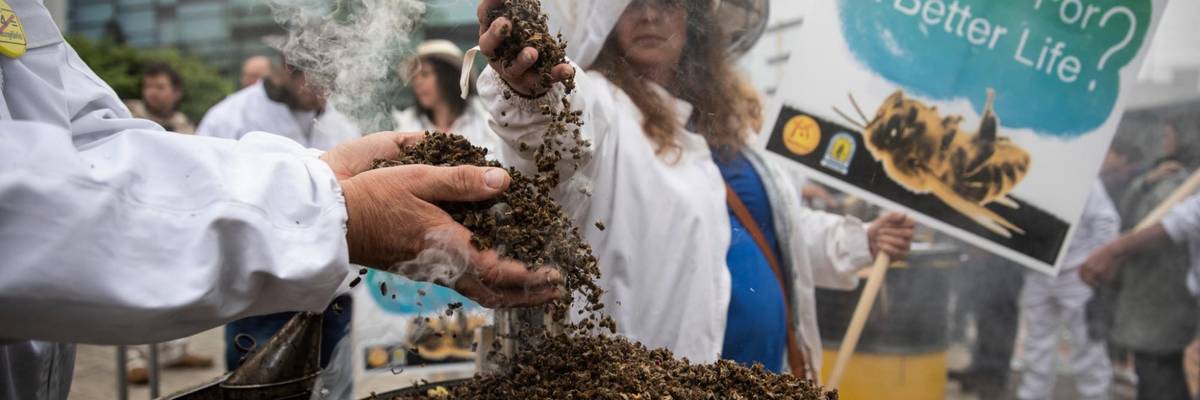
Protesters hold bees killed by pesticides prior to the annual shareholders meeting of German chemicals and pharmaceuticals conglomerate Bayer AG on April 26, 2019 in Bonn, Germany.
"Derogations with neonicotinoid-treated seeds are now definitely banned," said one advocate. "This ruling is relieving and shows the environment counts more than profits from some sugar and pesticide companies!"
The European Union's highest court ruled Thursday that member states must stop authorizing the use of bee-killing neonicotinoid pesticides.
Neonicotinoids are prohibited under E.U. law, but a loophole has enabled governments to grant emergency derogations temporarily permitting the use of seeds coated with these and other banned toxic insecticides.
Thursday's preliminary ruling by the European Court of Justice immediately halted derogations for neonicotinoids, which accounted for nearly half of the 236 exceptions that E.U. countries provided from 2019 to 2022. Bartosz Brzeziński, a food and agriculture reporter at Politico Europe, called the decision a "potentially fatal blow" to the highly hazardous class of pesticides.
Campaigners applauded the ruling, issued in response to a complaint filed by Pesticide Action Network (PAN) Europe, Nature & Progrès Belgium, and a Belgian beekeeper.
"This verdict is a reminder that administrations and politicians are bound to the law, not to the interests of the pesticide industry, or industrial agricultural lobbies."
"PAN Europe has been fighting this maladministration for many years," Hans Muilerman, a chemical officer for the group, said in a statement. "This landmark ruling of the E.U. court puts an end to 10 years of abuse by member states, with the blessing of the European Commission. Thanks to our action, the E.U. environment will become a safer place."
The plaintiffs originally asked the Belgian Administrative Court to intervene in 2019 after Belgium, at the behest of the sugar lobby, approved emergency use derogations for neonicotinoid-coated sugar beet seeds.
"This success will have an E.U.-wide effect, to protect bees and insects across the E.U., as well as citizens' health," said Marc Fichers, secretary-general of Nature & Progrès Belgium. "Derogations with neonicotinoid-treated seeds are now definitely banned. This ruling is relieving and shows the environment counts more than profits from some sugar and pesticide companies!"
The European Environmental Bureau, a continent-wide network of green groups, also welcomed the ruling, describing it as "good news for bees" while demanding further action "to protect biodiversity, human health, and food security."
In 2013, the European Commission banned the use of imidacloprid, clothianidin, and thiamethoxam—three neonicotinoids lethal to pollinators—on bee-attractive crops including maize, rapeseed, and some cereals. This was followed by a prohibition on all outdoor uses in 2018.
The Court of Justice upheld the ban in 2021, rejecting an appeal by Bayer, the German pharmaceutical and biotech company that merged with agrochemical giant Monsanto more than four years ago and produces imidacloprid, clothianidin, and thiamethoxam.
As Euractiv reported Thursday:
The latest ruling concerns six authorizations issued by the Belgian state for the use of these plant protection products on the basis of 'emergency situations'—where danger or threat to plant production or ecosystems cannot be contained by other reasonable means.
For this reason, the court concluded that "as regards seeds treated with plant protection products containing substances expressly prohibited, […] the [E.U.] legislature did not intend to allow member states to derogate from such an express prohibition."
The ruling added that member states have an obligation "to take all necessary measures to promote low pesticide input pest control, giving priority to non-chemical methods wherever possible."
Reflecting on the case, PAN Europe executive director Martin Dermine said that "it was very shocking to observe that the European Commission kept protecting the abuses of the system by member states."
"The commission supported the provision of derogations for supposedly E.U.-banned pesticides that are highly toxic to human health and the environment," said Dermine. "It was evident that the commission stood on the side of agribusiness, rather than with citizens' health and the environment. The European Commission's lawyers even told the judges that member states only give a derogation when no alternative exists, which is opposite to the reality!"
"Today is a great day for European pollinators and for our environment," Dermine declared. "The E.U. pesticide law gives priority to citizens' health and the environment but its implementation at E.U. and national levels is poor. This verdict is a reminder that administrations and politicians are bound to the law, not to the interests of the pesticide industry, or industrial agricultural lobbies."
PAN Europe attorney Antoine Bailleux added that "the Court of Justice has made it clear that substances prohibited at the E.U. level for health or environmental reasons cannot be introduced through the back door at the member state level, which had become common practice."
Dear Common Dreams reader, It’s been nearly 30 years since I co-founded Common Dreams with my late wife, Lina Newhouser. We had the radical notion that journalism should serve the public good, not corporate profits. It was clear to us from the outset what it would take to build such a project. No paid advertisements. No corporate sponsors. No millionaire publisher telling us what to think or do. Many people said we wouldn't last a year, but we proved those doubters wrong. Together with a tremendous team of journalists and dedicated staff, we built an independent media outlet free from the constraints of profits and corporate control. Our mission has always been simple: To inform. To inspire. To ignite change for the common good. Building Common Dreams was not easy. Our survival was never guaranteed. When you take on the most powerful forces—Wall Street greed, fossil fuel industry destruction, Big Tech lobbyists, and uber-rich oligarchs who have spent billions upon billions rigging the economy and democracy in their favor—the only bulwark you have is supporters who believe in your work. But here’s the urgent message from me today. It's never been this bad out there. And it's never been this hard to keep us going. At the very moment Common Dreams is most needed, the threats we face are intensifying. We need your support now more than ever. We don't accept corporate advertising and never will. We don't have a paywall because we don't think people should be blocked from critical news based on their ability to pay. Everything we do is funded by the donations of readers like you. When everyone does the little they can afford, we are strong. But if that support retreats or dries up, so do we. Will you donate now to make sure Common Dreams not only survives but thrives? —Craig Brown, Co-founder |
The European Union's highest court ruled Thursday that member states must stop authorizing the use of bee-killing neonicotinoid pesticides.
Neonicotinoids are prohibited under E.U. law, but a loophole has enabled governments to grant emergency derogations temporarily permitting the use of seeds coated with these and other banned toxic insecticides.
Thursday's preliminary ruling by the European Court of Justice immediately halted derogations for neonicotinoids, which accounted for nearly half of the 236 exceptions that E.U. countries provided from 2019 to 2022. Bartosz Brzeziński, a food and agriculture reporter at Politico Europe, called the decision a "potentially fatal blow" to the highly hazardous class of pesticides.
Campaigners applauded the ruling, issued in response to a complaint filed by Pesticide Action Network (PAN) Europe, Nature & Progrès Belgium, and a Belgian beekeeper.
"This verdict is a reminder that administrations and politicians are bound to the law, not to the interests of the pesticide industry, or industrial agricultural lobbies."
"PAN Europe has been fighting this maladministration for many years," Hans Muilerman, a chemical officer for the group, said in a statement. "This landmark ruling of the E.U. court puts an end to 10 years of abuse by member states, with the blessing of the European Commission. Thanks to our action, the E.U. environment will become a safer place."
The plaintiffs originally asked the Belgian Administrative Court to intervene in 2019 after Belgium, at the behest of the sugar lobby, approved emergency use derogations for neonicotinoid-coated sugar beet seeds.
"This success will have an E.U.-wide effect, to protect bees and insects across the E.U., as well as citizens' health," said Marc Fichers, secretary-general of Nature & Progrès Belgium. "Derogations with neonicotinoid-treated seeds are now definitely banned. This ruling is relieving and shows the environment counts more than profits from some sugar and pesticide companies!"
The European Environmental Bureau, a continent-wide network of green groups, also welcomed the ruling, describing it as "good news for bees" while demanding further action "to protect biodiversity, human health, and food security."
In 2013, the European Commission banned the use of imidacloprid, clothianidin, and thiamethoxam—three neonicotinoids lethal to pollinators—on bee-attractive crops including maize, rapeseed, and some cereals. This was followed by a prohibition on all outdoor uses in 2018.
The Court of Justice upheld the ban in 2021, rejecting an appeal by Bayer, the German pharmaceutical and biotech company that merged with agrochemical giant Monsanto more than four years ago and produces imidacloprid, clothianidin, and thiamethoxam.
As Euractiv reported Thursday:
The latest ruling concerns six authorizations issued by the Belgian state for the use of these plant protection products on the basis of 'emergency situations'—where danger or threat to plant production or ecosystems cannot be contained by other reasonable means.
For this reason, the court concluded that "as regards seeds treated with plant protection products containing substances expressly prohibited, […] the [E.U.] legislature did not intend to allow member states to derogate from such an express prohibition."
The ruling added that member states have an obligation "to take all necessary measures to promote low pesticide input pest control, giving priority to non-chemical methods wherever possible."
Reflecting on the case, PAN Europe executive director Martin Dermine said that "it was very shocking to observe that the European Commission kept protecting the abuses of the system by member states."
"The commission supported the provision of derogations for supposedly E.U.-banned pesticides that are highly toxic to human health and the environment," said Dermine. "It was evident that the commission stood on the side of agribusiness, rather than with citizens' health and the environment. The European Commission's lawyers even told the judges that member states only give a derogation when no alternative exists, which is opposite to the reality!"
"Today is a great day for European pollinators and for our environment," Dermine declared. "The E.U. pesticide law gives priority to citizens' health and the environment but its implementation at E.U. and national levels is poor. This verdict is a reminder that administrations and politicians are bound to the law, not to the interests of the pesticide industry, or industrial agricultural lobbies."
PAN Europe attorney Antoine Bailleux added that "the Court of Justice has made it clear that substances prohibited at the E.U. level for health or environmental reasons cannot be introduced through the back door at the member state level, which had become common practice."
The European Union's highest court ruled Thursday that member states must stop authorizing the use of bee-killing neonicotinoid pesticides.
Neonicotinoids are prohibited under E.U. law, but a loophole has enabled governments to grant emergency derogations temporarily permitting the use of seeds coated with these and other banned toxic insecticides.
Thursday's preliminary ruling by the European Court of Justice immediately halted derogations for neonicotinoids, which accounted for nearly half of the 236 exceptions that E.U. countries provided from 2019 to 2022. Bartosz Brzeziński, a food and agriculture reporter at Politico Europe, called the decision a "potentially fatal blow" to the highly hazardous class of pesticides.
Campaigners applauded the ruling, issued in response to a complaint filed by Pesticide Action Network (PAN) Europe, Nature & Progrès Belgium, and a Belgian beekeeper.
"This verdict is a reminder that administrations and politicians are bound to the law, not to the interests of the pesticide industry, or industrial agricultural lobbies."
"PAN Europe has been fighting this maladministration for many years," Hans Muilerman, a chemical officer for the group, said in a statement. "This landmark ruling of the E.U. court puts an end to 10 years of abuse by member states, with the blessing of the European Commission. Thanks to our action, the E.U. environment will become a safer place."
The plaintiffs originally asked the Belgian Administrative Court to intervene in 2019 after Belgium, at the behest of the sugar lobby, approved emergency use derogations for neonicotinoid-coated sugar beet seeds.
"This success will have an E.U.-wide effect, to protect bees and insects across the E.U., as well as citizens' health," said Marc Fichers, secretary-general of Nature & Progrès Belgium. "Derogations with neonicotinoid-treated seeds are now definitely banned. This ruling is relieving and shows the environment counts more than profits from some sugar and pesticide companies!"
The European Environmental Bureau, a continent-wide network of green groups, also welcomed the ruling, describing it as "good news for bees" while demanding further action "to protect biodiversity, human health, and food security."
In 2013, the European Commission banned the use of imidacloprid, clothianidin, and thiamethoxam—three neonicotinoids lethal to pollinators—on bee-attractive crops including maize, rapeseed, and some cereals. This was followed by a prohibition on all outdoor uses in 2018.
The Court of Justice upheld the ban in 2021, rejecting an appeal by Bayer, the German pharmaceutical and biotech company that merged with agrochemical giant Monsanto more than four years ago and produces imidacloprid, clothianidin, and thiamethoxam.
As Euractiv reported Thursday:
The latest ruling concerns six authorizations issued by the Belgian state for the use of these plant protection products on the basis of 'emergency situations'—where danger or threat to plant production or ecosystems cannot be contained by other reasonable means.
For this reason, the court concluded that "as regards seeds treated with plant protection products containing substances expressly prohibited, […] the [E.U.] legislature did not intend to allow member states to derogate from such an express prohibition."
The ruling added that member states have an obligation "to take all necessary measures to promote low pesticide input pest control, giving priority to non-chemical methods wherever possible."
Reflecting on the case, PAN Europe executive director Martin Dermine said that "it was very shocking to observe that the European Commission kept protecting the abuses of the system by member states."
"The commission supported the provision of derogations for supposedly E.U.-banned pesticides that are highly toxic to human health and the environment," said Dermine. "It was evident that the commission stood on the side of agribusiness, rather than with citizens' health and the environment. The European Commission's lawyers even told the judges that member states only give a derogation when no alternative exists, which is opposite to the reality!"
"Today is a great day for European pollinators and for our environment," Dermine declared. "The E.U. pesticide law gives priority to citizens' health and the environment but its implementation at E.U. and national levels is poor. This verdict is a reminder that administrations and politicians are bound to the law, not to the interests of the pesticide industry, or industrial agricultural lobbies."
PAN Europe attorney Antoine Bailleux added that "the Court of Justice has made it clear that substances prohibited at the E.U. level for health or environmental reasons cannot be introduced through the back door at the member state level, which had become common practice."

