SUBSCRIBE TO OUR FREE NEWSLETTER
Daily news & progressive opinion—funded by the people, not the corporations—delivered straight to your inbox.
5
#000000
#FFFFFF
To donate by check, phone, or other method, see our More Ways to Give page.
Daily news & progressive opinion—funded by the people, not the corporations—delivered straight to your inbox.
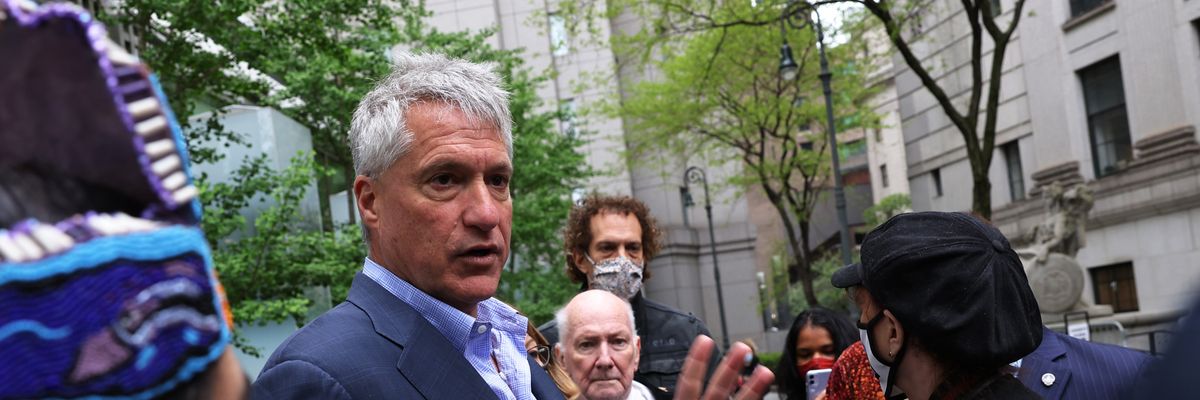
Attorney Steven Donziger speaks to his supporters as he arrives for a court appearance at Daniel Patrick Moynihan United States Courthouse on May 10, 2021 in New York City.
"The three liberal Supreme Court justices decided to let Donziger's absurd contempt conviction stand," said one observer.
Environmental attorney Steven Donziger was joined by a number of U.S. Supreme Court observers on Monday in denouncing a decision by seven of the nine justices, who refused to consider Donziger's case regarding the appointment of three special prosecutors after he was charged with criminal contempt of court.
A number of observers noted that a dissent was signed by two conservative judges, Justices Neil Gorsuch and Brett Kavanaugh—suggesting that the three liberal justices on the high court refused to give Donziger a hearing of his appeal, essentially siding with oil giant Chevron.
Donziger sued Chevron in the 1990s on behalf of a group of Ecaudorian people who argued Chevron had polluted their community, and helped them win $9.5 billion in the class action lawsuit.
"The three liberal Supreme Court justices decided to let Donziger's absurd contempt conviction stand," said journalist Alex Shultz of the San Francisco Chronicle.
Donziger was jailed for six months—including 136 days under house arrest at the end of his sentence in addition to 800 days under house arrest while he awaited trial—after being charged with contempt of court in 2021 for refusing to turn over his electronic devices to Chevron lawyers in a case filed by the company. The fossil fuel company argued Donziger had won the lawsuit for the Ecuadorians through "coercion, fraud, and bribery."
The judge appointed three special prosecutors after the U.S. attorney for the Southern District of New York declined to prosecute Donziger for contempt of court.
Donziger argued the judge had no right to appoint private attorneys as special prosecutors, saying the move violated the Appointments Clause of the Constitution and that the judge wrongly overrode the U.S. attorney's discretion.
The Supreme Court's refusal to hear his case, said Donziger, represents "a huge blow to the rule of law."
The attorney was among those who pointed to Gorsuch's argument in favor of hearing the case, in which the Trump-appointed right-wing justice said his prosecution by three private lawyers "broke a basic constitutional promise essential to our liberty."
"He's got a point," wrote journalist Ian Millhiser at Vox. "Especially in an era where litigants with an axe to grind can choose which judge will hear their case, permitting the judiciary to decide who to prosecute—and then to hear the very same cases brought by its own court-appointed prosecutors—vests far too much power in unelected judges. If courts have this authority, it is likely to be abused by some of the most partisan judges in the country."
Convicting someone of a federal crime generally requires two branches of government—prosecutors representing the executive branch and judges representing the judiciary—to agree on the accused person's guilt.
In Donziger's case, the judiciary branch acted on its own to prosecute the lawyer.
"The Constitution gives courts the power to 'serve as a neutral adjudicator in a criminal case,' not 'the power to prosecute crimes," wrote Gorsuch in the dissenting opinion. "Our Constitution does not tolerate what happened here."
By refusing to hear Donziger's appeal, the majority of justices—including liberal Justices Sonia Sotomayor, Elena Kagan, and Ketanji Brown Jackson—"endorsed the persecution of Donziger" by Chevron, said author and Yale University history professor Greg Grandin.
"A corporatist Supreme Court is there to serve corporations more than to serve the Constitution," noted author Marianne Williamson.
While the details of Donziger's case are "absolutely shocking," said former U.S. Rep. Tom Winter (D-Mont.), "what's not shocking [is] our Supreme Court, as an institution, being just fine with corporate capture of the legal system."
Millhiser pointed out that the Supreme Court's refusal to hear Donziger's case could have implications for the pending ruling regarding the legality of the Food and Drug Administration's approval of a common abortion drug. Trump-appointed Judge Matthew Kacsmaryk of the U.S. District Court for the Northern District of Texas is expected to rule in the case in the coming days:
Armed with the additional power to initiate prosecutions, even if this power is limited to contempt of court cases, a partisan judge like Kacsmaryk could potentially issue a nationwide injunction prohibiting anyone from performing an abortion, even in states where it is legal. Then, because anyone who violates a court order can potentially be held in contempt, Kacsmaryk could appoint his own hand-picked prosecutors to target anyone who violates his self-imposed abortion ban.
If Kacsmaryk, or a similarly partisan judge, attempted this move today, Attorney General Merrick Garland would almost certainly fire any prosecutor that Kacsmaryk appointed. But, in a Republican administration, the attorney general would likely be much more reluctant to exercise such authority.
"Gorsuch is right," said Millhiser, "to warn us against a regime that upends this balance of power."
Dear Common Dreams reader, It’s been nearly 30 years since I co-founded Common Dreams with my late wife, Lina Newhouser. We had the radical notion that journalism should serve the public good, not corporate profits. It was clear to us from the outset what it would take to build such a project. No paid advertisements. No corporate sponsors. No millionaire publisher telling us what to think or do. Many people said we wouldn't last a year, but we proved those doubters wrong. Together with a tremendous team of journalists and dedicated staff, we built an independent media outlet free from the constraints of profits and corporate control. Our mission has always been simple: To inform. To inspire. To ignite change for the common good. Building Common Dreams was not easy. Our survival was never guaranteed. When you take on the most powerful forces—Wall Street greed, fossil fuel industry destruction, Big Tech lobbyists, and uber-rich oligarchs who have spent billions upon billions rigging the economy and democracy in their favor—the only bulwark you have is supporters who believe in your work. But here’s the urgent message from me today. It's never been this bad out there. And it's never been this hard to keep us going. At the very moment Common Dreams is most needed, the threats we face are intensifying. We need your support now more than ever. We don't accept corporate advertising and never will. We don't have a paywall because we don't think people should be blocked from critical news based on their ability to pay. Everything we do is funded by the donations of readers like you. When everyone does the little they can afford, we are strong. But if that support retreats or dries up, so do we. Will you donate now to make sure Common Dreams not only survives but thrives? —Craig Brown, Co-founder |
Environmental attorney Steven Donziger was joined by a number of U.S. Supreme Court observers on Monday in denouncing a decision by seven of the nine justices, who refused to consider Donziger's case regarding the appointment of three special prosecutors after he was charged with criminal contempt of court.
A number of observers noted that a dissent was signed by two conservative judges, Justices Neil Gorsuch and Brett Kavanaugh—suggesting that the three liberal justices on the high court refused to give Donziger a hearing of his appeal, essentially siding with oil giant Chevron.
Donziger sued Chevron in the 1990s on behalf of a group of Ecaudorian people who argued Chevron had polluted their community, and helped them win $9.5 billion in the class action lawsuit.
"The three liberal Supreme Court justices decided to let Donziger's absurd contempt conviction stand," said journalist Alex Shultz of the San Francisco Chronicle.
Donziger was jailed for six months—including 136 days under house arrest at the end of his sentence in addition to 800 days under house arrest while he awaited trial—after being charged with contempt of court in 2021 for refusing to turn over his electronic devices to Chevron lawyers in a case filed by the company. The fossil fuel company argued Donziger had won the lawsuit for the Ecuadorians through "coercion, fraud, and bribery."
The judge appointed three special prosecutors after the U.S. attorney for the Southern District of New York declined to prosecute Donziger for contempt of court.
Donziger argued the judge had no right to appoint private attorneys as special prosecutors, saying the move violated the Appointments Clause of the Constitution and that the judge wrongly overrode the U.S. attorney's discretion.
The Supreme Court's refusal to hear his case, said Donziger, represents "a huge blow to the rule of law."
The attorney was among those who pointed to Gorsuch's argument in favor of hearing the case, in which the Trump-appointed right-wing justice said his prosecution by three private lawyers "broke a basic constitutional promise essential to our liberty."
"He's got a point," wrote journalist Ian Millhiser at Vox. "Especially in an era where litigants with an axe to grind can choose which judge will hear their case, permitting the judiciary to decide who to prosecute—and then to hear the very same cases brought by its own court-appointed prosecutors—vests far too much power in unelected judges. If courts have this authority, it is likely to be abused by some of the most partisan judges in the country."
Convicting someone of a federal crime generally requires two branches of government—prosecutors representing the executive branch and judges representing the judiciary—to agree on the accused person's guilt.
In Donziger's case, the judiciary branch acted on its own to prosecute the lawyer.
"The Constitution gives courts the power to 'serve as a neutral adjudicator in a criminal case,' not 'the power to prosecute crimes," wrote Gorsuch in the dissenting opinion. "Our Constitution does not tolerate what happened here."
By refusing to hear Donziger's appeal, the majority of justices—including liberal Justices Sonia Sotomayor, Elena Kagan, and Ketanji Brown Jackson—"endorsed the persecution of Donziger" by Chevron, said author and Yale University history professor Greg Grandin.
"A corporatist Supreme Court is there to serve corporations more than to serve the Constitution," noted author Marianne Williamson.
While the details of Donziger's case are "absolutely shocking," said former U.S. Rep. Tom Winter (D-Mont.), "what's not shocking [is] our Supreme Court, as an institution, being just fine with corporate capture of the legal system."
Millhiser pointed out that the Supreme Court's refusal to hear Donziger's case could have implications for the pending ruling regarding the legality of the Food and Drug Administration's approval of a common abortion drug. Trump-appointed Judge Matthew Kacsmaryk of the U.S. District Court for the Northern District of Texas is expected to rule in the case in the coming days:
Armed with the additional power to initiate prosecutions, even if this power is limited to contempt of court cases, a partisan judge like Kacsmaryk could potentially issue a nationwide injunction prohibiting anyone from performing an abortion, even in states where it is legal. Then, because anyone who violates a court order can potentially be held in contempt, Kacsmaryk could appoint his own hand-picked prosecutors to target anyone who violates his self-imposed abortion ban.
If Kacsmaryk, or a similarly partisan judge, attempted this move today, Attorney General Merrick Garland would almost certainly fire any prosecutor that Kacsmaryk appointed. But, in a Republican administration, the attorney general would likely be much more reluctant to exercise such authority.
"Gorsuch is right," said Millhiser, "to warn us against a regime that upends this balance of power."
Environmental attorney Steven Donziger was joined by a number of U.S. Supreme Court observers on Monday in denouncing a decision by seven of the nine justices, who refused to consider Donziger's case regarding the appointment of three special prosecutors after he was charged with criminal contempt of court.
A number of observers noted that a dissent was signed by two conservative judges, Justices Neil Gorsuch and Brett Kavanaugh—suggesting that the three liberal justices on the high court refused to give Donziger a hearing of his appeal, essentially siding with oil giant Chevron.
Donziger sued Chevron in the 1990s on behalf of a group of Ecaudorian people who argued Chevron had polluted their community, and helped them win $9.5 billion in the class action lawsuit.
"The three liberal Supreme Court justices decided to let Donziger's absurd contempt conviction stand," said journalist Alex Shultz of the San Francisco Chronicle.
Donziger was jailed for six months—including 136 days under house arrest at the end of his sentence in addition to 800 days under house arrest while he awaited trial—after being charged with contempt of court in 2021 for refusing to turn over his electronic devices to Chevron lawyers in a case filed by the company. The fossil fuel company argued Donziger had won the lawsuit for the Ecuadorians through "coercion, fraud, and bribery."
The judge appointed three special prosecutors after the U.S. attorney for the Southern District of New York declined to prosecute Donziger for contempt of court.
Donziger argued the judge had no right to appoint private attorneys as special prosecutors, saying the move violated the Appointments Clause of the Constitution and that the judge wrongly overrode the U.S. attorney's discretion.
The Supreme Court's refusal to hear his case, said Donziger, represents "a huge blow to the rule of law."
The attorney was among those who pointed to Gorsuch's argument in favor of hearing the case, in which the Trump-appointed right-wing justice said his prosecution by three private lawyers "broke a basic constitutional promise essential to our liberty."
"He's got a point," wrote journalist Ian Millhiser at Vox. "Especially in an era where litigants with an axe to grind can choose which judge will hear their case, permitting the judiciary to decide who to prosecute—and then to hear the very same cases brought by its own court-appointed prosecutors—vests far too much power in unelected judges. If courts have this authority, it is likely to be abused by some of the most partisan judges in the country."
Convicting someone of a federal crime generally requires two branches of government—prosecutors representing the executive branch and judges representing the judiciary—to agree on the accused person's guilt.
In Donziger's case, the judiciary branch acted on its own to prosecute the lawyer.
"The Constitution gives courts the power to 'serve as a neutral adjudicator in a criminal case,' not 'the power to prosecute crimes," wrote Gorsuch in the dissenting opinion. "Our Constitution does not tolerate what happened here."
By refusing to hear Donziger's appeal, the majority of justices—including liberal Justices Sonia Sotomayor, Elena Kagan, and Ketanji Brown Jackson—"endorsed the persecution of Donziger" by Chevron, said author and Yale University history professor Greg Grandin.
"A corporatist Supreme Court is there to serve corporations more than to serve the Constitution," noted author Marianne Williamson.
While the details of Donziger's case are "absolutely shocking," said former U.S. Rep. Tom Winter (D-Mont.), "what's not shocking [is] our Supreme Court, as an institution, being just fine with corporate capture of the legal system."
Millhiser pointed out that the Supreme Court's refusal to hear Donziger's case could have implications for the pending ruling regarding the legality of the Food and Drug Administration's approval of a common abortion drug. Trump-appointed Judge Matthew Kacsmaryk of the U.S. District Court for the Northern District of Texas is expected to rule in the case in the coming days:
Armed with the additional power to initiate prosecutions, even if this power is limited to contempt of court cases, a partisan judge like Kacsmaryk could potentially issue a nationwide injunction prohibiting anyone from performing an abortion, even in states where it is legal. Then, because anyone who violates a court order can potentially be held in contempt, Kacsmaryk could appoint his own hand-picked prosecutors to target anyone who violates his self-imposed abortion ban.
If Kacsmaryk, or a similarly partisan judge, attempted this move today, Attorney General Merrick Garland would almost certainly fire any prosecutor that Kacsmaryk appointed. But, in a Republican administration, the attorney general would likely be much more reluctant to exercise such authority.
"Gorsuch is right," said Millhiser, "to warn us against a regime that upends this balance of power."