SUBSCRIBE TO OUR FREE NEWSLETTER
Daily news & progressive opinion—funded by the people, not the corporations—delivered straight to your inbox.
5
#000000
#FFFFFF
To donate by check, phone, or other method, see our More Ways to Give page.
Daily news & progressive opinion—funded by the people, not the corporations—delivered straight to your inbox.
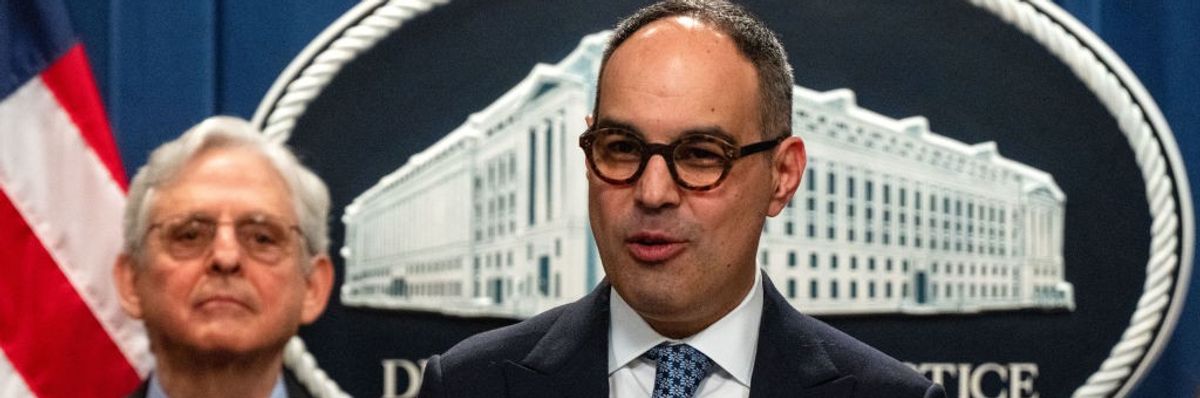
Assistant U.S. Attorney General Jonathan Kanter—who heads the Justice Department's Antitrust Division—speaks while Attorney General Merrick Garland stands by at a press conference on May 23, 2024 in Washington, D.C.
"House Democrats must take a firm stand against this problematic proposal and offer an amendment in markup to give the Antitrust Division the resources necessary to enforce the law," said one campaigner.
Anti-monopoly campaigners on Tuesday blasted House Republicans over a bill that would dramatically reduce funding for the U.S. Department of Justice's Antitrust Division and impose caps on how much the crucial agency gets from merger filing fees.
The House Appropriations Committee
proposal contains sweeping spending cuts, including a $40 million reduction in the DOJ Antitrust Division's budget. The $192.7 million allocated for the division is $95 million less than requested by U.S. President Joe Biden.
"House Republicans are not fully funding the Antitrust Division—this is a pro-Ticketmaster, pro-Google, pro-Apple, and pro-UnitedHealth agenda," Morgan Harper, director of policy and advocacy at the American Economic Liberties Project (AELP), said in a statement.
"This is a pro-Ticketmaster, pro-Google, pro-Apple, and pro-UnitedHealth agenda."
In addition to the budget cut, the bill contains one rider that would cap the amount of fees the Antitrust Division gets from the bipartisan Merger Filing Fee Modernization Act and another that would effectively ban the agency from hiring more staff.
The proposed bill "would openly and deliberately disregard the will of Congress by limiting the DOJ's access to these funds," AELP said, arguing that House Republicans "want monopolists to win."
"With cases against some of the biggest monopolies in the economy already in progress or looming, the additional funds would allow the division to hire more attorneys and staff to effectively enforce the law," the group added.
According to Harper:
Despite having even fewer attorneys than it did in the 1970s, [Assistant Attorney General] Jonathan Kanter's Antitrust Division is securing unprecedented wins to turn the tide on market concentration across the economy. Appropriators should be bolstering the Antitrust Division in this moment, not kneecapping it by limiting hiring and reducing funds Congress authorized through the Merger Filing Fee Modernization Act.
"House Democrats must take a firm stand against this problematic proposal and offer an amendment in markup to give the Antitrust Division the resources necessary to enforce the law," Harper added.
The GOP proposal comes amid a flurry of antitrust action by the Biden administration, whose DOJ has investigated UnitedHealth Group, the world's largest health insurance company, and sued Apple, Google, and Ticketmaster. Meanwhile, the Federal Trade Commission under Chair Lina Khan has taken on Amazon and other corporations.
"The DOJ Antitrust Division has won victories in court against employers that sought to suppress workers' pay and blocked harmful mergers in the airline industry," Congressional Progressive Caucus Chair Pramila Jayapal (D-Wash.) said while addressing U.S. Attorney General Merrick Garland during a hearing earlier this month.
"You're working to lower food prices by targeting anti-competitive practices and mergers in the grocery industry and the meat processing industry, and the Antitrust Division successfully ended a price fixing scheme in DVD and Blu-ray sales and prevented video game companies from suppressing wages in e-sports," she continued.
"These are incredible accomplishments, and you're also working to promote competition in the live music industry," Jayapal added, referring to the lawsuit
filed last month by the DOJ and 30 state attorneys general against Live Nation and its Ticketmaster subsidiary.
This country and this world are at a monumental crossroads. US voters have an opportunity to beat back the forces of fascism and confront the billionaires who are rigging the economy, our media system, and our democracy, making it increasingly impossible for ordinary people to get by. We’re not just talking about the election. We’re talking about what must be done once these fascist elements are vanquished from power. We need a bolder set of solutions than what either major party has so far been willing to offer and a working-class movement ready to fight like hell for it. Trump didn't emerge from nowhere. The conditions that fueled MAGA authoritarianism were created by decades of radical neoliberal economic policies and a corrupt political system dominated by corporate interests. They slashed taxes on the super-rich, promising that the benefits would trickle down. They said giveaways to the corporate titans would make life more affordable for the rest of us. It was all bullshit. And when a bitter, betrayed populace searches for someone to blame, right-wing demagogues have little trouble finding scapegoats. People know when they're being lied to, but you won't hear any of this from the corporate media. Only independent journalism—powered and funded by people who believe in building a better world—can deliver truly trustworthy daily news. If you share our vision, please contribute whatever you can to sustain our work. |
Anti-monopoly campaigners on Tuesday blasted House Republicans over a bill that would dramatically reduce funding for the U.S. Department of Justice's Antitrust Division and impose caps on how much the crucial agency gets from merger filing fees.
The House Appropriations Committee
proposal contains sweeping spending cuts, including a $40 million reduction in the DOJ Antitrust Division's budget. The $192.7 million allocated for the division is $95 million less than requested by U.S. President Joe Biden.
"House Republicans are not fully funding the Antitrust Division—this is a pro-Ticketmaster, pro-Google, pro-Apple, and pro-UnitedHealth agenda," Morgan Harper, director of policy and advocacy at the American Economic Liberties Project (AELP), said in a statement.
"This is a pro-Ticketmaster, pro-Google, pro-Apple, and pro-UnitedHealth agenda."
In addition to the budget cut, the bill contains one rider that would cap the amount of fees the Antitrust Division gets from the bipartisan Merger Filing Fee Modernization Act and another that would effectively ban the agency from hiring more staff.
The proposed bill "would openly and deliberately disregard the will of Congress by limiting the DOJ's access to these funds," AELP said, arguing that House Republicans "want monopolists to win."
"With cases against some of the biggest monopolies in the economy already in progress or looming, the additional funds would allow the division to hire more attorneys and staff to effectively enforce the law," the group added.
According to Harper:
Despite having even fewer attorneys than it did in the 1970s, [Assistant Attorney General] Jonathan Kanter's Antitrust Division is securing unprecedented wins to turn the tide on market concentration across the economy. Appropriators should be bolstering the Antitrust Division in this moment, not kneecapping it by limiting hiring and reducing funds Congress authorized through the Merger Filing Fee Modernization Act.
"House Democrats must take a firm stand against this problematic proposal and offer an amendment in markup to give the Antitrust Division the resources necessary to enforce the law," Harper added.
The GOP proposal comes amid a flurry of antitrust action by the Biden administration, whose DOJ has investigated UnitedHealth Group, the world's largest health insurance company, and sued Apple, Google, and Ticketmaster. Meanwhile, the Federal Trade Commission under Chair Lina Khan has taken on Amazon and other corporations.
"The DOJ Antitrust Division has won victories in court against employers that sought to suppress workers' pay and blocked harmful mergers in the airline industry," Congressional Progressive Caucus Chair Pramila Jayapal (D-Wash.) said while addressing U.S. Attorney General Merrick Garland during a hearing earlier this month.
"You're working to lower food prices by targeting anti-competitive practices and mergers in the grocery industry and the meat processing industry, and the Antitrust Division successfully ended a price fixing scheme in DVD and Blu-ray sales and prevented video game companies from suppressing wages in e-sports," she continued.
"These are incredible accomplishments, and you're also working to promote competition in the live music industry," Jayapal added, referring to the lawsuit
filed last month by the DOJ and 30 state attorneys general against Live Nation and its Ticketmaster subsidiary.