

SUBSCRIBE TO OUR FREE NEWSLETTER
Daily news & progressive opinion—funded by the people, not the corporations—delivered straight to your inbox.
5
#000000
#FFFFFF
To donate by check, phone, or other method, see our More Ways to Give page.
Daily news & progressive opinion—funded by the people, not the corporations—delivered straight to your inbox.
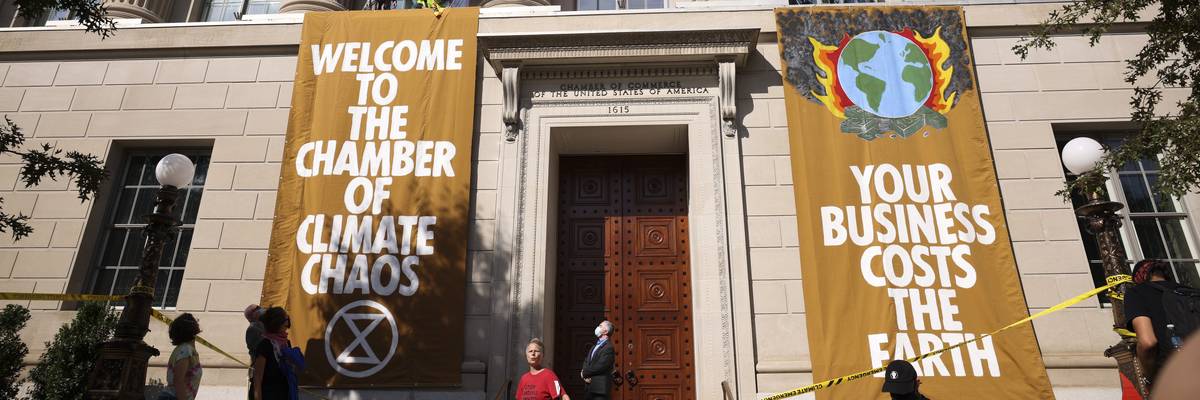
Climate activists protest from the side of the U.S. Chamber of Commerce headquarters on October 14, 2021 in Washington, D.C.
"Chamber litigation appears to be an advocacy tool to shield America's largest corporations from accountability, to the detriment of consumers and small businesses," said Public Citizen's Lisa Gilbert.
The U.S. Chamber of Commerce bills itself as a champion of small businesses, but a report published Tuesday shows that the powerful lobbying group primarily uses its vast resources to support large corporations in court as they combat antitrust regulations, environmental protections, efforts to lower prescription drug prices, and consumer access to the legal system.
The new report from the watchdog group Public Citizen examines 400 recent cases from the Chamber's Litigation Center, an online resource that tracks the organization's legal work.
Public Citizen's analysis found that the Chamber backed businesses with revenue of more than a billion dollars a year 55% of the time—and 35% of the time, the litigants were Fortune 500 companies.
"In comparison, the Chamber filed in support of at least one small business only 6% of the time," the new report says. "Accordingly, only 23 of the roughly 28 million small businesses in the U.S. (0.0001%) directly benefited from the Chamber's litigation."
Lisa Gilbert, executive vice president of Public Citizen, said in a statement that "Chamber litigation appears to be an advocacy tool to shield America's largest corporations from accountability, to the detriment of consumers and small businesses."
"The Chamber is helping big companies to protect their profits by stopping or stalling reforms that would bring down healthcare costs or reduce the student loan debt of small business owners, for example," said Gilbert.
"Its legal interventions on behalf of the largest corporations in America show the Chamber's words ring hollow."
Of the 400 cases Public Citizen considered, a plurality involved access to the U.S. courts. The watchdog defined court access cases as "legal disputes relating to whether or not forced arbitration clauses would be enforced and whether or not a class action lawsuit would be allowed to proceed."
"While the Chamber actively works to shut the door on everyday Americans seeking relief from the judicial system, the Chamber certainly had no issue availing itself of the court," Public Citizen's report states. "Recently, Chamber of Commerce President and CEO Suzanne Clark utilized the yearly State of American Business Address to boast about the organization's many misguided accusations of overregulation, stating: 'And that's why the chamber sued the [Federal Trade Commission], the [Securities and Exchange Commission], and the [Consumer Financial Protection Bureau] last year.'"
The Chamber, which is funded mostly by large donations, has recently intervened in high-profile cases with vast implications for the U.S. public, siding with Big Pharma in its attack on Medicare drug price negotiations and opposing the Biden administration's effort to cancel student loan debt for tens of millions of borrowers.
After the U.S. Supreme Court struck down the administration's debt cancellation policy last summer, the Chamber issued a statement applauding the ruling.
The Chamber also weighed in on the side of Microsoft last year as the world's most valuable public company fought an antitrust suit brought by the Federal Trade Commission.
"The Chamber repeatedly 'talks the talk' on fighting for the interests and empowerment of small businesses and everyday people trying to make a living. But its legal interventions on behalf of the largest corporations in America show the Chamber's words ring hollow," Public Citizen's report reads. "In fact, many of the arguments and declarations the Chamber makes on behalf of large businesses come at the direct detriment of the interests of small businesses across the country."
"If the Chamber really wanted to help small businesses," the report adds, "there's no lack of opportunity to begin advocating for the policies and legal rulings that most aid them."
Dear Common Dreams reader, It’s been nearly 30 years since I co-founded Common Dreams with my late wife, Lina Newhouser. We had the radical notion that journalism should serve the public good, not corporate profits. It was clear to us from the outset what it would take to build such a project. No paid advertisements. No corporate sponsors. No millionaire publisher telling us what to think or do. Many people said we wouldn't last a year, but we proved those doubters wrong. Together with a tremendous team of journalists and dedicated staff, we built an independent media outlet free from the constraints of profits and corporate control. Our mission has always been simple: To inform. To inspire. To ignite change for the common good. Building Common Dreams was not easy. Our survival was never guaranteed. When you take on the most powerful forces—Wall Street greed, fossil fuel industry destruction, Big Tech lobbyists, and uber-rich oligarchs who have spent billions upon billions rigging the economy and democracy in their favor—the only bulwark you have is supporters who believe in your work. But here’s the urgent message from me today. It's never been this bad out there. And it's never been this hard to keep us going. At the very moment Common Dreams is most needed, the threats we face are intensifying. We need your support now more than ever. We don't accept corporate advertising and never will. We don't have a paywall because we don't think people should be blocked from critical news based on their ability to pay. Everything we do is funded by the donations of readers like you. When everyone does the little they can afford, we are strong. But if that support retreats or dries up, so do we. Will you donate now to make sure Common Dreams not only survives but thrives? —Craig Brown, Co-founder |
The U.S. Chamber of Commerce bills itself as a champion of small businesses, but a report published Tuesday shows that the powerful lobbying group primarily uses its vast resources to support large corporations in court as they combat antitrust regulations, environmental protections, efforts to lower prescription drug prices, and consumer access to the legal system.
The new report from the watchdog group Public Citizen examines 400 recent cases from the Chamber's Litigation Center, an online resource that tracks the organization's legal work.
Public Citizen's analysis found that the Chamber backed businesses with revenue of more than a billion dollars a year 55% of the time—and 35% of the time, the litigants were Fortune 500 companies.
"In comparison, the Chamber filed in support of at least one small business only 6% of the time," the new report says. "Accordingly, only 23 of the roughly 28 million small businesses in the U.S. (0.0001%) directly benefited from the Chamber's litigation."
Lisa Gilbert, executive vice president of Public Citizen, said in a statement that "Chamber litigation appears to be an advocacy tool to shield America's largest corporations from accountability, to the detriment of consumers and small businesses."
"The Chamber is helping big companies to protect their profits by stopping or stalling reforms that would bring down healthcare costs or reduce the student loan debt of small business owners, for example," said Gilbert.
"Its legal interventions on behalf of the largest corporations in America show the Chamber's words ring hollow."
Of the 400 cases Public Citizen considered, a plurality involved access to the U.S. courts. The watchdog defined court access cases as "legal disputes relating to whether or not forced arbitration clauses would be enforced and whether or not a class action lawsuit would be allowed to proceed."
"While the Chamber actively works to shut the door on everyday Americans seeking relief from the judicial system, the Chamber certainly had no issue availing itself of the court," Public Citizen's report states. "Recently, Chamber of Commerce President and CEO Suzanne Clark utilized the yearly State of American Business Address to boast about the organization's many misguided accusations of overregulation, stating: 'And that's why the chamber sued the [Federal Trade Commission], the [Securities and Exchange Commission], and the [Consumer Financial Protection Bureau] last year.'"
The Chamber, which is funded mostly by large donations, has recently intervened in high-profile cases with vast implications for the U.S. public, siding with Big Pharma in its attack on Medicare drug price negotiations and opposing the Biden administration's effort to cancel student loan debt for tens of millions of borrowers.
After the U.S. Supreme Court struck down the administration's debt cancellation policy last summer, the Chamber issued a statement applauding the ruling.
The Chamber also weighed in on the side of Microsoft last year as the world's most valuable public company fought an antitrust suit brought by the Federal Trade Commission.
"The Chamber repeatedly 'talks the talk' on fighting for the interests and empowerment of small businesses and everyday people trying to make a living. But its legal interventions on behalf of the largest corporations in America show the Chamber's words ring hollow," Public Citizen's report reads. "In fact, many of the arguments and declarations the Chamber makes on behalf of large businesses come at the direct detriment of the interests of small businesses across the country."
"If the Chamber really wanted to help small businesses," the report adds, "there's no lack of opportunity to begin advocating for the policies and legal rulings that most aid them."
The U.S. Chamber of Commerce bills itself as a champion of small businesses, but a report published Tuesday shows that the powerful lobbying group primarily uses its vast resources to support large corporations in court as they combat antitrust regulations, environmental protections, efforts to lower prescription drug prices, and consumer access to the legal system.
The new report from the watchdog group Public Citizen examines 400 recent cases from the Chamber's Litigation Center, an online resource that tracks the organization's legal work.
Public Citizen's analysis found that the Chamber backed businesses with revenue of more than a billion dollars a year 55% of the time—and 35% of the time, the litigants were Fortune 500 companies.
"In comparison, the Chamber filed in support of at least one small business only 6% of the time," the new report says. "Accordingly, only 23 of the roughly 28 million small businesses in the U.S. (0.0001%) directly benefited from the Chamber's litigation."
Lisa Gilbert, executive vice president of Public Citizen, said in a statement that "Chamber litigation appears to be an advocacy tool to shield America's largest corporations from accountability, to the detriment of consumers and small businesses."
"The Chamber is helping big companies to protect their profits by stopping or stalling reforms that would bring down healthcare costs or reduce the student loan debt of small business owners, for example," said Gilbert.
"Its legal interventions on behalf of the largest corporations in America show the Chamber's words ring hollow."
Of the 400 cases Public Citizen considered, a plurality involved access to the U.S. courts. The watchdog defined court access cases as "legal disputes relating to whether or not forced arbitration clauses would be enforced and whether or not a class action lawsuit would be allowed to proceed."
"While the Chamber actively works to shut the door on everyday Americans seeking relief from the judicial system, the Chamber certainly had no issue availing itself of the court," Public Citizen's report states. "Recently, Chamber of Commerce President and CEO Suzanne Clark utilized the yearly State of American Business Address to boast about the organization's many misguided accusations of overregulation, stating: 'And that's why the chamber sued the [Federal Trade Commission], the [Securities and Exchange Commission], and the [Consumer Financial Protection Bureau] last year.'"
The Chamber, which is funded mostly by large donations, has recently intervened in high-profile cases with vast implications for the U.S. public, siding with Big Pharma in its attack on Medicare drug price negotiations and opposing the Biden administration's effort to cancel student loan debt for tens of millions of borrowers.
After the U.S. Supreme Court struck down the administration's debt cancellation policy last summer, the Chamber issued a statement applauding the ruling.
The Chamber also weighed in on the side of Microsoft last year as the world's most valuable public company fought an antitrust suit brought by the Federal Trade Commission.
"The Chamber repeatedly 'talks the talk' on fighting for the interests and empowerment of small businesses and everyday people trying to make a living. But its legal interventions on behalf of the largest corporations in America show the Chamber's words ring hollow," Public Citizen's report reads. "In fact, many of the arguments and declarations the Chamber makes on behalf of large businesses come at the direct detriment of the interests of small businesses across the country."
"If the Chamber really wanted to help small businesses," the report adds, "there's no lack of opportunity to begin advocating for the policies and legal rulings that most aid them."

