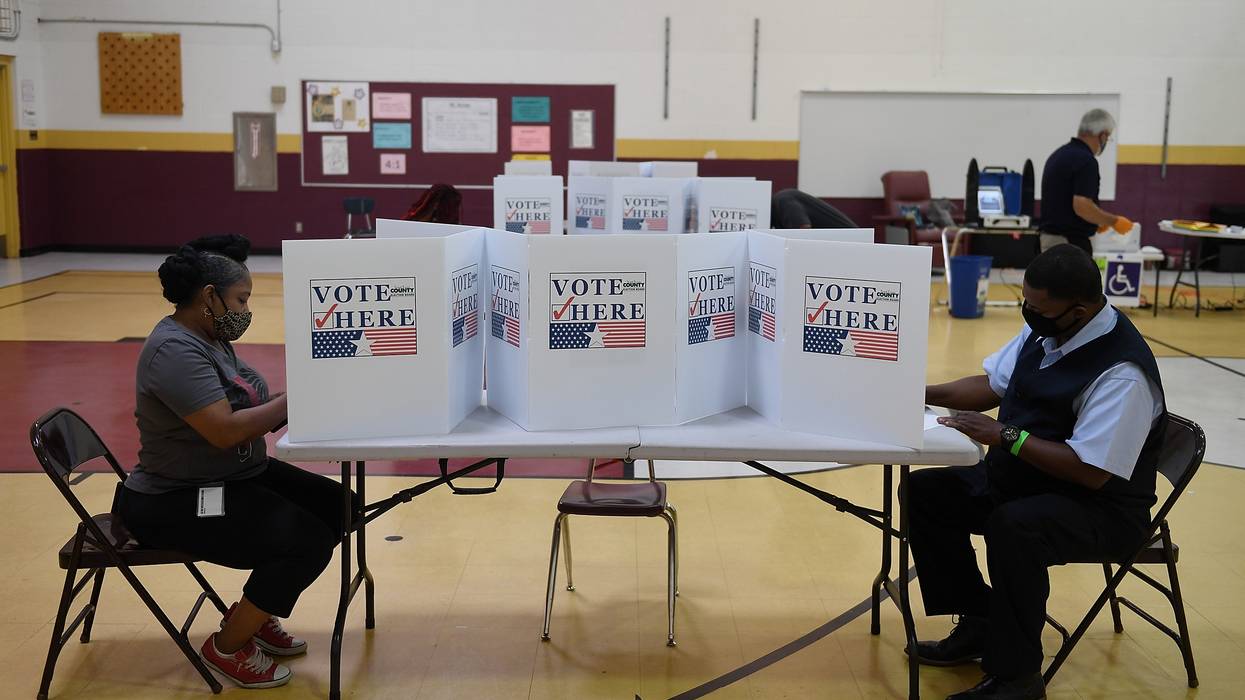
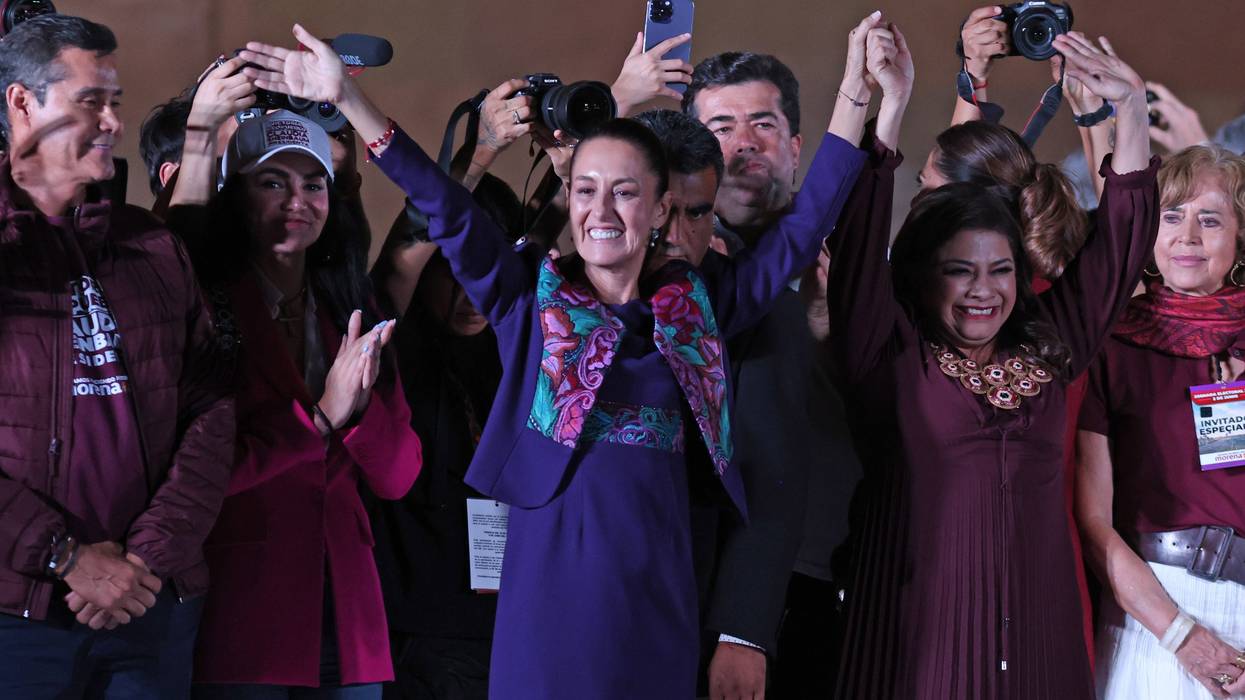
The reforms, in particular the establishment of popular elections for judges and supreme court justices, will profoundly shake up the Mexican judiciary. However, there is little basis for alleging that they represent a threat to democracy. Whatever the drawbacks or merits of the measures, the United States—where an ultra-conservative Supreme Court has been plagued by egregious conflict of interest scandals—has no business interfering in Mexico’s domestic affairs, let alone a democratic and constitutional process of reform.
With the additional constitutional reforms proposed including measures to enshrine a ban on genetically modified corn, hydraulic fracturing (“fracking”), and open-pit mining, a democratically elected supreme court willing to uphold such measures represents a genuine threat to big agrobusiness, fossil fuel capital, and extractive enterprises on both sides of the border.
More troublingly, attacks against Mexico’s judicial reform appeared to have more to do with disciplining the incoming Sheinbaum administration and undermining the progressive elements of her party’s agenda than defending democracy and the rule of law.
The judicial package was just one of 20 constitutional reform initiatives submitted to the Mexican congress by AMLO in February. It comes after key measures of the governing Morena party’s agenda were blocked by the country’s high court. The reform provisions include measures to expedite case resolution; enforce gender parity; open supreme court sessions to the public; cap judicial salaries; keep challenged laws or policies active until ruled unconstitutional; and establish bodies to supervise and sanction judicial officials, as well as a less savory move to expand the list of crimes that warrant mandatory pretrial incarceration.
U.S. objections, however, are focused on one key transformation: the democratic election of the judiciary.
Until the reform, Mexico’s federal judges and magistrates, as well as local circuit and district judges, were appointed through a process overseen by the Consejo de la Judicatura Federal (Federal Judiciary Council), an unelected arm of the judicial branch. The supreme court is currently composed of 11 justices including the president of the court who oversees and participates in the plenary. They meet as a full group and in two five-member chambers; the justices are nominated by the president of Mexico, approved by the senate, and serve 15-year terms.
Under the newly approved judicial overhaul, federal judges and magistrates will be popularly elected for nine-year terms, with the possibility of reelection. The same process will take place at the state level for circuit and district courts. Supreme court justices (referred to as ministers in Mexico) and Federal Electoral Tribunal magistrates will also be popularly elected. The number of supreme court ministers will be cut to nine and their terms reduced to 12 years, while the two chambers would be eliminated in favor of the single body.
Contrary to claims of executive overreach, the reforms stipulate that candidates who meet the necessary qualifications be proposed in equal proportions by all three branches of government, then narrowed down via a lottery system. The first elections will take place in June 2025 for the supreme court, Federal Electoral Tribunal, and half of the federal judiciary. By 2027, all sitting magistrates and judges will be up for election.
Throughout AMLO’s presidency (2018–2024), Mexico’s supreme court has served as a backstop against some of the government’s more ambitious reforms, sometimes intervening on behalf of powerful business interests. In a 3-5 decision in March 2021, for example, a supreme court chamber struck down a recently passed Electricity Industry Law for privileging the Comisión Federal de Electricidad (Federal Electricity Commission), a public utility, over private sector investors. On two occasions, the court overturned electoral reforms which, like the judicial reform, sought to restructure national election oversight bodies and elect their authorities by popular vote.
Morena argues that the reforms are intended to root out corruption and nepotism in the judicial system and democratize a historically elitist and authoritarian judicial branch. This argument has merit: Internal studies have found family networks of up to 89 relatives employed in the courts; 53.4% of magistrates and 18% of judges had more than four relatives working in the judicial branch in 2022.
Judicial positions in Mexico are lucrative: That same year, more than 1,000 high-ranking judicial employees were taking in between 430,000 and 518,000 pesos per month, well above $21,500 per month at a time when the monthly minimum wage in most of the country stood below $260.
Sheinbaum has defended the new measures, explaining that rather than consolidate executive power, the reform abdicates it.
“With this reform, the next president is renouncing the power to personally name supreme court justices,” she told the public in a recent social media message. “The president is democratically elected. Deputies and senators are democratically elected. Now, judges, magistrates, and justices will be democratically elected.”
Yet the reforms were met with resistance from powerful corporate interests. The U.S.-Mexico Chamber of Commerce warned that, without significant changes, the “social and economic impacts will be inevitable and devastating.”
In his two-page statement criticizing the measure, U.S. Ambassador Salazar wrote that the proposal “will threaten the historic trade relationship we have built,” while the Canadian embassy declared it was a source of concern for private investors.
Major U.S. outlets including The Washington Post and The New York Times also ran incendiary columns that suggested the measure would undermine governance and endanger trade relations.
Their arguments varied. Some contended that elections would provide an opportunity for organized criminal influence; others warned the reforms represented an authoritarian presidential power grab; some merely raised vague concerns about destabilizing the investment climate. Little evidence backs up these claims. Rather than the contents of the reforms, big business, in Mexico and in the United States, appeared to balk at the restructuring of a system that has generally favored its interests.
Much of the criticism took a misogynist tone. The Post’s August 25 editorial espoused a patronizing and not subtly gendered view of President Sheinbaum’s relationship with López Obrador. It referred to AMLO as “her boss” and “her patron,” as though Mexico’s first female president were a promoted secretary and not a veteran politician and climate scientist with the strongest electoral mandate in Mexican history.
At the same time, the measure drew protest from within the Mexican judiciary, prompting marches, work stoppages, and strikes by judges and court workers. They framed their actions as a struggle against a reckless consolidation of executive power and politicization of the bench by the outgoing president. Advocates for reform dismissed these protests as attempts to retain long-held privileges.
The package faced formal challenges from within the judiciary as well. On August 31, a judge in the state of Morelos—herself a vociferous opponent of the reform—issued an injunction to suspend debate in congress at the behest of a group of magistrates who argue they stand to lose their jobs without due process. Simultaneously, a judge in Chiapas issued another injunction to prevent the measure from advancing to state legislatures for ratification. Hours later, a district court judge suspended both injunctions, permitting the process to move forward.
International financial markets also reacted negatively, perhaps because they find the current corrupt judiciary more friendly to their interests than an election-based system that would demand more accountability to public interest and needs. Morgan Stanley downgraded its investment recommendation for Mexico, and Fitch Ratings expressed concerns that the reforms could negatively impact the country’s corporate investment climate. The Mexican peso, which had fallen significantly following Sheinbaum’s commanding June 2 presidential victory, dropped again as the reforms moved forward in congress.
At a moment of political transition, these market moves send a disturbing message tantamount to blackmail to a fledgling administration with an ambitious agenda for a public sector-led sustainable energy transition. With the additional constitutional reforms proposed including measures to enshrine a ban on genetically modified corn, hydraulic fracturing (“fracking”), and open-pit mining, a democratically elected supreme court willing to uphold such measures represents a genuine threat to big agrobusiness, fossil fuel capital, and extractive enterprises on both sides of the border.
Despite this tidal wave of opposition, the reforms passed the Chamber of Deputies on September 4, were approved in the senate on September 10, and were subsequently ratified by a majority of state legislatures, where Morena and its allies hold commanding majorities. On Sunday, September 16, Mexican Independence Day, the president signed them into law. Far from a presidential imposition, their implementation will be the result of Mexico’s constitutionally established democratic process.
Some critics on the left suggest that the reforms do not go far enough, exempting from popular election military tribunal judges and administrative magistrates. In an analysis for the Friedrich Naumann Foundation for Freedom, distinguished jurist and human rights advocate Carlos Pérez Vasquez argued: “If the radical democratization of justice is the point of the proposed reform, why not go further, returning to our own history to restore, gradually, the existence of popular juries as a central element of the democratic legitimacy of the justice system?”
Nevertheless, accusations that the reforms will undermine judicial independence and politicize a neutral judiciary ignore the reality that Mexico’s judicial branch is already an active political agent, while charges that the measures represent an authoritarian executive power grab willfully mischaracterize the initiative. The reforms may be imperfect, and they may not address the profound structural obstacles to justice in Mexico, but they represent a legitimate political project with support across the country’s national and local representative bodies.
In a recent column, independent Mexican journalist and political analyst Viri Ríos, a critic of the proposal for judicial elections, dismissed the opposition’s claims that they would put the country on a path to dictatorship.
“Personally, I don’t support the judicial reform, but I’m a democrat and therefore I know that my disagreement doesn’t authorize me to call my opponent authoritarian, much less to use everything in my power to subvert the implementation of their agenda,” she wrote. “In a democracy, losing has consequences. Unfortunately, in Mexico it’s clear that the losers don’t want to accept them.”
That the United States, a nation that combines lifetime Supreme Court appointments with a state-by-state system of local judicial selection in which most hold popular elections for lower court judges, could credibly lecture Mexico about judicial reform and the perils of judicial democracy is laughable.
Moreover, Salazar’s threats constituted a brazen intervention into a sovereign nation’s internal politics—hardly a first for a U.S. ambassador, but unacceptable nonetheless. Instead, the United States might prioritize putting its own house in order and follow Mexico’s example to confront the unelected far-right ideologues who have hijacked U.S. democracy from the bench with total impunity.
Mexico has every right to experiment with its forms of democratic self-governance. Maybe the United States should give it a try.