SUBSCRIBE TO OUR FREE NEWSLETTER
Daily news & progressive opinion—funded by the people, not the corporations—delivered straight to your inbox.
5
#000000
#FFFFFF
To donate by check, phone, or other method, see our More Ways to Give page.
Daily news & progressive opinion—funded by the people, not the corporations—delivered straight to your inbox.
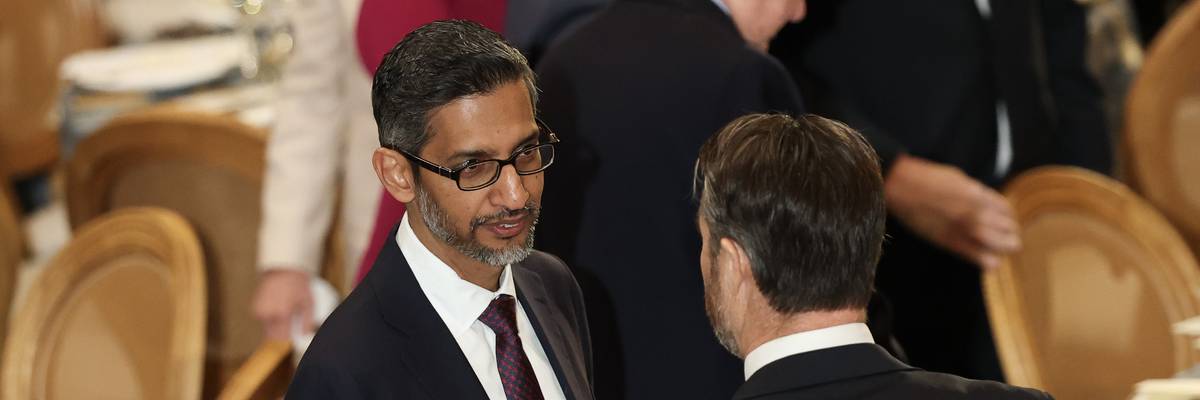
CEO of Google and Alphabet Sundar Pichai attends the inauguration of U.S. President-elect Donald Trump in the Rotunda of the U.S. Capitol on January 20, 2025 in Washington, DC.
"It is the American people who lose when corporations succeed in keeping their taxes low," according to the report's authors.
With portions of President Donald Trump's 2017 Tax Cuts and Jobs Act that favored high income households and corporations set to expire in 2025, the watchdog group Accountable.US and the coalition Americans for Tax Fairness released a report Wednesday detailing how top corporations benefited from corporate tax law in the five years following the 2017 reform.
These corporations, which include household names such as Apple, Bank of America, Microsoft, Meta, and General Motors, make a disproportionate share of national profits and pay a big chunk of total corporate taxes, though at low rates, according to the report—as in, the "corporate tax ten" identified by the report have a lot at stake when it comes to corporate tax policy.
Ahead of the coming debate around taxes in 2025, "the American public should be aware that the debate over corporate tax policy is less about national economic impact—as corporate lobbyists tend to insist—and more about the narrow profit interests of a few mammoth corporations," according to the report's authors.
While Trump's 2017 tax law permanently lowered the corporate tax rate from 35% to 21%—and this provision is not among those set to expire this year—Trump and House Republicans have expressed interest in dropping the corporate tax rate further, to 15%. Researchers at the Institute on Taxation and Economic Policy found that even after Trump dropped the corporate tax rate to 21%, most profitable corporations paid considerably less than that, "mainly due to loopholes and special breaks that the 2017 tax law left in place and, in some cases, introduced."
"We've seen how Trump's tax scam played out before—after promising to deliver for Main Street, he turned around and gave trillions in tax cuts to the ultra-wealthy and mega-corporations," said David Kass, ATF's executive director in a statement Wednesday. Regular American families "will be hurt by Republicans' plans to give trillions in additional tax cuts to make the rich richer and pay for it by cutting essential programs," he added.
Citing the Institute on Taxation and Economic Policy, the report notes that of the hundreds of billions in total subsidies received by corporations from 2018 through 2022—defined as "the difference between what they would owe over that period without special breaks in the tax code and what they actually paid with them in place"—over $150 billion of those total tax breaks were claimed by just 25 corporations, with Bank of America topping the list at nearly $24 billion in subsidies over those five years
Those breaks help explain how Bank of America paid a federal income-tax rate of just 3.8% on almost $139 billion in profits over that time period, according to the report.
Trump's 2017 legislation also lowered the tax rate for corporate income that comes from intangible assets that are held in the U.S. but generate sales overseas, so-called Foreign Derived Intangible Income (FDII) earnings, according to the report. The authors report that "of the over $50 billion the top 15 corporate beneficiaries of the FDII loophole have received over the first six years of the Trump law, almost one-quarter was reaped by Alphabet"—the parent company of Google.
The authors also note that if the 15% corporate tax rate was already in effect, Apple alone would have saved $3.5 billion on its taxes in the most recent annual reporting period.
The report gives other examples of how these top ten corporations benefit from subsidies already in place and how much they stand to gain from a potentially lowered corporate tax rate.
The report's argument that corporations approach tax policy first and foremost with their own profit margins in mind "is an important realization because it is the American people who lose when corporations succeed in keeping their taxes low: through cuts to public services because of the lost revenue; widening income and wealth gaps from increased corporate profits and stock prices; and in the growth of concentrated corporate power," the authors write.
Dear Common Dreams reader, It’s been nearly 30 years since I co-founded Common Dreams with my late wife, Lina Newhouser. We had the radical notion that journalism should serve the public good, not corporate profits. It was clear to us from the outset what it would take to build such a project. No paid advertisements. No corporate sponsors. No millionaire publisher telling us what to think or do. Many people said we wouldn't last a year, but we proved those doubters wrong. Together with a tremendous team of journalists and dedicated staff, we built an independent media outlet free from the constraints of profits and corporate control. Our mission has always been simple: To inform. To inspire. To ignite change for the common good. Building Common Dreams was not easy. Our survival was never guaranteed. When you take on the most powerful forces—Wall Street greed, fossil fuel industry destruction, Big Tech lobbyists, and uber-rich oligarchs who have spent billions upon billions rigging the economy and democracy in their favor—the only bulwark you have is supporters who believe in your work. But here’s the urgent message from me today. It's never been this bad out there. And it's never been this hard to keep us going. At the very moment Common Dreams is most needed, the threats we face are intensifying. We need your support now more than ever. We don't accept corporate advertising and never will. We don't have a paywall because we don't think people should be blocked from critical news based on their ability to pay. Everything we do is funded by the donations of readers like you. When everyone does the little they can afford, we are strong. But if that support retreats or dries up, so do we. Will you donate now to make sure Common Dreams not only survives but thrives? —Craig Brown, Co-founder |
With portions of President Donald Trump's 2017 Tax Cuts and Jobs Act that favored high income households and corporations set to expire in 2025, the watchdog group Accountable.US and the coalition Americans for Tax Fairness released a report Wednesday detailing how top corporations benefited from corporate tax law in the five years following the 2017 reform.
These corporations, which include household names such as Apple, Bank of America, Microsoft, Meta, and General Motors, make a disproportionate share of national profits and pay a big chunk of total corporate taxes, though at low rates, according to the report—as in, the "corporate tax ten" identified by the report have a lot at stake when it comes to corporate tax policy.
Ahead of the coming debate around taxes in 2025, "the American public should be aware that the debate over corporate tax policy is less about national economic impact—as corporate lobbyists tend to insist—and more about the narrow profit interests of a few mammoth corporations," according to the report's authors.
While Trump's 2017 tax law permanently lowered the corporate tax rate from 35% to 21%—and this provision is not among those set to expire this year—Trump and House Republicans have expressed interest in dropping the corporate tax rate further, to 15%. Researchers at the Institute on Taxation and Economic Policy found that even after Trump dropped the corporate tax rate to 21%, most profitable corporations paid considerably less than that, "mainly due to loopholes and special breaks that the 2017 tax law left in place and, in some cases, introduced."
"We've seen how Trump's tax scam played out before—after promising to deliver for Main Street, he turned around and gave trillions in tax cuts to the ultra-wealthy and mega-corporations," said David Kass, ATF's executive director in a statement Wednesday. Regular American families "will be hurt by Republicans' plans to give trillions in additional tax cuts to make the rich richer and pay for it by cutting essential programs," he added.
Citing the Institute on Taxation and Economic Policy, the report notes that of the hundreds of billions in total subsidies received by corporations from 2018 through 2022—defined as "the difference between what they would owe over that period without special breaks in the tax code and what they actually paid with them in place"—over $150 billion of those total tax breaks were claimed by just 25 corporations, with Bank of America topping the list at nearly $24 billion in subsidies over those five years
Those breaks help explain how Bank of America paid a federal income-tax rate of just 3.8% on almost $139 billion in profits over that time period, according to the report.
Trump's 2017 legislation also lowered the tax rate for corporate income that comes from intangible assets that are held in the U.S. but generate sales overseas, so-called Foreign Derived Intangible Income (FDII) earnings, according to the report. The authors report that "of the over $50 billion the top 15 corporate beneficiaries of the FDII loophole have received over the first six years of the Trump law, almost one-quarter was reaped by Alphabet"—the parent company of Google.
The authors also note that if the 15% corporate tax rate was already in effect, Apple alone would have saved $3.5 billion on its taxes in the most recent annual reporting period.
The report gives other examples of how these top ten corporations benefit from subsidies already in place and how much they stand to gain from a potentially lowered corporate tax rate.
The report's argument that corporations approach tax policy first and foremost with their own profit margins in mind "is an important realization because it is the American people who lose when corporations succeed in keeping their taxes low: through cuts to public services because of the lost revenue; widening income and wealth gaps from increased corporate profits and stock prices; and in the growth of concentrated corporate power," the authors write.
With portions of President Donald Trump's 2017 Tax Cuts and Jobs Act that favored high income households and corporations set to expire in 2025, the watchdog group Accountable.US and the coalition Americans for Tax Fairness released a report Wednesday detailing how top corporations benefited from corporate tax law in the five years following the 2017 reform.
These corporations, which include household names such as Apple, Bank of America, Microsoft, Meta, and General Motors, make a disproportionate share of national profits and pay a big chunk of total corporate taxes, though at low rates, according to the report—as in, the "corporate tax ten" identified by the report have a lot at stake when it comes to corporate tax policy.
Ahead of the coming debate around taxes in 2025, "the American public should be aware that the debate over corporate tax policy is less about national economic impact—as corporate lobbyists tend to insist—and more about the narrow profit interests of a few mammoth corporations," according to the report's authors.
While Trump's 2017 tax law permanently lowered the corporate tax rate from 35% to 21%—and this provision is not among those set to expire this year—Trump and House Republicans have expressed interest in dropping the corporate tax rate further, to 15%. Researchers at the Institute on Taxation and Economic Policy found that even after Trump dropped the corporate tax rate to 21%, most profitable corporations paid considerably less than that, "mainly due to loopholes and special breaks that the 2017 tax law left in place and, in some cases, introduced."
"We've seen how Trump's tax scam played out before—after promising to deliver for Main Street, he turned around and gave trillions in tax cuts to the ultra-wealthy and mega-corporations," said David Kass, ATF's executive director in a statement Wednesday. Regular American families "will be hurt by Republicans' plans to give trillions in additional tax cuts to make the rich richer and pay for it by cutting essential programs," he added.
Citing the Institute on Taxation and Economic Policy, the report notes that of the hundreds of billions in total subsidies received by corporations from 2018 through 2022—defined as "the difference between what they would owe over that period without special breaks in the tax code and what they actually paid with them in place"—over $150 billion of those total tax breaks were claimed by just 25 corporations, with Bank of America topping the list at nearly $24 billion in subsidies over those five years
Those breaks help explain how Bank of America paid a federal income-tax rate of just 3.8% on almost $139 billion in profits over that time period, according to the report.
Trump's 2017 legislation also lowered the tax rate for corporate income that comes from intangible assets that are held in the U.S. but generate sales overseas, so-called Foreign Derived Intangible Income (FDII) earnings, according to the report. The authors report that "of the over $50 billion the top 15 corporate beneficiaries of the FDII loophole have received over the first six years of the Trump law, almost one-quarter was reaped by Alphabet"—the parent company of Google.
The authors also note that if the 15% corporate tax rate was already in effect, Apple alone would have saved $3.5 billion on its taxes in the most recent annual reporting period.
The report gives other examples of how these top ten corporations benefit from subsidies already in place and how much they stand to gain from a potentially lowered corporate tax rate.
The report's argument that corporations approach tax policy first and foremost with their own profit margins in mind "is an important realization because it is the American people who lose when corporations succeed in keeping their taxes low: through cuts to public services because of the lost revenue; widening income and wealth gaps from increased corporate profits and stock prices; and in the growth of concentrated corporate power," the authors write.