

SUBSCRIBE TO OUR FREE NEWSLETTER
Daily news & progressive opinion—funded by the people, not the corporations—delivered straight to your inbox.
5
#000000
#FFFFFF
To donate by check, phone, or other method, see our More Ways to Give page.
While welcoming a "modest uptick" in corporate prosecutions by the U.S. Department of Justice last year, the watchdog Public Citizen on Monday called for the "bold ramp-up Biden DOJ leadership promised early in the administration."
Federal prosecutions of corporations over the past 25 years peaked in 2000, at 304, according to the organization's analysis of various datasets. After the turn of the century, figures trended down, with a low of 90 in 2021, the year that President Joe Biden was sworn in. Since then, the numbers have started to climb again—hitting 99 in 2022 and 113 in 2023.
However, the impact isn't felt equally across the corporate world. Last year, "about 76% of the corporations DOJ prosecuted had only 50 employees or less, while only about 12% had 1,000 employees or more," the report states. "This is the continuation of a long-standing trend—about 70% of the 4,946 corporations the federal government prosecuted between 1992 and 2021 were small businesses with fewer than 50 employees. Only about 6% employed 1,000 or more."
"Prosecutions remain far too few, and the ongoing overuse of leniency deals for big corporations that break the law continues to undermine deterrence."
Still, "the increase in corporate prosecutions is a welcome shift from the previous decline, and the new policy of rewarding corporate crime whistleblowers could go further toward restoring enforcement," said Rick Claypool, a Public Citizen research director who authored the report, in a statement Monday.
Deputy Attorney General Lisa Monaco announced the "DOJ-run whistleblower rewards program," through which an individual who helps the department discover "significant corporate or financial misconduct" could receive some of the forfeiture, in a speech to the American Bar Association's 39th National Institute on White Collar Crime earlier this month.
Although Claypool applauded the progress, he also emphasized that "prosecutions remain far too few, and the ongoing overuse of leniency deals for big corporations that break the law continues to undermine deterrence."
The report explains that "prosecutors use DOJ leniency agreements—deferred prosecution agreements (DPAs) and nonprosecution agreements (NPAs)—to avoid filing criminal charges against corporate defendants. Originally developed to offer nonviolent first-time individual offenders a second chance, such agreements now help the most powerful businesses in the world dodge the legal consequences of their criminal misconduct."
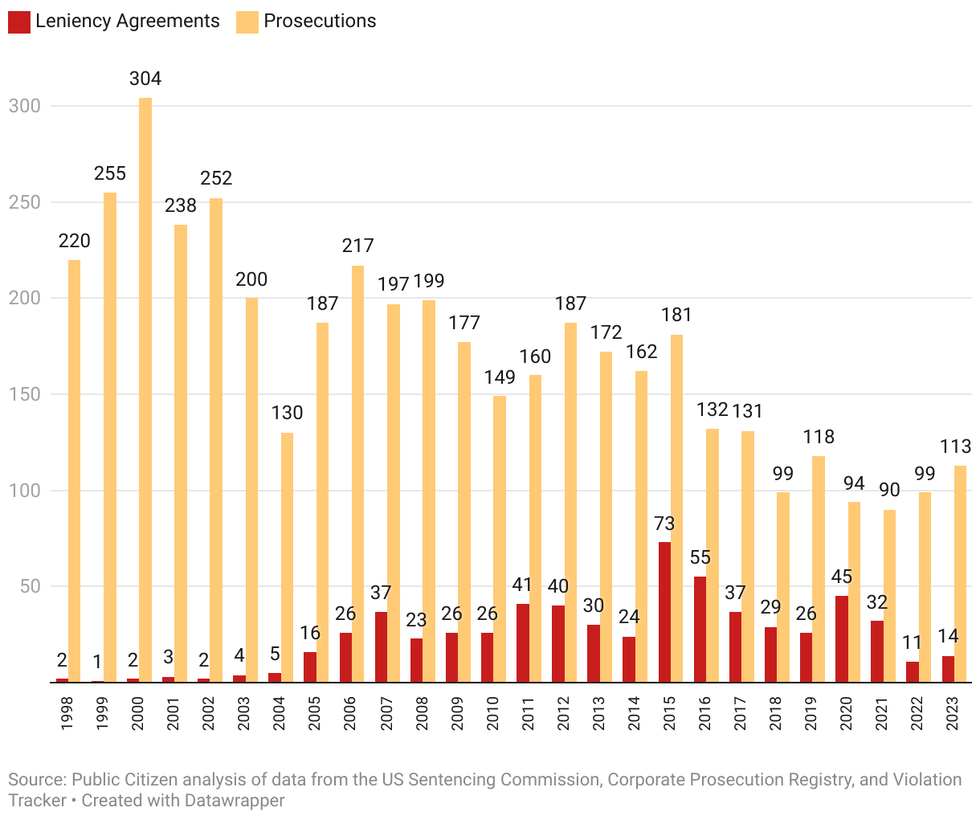
Previous Public Citizen research shows that "about 15% of the agreements historically involve repeat offenders, casting doubt on their deterrent effect," the report notes. "Most corporate repeat offenders that receive leniency agreements from the Department of Justice are large multinationals. Of the 14 corporations that received leniency deals in 2023, the majority (10, or 71%) had at least 5,000 employees or more."
Of those who took deals last year, the watchdog highlighted "generic pharmaceutical companies Teva and Glenmark, multinational tobacco corporation British American Tobacco, the Illinois subsidiary of telecommunications corporation AT&T, and the Swiss multinational technology firm ABB."
While calling out the DOJ for creating "the appearance that some businesses are 'too big to jail'" with its leniency agreements, Public Citizen also lauded Monaco's recent remarks about "delivering consequences for corporate recidivists."
"A history of misconduct matters," she said during the early March address. "After all, penalties exist, in part, to deter future misconduct. They're not the cost of doing business. So when a company breaks the law again—and it's clear the message wasn't received—we need to ratchet up the sanctions."
As the report details:
The first example Monaco provides of the Justice Department holding corporate repeat offenders accountable is Ericsson. Ericsson breached its 2019 leniency agreement with the DOJ to resolve allegations of criminal violations of the Foreign Corrupt Practices Act in Djibouti, China, Vietnam, Indonesia, and Kuwait. Following the breach—failing to meet cooperation and disclosure requirements—the DOJ subsequently prosecuted the corporation for its misconduct.
Other major corporations that have been prosecuted after breaching leniency agreements include the multinational agrichemical corporation Monsanto and the financial corporation formerly known as Royal Bank of Scotland, NatWest Group, which reportedly rebranded in part to dissociate itself from its past misconduct.
"The DOJ's fresh willingness to hold corporate offenders accountable for leniency agreement breaches is among the strongest and most necessary corporate accountability reforms implemented by the Biden administration," the report says. "It's also one that is currently facing its greatest test: Boeing."
Boeing entered into DPA in 2021, after a pair of deadly 737 MAX 8 jet crashes in 2018 and 2019. In January, a door plug flew off a 737 MAX 9 during a flight, resulting in an emergency landing and fresh scrutiny—including a DOJ criminal investigation.
In a February letter to DOJ leaders including Monaco and Attorney General Merrick Garland, Weissman wrote that "if the DOJ finds that Boeing again violated the law, Boeing should be prosecuted both for its original and its subsequent misconduct."
As Common Dreams reported earlier Monday, Boeing announced that its commercial airplanes division leader will leave immediately, the chairman of the board will resign after the annual meeting in May, and the CEO will step down at the end of this year.
"Of course CEO Dave Calhoun should be dismissed," responded Weissman. "But for real and lasting change to occur, Boeing must now be held criminally accountable both for the recent safety failures and the... crashes that took 346 lives."
While welcoming a "modest uptick" in corporate prosecutions by the U.S. Department of Justice last year, the watchdog Public Citizen on Monday called for the "bold ramp-up Biden DOJ leadership promised early in the administration."
Federal prosecutions of corporations over the past 25 years peaked in 2000, at 304, according to the organization's analysis of various datasets. After the turn of the century, figures trended down, with a low of 90 in 2021, the year that President Joe Biden was sworn in. Since then, the numbers have started to climb again—hitting 99 in 2022 and 113 in 2023.
However, the impact isn't felt equally across the corporate world. Last year, "about 76% of the corporations DOJ prosecuted had only 50 employees or less, while only about 12% had 1,000 employees or more," the report states. "This is the continuation of a long-standing trend—about 70% of the 4,946 corporations the federal government prosecuted between 1992 and 2021 were small businesses with fewer than 50 employees. Only about 6% employed 1,000 or more."
"Prosecutions remain far too few, and the ongoing overuse of leniency deals for big corporations that break the law continues to undermine deterrence."
Still, "the increase in corporate prosecutions is a welcome shift from the previous decline, and the new policy of rewarding corporate crime whistleblowers could go further toward restoring enforcement," said Rick Claypool, a Public Citizen research director who authored the report, in a statement Monday.
Deputy Attorney General Lisa Monaco announced the "DOJ-run whistleblower rewards program," through which an individual who helps the department discover "significant corporate or financial misconduct" could receive some of the forfeiture, in a speech to the American Bar Association's 39th National Institute on White Collar Crime earlier this month.
Although Claypool applauded the progress, he also emphasized that "prosecutions remain far too few, and the ongoing overuse of leniency deals for big corporations that break the law continues to undermine deterrence."
The report explains that "prosecutors use DOJ leniency agreements—deferred prosecution agreements (DPAs) and nonprosecution agreements (NPAs)—to avoid filing criminal charges against corporate defendants. Originally developed to offer nonviolent first-time individual offenders a second chance, such agreements now help the most powerful businesses in the world dodge the legal consequences of their criminal misconduct."
Previous Public Citizen research shows that "about 15% of the agreements historically involve repeat offenders, casting doubt on their deterrent effect," the report notes. "Most corporate repeat offenders that receive leniency agreements from the Department of Justice are large multinationals. Of the 14 corporations that received leniency deals in 2023, the majority (10, or 71%) had at least 5,000 employees or more."
Of those who took deals last year, the watchdog highlighted "generic pharmaceutical companies Teva and Glenmark, multinational tobacco corporation British American Tobacco, the Illinois subsidiary of telecommunications corporation AT&T, and the Swiss multinational technology firm ABB."
While calling out the DOJ for creating "the appearance that some businesses are 'too big to jail'" with its leniency agreements, Public Citizen also lauded Monaco's recent remarks about "delivering consequences for corporate recidivists."
"A history of misconduct matters," she said during the early March address. "After all, penalties exist, in part, to deter future misconduct. They're not the cost of doing business. So when a company breaks the law again—and it's clear the message wasn't received—we need to ratchet up the sanctions."
As the report details:
The first example Monaco provides of the Justice Department holding corporate repeat offenders accountable is Ericsson. Ericsson breached its 2019 leniency agreement with the DOJ to resolve allegations of criminal violations of the Foreign Corrupt Practices Act in Djibouti, China, Vietnam, Indonesia, and Kuwait. Following the breach—failing to meet cooperation and disclosure requirements—the DOJ subsequently prosecuted the corporation for its misconduct.
Other major corporations that have been prosecuted after breaching leniency agreements include the multinational agrichemical corporation Monsanto and the financial corporation formerly known as Royal Bank of Scotland, NatWest Group, which reportedly rebranded in part to dissociate itself from its past misconduct.
"The DOJ's fresh willingness to hold corporate offenders accountable for leniency agreement breaches is among the strongest and most necessary corporate accountability reforms implemented by the Biden administration," the report says. "It's also one that is currently facing its greatest test: Boeing."
Boeing entered into DPA in 2021, after a pair of deadly 737 MAX 8 jet crashes in 2018 and 2019. In January, a door plug flew off a 737 MAX 9 during a flight, resulting in an emergency landing and fresh scrutiny—including a DOJ criminal investigation.
In a February letter to DOJ leaders including Monaco and Attorney General Merrick Garland, Weissman wrote that "if the DOJ finds that Boeing again violated the law, Boeing should be prosecuted both for its original and its subsequent misconduct."
As Common Dreams reported earlier Monday, Boeing announced that its commercial airplanes division leader will leave immediately, the chairman of the board will resign after the annual meeting in May, and the CEO will step down at the end of this year.
"Of course CEO Dave Calhoun should be dismissed," responded Weissman. "But for real and lasting change to occur, Boeing must now be held criminally accountable both for the recent safety failures and the... crashes that took 346 lives."
While welcoming a "modest uptick" in corporate prosecutions by the U.S. Department of Justice last year, the watchdog Public Citizen on Monday called for the "bold ramp-up Biden DOJ leadership promised early in the administration."
Federal prosecutions of corporations over the past 25 years peaked in 2000, at 304, according to the organization's analysis of various datasets. After the turn of the century, figures trended down, with a low of 90 in 2021, the year that President Joe Biden was sworn in. Since then, the numbers have started to climb again—hitting 99 in 2022 and 113 in 2023.
However, the impact isn't felt equally across the corporate world. Last year, "about 76% of the corporations DOJ prosecuted had only 50 employees or less, while only about 12% had 1,000 employees or more," the report states. "This is the continuation of a long-standing trend—about 70% of the 4,946 corporations the federal government prosecuted between 1992 and 2021 were small businesses with fewer than 50 employees. Only about 6% employed 1,000 or more."
"Prosecutions remain far too few, and the ongoing overuse of leniency deals for big corporations that break the law continues to undermine deterrence."
Still, "the increase in corporate prosecutions is a welcome shift from the previous decline, and the new policy of rewarding corporate crime whistleblowers could go further toward restoring enforcement," said Rick Claypool, a Public Citizen research director who authored the report, in a statement Monday.
Deputy Attorney General Lisa Monaco announced the "DOJ-run whistleblower rewards program," through which an individual who helps the department discover "significant corporate or financial misconduct" could receive some of the forfeiture, in a speech to the American Bar Association's 39th National Institute on White Collar Crime earlier this month.
Although Claypool applauded the progress, he also emphasized that "prosecutions remain far too few, and the ongoing overuse of leniency deals for big corporations that break the law continues to undermine deterrence."
The report explains that "prosecutors use DOJ leniency agreements—deferred prosecution agreements (DPAs) and nonprosecution agreements (NPAs)—to avoid filing criminal charges against corporate defendants. Originally developed to offer nonviolent first-time individual offenders a second chance, such agreements now help the most powerful businesses in the world dodge the legal consequences of their criminal misconduct."
Previous Public Citizen research shows that "about 15% of the agreements historically involve repeat offenders, casting doubt on their deterrent effect," the report notes. "Most corporate repeat offenders that receive leniency agreements from the Department of Justice are large multinationals. Of the 14 corporations that received leniency deals in 2023, the majority (10, or 71%) had at least 5,000 employees or more."
Of those who took deals last year, the watchdog highlighted "generic pharmaceutical companies Teva and Glenmark, multinational tobacco corporation British American Tobacco, the Illinois subsidiary of telecommunications corporation AT&T, and the Swiss multinational technology firm ABB."
While calling out the DOJ for creating "the appearance that some businesses are 'too big to jail'" with its leniency agreements, Public Citizen also lauded Monaco's recent remarks about "delivering consequences for corporate recidivists."
"A history of misconduct matters," she said during the early March address. "After all, penalties exist, in part, to deter future misconduct. They're not the cost of doing business. So when a company breaks the law again—and it's clear the message wasn't received—we need to ratchet up the sanctions."
As the report details:
The first example Monaco provides of the Justice Department holding corporate repeat offenders accountable is Ericsson. Ericsson breached its 2019 leniency agreement with the DOJ to resolve allegations of criminal violations of the Foreign Corrupt Practices Act in Djibouti, China, Vietnam, Indonesia, and Kuwait. Following the breach—failing to meet cooperation and disclosure requirements—the DOJ subsequently prosecuted the corporation for its misconduct.
Other major corporations that have been prosecuted after breaching leniency agreements include the multinational agrichemical corporation Monsanto and the financial corporation formerly known as Royal Bank of Scotland, NatWest Group, which reportedly rebranded in part to dissociate itself from its past misconduct.
"The DOJ's fresh willingness to hold corporate offenders accountable for leniency agreement breaches is among the strongest and most necessary corporate accountability reforms implemented by the Biden administration," the report says. "It's also one that is currently facing its greatest test: Boeing."
Boeing entered into DPA in 2021, after a pair of deadly 737 MAX 8 jet crashes in 2018 and 2019. In January, a door plug flew off a 737 MAX 9 during a flight, resulting in an emergency landing and fresh scrutiny—including a DOJ criminal investigation.
In a February letter to DOJ leaders including Monaco and Attorney General Merrick Garland, Weissman wrote that "if the DOJ finds that Boeing again violated the law, Boeing should be prosecuted both for its original and its subsequent misconduct."
As Common Dreams reported earlier Monday, Boeing announced that its commercial airplanes division leader will leave immediately, the chairman of the board will resign after the annual meeting in May, and the CEO will step down at the end of this year.
"Of course CEO Dave Calhoun should be dismissed," responded Weissman. "But for real and lasting change to occur, Boeing must now be held criminally accountable both for the recent safety failures and the... crashes that took 346 lives."

