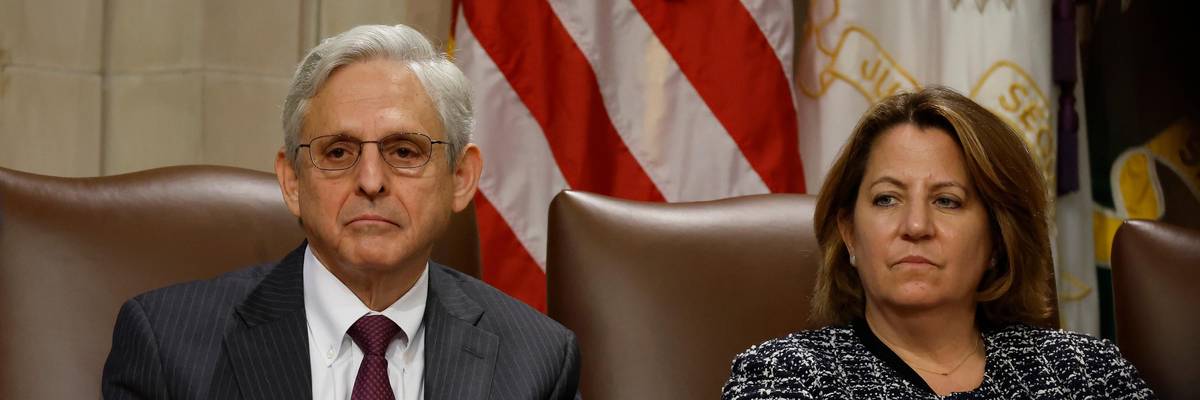
U.S. Attorney General Merrick Garland and Deputy Attorney General Lisa Monaco attend an event on May 20, 2022 in Washington, D.C. (Photo: Chip Somodevilla/Getty Images)
'Chickensh*t': Watchdogs Criticize Biden DOJ's New Corporate Crime Plan
The Justice Department's new approach to tackling corporate crime is "a modest step forward when a great leap is required," said the president of Public Citizen.
Watchdogs with a prominent consumer advocacy organization on Thursday sharply criticized the Justice Department's newly announced policy approach to combating corporate crime, calling it inadequate to reverse the decades-long trend of plummeting enforcement that has continued under the Biden administration.
In a speech in New York Thursday attended by prosecutors as well as corporate lawyers, Deputy U.S. Attorney General Lisa Monaco outlined a number of changes the DOJ is moving to implement in an effort to crack down on and deter corporate crime, including incentives for companies to quickly self-report misconduct, stiffer enforcement of existing laws, and a shift away from "multiple, successive non-prosecution or deferred prosecution agreements with the same company."
"We cannot ignore the data showing overall decline in corporate criminal prosecutions over the last decade. We need to do more and move faster," Monaco acknowledged. "So, starting today, we will take steps to empower our prosecutors, to clear impediments in their way, and to expedite our investigations of individuals."
"We need much bolder corporate crime enforcement policy changes than DOJ is proposing."
Watchdogs, however, warned that the changes Monaco announced aren't nearly enough in the face of rising and often glaring corporate crime.
"I call chickenshit," tweeted Public Citizen researcher Rick Claypool, invoking a term that James Comey--before he became FBI director--used to describe prosecutors who aggressively pursue slam-dunk cases while avoiding more difficult ones involving powerful actors.
"We need much bolder corporate crime enforcement policy changes than DOJ is proposing," Claypool added, pointing to recent research showing that federal corporate prosecutions have fallen dramatically over the past two decades, cratering under the Trump administration and hitting a record low of just 90 during President Joe Biden's first year in office.
Monaco defended the Biden DOJ's record during her remarks Thursday, citing "convictions of the founder and chief operating officer of Theranos; convictions of JPMorgan traders for commodities manipulation; the conviction of a managing director at Goldman Sachs for bribery; and the first-ever conviction of a pharmaceutical CEO for unlawful distribution of controlled substances."
But watchdogs argue a handful of prominent convictions, while welcome, do little to reverse the overall trend of plunging corporate crime enforcement.
"Today's corporate crime policy announcement is a modest step forward when a great leap is required," Public Citizen president Robert Weissman said in a statement Thursday. "Corporate crime--in the form of illegal pollution, fraud, reckless endangerment of consumers and workers, cartels, systematic rip-offs, and more--remains rampant, but corporate criminal prosecutions are at historically low levels. Public Citizen has demonstrated that federal corporate criminal prosecutions now stand at less than half the average rate of the past quarter century."
"At the same time, the DOJ continues to enter into corporate leniency agreements (deferred and non-prosecution agreements), declining to prosecute corporations in exchange for promises not to break the law in the future," said Weissman. "Virtually unknown 25 years ago, these leniency agreements now resolve roughly a quarter of corporate crime cases."
While Weissman reacted positively to Monaco's vow to "disfavor" such agreements, he argued "that doesn't go nearly far enough" and called for a complete end to "leniency deals for corporate wrongdoers."
"Corporations are the ultimate rational actors: If they know the costs of breaking the law are worth it for expected monetary gain, then they will break the law--irrespective of the societal damage," he said. "We are disappointed to see the department maintain a willingness to enter leniency deals, especially in light of their demonstrated failure to deter future wrongdoing."
"At the end of the day," Weissman added, "prosecutorial commitment is as important as any particular policy. Monaco talked tough about corporate crime today and there's no doubting her sincerity. Now it's up to the department to back it up."
We are at a crossroads
This country and this world are at a monumental crossroads. In a few short weeks, US voters will have an opportunity to beat back the forces of fascism and confront the billionaires who are rigging the economy, our media system, and our democracy, making it increasingly impossible for ordinary people to get by. We’re not just talking about the election. We’re talking about what must be done once these fascist elements are vanquished from power. We need a bolder set of solutions than what either major party has so far been willing to offer and a working-class movement ready to fight like hell for it. Trump didn't emerge from nowhere. The conditions that fueled MAGA authoritarianism were created by decades of radical neoliberal economic policies and a corrupt political system dominated by corporate interests. They slashed taxes on the super-rich, promising that the benefits would trickle down. They said giveaways to the corporate titans would make life more affordable for the rest of us. It was all bullshit. And when a bitter, betrayed populace searches for someone to blame, right-wing demagogues have little trouble finding scapegoats. People know when they're being lied to, but you won't hear any of this from the corporate media. Only independent journalism—powered and funded by people who believe in building a better world—can deliver truly trustworthy daily news. Our Fall Campaign is underway, and we need your help. To power our newsroom through the rest of the year, we need to raise $125,000 by midnight on October 31. So if you share our vision, please contribute whatever you can to sustain our work. |
Watchdogs with a prominent consumer advocacy organization on Thursday sharply criticized the Justice Department's newly announced policy approach to combating corporate crime, calling it inadequate to reverse the decades-long trend of plummeting enforcement that has continued under the Biden administration.
In a speech in New York Thursday attended by prosecutors as well as corporate lawyers, Deputy U.S. Attorney General Lisa Monaco outlined a number of changes the DOJ is moving to implement in an effort to crack down on and deter corporate crime, including incentives for companies to quickly self-report misconduct, stiffer enforcement of existing laws, and a shift away from "multiple, successive non-prosecution or deferred prosecution agreements with the same company."
"We cannot ignore the data showing overall decline in corporate criminal prosecutions over the last decade. We need to do more and move faster," Monaco acknowledged. "So, starting today, we will take steps to empower our prosecutors, to clear impediments in their way, and to expedite our investigations of individuals."
"We need much bolder corporate crime enforcement policy changes than DOJ is proposing."
Watchdogs, however, warned that the changes Monaco announced aren't nearly enough in the face of rising and often glaring corporate crime.
"I call chickenshit," tweeted Public Citizen researcher Rick Claypool, invoking a term that James Comey--before he became FBI director--used to describe prosecutors who aggressively pursue slam-dunk cases while avoiding more difficult ones involving powerful actors.
"We need much bolder corporate crime enforcement policy changes than DOJ is proposing," Claypool added, pointing to recent research showing that federal corporate prosecutions have fallen dramatically over the past two decades, cratering under the Trump administration and hitting a record low of just 90 during President Joe Biden's first year in office.
Monaco defended the Biden DOJ's record during her remarks Thursday, citing "convictions of the founder and chief operating officer of Theranos; convictions of JPMorgan traders for commodities manipulation; the conviction of a managing director at Goldman Sachs for bribery; and the first-ever conviction of a pharmaceutical CEO for unlawful distribution of controlled substances."
But watchdogs argue a handful of prominent convictions, while welcome, do little to reverse the overall trend of plunging corporate crime enforcement.
"Today's corporate crime policy announcement is a modest step forward when a great leap is required," Public Citizen president Robert Weissman said in a statement Thursday. "Corporate crime--in the form of illegal pollution, fraud, reckless endangerment of consumers and workers, cartels, systematic rip-offs, and more--remains rampant, but corporate criminal prosecutions are at historically low levels. Public Citizen has demonstrated that federal corporate criminal prosecutions now stand at less than half the average rate of the past quarter century."
"At the same time, the DOJ continues to enter into corporate leniency agreements (deferred and non-prosecution agreements), declining to prosecute corporations in exchange for promises not to break the law in the future," said Weissman. "Virtually unknown 25 years ago, these leniency agreements now resolve roughly a quarter of corporate crime cases."
While Weissman reacted positively to Monaco's vow to "disfavor" such agreements, he argued "that doesn't go nearly far enough" and called for a complete end to "leniency deals for corporate wrongdoers."
"Corporations are the ultimate rational actors: If they know the costs of breaking the law are worth it for expected monetary gain, then they will break the law--irrespective of the societal damage," he said. "We are disappointed to see the department maintain a willingness to enter leniency deals, especially in light of their demonstrated failure to deter future wrongdoing."
"At the end of the day," Weissman added, "prosecutorial commitment is as important as any particular policy. Monaco talked tough about corporate crime today and there's no doubting her sincerity. Now it's up to the department to back it up."
Watchdogs with a prominent consumer advocacy organization on Thursday sharply criticized the Justice Department's newly announced policy approach to combating corporate crime, calling it inadequate to reverse the decades-long trend of plummeting enforcement that has continued under the Biden administration.
In a speech in New York Thursday attended by prosecutors as well as corporate lawyers, Deputy U.S. Attorney General Lisa Monaco outlined a number of changes the DOJ is moving to implement in an effort to crack down on and deter corporate crime, including incentives for companies to quickly self-report misconduct, stiffer enforcement of existing laws, and a shift away from "multiple, successive non-prosecution or deferred prosecution agreements with the same company."
"We cannot ignore the data showing overall decline in corporate criminal prosecutions over the last decade. We need to do more and move faster," Monaco acknowledged. "So, starting today, we will take steps to empower our prosecutors, to clear impediments in their way, and to expedite our investigations of individuals."
"We need much bolder corporate crime enforcement policy changes than DOJ is proposing."
Watchdogs, however, warned that the changes Monaco announced aren't nearly enough in the face of rising and often glaring corporate crime.
"I call chickenshit," tweeted Public Citizen researcher Rick Claypool, invoking a term that James Comey--before he became FBI director--used to describe prosecutors who aggressively pursue slam-dunk cases while avoiding more difficult ones involving powerful actors.
"We need much bolder corporate crime enforcement policy changes than DOJ is proposing," Claypool added, pointing to recent research showing that federal corporate prosecutions have fallen dramatically over the past two decades, cratering under the Trump administration and hitting a record low of just 90 during President Joe Biden's first year in office.
Monaco defended the Biden DOJ's record during her remarks Thursday, citing "convictions of the founder and chief operating officer of Theranos; convictions of JPMorgan traders for commodities manipulation; the conviction of a managing director at Goldman Sachs for bribery; and the first-ever conviction of a pharmaceutical CEO for unlawful distribution of controlled substances."
But watchdogs argue a handful of prominent convictions, while welcome, do little to reverse the overall trend of plunging corporate crime enforcement.
"Today's corporate crime policy announcement is a modest step forward when a great leap is required," Public Citizen president Robert Weissman said in a statement Thursday. "Corporate crime--in the form of illegal pollution, fraud, reckless endangerment of consumers and workers, cartels, systematic rip-offs, and more--remains rampant, but corporate criminal prosecutions are at historically low levels. Public Citizen has demonstrated that federal corporate criminal prosecutions now stand at less than half the average rate of the past quarter century."
"At the same time, the DOJ continues to enter into corporate leniency agreements (deferred and non-prosecution agreements), declining to prosecute corporations in exchange for promises not to break the law in the future," said Weissman. "Virtually unknown 25 years ago, these leniency agreements now resolve roughly a quarter of corporate crime cases."
While Weissman reacted positively to Monaco's vow to "disfavor" such agreements, he argued "that doesn't go nearly far enough" and called for a complete end to "leniency deals for corporate wrongdoers."
"Corporations are the ultimate rational actors: If they know the costs of breaking the law are worth it for expected monetary gain, then they will break the law--irrespective of the societal damage," he said. "We are disappointed to see the department maintain a willingness to enter leniency deals, especially in light of their demonstrated failure to deter future wrongdoing."
"At the end of the day," Weissman added, "prosecutorial commitment is as important as any particular policy. Monaco talked tough about corporate crime today and there's no doubting her sincerity. Now it's up to the department to back it up."