SUBSCRIBE TO OUR FREE NEWSLETTER
Daily news & progressive opinion—funded by the people, not the corporations—delivered straight to your inbox.
5
#000000
#FFFFFF
To donate by check, phone, or other method, see our More Ways to Give page.
Daily news & progressive opinion—funded by the people, not the corporations—delivered straight to your inbox.
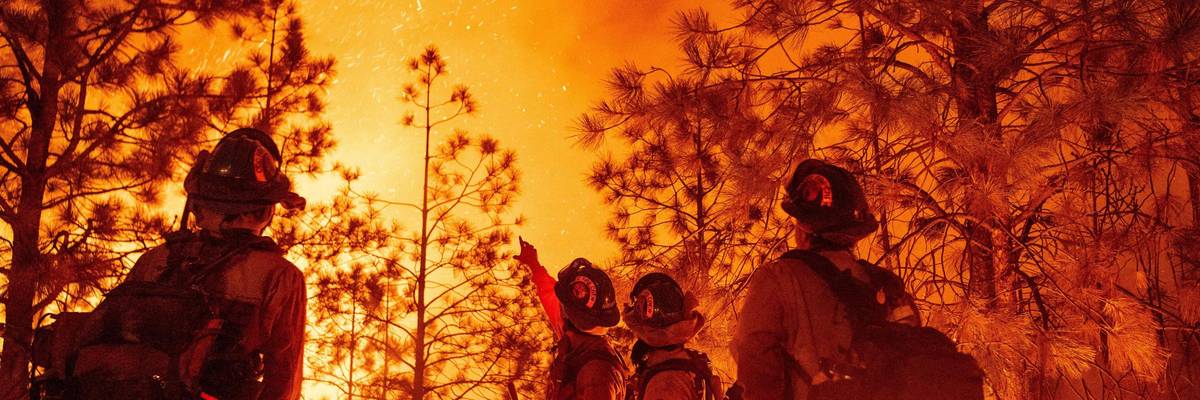
CalFire firefighters monitor the Mosquito fire in Foresthill, California on September 13, 2022.
"It's too late to avoid the climate storm altogether," said a study co-author. "Our ability to steer out of the storm is frustrated by having to manage the impacts of the storm on the ship."
A new study released Thursday warned that the planet has entered "a new chapter in the climate and ecological crisis," in which communities are forced to direct massive resources to responding to the escalating impacts of the climate emergency, taking focus away from efforts to slash fossil fuel emissions—causing what the report authors called a "doom loop" that will make avoiding the worst effects of planetary heating increasingly difficult.
The report, published by the Institute for Public Policy Research and Chatham House, calls on policymakers to "actively manage" the risk that further global heating poses to a green transition itself.
"It's too late to avoid the climate storm altogether, and the challenge of navigating around a storm is very different to the challenge of navigating through it," said Laurie Laybourn, an associate fellow of IPPR and visiting fellow at Chatham House who co-authored the study. "Our ability to steer out of the storm is frustrated by having to manage the impacts of the storm on the ship."
"This is an analogy for the challenge facing environmentalism as we head closer to 1.5°C of global heating," he added. "The worsening symptoms of the climate and ecological crisis—storms, food price shocks, conflict—will increasingly distract us from realizing action to tackle its root causes."
"It's too late to avoid the climate storm altogether, and the challenge of navigating around a storm is very different to the challenge of navigating through it."
The report notes that the cost of climate disasters—such as catastrophic flooding last year in Pakistan and in 2021 in Europe and prolonged drought in the western United States and parts of Africa—is already expected to reduce global economic output by $23 trillion by 2050, and recovery efforts could cost the U.S. $2 trillion per year by the end of the century.
"Such demands could come at the cost of diverting effort away from the rapid switch now needed to decarbonize the global economy," said the researchers in a statement. "The report argues that this risks creating a vicious circle, or 'doom loop'; the impacts of the climate and nature crises draw focus and resources away from tackling their underlying causes and the urgent steps needed to address them."
The researchers referred to the dynamic that has emerged in the debate over whether limiting global heating to 1.5°C above preindustrial levels, the target agreed upon in the Paris climate accords, is still possible and how the global community can meet that goal.
"Some argue that declaring the target to be still in reach remains the most powerful motivator, but others believe that breaching the limit could be the 'wake-up call' that would spur activists and policymakers to step up their efforts," said the authors. "But both stances can be exploited by 'climate delayers' who don't want to see rapid reductions in greenhouse gas emissions and wish to block transformational change."
A failure to move past that debate could lead to policymakers pursuing untested geoengineering methods of limiting planetary heating instead of passing policies to eliminate fossil fuel emissions, as energy experts and climate scientists have clearly stated they must in order to avoid the worst effects of the planetary emergency.
"This is a doom loop: the consequences of the crisis draw focus and resources from tackling its causes, leading to higher temperatures and ecological loss, which then create more severe consequences, diverting even more attention and resources, and so on," reads the report.
The study bolsters the argument made earlier in February by researchers at the University of Hamburg in Germany. As Common Dreams reported, their study said that continued despair over reaching climate "tipping points" such as the melting of sea ice and glaciers risks taking attention away from "the best hope for shaping a positive climate future... the ability of society to make fundamental changes."
Laybourn and his co-author, Chatham House research analyst Henry Throp, likened the "strategic risk" of losing sight of solutions to the danger "facing a ship that sailed too long towards a storm on the horizon without significantly changing course."
"As the storm begins to engulf the ship, making the changes needed to escape it is ever more difficult for the crew, who are distracted by its immediate impacts," they said.
The authors called on policymakers to:
"As global temperatures tick up ever closer to the 1.5°C threshold, collective narratives are needed that can convey the accelerating, cascading dangers and spur rapid transformative change," said Thorp. "These narratives must challenge actors and assumptions that delay action on climate change and should create the basis, direction, and momentum for a climate transition aligned with nature restoration and opportunities for sustainable development."
Dear Common Dreams reader, It’s been nearly 30 years since I co-founded Common Dreams with my late wife, Lina Newhouser. We had the radical notion that journalism should serve the public good, not corporate profits. It was clear to us from the outset what it would take to build such a project. No paid advertisements. No corporate sponsors. No millionaire publisher telling us what to think or do. Many people said we wouldn't last a year, but we proved those doubters wrong. Together with a tremendous team of journalists and dedicated staff, we built an independent media outlet free from the constraints of profits and corporate control. Our mission has always been simple: To inform. To inspire. To ignite change for the common good. Building Common Dreams was not easy. Our survival was never guaranteed. When you take on the most powerful forces—Wall Street greed, fossil fuel industry destruction, Big Tech lobbyists, and uber-rich oligarchs who have spent billions upon billions rigging the economy and democracy in their favor—the only bulwark you have is supporters who believe in your work. But here’s the urgent message from me today. It's never been this bad out there. And it's never been this hard to keep us going. At the very moment Common Dreams is most needed, the threats we face are intensifying. We need your support now more than ever. We don't accept corporate advertising and never will. We don't have a paywall because we don't think people should be blocked from critical news based on their ability to pay. Everything we do is funded by the donations of readers like you. When everyone does the little they can afford, we are strong. But if that support retreats or dries up, so do we. Will you donate now to make sure Common Dreams not only survives but thrives? —Craig Brown, Co-founder |
A new study released Thursday warned that the planet has entered "a new chapter in the climate and ecological crisis," in which communities are forced to direct massive resources to responding to the escalating impacts of the climate emergency, taking focus away from efforts to slash fossil fuel emissions—causing what the report authors called a "doom loop" that will make avoiding the worst effects of planetary heating increasingly difficult.
The report, published by the Institute for Public Policy Research and Chatham House, calls on policymakers to "actively manage" the risk that further global heating poses to a green transition itself.
"It's too late to avoid the climate storm altogether, and the challenge of navigating around a storm is very different to the challenge of navigating through it," said Laurie Laybourn, an associate fellow of IPPR and visiting fellow at Chatham House who co-authored the study. "Our ability to steer out of the storm is frustrated by having to manage the impacts of the storm on the ship."
"This is an analogy for the challenge facing environmentalism as we head closer to 1.5°C of global heating," he added. "The worsening symptoms of the climate and ecological crisis—storms, food price shocks, conflict—will increasingly distract us from realizing action to tackle its root causes."
"It's too late to avoid the climate storm altogether, and the challenge of navigating around a storm is very different to the challenge of navigating through it."
The report notes that the cost of climate disasters—such as catastrophic flooding last year in Pakistan and in 2021 in Europe and prolonged drought in the western United States and parts of Africa—is already expected to reduce global economic output by $23 trillion by 2050, and recovery efforts could cost the U.S. $2 trillion per year by the end of the century.
"Such demands could come at the cost of diverting effort away from the rapid switch now needed to decarbonize the global economy," said the researchers in a statement. "The report argues that this risks creating a vicious circle, or 'doom loop'; the impacts of the climate and nature crises draw focus and resources away from tackling their underlying causes and the urgent steps needed to address them."
The researchers referred to the dynamic that has emerged in the debate over whether limiting global heating to 1.5°C above preindustrial levels, the target agreed upon in the Paris climate accords, is still possible and how the global community can meet that goal.
"Some argue that declaring the target to be still in reach remains the most powerful motivator, but others believe that breaching the limit could be the 'wake-up call' that would spur activists and policymakers to step up their efforts," said the authors. "But both stances can be exploited by 'climate delayers' who don't want to see rapid reductions in greenhouse gas emissions and wish to block transformational change."
A failure to move past that debate could lead to policymakers pursuing untested geoengineering methods of limiting planetary heating instead of passing policies to eliminate fossil fuel emissions, as energy experts and climate scientists have clearly stated they must in order to avoid the worst effects of the planetary emergency.
"This is a doom loop: the consequences of the crisis draw focus and resources from tackling its causes, leading to higher temperatures and ecological loss, which then create more severe consequences, diverting even more attention and resources, and so on," reads the report.
The study bolsters the argument made earlier in February by researchers at the University of Hamburg in Germany. As Common Dreams reported, their study said that continued despair over reaching climate "tipping points" such as the melting of sea ice and glaciers risks taking attention away from "the best hope for shaping a positive climate future... the ability of society to make fundamental changes."
Laybourn and his co-author, Chatham House research analyst Henry Throp, likened the "strategic risk" of losing sight of solutions to the danger "facing a ship that sailed too long towards a storm on the horizon without significantly changing course."
"As the storm begins to engulf the ship, making the changes needed to escape it is ever more difficult for the crew, who are distracted by its immediate impacts," they said.
The authors called on policymakers to:
"As global temperatures tick up ever closer to the 1.5°C threshold, collective narratives are needed that can convey the accelerating, cascading dangers and spur rapid transformative change," said Thorp. "These narratives must challenge actors and assumptions that delay action on climate change and should create the basis, direction, and momentum for a climate transition aligned with nature restoration and opportunities for sustainable development."
A new study released Thursday warned that the planet has entered "a new chapter in the climate and ecological crisis," in which communities are forced to direct massive resources to responding to the escalating impacts of the climate emergency, taking focus away from efforts to slash fossil fuel emissions—causing what the report authors called a "doom loop" that will make avoiding the worst effects of planetary heating increasingly difficult.
The report, published by the Institute for Public Policy Research and Chatham House, calls on policymakers to "actively manage" the risk that further global heating poses to a green transition itself.
"It's too late to avoid the climate storm altogether, and the challenge of navigating around a storm is very different to the challenge of navigating through it," said Laurie Laybourn, an associate fellow of IPPR and visiting fellow at Chatham House who co-authored the study. "Our ability to steer out of the storm is frustrated by having to manage the impacts of the storm on the ship."
"This is an analogy for the challenge facing environmentalism as we head closer to 1.5°C of global heating," he added. "The worsening symptoms of the climate and ecological crisis—storms, food price shocks, conflict—will increasingly distract us from realizing action to tackle its root causes."
"It's too late to avoid the climate storm altogether, and the challenge of navigating around a storm is very different to the challenge of navigating through it."
The report notes that the cost of climate disasters—such as catastrophic flooding last year in Pakistan and in 2021 in Europe and prolonged drought in the western United States and parts of Africa—is already expected to reduce global economic output by $23 trillion by 2050, and recovery efforts could cost the U.S. $2 trillion per year by the end of the century.
"Such demands could come at the cost of diverting effort away from the rapid switch now needed to decarbonize the global economy," said the researchers in a statement. "The report argues that this risks creating a vicious circle, or 'doom loop'; the impacts of the climate and nature crises draw focus and resources away from tackling their underlying causes and the urgent steps needed to address them."
The researchers referred to the dynamic that has emerged in the debate over whether limiting global heating to 1.5°C above preindustrial levels, the target agreed upon in the Paris climate accords, is still possible and how the global community can meet that goal.
"Some argue that declaring the target to be still in reach remains the most powerful motivator, but others believe that breaching the limit could be the 'wake-up call' that would spur activists and policymakers to step up their efforts," said the authors. "But both stances can be exploited by 'climate delayers' who don't want to see rapid reductions in greenhouse gas emissions and wish to block transformational change."
A failure to move past that debate could lead to policymakers pursuing untested geoengineering methods of limiting planetary heating instead of passing policies to eliminate fossil fuel emissions, as energy experts and climate scientists have clearly stated they must in order to avoid the worst effects of the planetary emergency.
"This is a doom loop: the consequences of the crisis draw focus and resources from tackling its causes, leading to higher temperatures and ecological loss, which then create more severe consequences, diverting even more attention and resources, and so on," reads the report.
The study bolsters the argument made earlier in February by researchers at the University of Hamburg in Germany. As Common Dreams reported, their study said that continued despair over reaching climate "tipping points" such as the melting of sea ice and glaciers risks taking attention away from "the best hope for shaping a positive climate future... the ability of society to make fundamental changes."
Laybourn and his co-author, Chatham House research analyst Henry Throp, likened the "strategic risk" of losing sight of solutions to the danger "facing a ship that sailed too long towards a storm on the horizon without significantly changing course."
"As the storm begins to engulf the ship, making the changes needed to escape it is ever more difficult for the crew, who are distracted by its immediate impacts," they said.
The authors called on policymakers to:
"As global temperatures tick up ever closer to the 1.5°C threshold, collective narratives are needed that can convey the accelerating, cascading dangers and spur rapid transformative change," said Thorp. "These narratives must challenge actors and assumptions that delay action on climate change and should create the basis, direction, and momentum for a climate transition aligned with nature restoration and opportunities for sustainable development."