SUBSCRIBE TO OUR FREE NEWSLETTER
Daily news & progressive opinion—funded by the people, not the corporations—delivered straight to your inbox.
5
#000000
#FFFFFF
To donate by check, phone, or other method, see our More Ways to Give page.
Daily news & progressive opinion—funded by the people, not the corporations—delivered straight to your inbox.
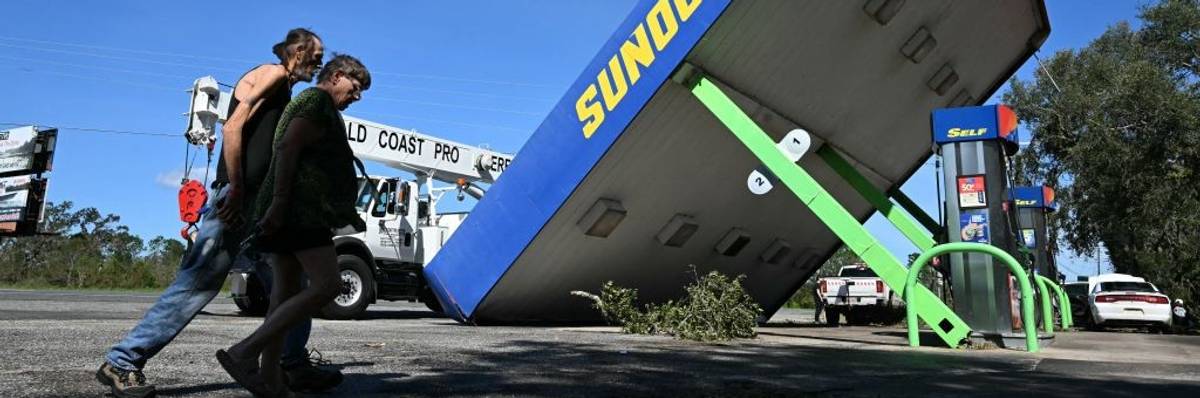
A rooftop of a Sunoco gas station rests on the ground after being damaged by Hurricane Helene in Perry, Florida on September 27, 2024.
Republican attorneys general are engaged in what one critic called "an obvious attempt to shield fossil fuel companies from facing accountability for their climate lies."
In yet another recent display of what's at stake in this year's U.S. presidential race, the U.S. Supreme Court on Monday requested that the Biden administration weigh in on a case intended to thwart climate lawsuits against fossil fuel companies.
The justices invited U.S. Solicitor General Elizabeth Prelogar—an appointee of Democratic President Joe Biden who represents the federal government in court—to file a brief "expressing the views of the United States" regarding Alabama v. California.
In May, Alabama Attorney General Steve Marshall and 18 of his Republican colleagues launched their bid to block lawsuits that several Democrat-led states including California have brought against energy giants for deceiving the public while fueling the global climate emergency. Multiple U.S. municipalities have filed similar suits against Big Oil.
Although justices have rejected the oil and gas industry's efforts to shift those suits from state to federal court, six of them are right-wingers with a record of anti-environment rulings. A spokesperson for Marshall told Reuters that the new request of Prelogar is "an encouraging sign that the justices are taking seriously the complaint of 19 states."
"Communities deserve their day in court to hold Big Oil accountable."
Meanwhile, Richard Wiles, president of the Center for Climate Integrity (CCI), took aim at the Alabama-led case, saying in a statement that "this meritless, politically driven request is an obvious attempt to shield fossil fuel companies from facing accountability for their climate lies and the monumental damage they're causing."
"It should be a no-brainer for the solicitor general to oppose this petition and for the Supreme Court to reject it," he added. "Communities deserve their day in court to hold Big Oil accountable."
Wiles responded similarly in June, when the Supreme Court asked Prelogar to weigh in on a case brought by the City and County of Honolulu.
Alyssa Johl, CCI's vice president of legal and general counsel, said at the time that "lawsuits like Honolulu's are not seeking to solve climate change or regulate emissions—these plaintiffs simply want Big Oil to stop lying and pay their fair share of the damages they knowingly caused. The solicitor general should make clear that federal laws do not preempt the ability of communities to hold companies accountable for their deceptive claims under state law."
Reuters pointed out Monday that Prelogar has not yet filed a brief in that case, but has some history with these suits:
The Democratic-led states have noted that the Supreme Court has previously rejected bids by oil companies to move several such lawsuits to federal court, after numerous U.S. appeals courts said the claims are not preempted by federal law.
Prelogar had weighed in on that issue as well and had successfully urged the justices to reject the oil companies' appeals.
Although it's not yet clear where the Biden administration will come down on either of these cases—and the U.S. Department of Justice has infamously fought a climate suit that youth plaintiffs filed against the federal government—the high court's move comes less than a month away from a presidential election in which the fossil fuel-driven global emergency is a divisive issue.
The Republican nominee, former Republican President Donald Trump, has pledged to roll back the Biden administration's insufficient yet historic progress on climate policy if the fossil fuel industry pours $1 billion into his campaign.
His Democratic opponent, Vice President Kamala Harris, is facing some criticism for watering down her previous climate policies but also had broad support from green groups, including some that had declined to endorse Biden before he dropped out and endorsed her in July.
Some climate campaigners and survivors of extreme weather events hope that Harris' election in November will lead to the Department of Justice launching a criminal case against fossil fuel companies, as Sen. Sheldon Whitehouse (D-R.I.) and Rep. Jamie Raskin (D-Md.) called for in May after conducting a three-year congressional investigation.
Harris is "the perfect person to prosecute the case against Big Oil," Fossil Free Media director Jamie Henn wrote in a Common Dreams opinion piece this summer. As California's attorney general, she "went after ConocoPhillips (the company behind the Willow Project in Alaska) for air quality violations at their gas stations and prosecuted a pipeline company for a 2015 spill in Santa Barbara. Before that, as San Francisco district attorney, she set up the city's first environmental justice division."
While many names have been floated as Harris' potential pick for attorney general, some climate advocates have recently urged her to pick Raskin to lead the Department of Justice. As progressive organizer Aaron Regunberg wrote for The New Republic in August, "Who better to ensure the DOJ stops bowing to fossil fuel industry pressure than the head of the House Oversight Committee's push to hold Big Oil accountable?"
Regardless of which cases are filed and how far they go, concerns remain about conflicts of interests in the courts, particularly at the highest level of the federal judiciary.
Justice Samuel Alito "has recused himself from Honolulu and other climate accountability cases—likely because of his investments in oil companies," CCI highlighted on social media Monday. "But today he did not recuse himself from the request from 19 Republican AGs to block lawsuits against Big Oil."
"Justice Amy Coney Barrett has also faced calls to recuse herself from cases against Big Oil because her father was a top attorney for Shell for 29 years," the group added. "But she has not."
Dear Common Dreams reader, It’s been nearly 30 years since I co-founded Common Dreams with my late wife, Lina Newhouser. We had the radical notion that journalism should serve the public good, not corporate profits. It was clear to us from the outset what it would take to build such a project. No paid advertisements. No corporate sponsors. No millionaire publisher telling us what to think or do. Many people said we wouldn't last a year, but we proved those doubters wrong. Together with a tremendous team of journalists and dedicated staff, we built an independent media outlet free from the constraints of profits and corporate control. Our mission has always been simple: To inform. To inspire. To ignite change for the common good. Building Common Dreams was not easy. Our survival was never guaranteed. When you take on the most powerful forces—Wall Street greed, fossil fuel industry destruction, Big Tech lobbyists, and uber-rich oligarchs who have spent billions upon billions rigging the economy and democracy in their favor—the only bulwark you have is supporters who believe in your work. But here’s the urgent message from me today. It's never been this bad out there. And it's never been this hard to keep us going. At the very moment Common Dreams is most needed, the threats we face are intensifying. We need your support now more than ever. We don't accept corporate advertising and never will. We don't have a paywall because we don't think people should be blocked from critical news based on their ability to pay. Everything we do is funded by the donations of readers like you. When everyone does the little they can afford, we are strong. But if that support retreats or dries up, so do we. Will you donate now to make sure Common Dreams not only survives but thrives? —Craig Brown, Co-founder |
In yet another recent display of what's at stake in this year's U.S. presidential race, the U.S. Supreme Court on Monday requested that the Biden administration weigh in on a case intended to thwart climate lawsuits against fossil fuel companies.
The justices invited U.S. Solicitor General Elizabeth Prelogar—an appointee of Democratic President Joe Biden who represents the federal government in court—to file a brief "expressing the views of the United States" regarding Alabama v. California.
In May, Alabama Attorney General Steve Marshall and 18 of his Republican colleagues launched their bid to block lawsuits that several Democrat-led states including California have brought against energy giants for deceiving the public while fueling the global climate emergency. Multiple U.S. municipalities have filed similar suits against Big Oil.
Although justices have rejected the oil and gas industry's efforts to shift those suits from state to federal court, six of them are right-wingers with a record of anti-environment rulings. A spokesperson for Marshall told Reuters that the new request of Prelogar is "an encouraging sign that the justices are taking seriously the complaint of 19 states."
"Communities deserve their day in court to hold Big Oil accountable."
Meanwhile, Richard Wiles, president of the Center for Climate Integrity (CCI), took aim at the Alabama-led case, saying in a statement that "this meritless, politically driven request is an obvious attempt to shield fossil fuel companies from facing accountability for their climate lies and the monumental damage they're causing."
"It should be a no-brainer for the solicitor general to oppose this petition and for the Supreme Court to reject it," he added. "Communities deserve their day in court to hold Big Oil accountable."
Wiles responded similarly in June, when the Supreme Court asked Prelogar to weigh in on a case brought by the City and County of Honolulu.
Alyssa Johl, CCI's vice president of legal and general counsel, said at the time that "lawsuits like Honolulu's are not seeking to solve climate change or regulate emissions—these plaintiffs simply want Big Oil to stop lying and pay their fair share of the damages they knowingly caused. The solicitor general should make clear that federal laws do not preempt the ability of communities to hold companies accountable for their deceptive claims under state law."
Reuters pointed out Monday that Prelogar has not yet filed a brief in that case, but has some history with these suits:
The Democratic-led states have noted that the Supreme Court has previously rejected bids by oil companies to move several such lawsuits to federal court, after numerous U.S. appeals courts said the claims are not preempted by federal law.
Prelogar had weighed in on that issue as well and had successfully urged the justices to reject the oil companies' appeals.
Although it's not yet clear where the Biden administration will come down on either of these cases—and the U.S. Department of Justice has infamously fought a climate suit that youth plaintiffs filed against the federal government—the high court's move comes less than a month away from a presidential election in which the fossil fuel-driven global emergency is a divisive issue.
The Republican nominee, former Republican President Donald Trump, has pledged to roll back the Biden administration's insufficient yet historic progress on climate policy if the fossil fuel industry pours $1 billion into his campaign.
His Democratic opponent, Vice President Kamala Harris, is facing some criticism for watering down her previous climate policies but also had broad support from green groups, including some that had declined to endorse Biden before he dropped out and endorsed her in July.
Some climate campaigners and survivors of extreme weather events hope that Harris' election in November will lead to the Department of Justice launching a criminal case against fossil fuel companies, as Sen. Sheldon Whitehouse (D-R.I.) and Rep. Jamie Raskin (D-Md.) called for in May after conducting a three-year congressional investigation.
Harris is "the perfect person to prosecute the case against Big Oil," Fossil Free Media director Jamie Henn wrote in a Common Dreams opinion piece this summer. As California's attorney general, she "went after ConocoPhillips (the company behind the Willow Project in Alaska) for air quality violations at their gas stations and prosecuted a pipeline company for a 2015 spill in Santa Barbara. Before that, as San Francisco district attorney, she set up the city's first environmental justice division."
While many names have been floated as Harris' potential pick for attorney general, some climate advocates have recently urged her to pick Raskin to lead the Department of Justice. As progressive organizer Aaron Regunberg wrote for The New Republic in August, "Who better to ensure the DOJ stops bowing to fossil fuel industry pressure than the head of the House Oversight Committee's push to hold Big Oil accountable?"
Regardless of which cases are filed and how far they go, concerns remain about conflicts of interests in the courts, particularly at the highest level of the federal judiciary.
Justice Samuel Alito "has recused himself from Honolulu and other climate accountability cases—likely because of his investments in oil companies," CCI highlighted on social media Monday. "But today he did not recuse himself from the request from 19 Republican AGs to block lawsuits against Big Oil."
"Justice Amy Coney Barrett has also faced calls to recuse herself from cases against Big Oil because her father was a top attorney for Shell for 29 years," the group added. "But she has not."
In yet another recent display of what's at stake in this year's U.S. presidential race, the U.S. Supreme Court on Monday requested that the Biden administration weigh in on a case intended to thwart climate lawsuits against fossil fuel companies.
The justices invited U.S. Solicitor General Elizabeth Prelogar—an appointee of Democratic President Joe Biden who represents the federal government in court—to file a brief "expressing the views of the United States" regarding Alabama v. California.
In May, Alabama Attorney General Steve Marshall and 18 of his Republican colleagues launched their bid to block lawsuits that several Democrat-led states including California have brought against energy giants for deceiving the public while fueling the global climate emergency. Multiple U.S. municipalities have filed similar suits against Big Oil.
Although justices have rejected the oil and gas industry's efforts to shift those suits from state to federal court, six of them are right-wingers with a record of anti-environment rulings. A spokesperson for Marshall told Reuters that the new request of Prelogar is "an encouraging sign that the justices are taking seriously the complaint of 19 states."
"Communities deserve their day in court to hold Big Oil accountable."
Meanwhile, Richard Wiles, president of the Center for Climate Integrity (CCI), took aim at the Alabama-led case, saying in a statement that "this meritless, politically driven request is an obvious attempt to shield fossil fuel companies from facing accountability for their climate lies and the monumental damage they're causing."
"It should be a no-brainer for the solicitor general to oppose this petition and for the Supreme Court to reject it," he added. "Communities deserve their day in court to hold Big Oil accountable."
Wiles responded similarly in June, when the Supreme Court asked Prelogar to weigh in on a case brought by the City and County of Honolulu.
Alyssa Johl, CCI's vice president of legal and general counsel, said at the time that "lawsuits like Honolulu's are not seeking to solve climate change or regulate emissions—these plaintiffs simply want Big Oil to stop lying and pay their fair share of the damages they knowingly caused. The solicitor general should make clear that federal laws do not preempt the ability of communities to hold companies accountable for their deceptive claims under state law."
Reuters pointed out Monday that Prelogar has not yet filed a brief in that case, but has some history with these suits:
The Democratic-led states have noted that the Supreme Court has previously rejected bids by oil companies to move several such lawsuits to federal court, after numerous U.S. appeals courts said the claims are not preempted by federal law.
Prelogar had weighed in on that issue as well and had successfully urged the justices to reject the oil companies' appeals.
Although it's not yet clear where the Biden administration will come down on either of these cases—and the U.S. Department of Justice has infamously fought a climate suit that youth plaintiffs filed against the federal government—the high court's move comes less than a month away from a presidential election in which the fossil fuel-driven global emergency is a divisive issue.
The Republican nominee, former Republican President Donald Trump, has pledged to roll back the Biden administration's insufficient yet historic progress on climate policy if the fossil fuel industry pours $1 billion into his campaign.
His Democratic opponent, Vice President Kamala Harris, is facing some criticism for watering down her previous climate policies but also had broad support from green groups, including some that had declined to endorse Biden before he dropped out and endorsed her in July.
Some climate campaigners and survivors of extreme weather events hope that Harris' election in November will lead to the Department of Justice launching a criminal case against fossil fuel companies, as Sen. Sheldon Whitehouse (D-R.I.) and Rep. Jamie Raskin (D-Md.) called for in May after conducting a three-year congressional investigation.
Harris is "the perfect person to prosecute the case against Big Oil," Fossil Free Media director Jamie Henn wrote in a Common Dreams opinion piece this summer. As California's attorney general, she "went after ConocoPhillips (the company behind the Willow Project in Alaska) for air quality violations at their gas stations and prosecuted a pipeline company for a 2015 spill in Santa Barbara. Before that, as San Francisco district attorney, she set up the city's first environmental justice division."
While many names have been floated as Harris' potential pick for attorney general, some climate advocates have recently urged her to pick Raskin to lead the Department of Justice. As progressive organizer Aaron Regunberg wrote for The New Republic in August, "Who better to ensure the DOJ stops bowing to fossil fuel industry pressure than the head of the House Oversight Committee's push to hold Big Oil accountable?"
Regardless of which cases are filed and how far they go, concerns remain about conflicts of interests in the courts, particularly at the highest level of the federal judiciary.
Justice Samuel Alito "has recused himself from Honolulu and other climate accountability cases—likely because of his investments in oil companies," CCI highlighted on social media Monday. "But today he did not recuse himself from the request from 19 Republican AGs to block lawsuits against Big Oil."
"Justice Amy Coney Barrett has also faced calls to recuse herself from cases against Big Oil because her father was a top attorney for Shell for 29 years," the group added. "But she has not."