SUBSCRIBE TO OUR FREE NEWSLETTER
Daily news & progressive opinion—funded by the people, not the corporations—delivered straight to your inbox.
5
#000000
#FFFFFF
To donate by check, phone, or other method, see our More Ways to Give page.
Daily news & progressive opinion—funded by the people, not the corporations—delivered straight to your inbox.
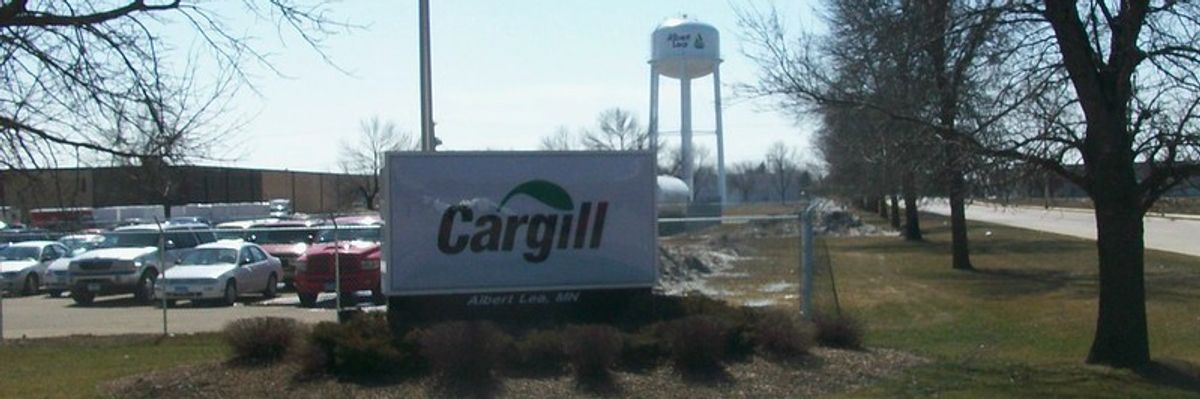
A Cargill billboard is displayed in Minnesota.
"We knew that the company didn't care, but we expected more from the family," one campaigner said.
The Cargill-MacMillan family refused to meet with a young Indigenous advocate who had traveled 4,000 miles to hand-deliver a letter calling on them to stop deforestation in the Brazilian Amazon and Cerrado grassland.
Security guards denied entry to 21-year-old Beka Saw Munduruku when she arrived at the driveway of the family's offices in Wayzata, Minnesota, on Thursday. The family had not responded to requests to arrange a meeting ahead of time.
"It is appalling that an emissary who traveled 4,000 miles to deliver an urgent message from her people would be treated with such dismissal and disrespect," Amazon Watch program director Christian Poirier said in a statement.
"The Cargill-MacMillan family has demonstrated that they are unconcerned with the impacts of the company's actions on those victimized by them."
Cargill is the world's largest agribusiness company, according to advocacy group Stand.earth. It is also family-owned, with around 88% of it controlled by approximately 20 people. The Cargill-MacMillans have the highest concentration of billionaires of any family worldwide and are the fourth-richest family in the U.S. While the company has made commitments to end deforestation and human rights abuses in its supply chain, Munduruku said that this hasn't been the experience of her community in the state of Pará in the Brazilian Amazon.
"In every region where Cargill operates, you are destroying the environment and driving out or threatening the communities who live there," Munduruku wrote in the letter she attempted to deliver Thursday.
In her letter, Munduruku called out a specific project of Cargill's: the 1,000-kilometer Ferrogrão railway that would cut a swath through the Amazon to transport soy grown in the Cerrado.
"Last year the forests and savannas of the Cerrado were destroyed at a rate of 8,000 acres a day," Munduruku wrote in her letter. "This is an area of destruction the size of your hometown of Minneapolis every five days."
Munduruku, who is a member of the Munduruku community and lives on Sawré Muybu Indigenous territory, is the first Indigenous Brazilian leader to visit Cargill on its home turf to protest its activities.
By refusing to see her, Stand.earth campaign director Mathew Jacobson said, "the Cargill-MacMillan family has demonstrated that they are unconcerned with the impacts of the company's actions on those victimized by them. And they are dismissive of all attempts to bring it to their attention."
"We knew that the company didn't care, but we expected more from the family," Jacobson continued. "It's high time the family intervenes. We hope that the family will choose to be remembered as one that made the world a better place, not a worse one."
Dear Common Dreams reader, It’s been nearly 30 years since I co-founded Common Dreams with my late wife, Lina Newhouser. We had the radical notion that journalism should serve the public good, not corporate profits. It was clear to us from the outset what it would take to build such a project. No paid advertisements. No corporate sponsors. No millionaire publisher telling us what to think or do. Many people said we wouldn't last a year, but we proved those doubters wrong. Together with a tremendous team of journalists and dedicated staff, we built an independent media outlet free from the constraints of profits and corporate control. Our mission has always been simple: To inform. To inspire. To ignite change for the common good. Building Common Dreams was not easy. Our survival was never guaranteed. When you take on the most powerful forces—Wall Street greed, fossil fuel industry destruction, Big Tech lobbyists, and uber-rich oligarchs who have spent billions upon billions rigging the economy and democracy in their favor—the only bulwark you have is supporters who believe in your work. But here’s the urgent message from me today. It's never been this bad out there. And it's never been this hard to keep us going. At the very moment Common Dreams is most needed, the threats we face are intensifying. We need your support now more than ever. We don't accept corporate advertising and never will. We don't have a paywall because we don't think people should be blocked from critical news based on their ability to pay. Everything we do is funded by the donations of readers like you. When everyone does the little they can afford, we are strong. But if that support retreats or dries up, so do we. Will you donate now to make sure Common Dreams not only survives but thrives? —Craig Brown, Co-founder |
The Cargill-MacMillan family refused to meet with a young Indigenous advocate who had traveled 4,000 miles to hand-deliver a letter calling on them to stop deforestation in the Brazilian Amazon and Cerrado grassland.
Security guards denied entry to 21-year-old Beka Saw Munduruku when she arrived at the driveway of the family's offices in Wayzata, Minnesota, on Thursday. The family had not responded to requests to arrange a meeting ahead of time.
"It is appalling that an emissary who traveled 4,000 miles to deliver an urgent message from her people would be treated with such dismissal and disrespect," Amazon Watch program director Christian Poirier said in a statement.
"The Cargill-MacMillan family has demonstrated that they are unconcerned with the impacts of the company's actions on those victimized by them."
Cargill is the world's largest agribusiness company, according to advocacy group Stand.earth. It is also family-owned, with around 88% of it controlled by approximately 20 people. The Cargill-MacMillans have the highest concentration of billionaires of any family worldwide and are the fourth-richest family in the U.S. While the company has made commitments to end deforestation and human rights abuses in its supply chain, Munduruku said that this hasn't been the experience of her community in the state of Pará in the Brazilian Amazon.
"In every region where Cargill operates, you are destroying the environment and driving out or threatening the communities who live there," Munduruku wrote in the letter she attempted to deliver Thursday.
In her letter, Munduruku called out a specific project of Cargill's: the 1,000-kilometer Ferrogrão railway that would cut a swath through the Amazon to transport soy grown in the Cerrado.
"Last year the forests and savannas of the Cerrado were destroyed at a rate of 8,000 acres a day," Munduruku wrote in her letter. "This is an area of destruction the size of your hometown of Minneapolis every five days."
Munduruku, who is a member of the Munduruku community and lives on Sawré Muybu Indigenous territory, is the first Indigenous Brazilian leader to visit Cargill on its home turf to protest its activities.
By refusing to see her, Stand.earth campaign director Mathew Jacobson said, "the Cargill-MacMillan family has demonstrated that they are unconcerned with the impacts of the company's actions on those victimized by them. And they are dismissive of all attempts to bring it to their attention."
"We knew that the company didn't care, but we expected more from the family," Jacobson continued. "It's high time the family intervenes. We hope that the family will choose to be remembered as one that made the world a better place, not a worse one."
The Cargill-MacMillan family refused to meet with a young Indigenous advocate who had traveled 4,000 miles to hand-deliver a letter calling on them to stop deforestation in the Brazilian Amazon and Cerrado grassland.
Security guards denied entry to 21-year-old Beka Saw Munduruku when she arrived at the driveway of the family's offices in Wayzata, Minnesota, on Thursday. The family had not responded to requests to arrange a meeting ahead of time.
"It is appalling that an emissary who traveled 4,000 miles to deliver an urgent message from her people would be treated with such dismissal and disrespect," Amazon Watch program director Christian Poirier said in a statement.
"The Cargill-MacMillan family has demonstrated that they are unconcerned with the impacts of the company's actions on those victimized by them."
Cargill is the world's largest agribusiness company, according to advocacy group Stand.earth. It is also family-owned, with around 88% of it controlled by approximately 20 people. The Cargill-MacMillans have the highest concentration of billionaires of any family worldwide and are the fourth-richest family in the U.S. While the company has made commitments to end deforestation and human rights abuses in its supply chain, Munduruku said that this hasn't been the experience of her community in the state of Pará in the Brazilian Amazon.
"In every region where Cargill operates, you are destroying the environment and driving out or threatening the communities who live there," Munduruku wrote in the letter she attempted to deliver Thursday.
In her letter, Munduruku called out a specific project of Cargill's: the 1,000-kilometer Ferrogrão railway that would cut a swath through the Amazon to transport soy grown in the Cerrado.
"Last year the forests and savannas of the Cerrado were destroyed at a rate of 8,000 acres a day," Munduruku wrote in her letter. "This is an area of destruction the size of your hometown of Minneapolis every five days."
Munduruku, who is a member of the Munduruku community and lives on Sawré Muybu Indigenous territory, is the first Indigenous Brazilian leader to visit Cargill on its home turf to protest its activities.
By refusing to see her, Stand.earth campaign director Mathew Jacobson said, "the Cargill-MacMillan family has demonstrated that they are unconcerned with the impacts of the company's actions on those victimized by them. And they are dismissive of all attempts to bring it to their attention."
"We knew that the company didn't care, but we expected more from the family," Jacobson continued. "It's high time the family intervenes. We hope that the family will choose to be remembered as one that made the world a better place, not a worse one."