SUBSCRIBE TO OUR FREE NEWSLETTER
Daily news & progressive opinion—funded by the people, not the corporations—delivered straight to your inbox.
5
#000000
#FFFFFF
To donate by check, phone, or other method, see our More Ways to Give page.
Daily news & progressive opinion—funded by the people, not the corporations—delivered straight to your inbox.
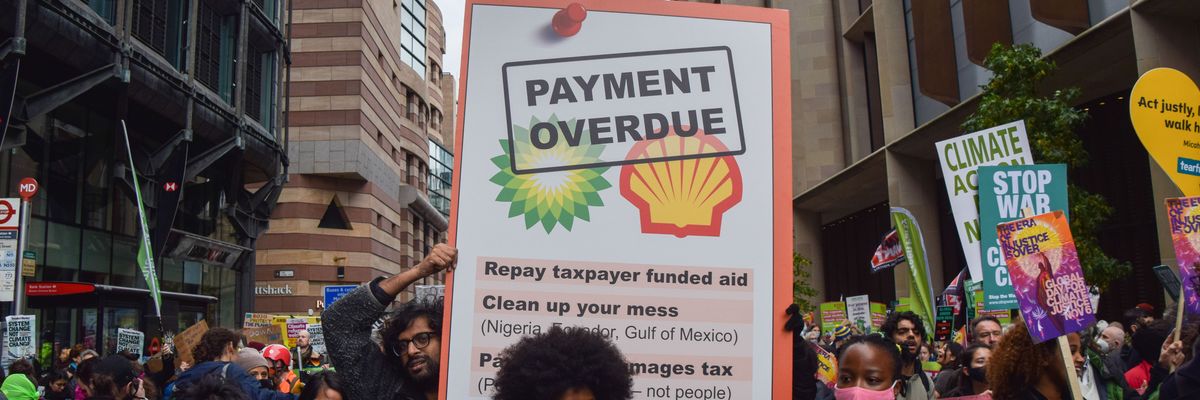
A protester holds a placard demanding that fossil fuel companies BP and Shell repay taxpayer-funded aid during a protest in London on November 6, 2021.
"Instead of helping to rebuild Ukraine, ease the burden of high bills, or support countries suffering from the climate crisis, BP is making the rich richer," one campaigner said.
Oil major BP has paid out $27.4 billion to shareholders since Russia invaded Ukraine in February 2022, Global Witness found in an analysis published Tuesday.
The environmental justice group released its calculations one day after BP announced its profits for the first quarter of 2024: The company made a total of $2.7 billion and spent $1.75 billion—more than half that amount—on share buybacks.
"It's obscene that anyone would profit from the Ukraine war, the energy crisis, or the climate crisis, but that's what's happening," Alice Harrison, head of fossil fuel campaigns at Global Witness, said in a statement. "With the biggest spoils going to one of the richest, most destructive industries in the world—the fossil fuel industry."
"Since Russia's invasion of Ukraine, [oil companies] are seen as providing countries with energy security rather than being terrible companies polluting the world—and they have used that to their advantage."
BP's first-quarter profit announcement came one day after the Financial Times reported that shareholders expected the company to relax its plans to reduce oil and gas production. The company is currently the only major player in the industry that has committed to actually curbing production, with a reduction target of 25% of 2019 levels by 2030. That target, set in 2023, was already a scaling back of its 2020 goal to cut production by 40% by the end of the decade.
However, in January, Murray Auchincloss replaced Bernard Looney as BP's CEO, and shareholders say he has different priorities.
"Murray is saying outwardly that there's no change, but behind the scenes he's being a lot more pragmatic, returns-focused, and hard-nosed about it," one anonymous investor told FT. "We'd all love them to build more in renewables but from a shareholder point of view, returns are not there."
Shareholders also spoke candidly about how Russia's invasion of Ukraine had impacted the industry.
"Since Russia's invasion of Ukraine, [oil companies] are seen as providing countries with energy security rather than being terrible companies polluting the world—and they have used that to their advantage," one said.
Another speculated that BP's rumored change in strategy was "partly a response to market pricing" as higher interest rates made renewable energy projects more expensive while the Ukraine war raised oil prices.
In a recent letter to BP's board, activist shareholder Bluebell Capital Partners said that if the company was planning to raise production, as it had suggested privately to shareholders, then that "should be reflected in BP's official communication and targets."
However, a U.S. Senate hearing last week focusing on major oil companies including BP revealed that the industry has a history of saying one thing and doing another when it comes to climate targets. For example, while BP has committed to the Paris climate agreement on its website, in internal emails shared at the hearing, the company admitted that "no one is committed to anything, other than to stay in the game."
In response to BP's quarterly profits, Oxfam argued that oil and gas companies cannot be trusted to regulate themselves.
"With BP's earnings once again in the billions and its oil production higher than the last quarter, we clearly cannot rely on fossil fuel companies to lead us out of the escalating climate crisis," Oxfam Great Britain's senior climate justice policy adviser, Chiara Ligouri, said in a statement. "The buck must stop with the government. Instead of adding fuel to the fire by allowing new oil and gas licenses, they can and should be taxing fossil fuel companies like BP more to ensure they pay their fair share for damage caused by their activities."
"We need faster and fairer action to support people living in poverty—in the U.K. and globally—who did the least to cause the crisis but who are now suffering the most, and fossil fuel companies should foot the bill," Ligouri added.
Harrison of Global Witness also called for a transition to renewable energy.
"Instead of helping to rebuild Ukraine, ease the burden of high bills, or support countries suffering from the climate crisis, BP is making the rich richer," Harrison said. "And this will continue to be the case until we make the urgent switch to a clean energy system."
Dear Common Dreams reader, It’s been nearly 30 years since I co-founded Common Dreams with my late wife, Lina Newhouser. We had the radical notion that journalism should serve the public good, not corporate profits. It was clear to us from the outset what it would take to build such a project. No paid advertisements. No corporate sponsors. No millionaire publisher telling us what to think or do. Many people said we wouldn't last a year, but we proved those doubters wrong. Together with a tremendous team of journalists and dedicated staff, we built an independent media outlet free from the constraints of profits and corporate control. Our mission has always been simple: To inform. To inspire. To ignite change for the common good. Building Common Dreams was not easy. Our survival was never guaranteed. When you take on the most powerful forces—Wall Street greed, fossil fuel industry destruction, Big Tech lobbyists, and uber-rich oligarchs who have spent billions upon billions rigging the economy and democracy in their favor—the only bulwark you have is supporters who believe in your work. But here’s the urgent message from me today. It's never been this bad out there. And it's never been this hard to keep us going. At the very moment Common Dreams is most needed, the threats we face are intensifying. We need your support now more than ever. We don't accept corporate advertising and never will. We don't have a paywall because we don't think people should be blocked from critical news based on their ability to pay. Everything we do is funded by the donations of readers like you. When everyone does the little they can afford, we are strong. But if that support retreats or dries up, so do we. Will you donate now to make sure Common Dreams not only survives but thrives? —Craig Brown, Co-founder |
Oil major BP has paid out $27.4 billion to shareholders since Russia invaded Ukraine in February 2022, Global Witness found in an analysis published Tuesday.
The environmental justice group released its calculations one day after BP announced its profits for the first quarter of 2024: The company made a total of $2.7 billion and spent $1.75 billion—more than half that amount—on share buybacks.
"It's obscene that anyone would profit from the Ukraine war, the energy crisis, or the climate crisis, but that's what's happening," Alice Harrison, head of fossil fuel campaigns at Global Witness, said in a statement. "With the biggest spoils going to one of the richest, most destructive industries in the world—the fossil fuel industry."
"Since Russia's invasion of Ukraine, [oil companies] are seen as providing countries with energy security rather than being terrible companies polluting the world—and they have used that to their advantage."
BP's first-quarter profit announcement came one day after the Financial Times reported that shareholders expected the company to relax its plans to reduce oil and gas production. The company is currently the only major player in the industry that has committed to actually curbing production, with a reduction target of 25% of 2019 levels by 2030. That target, set in 2023, was already a scaling back of its 2020 goal to cut production by 40% by the end of the decade.
However, in January, Murray Auchincloss replaced Bernard Looney as BP's CEO, and shareholders say he has different priorities.
"Murray is saying outwardly that there's no change, but behind the scenes he's being a lot more pragmatic, returns-focused, and hard-nosed about it," one anonymous investor told FT. "We'd all love them to build more in renewables but from a shareholder point of view, returns are not there."
Shareholders also spoke candidly about how Russia's invasion of Ukraine had impacted the industry.
"Since Russia's invasion of Ukraine, [oil companies] are seen as providing countries with energy security rather than being terrible companies polluting the world—and they have used that to their advantage," one said.
Another speculated that BP's rumored change in strategy was "partly a response to market pricing" as higher interest rates made renewable energy projects more expensive while the Ukraine war raised oil prices.
In a recent letter to BP's board, activist shareholder Bluebell Capital Partners said that if the company was planning to raise production, as it had suggested privately to shareholders, then that "should be reflected in BP's official communication and targets."
However, a U.S. Senate hearing last week focusing on major oil companies including BP revealed that the industry has a history of saying one thing and doing another when it comes to climate targets. For example, while BP has committed to the Paris climate agreement on its website, in internal emails shared at the hearing, the company admitted that "no one is committed to anything, other than to stay in the game."
In response to BP's quarterly profits, Oxfam argued that oil and gas companies cannot be trusted to regulate themselves.
"With BP's earnings once again in the billions and its oil production higher than the last quarter, we clearly cannot rely on fossil fuel companies to lead us out of the escalating climate crisis," Oxfam Great Britain's senior climate justice policy adviser, Chiara Ligouri, said in a statement. "The buck must stop with the government. Instead of adding fuel to the fire by allowing new oil and gas licenses, they can and should be taxing fossil fuel companies like BP more to ensure they pay their fair share for damage caused by their activities."
"We need faster and fairer action to support people living in poverty—in the U.K. and globally—who did the least to cause the crisis but who are now suffering the most, and fossil fuel companies should foot the bill," Ligouri added.
Harrison of Global Witness also called for a transition to renewable energy.
"Instead of helping to rebuild Ukraine, ease the burden of high bills, or support countries suffering from the climate crisis, BP is making the rich richer," Harrison said. "And this will continue to be the case until we make the urgent switch to a clean energy system."
Oil major BP has paid out $27.4 billion to shareholders since Russia invaded Ukraine in February 2022, Global Witness found in an analysis published Tuesday.
The environmental justice group released its calculations one day after BP announced its profits for the first quarter of 2024: The company made a total of $2.7 billion and spent $1.75 billion—more than half that amount—on share buybacks.
"It's obscene that anyone would profit from the Ukraine war, the energy crisis, or the climate crisis, but that's what's happening," Alice Harrison, head of fossil fuel campaigns at Global Witness, said in a statement. "With the biggest spoils going to one of the richest, most destructive industries in the world—the fossil fuel industry."
"Since Russia's invasion of Ukraine, [oil companies] are seen as providing countries with energy security rather than being terrible companies polluting the world—and they have used that to their advantage."
BP's first-quarter profit announcement came one day after the Financial Times reported that shareholders expected the company to relax its plans to reduce oil and gas production. The company is currently the only major player in the industry that has committed to actually curbing production, with a reduction target of 25% of 2019 levels by 2030. That target, set in 2023, was already a scaling back of its 2020 goal to cut production by 40% by the end of the decade.
However, in January, Murray Auchincloss replaced Bernard Looney as BP's CEO, and shareholders say he has different priorities.
"Murray is saying outwardly that there's no change, but behind the scenes he's being a lot more pragmatic, returns-focused, and hard-nosed about it," one anonymous investor told FT. "We'd all love them to build more in renewables but from a shareholder point of view, returns are not there."
Shareholders also spoke candidly about how Russia's invasion of Ukraine had impacted the industry.
"Since Russia's invasion of Ukraine, [oil companies] are seen as providing countries with energy security rather than being terrible companies polluting the world—and they have used that to their advantage," one said.
Another speculated that BP's rumored change in strategy was "partly a response to market pricing" as higher interest rates made renewable energy projects more expensive while the Ukraine war raised oil prices.
In a recent letter to BP's board, activist shareholder Bluebell Capital Partners said that if the company was planning to raise production, as it had suggested privately to shareholders, then that "should be reflected in BP's official communication and targets."
However, a U.S. Senate hearing last week focusing on major oil companies including BP revealed that the industry has a history of saying one thing and doing another when it comes to climate targets. For example, while BP has committed to the Paris climate agreement on its website, in internal emails shared at the hearing, the company admitted that "no one is committed to anything, other than to stay in the game."
In response to BP's quarterly profits, Oxfam argued that oil and gas companies cannot be trusted to regulate themselves.
"With BP's earnings once again in the billions and its oil production higher than the last quarter, we clearly cannot rely on fossil fuel companies to lead us out of the escalating climate crisis," Oxfam Great Britain's senior climate justice policy adviser, Chiara Ligouri, said in a statement. "The buck must stop with the government. Instead of adding fuel to the fire by allowing new oil and gas licenses, they can and should be taxing fossil fuel companies like BP more to ensure they pay their fair share for damage caused by their activities."
"We need faster and fairer action to support people living in poverty—in the U.K. and globally—who did the least to cause the crisis but who are now suffering the most, and fossil fuel companies should foot the bill," Ligouri added.
Harrison of Global Witness also called for a transition to renewable energy.
"Instead of helping to rebuild Ukraine, ease the burden of high bills, or support countries suffering from the climate crisis, BP is making the rich richer," Harrison said. "And this will continue to be the case until we make the urgent switch to a clean energy system."