SUBSCRIBE TO OUR FREE NEWSLETTER
Daily news & progressive opinion—funded by the people, not the corporations—delivered straight to your inbox.
5
#000000
#FFFFFF
To donate by check, phone, or other method, see our More Ways to Give page.
Daily news & progressive opinion—funded by the people, not the corporations—delivered straight to your inbox.
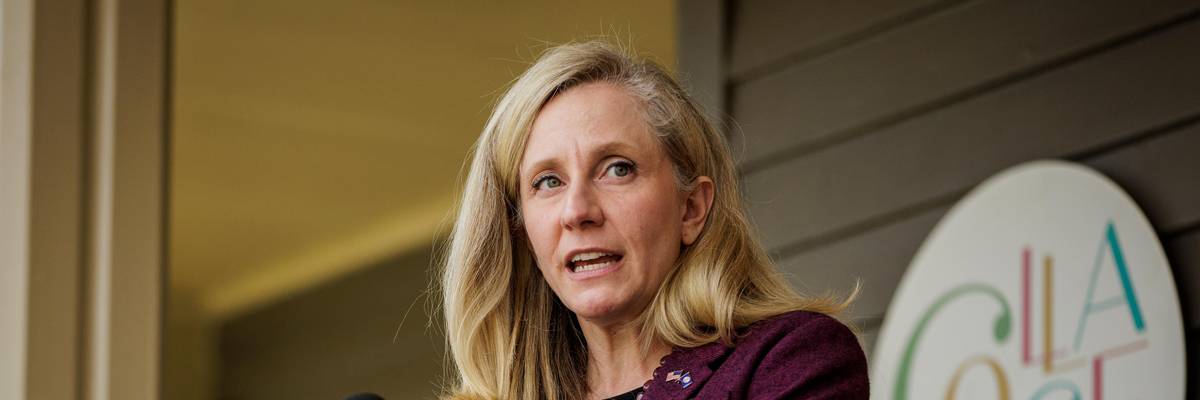
U.S. Rep. Abigail Spanberger (D-Va.) speaks during a press conference on November 3, 2022 in Fredericksburg, Virginia.
"Looks like the Blue Dogs are on their last leg," said one progressive. "It's a new day."
The Democratic Party's conservative Blue Dog Coalition has been slashed in half due partially to a disagreement within its ranks over efforts to attract more members, Politico reported on Tuesday, with a number of corporate lawmakers insisting on preserving the Blue Dogs' "longstanding legacy" and name despite its reputation as a "Southern 'boys' club'."
U.S. Reps. Abigail Spanberger (D-Va.), Ed Case (D-Hawaii), David Scott (D-Ga.), Brad Schneider (D-Ill.), Lou Correa (D-Calif.), and Mike Sherrill (D-N.J.) all left the coalition earlier this month after the 15 members held a secret-ballot vote on changing the group's name to the Common Sense Coalition.
The name change, the departing members argued, would help the group to recruit more lawmakers as it has reached an all-time low, 16 years after the Blue Dog alliance was forced to impose a cap on its membership to keep it at 20% of the Democratic caucus.
Despite the group's large roster during the George W. Bush and Obama administrations, a spokesperson for the Blue Dogs claimed Tuesday that they "have never prioritized having a large coalition" and are focused on what they refer to as "fiscally-responsible policies [and] ensuring a strong national defense."
"With a narrow majority governing the House, even a smaller group of members focused on getting things done for the American people on these issues can and will play a vital role," Andy LaVigne, the group's executive director, told Politico.
A desire to remain insular instead of appealing to a broader group of Democrats is "exactly the charge you'd expect centrists to lob at progressives," said Nick Field of Decision Desk HQ.
While the Blue Dog Coalition has long claimed to represent "mainstream American values" and the "commonsense, moderate voice of the Democratic Party," the group's contraction in recent years has coincided with the steady growth of the progressive "Squad" in the U.S. House and a wealth of evidence that the majority of Democratic voters are not aligned with the Blue Dogs' longtime push of austerity policies.
The Blue Dogs—both those who are staying in the coalition and those who are leaving—have attacked progressive policies as unrealistic and divisive.
Meanwhile, the informal Squad, whose members do not accept corporate PAC donations and are proponents of a Green New Deal, Medicare for All, and other bold policy proposals, has grown to include lawmakers from states including Texas, Florida, Pennsylvania, and Missouri since the group's first four members were elected in 2018. Around 10 lawmakers are now part of the Squad, which started with Reps. Alexandria Ocasio-Cortez (D-N.Y.), Rashida Tlaib (D-Mich.), Ilhan Omar (D-Minn.), and Ayanna Pressley (D-Mass.), and their influence has been made clear across the party as more than 70 Democrats in the 118th Congress have sworn off corporate PAC contributions.
While policies pushed by the Squad are broadly popular, the dwindling Blue Dog Coalition includes the last remaining Democrats who oppose abortion rights and marriage equality. The members who stayed after this month's vote include Reps. Sanford Bishop (D-Ga.), Mike Thompson (D-Calif.), Josh Gottheimer (D-N.J.), Jared Golden (D-Maine), Henry Cuellar (D-Texas), Jim Costa (D-Calif.), and Vicente Gonzalez (D-Texas). Rep. Wiley Nickel (D-N.C.) has not confirmed whether he'll stay or go.
The departure of nearly half of the coalition suggests that the Blue Dogs "are on their last leg," tweeted Lindsay Owens, executive director of the economic justice group Groundwork Collaborative.
With the splintering of the conservative group, said Sam Shirazi, a civil rights attorney and commentator on politics in Spanberger's state of Virginia, "the long decline of the Blue Dog coalition continues."
Dear Common Dreams reader, It’s been nearly 30 years since I co-founded Common Dreams with my late wife, Lina Newhouser. We had the radical notion that journalism should serve the public good, not corporate profits. It was clear to us from the outset what it would take to build such a project. No paid advertisements. No corporate sponsors. No millionaire publisher telling us what to think or do. Many people said we wouldn't last a year, but we proved those doubters wrong. Together with a tremendous team of journalists and dedicated staff, we built an independent media outlet free from the constraints of profits and corporate control. Our mission has always been simple: To inform. To inspire. To ignite change for the common good. Building Common Dreams was not easy. Our survival was never guaranteed. When you take on the most powerful forces—Wall Street greed, fossil fuel industry destruction, Big Tech lobbyists, and uber-rich oligarchs who have spent billions upon billions rigging the economy and democracy in their favor—the only bulwark you have is supporters who believe in your work. But here’s the urgent message from me today. It's never been this bad out there. And it's never been this hard to keep us going. At the very moment Common Dreams is most needed, the threats we face are intensifying. We need your support now more than ever. We don't accept corporate advertising and never will. We don't have a paywall because we don't think people should be blocked from critical news based on their ability to pay. Everything we do is funded by the donations of readers like you. When everyone does the little they can afford, we are strong. But if that support retreats or dries up, so do we. Will you donate now to make sure Common Dreams not only survives but thrives? —Craig Brown, Co-founder |
The Democratic Party's conservative Blue Dog Coalition has been slashed in half due partially to a disagreement within its ranks over efforts to attract more members, Politico reported on Tuesday, with a number of corporate lawmakers insisting on preserving the Blue Dogs' "longstanding legacy" and name despite its reputation as a "Southern 'boys' club'."
U.S. Reps. Abigail Spanberger (D-Va.), Ed Case (D-Hawaii), David Scott (D-Ga.), Brad Schneider (D-Ill.), Lou Correa (D-Calif.), and Mike Sherrill (D-N.J.) all left the coalition earlier this month after the 15 members held a secret-ballot vote on changing the group's name to the Common Sense Coalition.
The name change, the departing members argued, would help the group to recruit more lawmakers as it has reached an all-time low, 16 years after the Blue Dog alliance was forced to impose a cap on its membership to keep it at 20% of the Democratic caucus.
Despite the group's large roster during the George W. Bush and Obama administrations, a spokesperson for the Blue Dogs claimed Tuesday that they "have never prioritized having a large coalition" and are focused on what they refer to as "fiscally-responsible policies [and] ensuring a strong national defense."
"With a narrow majority governing the House, even a smaller group of members focused on getting things done for the American people on these issues can and will play a vital role," Andy LaVigne, the group's executive director, told Politico.
A desire to remain insular instead of appealing to a broader group of Democrats is "exactly the charge you'd expect centrists to lob at progressives," said Nick Field of Decision Desk HQ.
While the Blue Dog Coalition has long claimed to represent "mainstream American values" and the "commonsense, moderate voice of the Democratic Party," the group's contraction in recent years has coincided with the steady growth of the progressive "Squad" in the U.S. House and a wealth of evidence that the majority of Democratic voters are not aligned with the Blue Dogs' longtime push of austerity policies.
The Blue Dogs—both those who are staying in the coalition and those who are leaving—have attacked progressive policies as unrealistic and divisive.
Meanwhile, the informal Squad, whose members do not accept corporate PAC donations and are proponents of a Green New Deal, Medicare for All, and other bold policy proposals, has grown to include lawmakers from states including Texas, Florida, Pennsylvania, and Missouri since the group's first four members were elected in 2018. Around 10 lawmakers are now part of the Squad, which started with Reps. Alexandria Ocasio-Cortez (D-N.Y.), Rashida Tlaib (D-Mich.), Ilhan Omar (D-Minn.), and Ayanna Pressley (D-Mass.), and their influence has been made clear across the party as more than 70 Democrats in the 118th Congress have sworn off corporate PAC contributions.
While policies pushed by the Squad are broadly popular, the dwindling Blue Dog Coalition includes the last remaining Democrats who oppose abortion rights and marriage equality. The members who stayed after this month's vote include Reps. Sanford Bishop (D-Ga.), Mike Thompson (D-Calif.), Josh Gottheimer (D-N.J.), Jared Golden (D-Maine), Henry Cuellar (D-Texas), Jim Costa (D-Calif.), and Vicente Gonzalez (D-Texas). Rep. Wiley Nickel (D-N.C.) has not confirmed whether he'll stay or go.
The departure of nearly half of the coalition suggests that the Blue Dogs "are on their last leg," tweeted Lindsay Owens, executive director of the economic justice group Groundwork Collaborative.
With the splintering of the conservative group, said Sam Shirazi, a civil rights attorney and commentator on politics in Spanberger's state of Virginia, "the long decline of the Blue Dog coalition continues."
The Democratic Party's conservative Blue Dog Coalition has been slashed in half due partially to a disagreement within its ranks over efforts to attract more members, Politico reported on Tuesday, with a number of corporate lawmakers insisting on preserving the Blue Dogs' "longstanding legacy" and name despite its reputation as a "Southern 'boys' club'."
U.S. Reps. Abigail Spanberger (D-Va.), Ed Case (D-Hawaii), David Scott (D-Ga.), Brad Schneider (D-Ill.), Lou Correa (D-Calif.), and Mike Sherrill (D-N.J.) all left the coalition earlier this month after the 15 members held a secret-ballot vote on changing the group's name to the Common Sense Coalition.
The name change, the departing members argued, would help the group to recruit more lawmakers as it has reached an all-time low, 16 years after the Blue Dog alliance was forced to impose a cap on its membership to keep it at 20% of the Democratic caucus.
Despite the group's large roster during the George W. Bush and Obama administrations, a spokesperson for the Blue Dogs claimed Tuesday that they "have never prioritized having a large coalition" and are focused on what they refer to as "fiscally-responsible policies [and] ensuring a strong national defense."
"With a narrow majority governing the House, even a smaller group of members focused on getting things done for the American people on these issues can and will play a vital role," Andy LaVigne, the group's executive director, told Politico.
A desire to remain insular instead of appealing to a broader group of Democrats is "exactly the charge you'd expect centrists to lob at progressives," said Nick Field of Decision Desk HQ.
While the Blue Dog Coalition has long claimed to represent "mainstream American values" and the "commonsense, moderate voice of the Democratic Party," the group's contraction in recent years has coincided with the steady growth of the progressive "Squad" in the U.S. House and a wealth of evidence that the majority of Democratic voters are not aligned with the Blue Dogs' longtime push of austerity policies.
The Blue Dogs—both those who are staying in the coalition and those who are leaving—have attacked progressive policies as unrealistic and divisive.
Meanwhile, the informal Squad, whose members do not accept corporate PAC donations and are proponents of a Green New Deal, Medicare for All, and other bold policy proposals, has grown to include lawmakers from states including Texas, Florida, Pennsylvania, and Missouri since the group's first four members were elected in 2018. Around 10 lawmakers are now part of the Squad, which started with Reps. Alexandria Ocasio-Cortez (D-N.Y.), Rashida Tlaib (D-Mich.), Ilhan Omar (D-Minn.), and Ayanna Pressley (D-Mass.), and their influence has been made clear across the party as more than 70 Democrats in the 118th Congress have sworn off corporate PAC contributions.
While policies pushed by the Squad are broadly popular, the dwindling Blue Dog Coalition includes the last remaining Democrats who oppose abortion rights and marriage equality. The members who stayed after this month's vote include Reps. Sanford Bishop (D-Ga.), Mike Thompson (D-Calif.), Josh Gottheimer (D-N.J.), Jared Golden (D-Maine), Henry Cuellar (D-Texas), Jim Costa (D-Calif.), and Vicente Gonzalez (D-Texas). Rep. Wiley Nickel (D-N.C.) has not confirmed whether he'll stay or go.
The departure of nearly half of the coalition suggests that the Blue Dogs "are on their last leg," tweeted Lindsay Owens, executive director of the economic justice group Groundwork Collaborative.
With the splintering of the conservative group, said Sam Shirazi, a civil rights attorney and commentator on politics in Spanberger's state of Virginia, "the long decline of the Blue Dog coalition continues."