SUBSCRIBE TO OUR FREE NEWSLETTER
Daily news & progressive opinion—funded by the people, not the corporations—delivered straight to your inbox.
5
#000000
#FFFFFF
To donate by check, phone, or other method, see our More Ways to Give page.
Daily news & progressive opinion—funded by the people, not the corporations—delivered straight to your inbox.
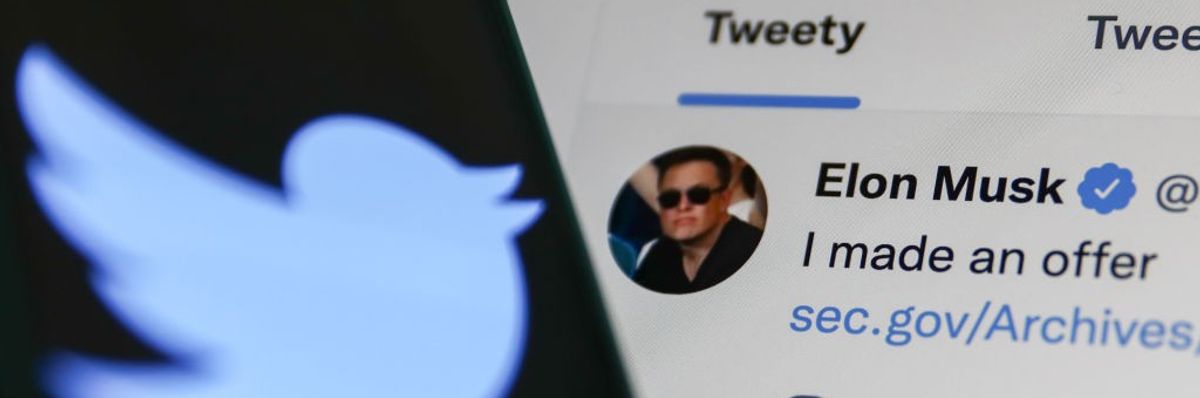
Elon Musk's Tweet displayed on a screen and Twitter logo displayed on a phone screen are seen in this illustration photo taken in Krakow, Poland on April 14, 2022.
"False endorsements violate FTC rules, legally exposing Musk," said Tim Karr of the advocacy and watchdog group Free Press.
Experts warned Sunday that the practice of Twitter adding official blue check marks to high-profile users on the social media platform without their consent could be a violation of FTC guidelines meant to prevent fraud.
The mysterious application of the blue checks—indicating that people had voluntarily paid to be members of the new Twitter Blue premium plan controversially launched by billionaire owner Elon Musk—was a source of endless online conversation over the weekend after living celebrities like basketball star LeBron James and novelist Stephen King as well as deceased people like food writer Anthony Bourdain and slain journalist Jamal Khashoggi had the checks applied to their accounts.
On Friday, Musk confirmed he was paying "personally" to keep the checks on at least some of these accounts.
The so-called "purge" began last week, when many institutions, organizations, and individuals discovered that the traditional "blue check" verifications they'd enjoyed for years—which indicated they were who they said they were and came at no cost—disappeared. (Full disclosure: Common Dreams, a nonprofit and independent news outlet, was stripped of its blue check verification last week.)
Over the weekend, others who said they did not sign up for the new Twitter Blue program started noticing new checks appearing on their accounts without warning.
According to Timothy Karr, senior director of strategy and communications for the media advocacy group Free Press, what Musk is doing with the blue checks is a violation of rules set up by the Federal Trade Commission (FTC).
"Musk has 'gifted' checks to celebrity Twitter accounts and other influencers without first seeking permission," said Karr. But because the blue checks "act like endorsements of Twitter Blue," the new paid program that charges $8 for premium access and status on the platform, this is where the violation comes in.
"False endorsements violate FTC rules, legally exposing Musk," argued Karr.
Alejandra Caraballo, a clinical instructor at Harvard Law School's Cyberlaw Clinic, backed up this legal assessment.
"Considering that the blue check states that someone is subscribed to and paying for a product, falsely adding that to large accounts may constitute a deceptive trade practice," said Caraballo in an online post. "Paging the FTC."
Unverified reports indicate that voluntary and paid signups for Twitter Blue have been meager, with estimates in the low double-digits or maybe several hundred. Either way, a far-cry from what would be needed to generate any meaningful profit from the program, which Musk indicated was the goal.
Writing for Mashable on Saturday, Chance Townsend detailed the mess of the whole episode:
Musk appears to have mistaken the past prestige associated with ID verification for something that can be commodified. But it now looks like that bubble has burst. With legacy accounts having had their checkmarks removed, and the platform's only ID verification system now saddled with stigma, the platform is facing a bad impersonation problem — a complication that spurred major advertisers to back out of Twitter in previous months.
Meanwhile, with others online citing Section 43(a) of the Lanham Act, which covers rules about trademark and false endorsements, Caraballo argued that Stephen King or others who were “gifted” the check marks could bring legal challenges to Musk under the statute.
"Anyone given this without their approval could have grounds to bring a false endorsement claim," she said. "That would be separate from a FTC investigation over deceptive trade practices."
Earlier this month, one of Twitter's top lawyers, Christian Dowell, who had been directly involved with the company's ongoing discussions with the FTC over privacy and data issues, resigned.
In his Sunday thread on Twitter, Karr mentioned Dowell's departure and then remarked, "Seems Musk never hired someone to fill that position."
Dear Common Dreams reader, It’s been nearly 30 years since I co-founded Common Dreams with my late wife, Lina Newhouser. We had the radical notion that journalism should serve the public good, not corporate profits. It was clear to us from the outset what it would take to build such a project. No paid advertisements. No corporate sponsors. No millionaire publisher telling us what to think or do. Many people said we wouldn't last a year, but we proved those doubters wrong. Together with a tremendous team of journalists and dedicated staff, we built an independent media outlet free from the constraints of profits and corporate control. Our mission has always been simple: To inform. To inspire. To ignite change for the common good. Building Common Dreams was not easy. Our survival was never guaranteed. When you take on the most powerful forces—Wall Street greed, fossil fuel industry destruction, Big Tech lobbyists, and uber-rich oligarchs who have spent billions upon billions rigging the economy and democracy in their favor—the only bulwark you have is supporters who believe in your work. But here’s the urgent message from me today. It's never been this bad out there. And it's never been this hard to keep us going. At the very moment Common Dreams is most needed, the threats we face are intensifying. We need your support now more than ever. We don't accept corporate advertising and never will. We don't have a paywall because we don't think people should be blocked from critical news based on their ability to pay. Everything we do is funded by the donations of readers like you. When everyone does the little they can afford, we are strong. But if that support retreats or dries up, so do we. Will you donate now to make sure Common Dreams not only survives but thrives? —Craig Brown, Co-founder |
Experts warned Sunday that the practice of Twitter adding official blue check marks to high-profile users on the social media platform without their consent could be a violation of FTC guidelines meant to prevent fraud.
The mysterious application of the blue checks—indicating that people had voluntarily paid to be members of the new Twitter Blue premium plan controversially launched by billionaire owner Elon Musk—was a source of endless online conversation over the weekend after living celebrities like basketball star LeBron James and novelist Stephen King as well as deceased people like food writer Anthony Bourdain and slain journalist Jamal Khashoggi had the checks applied to their accounts.
On Friday, Musk confirmed he was paying "personally" to keep the checks on at least some of these accounts.
The so-called "purge" began last week, when many institutions, organizations, and individuals discovered that the traditional "blue check" verifications they'd enjoyed for years—which indicated they were who they said they were and came at no cost—disappeared. (Full disclosure: Common Dreams, a nonprofit and independent news outlet, was stripped of its blue check verification last week.)
Over the weekend, others who said they did not sign up for the new Twitter Blue program started noticing new checks appearing on their accounts without warning.
According to Timothy Karr, senior director of strategy and communications for the media advocacy group Free Press, what Musk is doing with the blue checks is a violation of rules set up by the Federal Trade Commission (FTC).
"Musk has 'gifted' checks to celebrity Twitter accounts and other influencers without first seeking permission," said Karr. But because the blue checks "act like endorsements of Twitter Blue," the new paid program that charges $8 for premium access and status on the platform, this is where the violation comes in.
"False endorsements violate FTC rules, legally exposing Musk," argued Karr.
Alejandra Caraballo, a clinical instructor at Harvard Law School's Cyberlaw Clinic, backed up this legal assessment.
"Considering that the blue check states that someone is subscribed to and paying for a product, falsely adding that to large accounts may constitute a deceptive trade practice," said Caraballo in an online post. "Paging the FTC."
Unverified reports indicate that voluntary and paid signups for Twitter Blue have been meager, with estimates in the low double-digits or maybe several hundred. Either way, a far-cry from what would be needed to generate any meaningful profit from the program, which Musk indicated was the goal.
Writing for Mashable on Saturday, Chance Townsend detailed the mess of the whole episode:
Musk appears to have mistaken the past prestige associated with ID verification for something that can be commodified. But it now looks like that bubble has burst. With legacy accounts having had their checkmarks removed, and the platform's only ID verification system now saddled with stigma, the platform is facing a bad impersonation problem — a complication that spurred major advertisers to back out of Twitter in previous months.
Meanwhile, with others online citing Section 43(a) of the Lanham Act, which covers rules about trademark and false endorsements, Caraballo argued that Stephen King or others who were “gifted” the check marks could bring legal challenges to Musk under the statute.
"Anyone given this without their approval could have grounds to bring a false endorsement claim," she said. "That would be separate from a FTC investigation over deceptive trade practices."
Earlier this month, one of Twitter's top lawyers, Christian Dowell, who had been directly involved with the company's ongoing discussions with the FTC over privacy and data issues, resigned.
In his Sunday thread on Twitter, Karr mentioned Dowell's departure and then remarked, "Seems Musk never hired someone to fill that position."
Experts warned Sunday that the practice of Twitter adding official blue check marks to high-profile users on the social media platform without their consent could be a violation of FTC guidelines meant to prevent fraud.
The mysterious application of the blue checks—indicating that people had voluntarily paid to be members of the new Twitter Blue premium plan controversially launched by billionaire owner Elon Musk—was a source of endless online conversation over the weekend after living celebrities like basketball star LeBron James and novelist Stephen King as well as deceased people like food writer Anthony Bourdain and slain journalist Jamal Khashoggi had the checks applied to their accounts.
On Friday, Musk confirmed he was paying "personally" to keep the checks on at least some of these accounts.
The so-called "purge" began last week, when many institutions, organizations, and individuals discovered that the traditional "blue check" verifications they'd enjoyed for years—which indicated they were who they said they were and came at no cost—disappeared. (Full disclosure: Common Dreams, a nonprofit and independent news outlet, was stripped of its blue check verification last week.)
Over the weekend, others who said they did not sign up for the new Twitter Blue program started noticing new checks appearing on their accounts without warning.
According to Timothy Karr, senior director of strategy and communications for the media advocacy group Free Press, what Musk is doing with the blue checks is a violation of rules set up by the Federal Trade Commission (FTC).
"Musk has 'gifted' checks to celebrity Twitter accounts and other influencers without first seeking permission," said Karr. But because the blue checks "act like endorsements of Twitter Blue," the new paid program that charges $8 for premium access and status on the platform, this is where the violation comes in.
"False endorsements violate FTC rules, legally exposing Musk," argued Karr.
Alejandra Caraballo, a clinical instructor at Harvard Law School's Cyberlaw Clinic, backed up this legal assessment.
"Considering that the blue check states that someone is subscribed to and paying for a product, falsely adding that to large accounts may constitute a deceptive trade practice," said Caraballo in an online post. "Paging the FTC."
Unverified reports indicate that voluntary and paid signups for Twitter Blue have been meager, with estimates in the low double-digits or maybe several hundred. Either way, a far-cry from what would be needed to generate any meaningful profit from the program, which Musk indicated was the goal.
Writing for Mashable on Saturday, Chance Townsend detailed the mess of the whole episode:
Musk appears to have mistaken the past prestige associated with ID verification for something that can be commodified. But it now looks like that bubble has burst. With legacy accounts having had their checkmarks removed, and the platform's only ID verification system now saddled with stigma, the platform is facing a bad impersonation problem — a complication that spurred major advertisers to back out of Twitter in previous months.
Meanwhile, with others online citing Section 43(a) of the Lanham Act, which covers rules about trademark and false endorsements, Caraballo argued that Stephen King or others who were “gifted” the check marks could bring legal challenges to Musk under the statute.
"Anyone given this without their approval could have grounds to bring a false endorsement claim," she said. "That would be separate from a FTC investigation over deceptive trade practices."
Earlier this month, one of Twitter's top lawyers, Christian Dowell, who had been directly involved with the company's ongoing discussions with the FTC over privacy and data issues, resigned.
In his Sunday thread on Twitter, Karr mentioned Dowell's departure and then remarked, "Seems Musk never hired someone to fill that position."