SUBSCRIBE TO OUR FREE NEWSLETTER
Daily news & progressive opinion—funded by the people, not the corporations—delivered straight to your inbox.
5
#000000
#FFFFFF
To donate by check, phone, or other method, see our More Ways to Give page.
Daily news & progressive opinion—funded by the people, not the corporations—delivered straight to your inbox.
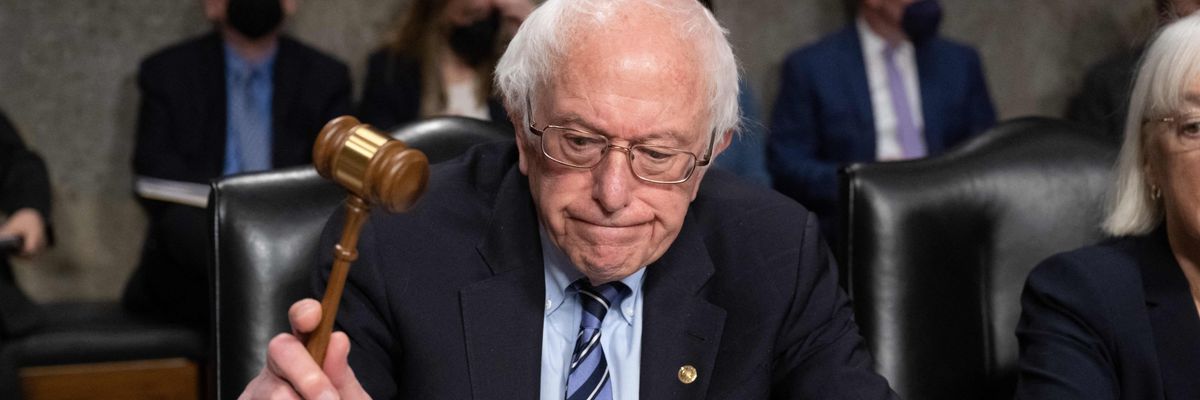
U.S. Senator Bernie Sanders (I-Vt.) presides over a Senate Committee on Health, Education, Labor, and Pensions hearing on Capitol Hill in Washington, D.C. on March 29, 2023.
The HELP Committee chair pledged to work with Senate leadership "in the coming weeks to move this bill forward and ensure that millions more Americans can get the healthcare they deserve."
U.S. Senate Health, Education, Labor, and Pensions Committee Chair Bernie Sanders celebrated on Thursday after the panel advanced his Bipartisan Primary Care and Health Workforce Act, teeing up a possible full-chamber vote on the bill.
"Everyone in America understands that our healthcare system is broken and getting worse," Sanders (I-Vt.) said in a statement. "Despite spending twice as much per capita as any other nation, millions of Americans are unable to access the primary care and dental care they desperately need and we have a massive shortage of doctors, nurses, dentists, and mental health professionals."
"With today's passage of bipartisan legislation in the Senate HELP Committee, we are beginning to address that crisis," added the senator, a longtime advocate of Medicare for All. "I'm pleased this legislation passed with a strong bipartisan 14-7 vote."
"I especially want to thank Sen. Roger Marshall (R-Kansas) for his hard work on this legislation," he said. "Together, we will work with Senate leadership in the coming weeks to move this bill forward and ensure that millions more Americans can get the healthcare they deserve."
The committee's decision to advance the healthcare bill—and three others, which were agreed to by voice votes—comes just a week after Sanders and Marshall, a physician, announced that they had reached a deal on the "historic" legislation.
The bill, which took months of work, "increases mandatory funding for Federally Qualified Community Health Centers from $4 billion a year to $5.8 billion a year for three years, which will enable more Americans to receive not only high-quality primary healthcare, but dental care, mental health counseling, and low-cost prescription drugs," Sanders told the committee on Thursday.
"What we have in front of us with your vote is the most significant piece of legislation in addressing the primary healthcare crisis in modern American history."
"In addition, this bill includes a one-time allocation of $3 billion to be used to establish dental operatories so that community health centers can expand their dental care capabilities," he continued. "This legislation will save substantial sums of money. Investing in primary healthcare will keep people healthier and out of hospitals; investing in community health centers will keep people out of emergency rooms, which cost about ten times more per visit than a community health center."
Dr. Kyu Rhee, president and CEO of the National Association of Community Health Centers (NACHC), said last week that "health centers appreciate the strong leadership from Chairman Sanders and Sen. Roger Marshall."
"This bill lays out a vision that emphasizes the role of health centers and expands their reach beyond the 31.5 million existing patients," he pointed out. "The bill also encourages much-needed growth of the primary care workforce by investing in innovative health center-led career development programs."
Noting Thursday that Senate HELP Committee Ranking Member Bill Cassidy (R-La.) put forth over five dozen amendments, Sanders said: "Is this a perfect piece of legislation? No, I don't think so."
Yet, Sanders stressed, it also represents a remarkable opportunity.
"As every member of this committee knows, it is very difficult to get any substantive legislation passed in Congress today," he said. "Sen. Marshall and I and other senators have tried, and what we have in front of us with your vote is the most significant piece of legislation in addressing the primary healthcare crisis in modern American history."
The Senate panel's vote for the Bipartisan Primary Care and Health Workforce Act comes as House Republicans are self-destructing, pushing the United States toward a potential government shutdown in just over a week. Unless Congress acts to prevent a shutdown before the end of the month, all federal funding for health centers will expire.
NACHC's Rhee said Monday that "I am staying up at night worrying about the stability of our primary care workforce."
"This debate over health center funding comes as clinicians are considering what residency they should go on, what training program, or whether or not they should sign a contract at a community health center," he added. "That is why it makes sense to invest in health centers and in primary care development programs to grow the current workforce of 285,000 health center professionals."
Dear Common Dreams reader, It’s been nearly 30 years since I co-founded Common Dreams with my late wife, Lina Newhouser. We had the radical notion that journalism should serve the public good, not corporate profits. It was clear to us from the outset what it would take to build such a project. No paid advertisements. No corporate sponsors. No millionaire publisher telling us what to think or do. Many people said we wouldn't last a year, but we proved those doubters wrong. Together with a tremendous team of journalists and dedicated staff, we built an independent media outlet free from the constraints of profits and corporate control. Our mission has always been simple: To inform. To inspire. To ignite change for the common good. Building Common Dreams was not easy. Our survival was never guaranteed. When you take on the most powerful forces—Wall Street greed, fossil fuel industry destruction, Big Tech lobbyists, and uber-rich oligarchs who have spent billions upon billions rigging the economy and democracy in their favor—the only bulwark you have is supporters who believe in your work. But here’s the urgent message from me today. It's never been this bad out there. And it's never been this hard to keep us going. At the very moment Common Dreams is most needed, the threats we face are intensifying. We need your support now more than ever. We don't accept corporate advertising and never will. We don't have a paywall because we don't think people should be blocked from critical news based on their ability to pay. Everything we do is funded by the donations of readers like you. When everyone does the little they can afford, we are strong. But if that support retreats or dries up, so do we. Will you donate now to make sure Common Dreams not only survives but thrives? —Craig Brown, Co-founder |
U.S. Senate Health, Education, Labor, and Pensions Committee Chair Bernie Sanders celebrated on Thursday after the panel advanced his Bipartisan Primary Care and Health Workforce Act, teeing up a possible full-chamber vote on the bill.
"Everyone in America understands that our healthcare system is broken and getting worse," Sanders (I-Vt.) said in a statement. "Despite spending twice as much per capita as any other nation, millions of Americans are unable to access the primary care and dental care they desperately need and we have a massive shortage of doctors, nurses, dentists, and mental health professionals."
"With today's passage of bipartisan legislation in the Senate HELP Committee, we are beginning to address that crisis," added the senator, a longtime advocate of Medicare for All. "I'm pleased this legislation passed with a strong bipartisan 14-7 vote."
"I especially want to thank Sen. Roger Marshall (R-Kansas) for his hard work on this legislation," he said. "Together, we will work with Senate leadership in the coming weeks to move this bill forward and ensure that millions more Americans can get the healthcare they deserve."
The committee's decision to advance the healthcare bill—and three others, which were agreed to by voice votes—comes just a week after Sanders and Marshall, a physician, announced that they had reached a deal on the "historic" legislation.
The bill, which took months of work, "increases mandatory funding for Federally Qualified Community Health Centers from $4 billion a year to $5.8 billion a year for three years, which will enable more Americans to receive not only high-quality primary healthcare, but dental care, mental health counseling, and low-cost prescription drugs," Sanders told the committee on Thursday.
"What we have in front of us with your vote is the most significant piece of legislation in addressing the primary healthcare crisis in modern American history."
"In addition, this bill includes a one-time allocation of $3 billion to be used to establish dental operatories so that community health centers can expand their dental care capabilities," he continued. "This legislation will save substantial sums of money. Investing in primary healthcare will keep people healthier and out of hospitals; investing in community health centers will keep people out of emergency rooms, which cost about ten times more per visit than a community health center."
Dr. Kyu Rhee, president and CEO of the National Association of Community Health Centers (NACHC), said last week that "health centers appreciate the strong leadership from Chairman Sanders and Sen. Roger Marshall."
"This bill lays out a vision that emphasizes the role of health centers and expands their reach beyond the 31.5 million existing patients," he pointed out. "The bill also encourages much-needed growth of the primary care workforce by investing in innovative health center-led career development programs."
Noting Thursday that Senate HELP Committee Ranking Member Bill Cassidy (R-La.) put forth over five dozen amendments, Sanders said: "Is this a perfect piece of legislation? No, I don't think so."
Yet, Sanders stressed, it also represents a remarkable opportunity.
"As every member of this committee knows, it is very difficult to get any substantive legislation passed in Congress today," he said. "Sen. Marshall and I and other senators have tried, and what we have in front of us with your vote is the most significant piece of legislation in addressing the primary healthcare crisis in modern American history."
The Senate panel's vote for the Bipartisan Primary Care and Health Workforce Act comes as House Republicans are self-destructing, pushing the United States toward a potential government shutdown in just over a week. Unless Congress acts to prevent a shutdown before the end of the month, all federal funding for health centers will expire.
NACHC's Rhee said Monday that "I am staying up at night worrying about the stability of our primary care workforce."
"This debate over health center funding comes as clinicians are considering what residency they should go on, what training program, or whether or not they should sign a contract at a community health center," he added. "That is why it makes sense to invest in health centers and in primary care development programs to grow the current workforce of 285,000 health center professionals."
U.S. Senate Health, Education, Labor, and Pensions Committee Chair Bernie Sanders celebrated on Thursday after the panel advanced his Bipartisan Primary Care and Health Workforce Act, teeing up a possible full-chamber vote on the bill.
"Everyone in America understands that our healthcare system is broken and getting worse," Sanders (I-Vt.) said in a statement. "Despite spending twice as much per capita as any other nation, millions of Americans are unable to access the primary care and dental care they desperately need and we have a massive shortage of doctors, nurses, dentists, and mental health professionals."
"With today's passage of bipartisan legislation in the Senate HELP Committee, we are beginning to address that crisis," added the senator, a longtime advocate of Medicare for All. "I'm pleased this legislation passed with a strong bipartisan 14-7 vote."
"I especially want to thank Sen. Roger Marshall (R-Kansas) for his hard work on this legislation," he said. "Together, we will work with Senate leadership in the coming weeks to move this bill forward and ensure that millions more Americans can get the healthcare they deserve."
The committee's decision to advance the healthcare bill—and three others, which were agreed to by voice votes—comes just a week after Sanders and Marshall, a physician, announced that they had reached a deal on the "historic" legislation.
The bill, which took months of work, "increases mandatory funding for Federally Qualified Community Health Centers from $4 billion a year to $5.8 billion a year for three years, which will enable more Americans to receive not only high-quality primary healthcare, but dental care, mental health counseling, and low-cost prescription drugs," Sanders told the committee on Thursday.
"What we have in front of us with your vote is the most significant piece of legislation in addressing the primary healthcare crisis in modern American history."
"In addition, this bill includes a one-time allocation of $3 billion to be used to establish dental operatories so that community health centers can expand their dental care capabilities," he continued. "This legislation will save substantial sums of money. Investing in primary healthcare will keep people healthier and out of hospitals; investing in community health centers will keep people out of emergency rooms, which cost about ten times more per visit than a community health center."
Dr. Kyu Rhee, president and CEO of the National Association of Community Health Centers (NACHC), said last week that "health centers appreciate the strong leadership from Chairman Sanders and Sen. Roger Marshall."
"This bill lays out a vision that emphasizes the role of health centers and expands their reach beyond the 31.5 million existing patients," he pointed out. "The bill also encourages much-needed growth of the primary care workforce by investing in innovative health center-led career development programs."
Noting Thursday that Senate HELP Committee Ranking Member Bill Cassidy (R-La.) put forth over five dozen amendments, Sanders said: "Is this a perfect piece of legislation? No, I don't think so."
Yet, Sanders stressed, it also represents a remarkable opportunity.
"As every member of this committee knows, it is very difficult to get any substantive legislation passed in Congress today," he said. "Sen. Marshall and I and other senators have tried, and what we have in front of us with your vote is the most significant piece of legislation in addressing the primary healthcare crisis in modern American history."
The Senate panel's vote for the Bipartisan Primary Care and Health Workforce Act comes as House Republicans are self-destructing, pushing the United States toward a potential government shutdown in just over a week. Unless Congress acts to prevent a shutdown before the end of the month, all federal funding for health centers will expire.
NACHC's Rhee said Monday that "I am staying up at night worrying about the stability of our primary care workforce."
"This debate over health center funding comes as clinicians are considering what residency they should go on, what training program, or whether or not they should sign a contract at a community health center," he added. "That is why it makes sense to invest in health centers and in primary care development programs to grow the current workforce of 285,000 health center professionals."