SUBSCRIBE TO OUR FREE NEWSLETTER
Daily news & progressive opinion—funded by the people, not the corporations—delivered straight to your inbox.
5
#000000
#FFFFFF
To donate by check, phone, or other method, see our More Ways to Give page.
Daily news & progressive opinion—funded by the people, not the corporations—delivered straight to your inbox.
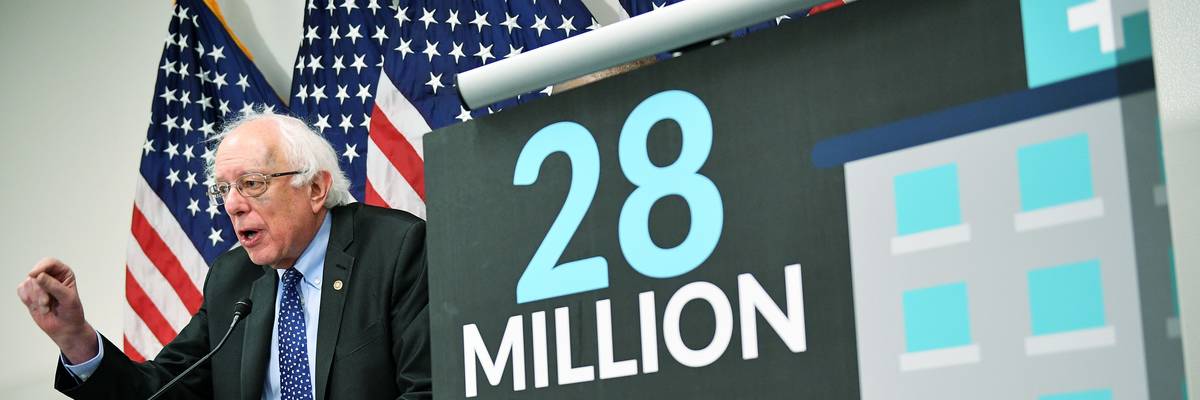
Sen. Bernie Sanders (I-Vt.) announces the introduction of the Community Health Center and Primary Care Workforce Expansion Act of 2019 at the U.S. Capitol on March 28, 2019.
"In the midst of a broken and dysfunctional healthcare system, I will be doing everything I can to expand community health centers so that every American has access to the primary care that they need and deserve."
Sen. Bernie Sanders warned Monday that without swift congressional action, the $5.8 billion in federal funding relied on each year by community health centers around the United States will expire on September 30, resulting in a devastating "primary care cliff."
"Congress can and must avoid" such a scenario, says a statement from the Vermont Independent's office.
Sanders announced that the Senate Health, Education, Labor, and Pensions (HELP) Committee he chairs is scheduled to hold a hearing this Thursday at 10:00 am ET titled, "Community Health Centers: Saving Lives, Saving Money."
Millions of people in the U.S. currently receive lifesaving services from community health centers in thousands of neighborhoods nationwide.
“In America today, community health centers are providing cost-effective primary medical care, dental care, mental health counseling, and low-cost prescription drugs to 30 million people regardless of a person's bank account or insurance status," said Sanders.
"Not only do these health centers save lives and ease human suffering," Sanders continued. "They save Medicare, Medicaid, and our entire healthcare system billions of dollars each year because they avoid the need to go to expensive emergency rooms and hospitals."
"In the midst of a broken and dysfunctional healthcare system, I will be doing everything I can to expand community health centers so that every American has access to the primary care that they need and deserve," he added.
According to the senator's office:
Nearly 100 million Americans live in a primary care desert, nearly 70 million live in a dental care desert, and some 158 million Americans—nearly half the country's population—live in a mental healthcare desert. Today, 85 million people are uninsured or under-insured, over 500,000 people go bankrupt each year because of medically related debt, and more than 68,000 people die each year because they cannot afford the healthcare they desperately need. Expanding community health centers will begin to address this urgent crisis.
The following individuals are scheduled to testify at the hearing: Amanda Pears Kelly, chief executive officer of Advocates for Community Health and executive director of the Association of Clinicians for the Underserved; Ben Harvey, chief executive officer of Indiana Primary Health Care Association; Robert Nocon, assistant professor at Kaiser Permanente Bernard J. Tyson School of Medicine; Sue Veer, president and chief executive officer of Carolina Health Centers; and Jessica Farb, managing director at the Government Accountability Office.
Dear Common Dreams reader, It’s been nearly 30 years since I co-founded Common Dreams with my late wife, Lina Newhouser. We had the radical notion that journalism should serve the public good, not corporate profits. It was clear to us from the outset what it would take to build such a project. No paid advertisements. No corporate sponsors. No millionaire publisher telling us what to think or do. Many people said we wouldn't last a year, but we proved those doubters wrong. Together with a tremendous team of journalists and dedicated staff, we built an independent media outlet free from the constraints of profits and corporate control. Our mission has always been simple: To inform. To inspire. To ignite change for the common good. Building Common Dreams was not easy. Our survival was never guaranteed. When you take on the most powerful forces—Wall Street greed, fossil fuel industry destruction, Big Tech lobbyists, and uber-rich oligarchs who have spent billions upon billions rigging the economy and democracy in their favor—the only bulwark you have is supporters who believe in your work. But here’s the urgent message from me today. It's never been this bad out there. And it's never been this hard to keep us going. At the very moment Common Dreams is most needed, the threats we face are intensifying. We need your support now more than ever. We don't accept corporate advertising and never will. We don't have a paywall because we don't think people should be blocked from critical news based on their ability to pay. Everything we do is funded by the donations of readers like you. When everyone does the little they can afford, we are strong. But if that support retreats or dries up, so do we. Will you donate now to make sure Common Dreams not only survives but thrives? —Craig Brown, Co-founder |
Sen. Bernie Sanders warned Monday that without swift congressional action, the $5.8 billion in federal funding relied on each year by community health centers around the United States will expire on September 30, resulting in a devastating "primary care cliff."
"Congress can and must avoid" such a scenario, says a statement from the Vermont Independent's office.
Sanders announced that the Senate Health, Education, Labor, and Pensions (HELP) Committee he chairs is scheduled to hold a hearing this Thursday at 10:00 am ET titled, "Community Health Centers: Saving Lives, Saving Money."
Millions of people in the U.S. currently receive lifesaving services from community health centers in thousands of neighborhoods nationwide.
“In America today, community health centers are providing cost-effective primary medical care, dental care, mental health counseling, and low-cost prescription drugs to 30 million people regardless of a person's bank account or insurance status," said Sanders.
"Not only do these health centers save lives and ease human suffering," Sanders continued. "They save Medicare, Medicaid, and our entire healthcare system billions of dollars each year because they avoid the need to go to expensive emergency rooms and hospitals."
"In the midst of a broken and dysfunctional healthcare system, I will be doing everything I can to expand community health centers so that every American has access to the primary care that they need and deserve," he added.
According to the senator's office:
Nearly 100 million Americans live in a primary care desert, nearly 70 million live in a dental care desert, and some 158 million Americans—nearly half the country's population—live in a mental healthcare desert. Today, 85 million people are uninsured or under-insured, over 500,000 people go bankrupt each year because of medically related debt, and more than 68,000 people die each year because they cannot afford the healthcare they desperately need. Expanding community health centers will begin to address this urgent crisis.
The following individuals are scheduled to testify at the hearing: Amanda Pears Kelly, chief executive officer of Advocates for Community Health and executive director of the Association of Clinicians for the Underserved; Ben Harvey, chief executive officer of Indiana Primary Health Care Association; Robert Nocon, assistant professor at Kaiser Permanente Bernard J. Tyson School of Medicine; Sue Veer, president and chief executive officer of Carolina Health Centers; and Jessica Farb, managing director at the Government Accountability Office.
Sen. Bernie Sanders warned Monday that without swift congressional action, the $5.8 billion in federal funding relied on each year by community health centers around the United States will expire on September 30, resulting in a devastating "primary care cliff."
"Congress can and must avoid" such a scenario, says a statement from the Vermont Independent's office.
Sanders announced that the Senate Health, Education, Labor, and Pensions (HELP) Committee he chairs is scheduled to hold a hearing this Thursday at 10:00 am ET titled, "Community Health Centers: Saving Lives, Saving Money."
Millions of people in the U.S. currently receive lifesaving services from community health centers in thousands of neighborhoods nationwide.
“In America today, community health centers are providing cost-effective primary medical care, dental care, mental health counseling, and low-cost prescription drugs to 30 million people regardless of a person's bank account or insurance status," said Sanders.
"Not only do these health centers save lives and ease human suffering," Sanders continued. "They save Medicare, Medicaid, and our entire healthcare system billions of dollars each year because they avoid the need to go to expensive emergency rooms and hospitals."
"In the midst of a broken and dysfunctional healthcare system, I will be doing everything I can to expand community health centers so that every American has access to the primary care that they need and deserve," he added.
According to the senator's office:
Nearly 100 million Americans live in a primary care desert, nearly 70 million live in a dental care desert, and some 158 million Americans—nearly half the country's population—live in a mental healthcare desert. Today, 85 million people are uninsured or under-insured, over 500,000 people go bankrupt each year because of medically related debt, and more than 68,000 people die each year because they cannot afford the healthcare they desperately need. Expanding community health centers will begin to address this urgent crisis.
The following individuals are scheduled to testify at the hearing: Amanda Pears Kelly, chief executive officer of Advocates for Community Health and executive director of the Association of Clinicians for the Underserved; Ben Harvey, chief executive officer of Indiana Primary Health Care Association; Robert Nocon, assistant professor at Kaiser Permanente Bernard J. Tyson School of Medicine; Sue Veer, president and chief executive officer of Carolina Health Centers; and Jessica Farb, managing director at the Government Accountability Office.