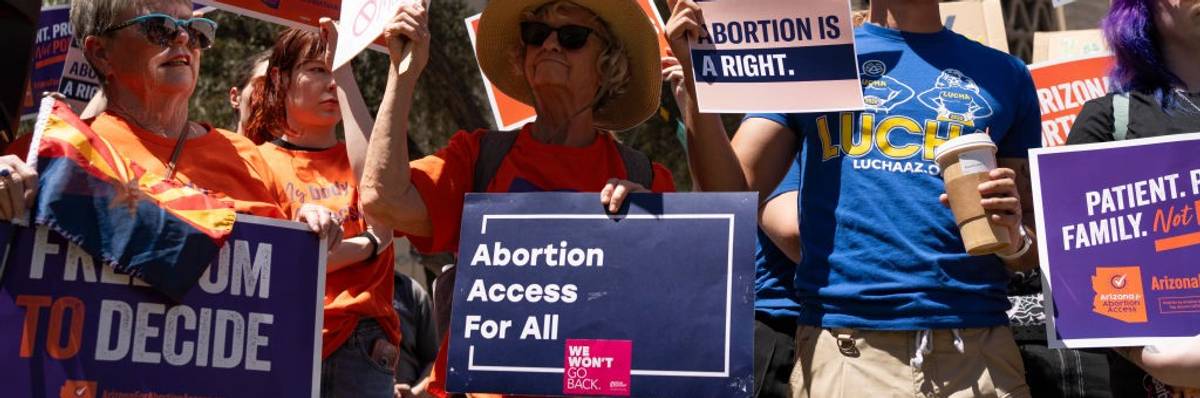
Members of Arizona for Abortion Access, the ballot initiative to enshrine abortion rights in the state constitution, hold a press conference on April 17, 2024 in Phoenix.
Pamphlet on Arizona Abortion Measure Can Say 'Unborn Human Being'
"We are deeply disappointed in this ruling, but will not be deterred from doing everything in our power to communicate to voters the truth of the Arizona Abortion Access Act," said the campaign behind the ballot measure.
While celebrating that Arizona voters will get to weigh in on an abortion rights ballot measure this November, reproductive rights advocates on Wednesday blasted a state Supreme Court ruling about language in a related informational pamphlet.
Overturning a decision from the Maricopa County Superior Court, the Arizona Supreme Court ruled that Republican legislators' use of "unborn human being" to refer to a fetus in the pamphlet "substantially complies" with the state's impartiality requirements.
"The Arizona Supreme Court today reversed the trial court's well-reasoned ruling and held that the phrase 'unborn human being'—a watchword for anti-abortion advocates with no basis in medicine or science—is somehow impartial or objective," the Arizona for Abortion Access campaign said in a statement.
"This means that Arizona voters won't get to learn about the questions on their ballot in a fair, neutral, and accurate way but will instead be subjected to biased, politically charged words developed not by experts but by anti-abortion special interests to manipulate voters and spread misinformation," the campaign continued.
"We are deeply disappointed in this ruling," the campaign added, "but will not be deterred from doing everything in our power to communicate to voters the truth of the Arizona Abortion Access Act and why it's critical to vote YES to restore and protect access to abortion care this fall."
The Arizona Abortion Access Act is a proposed state constitutional amendment that would prohibit many restrictions on abortions before fetal viability and safeguard access to care after viability to protect the life or health of the patient. The office of Arizona's secretary of state formally certified the proposed ballot measure on Monday.
The campaign to get the measure on the ballot garnered national attention earlier this year, when the Arizona Supreme Court upheld an 1864 abortion ban that includes no exceptions for pregnancies resulting from rape or incest. Although Democratic Arizona Gov. Katie Hobbs signed legislation to repeal the ban less than a month later, reproductive rights advocates have continued to emphasize the importance of passing the amendment.
Arizona is one of several states where reproductive freedom measures are—or soon could be—on the ballot in November. Rights advocates have increasingly pushed and succeeded in passing such measures since the U.S. Supreme Court's right-wing supermajority reversed Roe v. Wade two years ago, which set off a fresh wave of GOP efforts to enact state abortion bans.
The battle over the Arizona pamphlet is connected to a broad push by the anti-choice movement to ultimately end abortion care by recognizing fetuses and embryos as people with legal protections and rights.
This strategy has even influenced the latest Republican Party platform, which says that "we believe that the 14th Amendment to the Constitution of the United States guarantees that no person can be denied life or liberty without due process, and that the states are, therefore, free to pass laws protecting those rights."
The platform was finalized last month, shortly before the Republican nominee, former President Donald Trump, announced U.S. Sen. JD Vance (R-Ohio) as his running mate—a decision that further stoked fears of what a GOP victory in November would mean for abortion rights at the federal level.
Trump and Vance are set to face Democratic Vice President Kamala Harris and Minnesota Gov. Tim Walz, who have strong support from reproductive rights groups. Planned Parenthood Action Fund president Alexis McGill Johnson recently declared that they "are the only people we can trust to ensure that everyone has the freedom to make decisions about their own bodies."
We are at a crossroads
This country and this world are at a monumental crossroads. In a few short weeks, US voters will have an opportunity to beat back the forces of fascism and confront the billionaires who are rigging the economy, our media system, and our democracy, making it increasingly impossible for ordinary people to get by. We’re not just talking about the election. We’re talking about what must be done once these fascist elements are vanquished from power. We need a bolder set of solutions than what either major party has so far been willing to offer and a working-class movement ready to fight like hell for it. Trump didn't emerge from nowhere. The conditions that fueled MAGA authoritarianism were created by decades of radical neoliberal economic policies and a corrupt political system dominated by corporate interests. They slashed taxes on the super-rich, promising that the benefits would trickle down. They said giveaways to the corporate titans would make life more affordable for the rest of us. It was all bullshit. And when a bitter, betrayed populace searches for someone to blame, right-wing demagogues have little trouble finding scapegoats. People know when they're being lied to, but you won't hear any of this from the corporate media. Only independent journalism—powered and funded by people who believe in building a better world—can deliver truly trustworthy daily news. Our Fall Campaign is underway, and we need your help. To power our newsroom through the rest of the year, we need to raise $125,000 by midnight on October 31. So if you share our vision, please contribute whatever you can to sustain our work. |
While celebrating that Arizona voters will get to weigh in on an abortion rights ballot measure this November, reproductive rights advocates on Wednesday blasted a state Supreme Court ruling about language in a related informational pamphlet.
Overturning a decision from the Maricopa County Superior Court, the Arizona Supreme Court ruled that Republican legislators' use of "unborn human being" to refer to a fetus in the pamphlet "substantially complies" with the state's impartiality requirements.
"The Arizona Supreme Court today reversed the trial court's well-reasoned ruling and held that the phrase 'unborn human being'—a watchword for anti-abortion advocates with no basis in medicine or science—is somehow impartial or objective," the Arizona for Abortion Access campaign said in a statement.
"This means that Arizona voters won't get to learn about the questions on their ballot in a fair, neutral, and accurate way but will instead be subjected to biased, politically charged words developed not by experts but by anti-abortion special interests to manipulate voters and spread misinformation," the campaign continued.
"We are deeply disappointed in this ruling," the campaign added, "but will not be deterred from doing everything in our power to communicate to voters the truth of the Arizona Abortion Access Act and why it's critical to vote YES to restore and protect access to abortion care this fall."
The Arizona Abortion Access Act is a proposed state constitutional amendment that would prohibit many restrictions on abortions before fetal viability and safeguard access to care after viability to protect the life or health of the patient. The office of Arizona's secretary of state formally certified the proposed ballot measure on Monday.
The campaign to get the measure on the ballot garnered national attention earlier this year, when the Arizona Supreme Court upheld an 1864 abortion ban that includes no exceptions for pregnancies resulting from rape or incest. Although Democratic Arizona Gov. Katie Hobbs signed legislation to repeal the ban less than a month later, reproductive rights advocates have continued to emphasize the importance of passing the amendment.
Arizona is one of several states where reproductive freedom measures are—or soon could be—on the ballot in November. Rights advocates have increasingly pushed and succeeded in passing such measures since the U.S. Supreme Court's right-wing supermajority reversed Roe v. Wade two years ago, which set off a fresh wave of GOP efforts to enact state abortion bans.
The battle over the Arizona pamphlet is connected to a broad push by the anti-choice movement to ultimately end abortion care by recognizing fetuses and embryos as people with legal protections and rights.
This strategy has even influenced the latest Republican Party platform, which says that "we believe that the 14th Amendment to the Constitution of the United States guarantees that no person can be denied life or liberty without due process, and that the states are, therefore, free to pass laws protecting those rights."
The platform was finalized last month, shortly before the Republican nominee, former President Donald Trump, announced U.S. Sen. JD Vance (R-Ohio) as his running mate—a decision that further stoked fears of what a GOP victory in November would mean for abortion rights at the federal level.
Trump and Vance are set to face Democratic Vice President Kamala Harris and Minnesota Gov. Tim Walz, who have strong support from reproductive rights groups. Planned Parenthood Action Fund president Alexis McGill Johnson recently declared that they "are the only people we can trust to ensure that everyone has the freedom to make decisions about their own bodies."
- 'Huge Win': Abortion Rights Amendment Will Be on Arizona Ballot in November ›
- Arizona Supreme Court Upholds 1864 Abortion Ban—But Voters Will Get 'Ultimate Say' in November ›
- 'One Step Closer': Arizona House Votes to Repeal 1864 Abortion Ban ›
- Arizonans Submit Over Double the Signatures Needed for Abortion Ballot Measure ›
- As Hobbs Signs Repeal, Arizonans Push Abortion Rights Ballot Measure ›
While celebrating that Arizona voters will get to weigh in on an abortion rights ballot measure this November, reproductive rights advocates on Wednesday blasted a state Supreme Court ruling about language in a related informational pamphlet.
Overturning a decision from the Maricopa County Superior Court, the Arizona Supreme Court ruled that Republican legislators' use of "unborn human being" to refer to a fetus in the pamphlet "substantially complies" with the state's impartiality requirements.
"The Arizona Supreme Court today reversed the trial court's well-reasoned ruling and held that the phrase 'unborn human being'—a watchword for anti-abortion advocates with no basis in medicine or science—is somehow impartial or objective," the Arizona for Abortion Access campaign said in a statement.
"This means that Arizona voters won't get to learn about the questions on their ballot in a fair, neutral, and accurate way but will instead be subjected to biased, politically charged words developed not by experts but by anti-abortion special interests to manipulate voters and spread misinformation," the campaign continued.
"We are deeply disappointed in this ruling," the campaign added, "but will not be deterred from doing everything in our power to communicate to voters the truth of the Arizona Abortion Access Act and why it's critical to vote YES to restore and protect access to abortion care this fall."
The Arizona Abortion Access Act is a proposed state constitutional amendment that would prohibit many restrictions on abortions before fetal viability and safeguard access to care after viability to protect the life or health of the patient. The office of Arizona's secretary of state formally certified the proposed ballot measure on Monday.
The campaign to get the measure on the ballot garnered national attention earlier this year, when the Arizona Supreme Court upheld an 1864 abortion ban that includes no exceptions for pregnancies resulting from rape or incest. Although Democratic Arizona Gov. Katie Hobbs signed legislation to repeal the ban less than a month later, reproductive rights advocates have continued to emphasize the importance of passing the amendment.
Arizona is one of several states where reproductive freedom measures are—or soon could be—on the ballot in November. Rights advocates have increasingly pushed and succeeded in passing such measures since the U.S. Supreme Court's right-wing supermajority reversed Roe v. Wade two years ago, which set off a fresh wave of GOP efforts to enact state abortion bans.
The battle over the Arizona pamphlet is connected to a broad push by the anti-choice movement to ultimately end abortion care by recognizing fetuses and embryos as people with legal protections and rights.
This strategy has even influenced the latest Republican Party platform, which says that "we believe that the 14th Amendment to the Constitution of the United States guarantees that no person can be denied life or liberty without due process, and that the states are, therefore, free to pass laws protecting those rights."
The platform was finalized last month, shortly before the Republican nominee, former President Donald Trump, announced U.S. Sen. JD Vance (R-Ohio) as his running mate—a decision that further stoked fears of what a GOP victory in November would mean for abortion rights at the federal level.
Trump and Vance are set to face Democratic Vice President Kamala Harris and Minnesota Gov. Tim Walz, who have strong support from reproductive rights groups. Planned Parenthood Action Fund president Alexis McGill Johnson recently declared that they "are the only people we can trust to ensure that everyone has the freedom to make decisions about their own bodies."
- 'Huge Win': Abortion Rights Amendment Will Be on Arizona Ballot in November ›
- Arizona Supreme Court Upholds 1864 Abortion Ban—But Voters Will Get 'Ultimate Say' in November ›
- 'One Step Closer': Arizona House Votes to Repeal 1864 Abortion Ban ›
- Arizonans Submit Over Double the Signatures Needed for Abortion Ballot Measure ›
- As Hobbs Signs Repeal, Arizonans Push Abortion Rights Ballot Measure ›