

SUBSCRIBE TO OUR FREE NEWSLETTER
Daily news & progressive opinion—funded by the people, not the corporations—delivered straight to your inbox.
5
#000000
#FFFFFF
To donate by check, phone, or other method, see our More Ways to Give page.
Daily news & progressive opinion—funded by the people, not the corporations—delivered straight to your inbox.
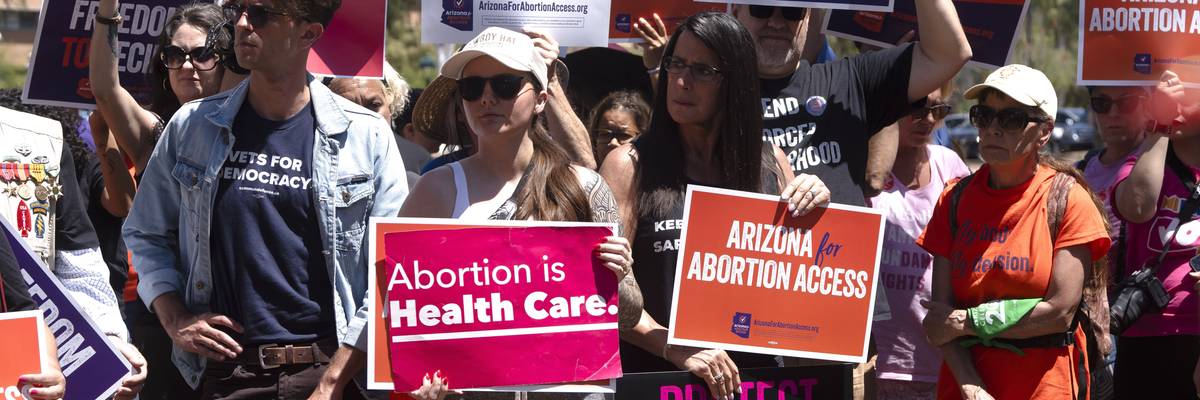
Abortion rights advocates hold a press conference and protest condemning on April 17, 2024 in Phoenix, Arizona.
"Now, in November, it is time for Arizonans to take the next step and vote yes on this important initiative," said one campaigner.
Reproductive rights advocates in Arizona celebrated a key victory late Monday after the state formally certified their proposed ballot measure, which aims to establish "a fundamental right to abortion" in Arizona's constitution.
The office of Arizona's secretary of state said it verified 577,971 signatures in support of placing the proposed constitutional amendment on the November ballot. That's well above the required 383,923 signatures, and organizers said the total number of verified signatures surpassed the state record for ballot initiatives—an indication that the effort has generated widespread enthusiasm amid right-wing attacks on reproductive rights across the country.
"Today marks an important and exciting turning point toward ensuring the human right to abortion for Arizonans," said Karla Gonzales Garcia, gender, sexuality, and identity director with Amnesty International USA, part of the Arizona for Abortion Access coalition.
"The outpouring of support for bringing this ballot initiative to the people for a vote clearly shows that the human right to abortion is an important issue for Arizonans. Now, in November, it is time for Arizonans to take the next step and vote yes on this important initiative," she added. "Since the fall of Roe v. Wade, we're facing a human rights crisis in this country when it comes to abortion access. Too many people still cannot access healthcare, including abortions, they need. While the lasting solutions to ensure abortion access must be national in scope and go beyond restoring Roe, Arizonans have the powerful opportunity to constitutionally protect access to abortion in their state."
Under current Arizona law, abortion is banned after 15 weeks of pregnancy and—according to the Guttmacher Institute—patients are forced to jump through a number of hoops to receive care, such as getting an ultrasound even if it's medically unnecessary and making at least two in-person trips.
Proposition 139, the Arizona for Abortion Access Act, would establish "a fundamental right to abortion under Arizona's constitution" and bar the state from interfering "with this fundamental right before fetal viability unless it has a compelling reason and does so in the least restrictive way possible."
The initial victory for Proposition 139 organizers comes months after Arizona's Democratic governor signed legislation repealing a draconian abortion ban dating back to 1864. The Arizona Supreme Court ruled a month earlier that the law was enforceable after the U.S. Supreme Court overturned Roe v. Wade in the summer of 2022.
Arizona's 15-week abortion ban, signed into law by former Republican Gov. Doug Ducey, is now in effect—but voters in the battleground state will have a chance to effectively repeal the ban in November.
Cheryl Bruce, campaign manager for Arizona for Abortion Access, said in a statement Monday that the official certification of the ballot measure "is a huge win."
Arizonans, she said, "will now get to vote yes on restoring and protecting the right to access abortion care, free from political interference, once and for all."
Arizona is one of a number of states where abortion rights will be on the ballot in November. Since the U.S. Supreme Court's decision overturning Roe, abortion rights have won every time they've been put directly to voters, a winning streak that has intensified right-wing efforts to derail ballot initiatives.
In Arkansas, campaigners are suing the state's top election official for moving to disqualify a proposed abortion rights ballot initiative for what they say were obvious political reasons.
Arkansas is one of 17 U.S. states where abortion is completely banned with extremely limited exceptions.
Dear Common Dreams reader, It’s been nearly 30 years since I co-founded Common Dreams with my late wife, Lina Newhouser. We had the radical notion that journalism should serve the public good, not corporate profits. It was clear to us from the outset what it would take to build such a project. No paid advertisements. No corporate sponsors. No millionaire publisher telling us what to think or do. Many people said we wouldn't last a year, but we proved those doubters wrong. Together with a tremendous team of journalists and dedicated staff, we built an independent media outlet free from the constraints of profits and corporate control. Our mission has always been simple: To inform. To inspire. To ignite change for the common good. Building Common Dreams was not easy. Our survival was never guaranteed. When you take on the most powerful forces—Wall Street greed, fossil fuel industry destruction, Big Tech lobbyists, and uber-rich oligarchs who have spent billions upon billions rigging the economy and democracy in their favor—the only bulwark you have is supporters who believe in your work. But here’s the urgent message from me today. It's never been this bad out there. And it's never been this hard to keep us going. At the very moment Common Dreams is most needed, the threats we face are intensifying. We need your support now more than ever. We don't accept corporate advertising and never will. We don't have a paywall because we don't think people should be blocked from critical news based on their ability to pay. Everything we do is funded by the donations of readers like you. When everyone does the little they can afford, we are strong. But if that support retreats or dries up, so do we. Will you donate now to make sure Common Dreams not only survives but thrives? —Craig Brown, Co-founder |
Reproductive rights advocates in Arizona celebrated a key victory late Monday after the state formally certified their proposed ballot measure, which aims to establish "a fundamental right to abortion" in Arizona's constitution.
The office of Arizona's secretary of state said it verified 577,971 signatures in support of placing the proposed constitutional amendment on the November ballot. That's well above the required 383,923 signatures, and organizers said the total number of verified signatures surpassed the state record for ballot initiatives—an indication that the effort has generated widespread enthusiasm amid right-wing attacks on reproductive rights across the country.
"Today marks an important and exciting turning point toward ensuring the human right to abortion for Arizonans," said Karla Gonzales Garcia, gender, sexuality, and identity director with Amnesty International USA, part of the Arizona for Abortion Access coalition.
"The outpouring of support for bringing this ballot initiative to the people for a vote clearly shows that the human right to abortion is an important issue for Arizonans. Now, in November, it is time for Arizonans to take the next step and vote yes on this important initiative," she added. "Since the fall of Roe v. Wade, we're facing a human rights crisis in this country when it comes to abortion access. Too many people still cannot access healthcare, including abortions, they need. While the lasting solutions to ensure abortion access must be national in scope and go beyond restoring Roe, Arizonans have the powerful opportunity to constitutionally protect access to abortion in their state."
Under current Arizona law, abortion is banned after 15 weeks of pregnancy and—according to the Guttmacher Institute—patients are forced to jump through a number of hoops to receive care, such as getting an ultrasound even if it's medically unnecessary and making at least two in-person trips.
Proposition 139, the Arizona for Abortion Access Act, would establish "a fundamental right to abortion under Arizona's constitution" and bar the state from interfering "with this fundamental right before fetal viability unless it has a compelling reason and does so in the least restrictive way possible."
The initial victory for Proposition 139 organizers comes months after Arizona's Democratic governor signed legislation repealing a draconian abortion ban dating back to 1864. The Arizona Supreme Court ruled a month earlier that the law was enforceable after the U.S. Supreme Court overturned Roe v. Wade in the summer of 2022.
Arizona's 15-week abortion ban, signed into law by former Republican Gov. Doug Ducey, is now in effect—but voters in the battleground state will have a chance to effectively repeal the ban in November.
Cheryl Bruce, campaign manager for Arizona for Abortion Access, said in a statement Monday that the official certification of the ballot measure "is a huge win."
Arizonans, she said, "will now get to vote yes on restoring and protecting the right to access abortion care, free from political interference, once and for all."
Arizona is one of a number of states where abortion rights will be on the ballot in November. Since the U.S. Supreme Court's decision overturning Roe, abortion rights have won every time they've been put directly to voters, a winning streak that has intensified right-wing efforts to derail ballot initiatives.
In Arkansas, campaigners are suing the state's top election official for moving to disqualify a proposed abortion rights ballot initiative for what they say were obvious political reasons.
Arkansas is one of 17 U.S. states where abortion is completely banned with extremely limited exceptions.
Reproductive rights advocates in Arizona celebrated a key victory late Monday after the state formally certified their proposed ballot measure, which aims to establish "a fundamental right to abortion" in Arizona's constitution.
The office of Arizona's secretary of state said it verified 577,971 signatures in support of placing the proposed constitutional amendment on the November ballot. That's well above the required 383,923 signatures, and organizers said the total number of verified signatures surpassed the state record for ballot initiatives—an indication that the effort has generated widespread enthusiasm amid right-wing attacks on reproductive rights across the country.
"Today marks an important and exciting turning point toward ensuring the human right to abortion for Arizonans," said Karla Gonzales Garcia, gender, sexuality, and identity director with Amnesty International USA, part of the Arizona for Abortion Access coalition.
"The outpouring of support for bringing this ballot initiative to the people for a vote clearly shows that the human right to abortion is an important issue for Arizonans. Now, in November, it is time for Arizonans to take the next step and vote yes on this important initiative," she added. "Since the fall of Roe v. Wade, we're facing a human rights crisis in this country when it comes to abortion access. Too many people still cannot access healthcare, including abortions, they need. While the lasting solutions to ensure abortion access must be national in scope and go beyond restoring Roe, Arizonans have the powerful opportunity to constitutionally protect access to abortion in their state."
Under current Arizona law, abortion is banned after 15 weeks of pregnancy and—according to the Guttmacher Institute—patients are forced to jump through a number of hoops to receive care, such as getting an ultrasound even if it's medically unnecessary and making at least two in-person trips.
Proposition 139, the Arizona for Abortion Access Act, would establish "a fundamental right to abortion under Arizona's constitution" and bar the state from interfering "with this fundamental right before fetal viability unless it has a compelling reason and does so in the least restrictive way possible."
The initial victory for Proposition 139 organizers comes months after Arizona's Democratic governor signed legislation repealing a draconian abortion ban dating back to 1864. The Arizona Supreme Court ruled a month earlier that the law was enforceable after the U.S. Supreme Court overturned Roe v. Wade in the summer of 2022.
Arizona's 15-week abortion ban, signed into law by former Republican Gov. Doug Ducey, is now in effect—but voters in the battleground state will have a chance to effectively repeal the ban in November.
Cheryl Bruce, campaign manager for Arizona for Abortion Access, said in a statement Monday that the official certification of the ballot measure "is a huge win."
Arizonans, she said, "will now get to vote yes on restoring and protecting the right to access abortion care, free from political interference, once and for all."
Arizona is one of a number of states where abortion rights will be on the ballot in November. Since the U.S. Supreme Court's decision overturning Roe, abortion rights have won every time they've been put directly to voters, a winning streak that has intensified right-wing efforts to derail ballot initiatives.
In Arkansas, campaigners are suing the state's top election official for moving to disqualify a proposed abortion rights ballot initiative for what they say were obvious political reasons.
Arkansas is one of 17 U.S. states where abortion is completely banned with extremely limited exceptions.

