SUBSCRIBE TO OUR FREE NEWSLETTER
Daily news & progressive opinion—funded by the people, not the corporations—delivered straight to your inbox.
5
#000000
#FFFFFF
To donate by check, phone, or other method, see our More Ways to Give page.
Daily news & progressive opinion—funded by the people, not the corporations—delivered straight to your inbox.
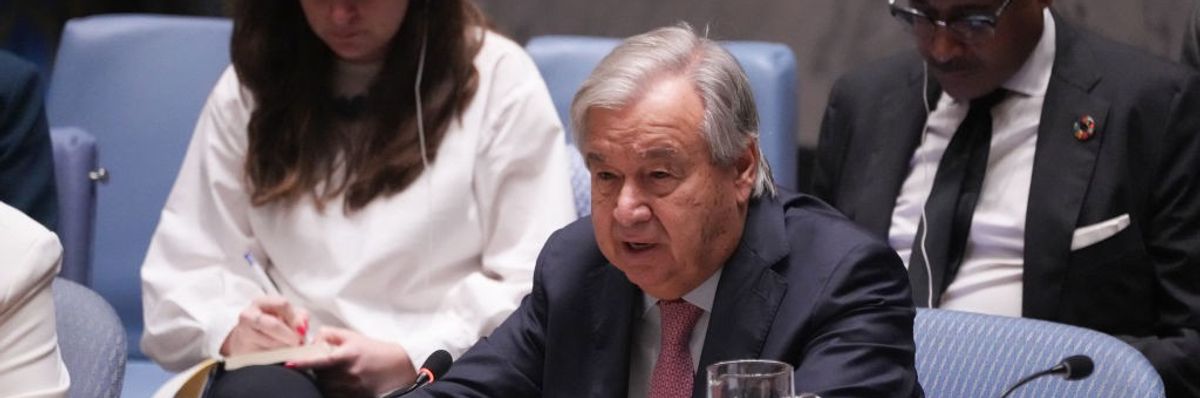
United Nations Secretary-General António Guterres speaks at a Security Council meeting on October 2, 2024 in New York.
"This deadly cycle of tit-for-tat violence must stop. Time is running out," said United Nations Secretary-General António Guterres.
United Nations Secretary-General António Guterres on Wednesday reiterated his urgent call for an end to violence and a diplomatic resolution in the Middle East shortly after Israel's foreign minister declared that the U.N. chief was barred from entering the country, a move that drew international condemnation.
"The raging fires in the Middle East are fast becoming an inferno," Guterres told a meeting of the U.N. Security Council, denouncing Israel's "relentless airstrikes across Lebanon," devastation of the Gaza Strip, and obstruction of a cease-fire agreement that could pull the region back from the brink of all-out war.
"Since last October, Israel has conducted in Gaza the most deadly and destructive military campaign in my years as secretary-general," said Guterres. "The suffering endured by the Palestinian people in Gaza is beyond imagination."
Guterres also condemned Hezbollah's "continued rocket and missile attacks on Israel" and Iran's retaliatory ballistic missile strikes against Israeli military targets. As he did so, Guterres pushed back on Israeli Foreign Minister Israel Katz's accusation that the U.N. chief did not repudiate the Iranian attack with his brief Tuesday statement.
"As I did in relation to the Iranian attack in April—and as should have been obvious yesterday in the context of the condemnation I expressed—I again strongly condemn yesterday's massive missile attack by Iran on Israel," Guterres said Wednesday. "It is high time to stop the sickening cycle of escalation after escalation that is leading the people of the Middle East straight over the cliff."
"Each escalation has served as a pretext for the next," he continued. "We must never lose sight of the tremendous toll that this growing conflict is taking on civilians. We cannot look away from systematic violations of international humanitarian law. This deadly cycle of tit-for-tat violence must stop. Time is running out."
Watch Guterres' full speech:
The Israeli foreign minister's designation of Guterres—a persistent and vocal advocate for peace—as "persona non grata" means the U.N. chief is barred from entering Israel as a diplomat, but Israeli journalist Yanir Cozin pointed out that he could get into the country with a non-diplomatic passport.
Amar Bendjama, Algeria's ambassador to the U.N., told the Security Council on Wednesday that the Israeli foreign minister's decision reflects the Israeli government's "clear disdain of the U.N. system and the entire international community."
"Our inaction has effectively granted Israel carte blanche to continue its rampage in Gaza, in the West Bank—carte blanche to escalate against Lebanon and pursue a bloody agenda of death and destruction," said Bendjama.
The emergency Security Council session came as the Israeli military confirmed that eight of its soldiers were killed Wednesday in ground fights with Hezbollah in Lebanon.
"Hezbollah said its fighters were engaging Israeli forces inside Lebanon on Wednesday, reporting ground clashes for the first time since Israeli forces pushed over the border," Reuters reported. "Hezbollah said it had destroyed three Israeli Merkava tanks with rockets near the border town of Maroun El Ras."
Amid the spiraling violence across the region and worsening humanitarian disasters in Gaza, Lebanon, and the West Bank, U.N. High Commissioner for Human Rights Volker Türk implored "all states, including members of the Security Council, to act resolutely to prevent a wider conflict in the Middle East with potentially devastating consequences for civilians."
"It is vital that they use their voices and influence to bring the warring parties to the negotiating table to end this," said Türk. "We appeal to reason. Peace must prevail."
Dear Common Dreams reader, It’s been nearly 30 years since I co-founded Common Dreams with my late wife, Lina Newhouser. We had the radical notion that journalism should serve the public good, not corporate profits. It was clear to us from the outset what it would take to build such a project. No paid advertisements. No corporate sponsors. No millionaire publisher telling us what to think or do. Many people said we wouldn't last a year, but we proved those doubters wrong. Together with a tremendous team of journalists and dedicated staff, we built an independent media outlet free from the constraints of profits and corporate control. Our mission has always been simple: To inform. To inspire. To ignite change for the common good. Building Common Dreams was not easy. Our survival was never guaranteed. When you take on the most powerful forces—Wall Street greed, fossil fuel industry destruction, Big Tech lobbyists, and uber-rich oligarchs who have spent billions upon billions rigging the economy and democracy in their favor—the only bulwark you have is supporters who believe in your work. But here’s the urgent message from me today. It's never been this bad out there. And it's never been this hard to keep us going. At the very moment Common Dreams is most needed, the threats we face are intensifying. We need your support now more than ever. We don't accept corporate advertising and never will. We don't have a paywall because we don't think people should be blocked from critical news based on their ability to pay. Everything we do is funded by the donations of readers like you. When everyone does the little they can afford, we are strong. But if that support retreats or dries up, so do we. Will you donate now to make sure Common Dreams not only survives but thrives? —Craig Brown, Co-founder |
United Nations Secretary-General António Guterres on Wednesday reiterated his urgent call for an end to violence and a diplomatic resolution in the Middle East shortly after Israel's foreign minister declared that the U.N. chief was barred from entering the country, a move that drew international condemnation.
"The raging fires in the Middle East are fast becoming an inferno," Guterres told a meeting of the U.N. Security Council, denouncing Israel's "relentless airstrikes across Lebanon," devastation of the Gaza Strip, and obstruction of a cease-fire agreement that could pull the region back from the brink of all-out war.
"Since last October, Israel has conducted in Gaza the most deadly and destructive military campaign in my years as secretary-general," said Guterres. "The suffering endured by the Palestinian people in Gaza is beyond imagination."
Guterres also condemned Hezbollah's "continued rocket and missile attacks on Israel" and Iran's retaliatory ballistic missile strikes against Israeli military targets. As he did so, Guterres pushed back on Israeli Foreign Minister Israel Katz's accusation that the U.N. chief did not repudiate the Iranian attack with his brief Tuesday statement.
"As I did in relation to the Iranian attack in April—and as should have been obvious yesterday in the context of the condemnation I expressed—I again strongly condemn yesterday's massive missile attack by Iran on Israel," Guterres said Wednesday. "It is high time to stop the sickening cycle of escalation after escalation that is leading the people of the Middle East straight over the cliff."
"Each escalation has served as a pretext for the next," he continued. "We must never lose sight of the tremendous toll that this growing conflict is taking on civilians. We cannot look away from systematic violations of international humanitarian law. This deadly cycle of tit-for-tat violence must stop. Time is running out."
Watch Guterres' full speech:
The Israeli foreign minister's designation of Guterres—a persistent and vocal advocate for peace—as "persona non grata" means the U.N. chief is barred from entering Israel as a diplomat, but Israeli journalist Yanir Cozin pointed out that he could get into the country with a non-diplomatic passport.
Amar Bendjama, Algeria's ambassador to the U.N., told the Security Council on Wednesday that the Israeli foreign minister's decision reflects the Israeli government's "clear disdain of the U.N. system and the entire international community."
"Our inaction has effectively granted Israel carte blanche to continue its rampage in Gaza, in the West Bank—carte blanche to escalate against Lebanon and pursue a bloody agenda of death and destruction," said Bendjama.
The emergency Security Council session came as the Israeli military confirmed that eight of its soldiers were killed Wednesday in ground fights with Hezbollah in Lebanon.
"Hezbollah said its fighters were engaging Israeli forces inside Lebanon on Wednesday, reporting ground clashes for the first time since Israeli forces pushed over the border," Reuters reported. "Hezbollah said it had destroyed three Israeli Merkava tanks with rockets near the border town of Maroun El Ras."
Amid the spiraling violence across the region and worsening humanitarian disasters in Gaza, Lebanon, and the West Bank, U.N. High Commissioner for Human Rights Volker Türk implored "all states, including members of the Security Council, to act resolutely to prevent a wider conflict in the Middle East with potentially devastating consequences for civilians."
"It is vital that they use their voices and influence to bring the warring parties to the negotiating table to end this," said Türk. "We appeal to reason. Peace must prevail."
United Nations Secretary-General António Guterres on Wednesday reiterated his urgent call for an end to violence and a diplomatic resolution in the Middle East shortly after Israel's foreign minister declared that the U.N. chief was barred from entering the country, a move that drew international condemnation.
"The raging fires in the Middle East are fast becoming an inferno," Guterres told a meeting of the U.N. Security Council, denouncing Israel's "relentless airstrikes across Lebanon," devastation of the Gaza Strip, and obstruction of a cease-fire agreement that could pull the region back from the brink of all-out war.
"Since last October, Israel has conducted in Gaza the most deadly and destructive military campaign in my years as secretary-general," said Guterres. "The suffering endured by the Palestinian people in Gaza is beyond imagination."
Guterres also condemned Hezbollah's "continued rocket and missile attacks on Israel" and Iran's retaliatory ballistic missile strikes against Israeli military targets. As he did so, Guterres pushed back on Israeli Foreign Minister Israel Katz's accusation that the U.N. chief did not repudiate the Iranian attack with his brief Tuesday statement.
"As I did in relation to the Iranian attack in April—and as should have been obvious yesterday in the context of the condemnation I expressed—I again strongly condemn yesterday's massive missile attack by Iran on Israel," Guterres said Wednesday. "It is high time to stop the sickening cycle of escalation after escalation that is leading the people of the Middle East straight over the cliff."
"Each escalation has served as a pretext for the next," he continued. "We must never lose sight of the tremendous toll that this growing conflict is taking on civilians. We cannot look away from systematic violations of international humanitarian law. This deadly cycle of tit-for-tat violence must stop. Time is running out."
Watch Guterres' full speech:
The Israeli foreign minister's designation of Guterres—a persistent and vocal advocate for peace—as "persona non grata" means the U.N. chief is barred from entering Israel as a diplomat, but Israeli journalist Yanir Cozin pointed out that he could get into the country with a non-diplomatic passport.
Amar Bendjama, Algeria's ambassador to the U.N., told the Security Council on Wednesday that the Israeli foreign minister's decision reflects the Israeli government's "clear disdain of the U.N. system and the entire international community."
"Our inaction has effectively granted Israel carte blanche to continue its rampage in Gaza, in the West Bank—carte blanche to escalate against Lebanon and pursue a bloody agenda of death and destruction," said Bendjama.
The emergency Security Council session came as the Israeli military confirmed that eight of its soldiers were killed Wednesday in ground fights with Hezbollah in Lebanon.
"Hezbollah said its fighters were engaging Israeli forces inside Lebanon on Wednesday, reporting ground clashes for the first time since Israeli forces pushed over the border," Reuters reported. "Hezbollah said it had destroyed three Israeli Merkava tanks with rockets near the border town of Maroun El Ras."
Amid the spiraling violence across the region and worsening humanitarian disasters in Gaza, Lebanon, and the West Bank, U.N. High Commissioner for Human Rights Volker Türk implored "all states, including members of the Security Council, to act resolutely to prevent a wider conflict in the Middle East with potentially devastating consequences for civilians."
"It is vital that they use their voices and influence to bring the warring parties to the negotiating table to end this," said Türk. "We appeal to reason. Peace must prevail."