SUBSCRIBE TO OUR FREE NEWSLETTER
Daily news & progressive opinion—funded by the people, not the corporations—delivered straight to your inbox.
5
#000000
#FFFFFF
To donate by check, phone, or other method, see our More Ways to Give page.
Daily news & progressive opinion—funded by the people, not the corporations—delivered straight to your inbox.
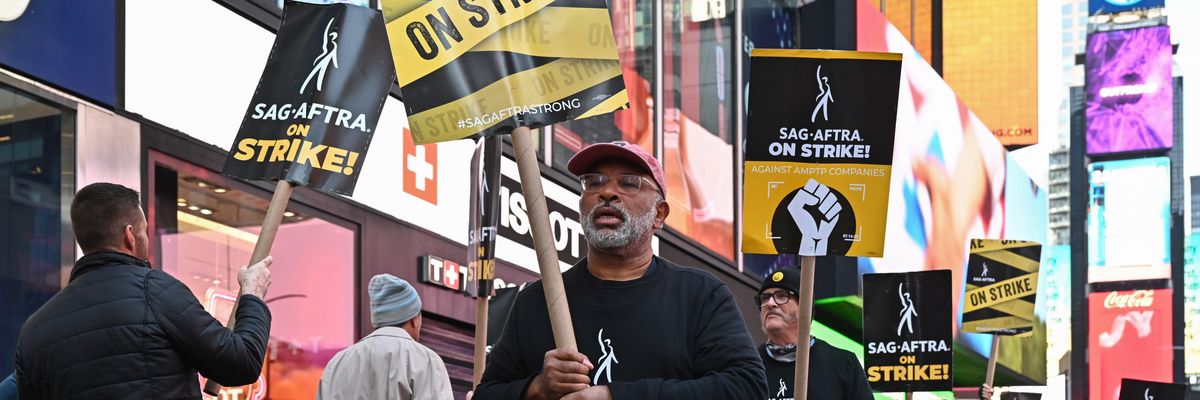
Geoffrey Owens walks a picket line in support of the SAG-AFTRA strike outside Warner Bros. Discovery Headquarters on November 6, 2023 in New York City.
"It's the cheap, dark future studios want," said one television writer. "Right now, SAG-AFTRA is the only thing preventing it. And they're fighting like hell."
Negotiations between the world's largest labor union representing screen performers and some of the most powerful studios in Hollywood were set to resume on Tuesday after union negotiators announced that they had rejected the companies' "last, best, and final offer," arguing that the terms did not include sufficient artificial intelligence protections for highly-paid actors.
The latest offer included language that would have cascading negative effects on the entire entertainment industry, said supporters of the ongoing actors' strikes.
The negotiating committee of the Screen Actors Guild-American Federation of Television and Radio Artists (SAG-AFTRA), including chief negotiator Duncan Crabtree-Ireland and union president Fran Drescher, told the union's 160,000 members Monday evening that they were "determined to secure the right deal and thereby bring this strike to an end responsibly." The union began a work stoppage on July 13 after more than a month of negotiations regarding residual pay, AI, and other issues.
The Alliance of Motion Picture and Television Producers' (AMPTP) supposed "final" offer included a requirement that studios and streaming services pay to make AI images with the likeness of highly-paid "Schedule F" performers, who earn more than the minimum for series regulars ($32,000 per TV episode) and feature films ($60,000).
But SAG-AFTRA is also demanding a provision that would require compensation for the re-use of AI scans and one that would require companies to secure consent from a deceased actors' estate to use an AI scan of them.
The language in the AMPTP's offer was derided as the "zombie" clause by television writer David Slack, who called the studios' proposal "a nightmare scenario" that would play out like an episode of the dystopian series Black Mirror.
While the clause pertains to highly paid actors, Slack noted that it would ultimately impact thousands of people who work across the entertainment industry, as the studios' goal appears to be gaining the ability to produce films and television without paying the actors who appear in them.
"The AMPTP's zombie clause also means less money for talent agents and managers—as performers making a good living right now are suddenly scanned once, given one check, and then sent home forever," said Slack. "And who is going to pay the publicists, PR firms, event managers, and press junket journalists for TV and movie premieres—when they start releasing shows where all the 'actors' were either not involved in the 'filming' or are already dead?"
Before the Writers Guild of America secured a deal that was ratified in October, ending the writers' strike after nearly five months, the union also refused to accept an AMPTP offer that was presented as its "best and final."
"The AMPTP tried their 'Last, Best, and Final' trick—and the SAG-AFTRA [negotiating committee] didn't blink," said Slack. "This is how you win."
Dear Common Dreams reader, It’s been nearly 30 years since I co-founded Common Dreams with my late wife, Lina Newhouser. We had the radical notion that journalism should serve the public good, not corporate profits. It was clear to us from the outset what it would take to build such a project. No paid advertisements. No corporate sponsors. No millionaire publisher telling us what to think or do. Many people said we wouldn't last a year, but we proved those doubters wrong. Together with a tremendous team of journalists and dedicated staff, we built an independent media outlet free from the constraints of profits and corporate control. Our mission has always been simple: To inform. To inspire. To ignite change for the common good. Building Common Dreams was not easy. Our survival was never guaranteed. When you take on the most powerful forces—Wall Street greed, fossil fuel industry destruction, Big Tech lobbyists, and uber-rich oligarchs who have spent billions upon billions rigging the economy and democracy in their favor—the only bulwark you have is supporters who believe in your work. But here’s the urgent message from me today. It's never been this bad out there. And it's never been this hard to keep us going. At the very moment Common Dreams is most needed, the threats we face are intensifying. We need your support now more than ever. We don't accept corporate advertising and never will. We don't have a paywall because we don't think people should be blocked from critical news based on their ability to pay. Everything we do is funded by the donations of readers like you. When everyone does the little they can afford, we are strong. But if that support retreats or dries up, so do we. Will you donate now to make sure Common Dreams not only survives but thrives? —Craig Brown, Co-founder |
Negotiations between the world's largest labor union representing screen performers and some of the most powerful studios in Hollywood were set to resume on Tuesday after union negotiators announced that they had rejected the companies' "last, best, and final offer," arguing that the terms did not include sufficient artificial intelligence protections for highly-paid actors.
The latest offer included language that would have cascading negative effects on the entire entertainment industry, said supporters of the ongoing actors' strikes.
The negotiating committee of the Screen Actors Guild-American Federation of Television and Radio Artists (SAG-AFTRA), including chief negotiator Duncan Crabtree-Ireland and union president Fran Drescher, told the union's 160,000 members Monday evening that they were "determined to secure the right deal and thereby bring this strike to an end responsibly." The union began a work stoppage on July 13 after more than a month of negotiations regarding residual pay, AI, and other issues.
The Alliance of Motion Picture and Television Producers' (AMPTP) supposed "final" offer included a requirement that studios and streaming services pay to make AI images with the likeness of highly-paid "Schedule F" performers, who earn more than the minimum for series regulars ($32,000 per TV episode) and feature films ($60,000).
But SAG-AFTRA is also demanding a provision that would require compensation for the re-use of AI scans and one that would require companies to secure consent from a deceased actors' estate to use an AI scan of them.
The language in the AMPTP's offer was derided as the "zombie" clause by television writer David Slack, who called the studios' proposal "a nightmare scenario" that would play out like an episode of the dystopian series Black Mirror.
While the clause pertains to highly paid actors, Slack noted that it would ultimately impact thousands of people who work across the entertainment industry, as the studios' goal appears to be gaining the ability to produce films and television without paying the actors who appear in them.
"The AMPTP's zombie clause also means less money for talent agents and managers—as performers making a good living right now are suddenly scanned once, given one check, and then sent home forever," said Slack. "And who is going to pay the publicists, PR firms, event managers, and press junket journalists for TV and movie premieres—when they start releasing shows where all the 'actors' were either not involved in the 'filming' or are already dead?"
Before the Writers Guild of America secured a deal that was ratified in October, ending the writers' strike after nearly five months, the union also refused to accept an AMPTP offer that was presented as its "best and final."
"The AMPTP tried their 'Last, Best, and Final' trick—and the SAG-AFTRA [negotiating committee] didn't blink," said Slack. "This is how you win."
Negotiations between the world's largest labor union representing screen performers and some of the most powerful studios in Hollywood were set to resume on Tuesday after union negotiators announced that they had rejected the companies' "last, best, and final offer," arguing that the terms did not include sufficient artificial intelligence protections for highly-paid actors.
The latest offer included language that would have cascading negative effects on the entire entertainment industry, said supporters of the ongoing actors' strikes.
The negotiating committee of the Screen Actors Guild-American Federation of Television and Radio Artists (SAG-AFTRA), including chief negotiator Duncan Crabtree-Ireland and union president Fran Drescher, told the union's 160,000 members Monday evening that they were "determined to secure the right deal and thereby bring this strike to an end responsibly." The union began a work stoppage on July 13 after more than a month of negotiations regarding residual pay, AI, and other issues.
The Alliance of Motion Picture and Television Producers' (AMPTP) supposed "final" offer included a requirement that studios and streaming services pay to make AI images with the likeness of highly-paid "Schedule F" performers, who earn more than the minimum for series regulars ($32,000 per TV episode) and feature films ($60,000).
But SAG-AFTRA is also demanding a provision that would require compensation for the re-use of AI scans and one that would require companies to secure consent from a deceased actors' estate to use an AI scan of them.
The language in the AMPTP's offer was derided as the "zombie" clause by television writer David Slack, who called the studios' proposal "a nightmare scenario" that would play out like an episode of the dystopian series Black Mirror.
While the clause pertains to highly paid actors, Slack noted that it would ultimately impact thousands of people who work across the entertainment industry, as the studios' goal appears to be gaining the ability to produce films and television without paying the actors who appear in them.
"The AMPTP's zombie clause also means less money for talent agents and managers—as performers making a good living right now are suddenly scanned once, given one check, and then sent home forever," said Slack. "And who is going to pay the publicists, PR firms, event managers, and press junket journalists for TV and movie premieres—when they start releasing shows where all the 'actors' were either not involved in the 'filming' or are already dead?"
Before the Writers Guild of America secured a deal that was ratified in October, ending the writers' strike after nearly five months, the union also refused to accept an AMPTP offer that was presented as its "best and final."
"The AMPTP tried their 'Last, Best, and Final' trick—and the SAG-AFTRA [negotiating committee] didn't blink," said Slack. "This is how you win."