SUBSCRIBE TO OUR FREE NEWSLETTER
Daily news & progressive opinion—funded by the people, not the corporations—delivered straight to your inbox.
5
#000000
#FFFFFF
To donate by check, phone, or other method, see our More Ways to Give page.
Daily news & progressive opinion—funded by the people, not the corporations—delivered straight to your inbox.
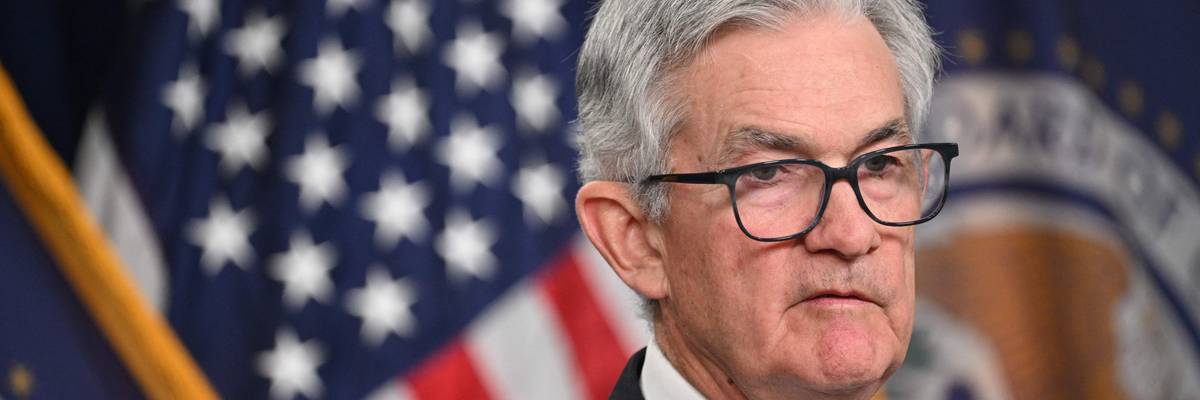
Federal Reserve Chair Jerome Powell speaks during a news conference on November 2, 2022.
The chief economist at the global investment bank UBS, the world's largest wealth manager, argued in an op-ed for the Financial Times on Wednesday that inflation in the United States "is more a product of profits than wages" and criticized Federal Reserve Chair Jerome Powell for refusing to acknowledge that fact as he plows ahead with massive interest rate hikes.
"Powell's public remarks offer little insight into how he expects higher rates to tame inflation," Paul Donovan of UBS Global Wealth Management wrote just ahead of the Fed's latest interest rate increase of 75 basis points. "This is the current inflation story. Companies have passed higher costs on to customers. But they have also taken advantage of circumstances to expand profit margins. The broadening of inflation beyond commodity prices is more profit margin expansion than wage cost pressures."
"Even a major bank's chief economist now admits that corporations are price gouging under the guise of inflation."
"Despite negative real wages, consumers have carried on consuming," Donovan added. "Consumers seem to be buying stories that seem to justify price increases, but which really serve as cover for profit margin expansion... This unconventional inflation means higher unemployment and lower wages are not the only possible cure for it. Policy has more routes to lower inflation if the cause is about profits."
Thus far, though, the Powell-led Federal Reserve has primarily used interest rate increases in its as-yet unsuccessful effort to bring down inflation, even as critics warn that such an approach harms workers and risks a devastating recession without tackling the primary drivers of price increases.
At his Wednesday press conference, Powell once again conceded that rate hikes "don't directly affect for the most part food and energy prices," two major sources of inflation dictated by profit-seeking corporations such as Exxon, Chevron, and PepsiCo.
"We increased prices at the beginning of the fourth quarter based on what we knew at that point," Pepsi's chief financial officer said on the company's earnings call last month. "And going forward, with the investments that we've made in brands, I still think we're capable of taking whatever pricing we need."
During his public appearance Wednesday, Powell wasn't asked a single question about the role corporate profiteering has played in causing high inflation even as executives boast about their enormous pricing power.
Progressive advocates and economists who have been spotlighting corporate America's inflationary profiteering for months seized on Donovan's Financial Times op-ed as further evidence that their data-driven argument is gradually piercing the mainstream, even as Powell ignores it.
"Even a major bank's chief economist now admits that corporations are price gouging under the guise of inflation," the American Economic Liberties Project tweeted Thursday.
Christian Hallum, tax justice lead at Oxfam International, added that "skyrocketing profits are to blame for inflation, according to the chief economist at UBS Global Wealth Management."
"Maybe we should tax windfall profits instead of trying to create unemployment through interest rate hikes?" Hallum suggested.
This country and this world are at a monumental crossroads. US voters have an opportunity to beat back the forces of fascism and confront the billionaires who are rigging the economy, our media system, and our democracy, making it increasingly impossible for ordinary people to get by. We’re not just talking about the election. We’re talking about what must be done once these fascist elements are vanquished from power. We need a bolder set of solutions than what either major party has so far been willing to offer and a working-class movement ready to fight like hell for it. Trump didn't emerge from nowhere. The conditions that fueled MAGA authoritarianism were created by decades of radical neoliberal economic policies and a corrupt political system dominated by corporate interests. They slashed taxes on the super-rich, promising that the benefits would trickle down. They said giveaways to the corporate titans would make life more affordable for the rest of us. It was all bullshit. And when a bitter, betrayed populace searches for someone to blame, right-wing demagogues have little trouble finding scapegoats. People know when they're being lied to, but you won't hear any of this from the corporate media. Only independent journalism—powered and funded by people who believe in building a better world—can deliver truly trustworthy daily news. If you share our vision, please contribute whatever you can to sustain our work. |
The chief economist at the global investment bank UBS, the world's largest wealth manager, argued in an op-ed for the Financial Times on Wednesday that inflation in the United States "is more a product of profits than wages" and criticized Federal Reserve Chair Jerome Powell for refusing to acknowledge that fact as he plows ahead with massive interest rate hikes.
"Powell's public remarks offer little insight into how he expects higher rates to tame inflation," Paul Donovan of UBS Global Wealth Management wrote just ahead of the Fed's latest interest rate increase of 75 basis points. "This is the current inflation story. Companies have passed higher costs on to customers. But they have also taken advantage of circumstances to expand profit margins. The broadening of inflation beyond commodity prices is more profit margin expansion than wage cost pressures."
"Even a major bank's chief economist now admits that corporations are price gouging under the guise of inflation."
"Despite negative real wages, consumers have carried on consuming," Donovan added. "Consumers seem to be buying stories that seem to justify price increases, but which really serve as cover for profit margin expansion... This unconventional inflation means higher unemployment and lower wages are not the only possible cure for it. Policy has more routes to lower inflation if the cause is about profits."
Thus far, though, the Powell-led Federal Reserve has primarily used interest rate increases in its as-yet unsuccessful effort to bring down inflation, even as critics warn that such an approach harms workers and risks a devastating recession without tackling the primary drivers of price increases.
At his Wednesday press conference, Powell once again conceded that rate hikes "don't directly affect for the most part food and energy prices," two major sources of inflation dictated by profit-seeking corporations such as Exxon, Chevron, and PepsiCo.
"We increased prices at the beginning of the fourth quarter based on what we knew at that point," Pepsi's chief financial officer said on the company's earnings call last month. "And going forward, with the investments that we've made in brands, I still think we're capable of taking whatever pricing we need."
During his public appearance Wednesday, Powell wasn't asked a single question about the role corporate profiteering has played in causing high inflation even as executives boast about their enormous pricing power.
Progressive advocates and economists who have been spotlighting corporate America's inflationary profiteering for months seized on Donovan's Financial Times op-ed as further evidence that their data-driven argument is gradually piercing the mainstream, even as Powell ignores it.
"Even a major bank's chief economist now admits that corporations are price gouging under the guise of inflation," the American Economic Liberties Project tweeted Thursday.
Christian Hallum, tax justice lead at Oxfam International, added that "skyrocketing profits are to blame for inflation, according to the chief economist at UBS Global Wealth Management."
"Maybe we should tax windfall profits instead of trying to create unemployment through interest rate hikes?" Hallum suggested.