SUBSCRIBE TO OUR FREE NEWSLETTER
Daily news & progressive opinion—funded by the people, not the corporations—delivered straight to your inbox.
5
#000000
#FFFFFF
To donate by check, phone, or other method, see our More Ways to Give page.
Daily news & progressive opinion—funded by the people, not the corporations—delivered straight to your inbox.
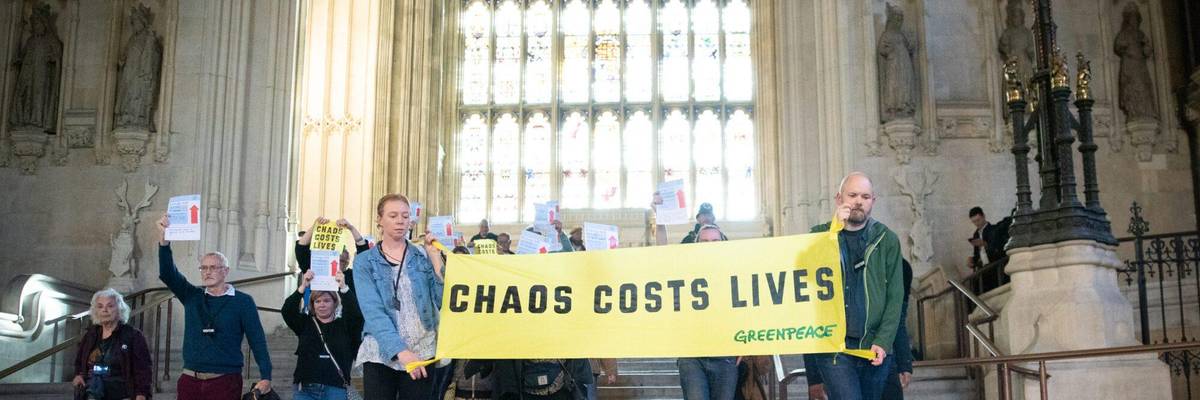
Dozens of climate and energy justice campaigners call for a stronger windfall profits tax to fund home insulation and renewable power generation from inside the U.K. Parliament in London on October 24, 2022. (Photo: Suzanne Plunkett/Greenpeace)
Hours after lawmakers from the ruling Conservative Party voted to make Rishi Sunak the United Kingdom's third prime minister this year, more than 30 climate and energy justice activists occupied the lobby of Parliament to demand that the government fund home insulation and renewable power generation through a more robust tax on oil and gas corporations' windfall profits.
An estimated 45 million people in the U.K. are facing fuel poverty as winter quickly approaches, according to one recent study. Meanwhile, heavily subsidized fossil fuel giants are raking in record profits, which they use to block policies that would facilitate a green transition and rein in their destructive industry.
Greenpeace campaigners, armed with sky-high utility bills from across the country, read the testimonies of people struggling to make ends meet amid a historic cost-of-living crisis that Sunak's right-wing predecessors--Boris Johnson and Liz Truss--and Tory colleagues have, according to progressive critics, exacerbated through adherence to neoliberal orthodoxy.
Stressing that "chaos costs lives," activists made the case for simultaneously addressing soaring energy prices and the worsening climate emergency by taxing fossil fuel profits and using the revenue to invest in better residential insulation and expanded clean energy production.
"Thanks to spiraling gas prices and the oldest, coldest housing in Europe, millions of people are being pushed into fuel poverty," Greenpeace U.K. noted in a blog post. "People across the country have waited for government after government to provide enough help to lower their energy bills--but mostly what we've had is political chaos."
The group continued:
Rising energy bills and cold homes will cost lives. The U.K. already has the sixth highest rate of excess winter deaths in Europe. Higher bills also disproportionately impact disabled and older people, people of color, and those from impoverished communities. For instance, many medical and mobility devices require electricity. Meaning, on average, disabled people have much higher energy bills just for using equipment they need in their day-to-day lives. Political leaders have failed to put people first and provide sufficient support for the energy crisis.
It's political choices that have caused the levels of inequality and fuel poverty we're facing. If this government properly taxed record fossil fuel profits, it could help fund extra support for those in need, and help pay for a nationwide program to insulate homes. Instead, the last six weeks have seen u-turns on the Conservative manifesto pledge on fracking and new commitments to North Sea oil and gas, which will wreck our climate and won't lower our bills.
Two months ago, the U.K. Treasury estimated that the nation's energy firms are poised to enjoy up to PS170 billion ($191.9 billion) in excess profits--defined as the gap between money made now and what would have been expected based on price forecasts prior to Russia's invasion of Ukraine--over the next two years.
A 25% windfall tax on oil and gas producers approved in July is expected to raise PS5 billion ($5.6 billion) in its first year. However, the existing surtax on excess fossil fuel profits contains loopholes allowing companies to drastically reduce their tax bill by investing more in oil and gas extraction, which the industry claims will boost supply. The recently enacted windfall tax, which lasts through 2025, also exempts eletricity generators, even though Treasury officials attribute roughly two-fifths of the PS170 billion in excess profits to such actors.
With winter energy bills projected to triple compared with last year, calls are growing in the U.K. to increase the windfall tax rate on excess fossil fuel profits and extend it to electricity generators benefiting from rising oil and gas prices.
While Truss vehemently opposed windfall taxes--asserting that they "send the wrong message to investors"--Sunak introduced the current windfall tax in May when he was Johnson's chancellor of the exchequer.
According to Greenpeace, Monday's action was meant to show Sunak that "he can't ignore the almost seven million households facing fuel poverty."
The life-threatening crises of surging utility bills and unmitigated greenhouse gas pollution are both caused by fossil fuel dependence, the group noted. Consequently, these problems have lifesaving solutions that are straightforward and aligned.
"To lower our bills long-term and reduce our emissions," Greenpeace urged Sunak to do the following:
"It's time we have a government that brings down bills for good and plays its part in tackling the climate crisis," the group added.
On social media, Greenpeace encouraged people to sign a petition imploring U.K. lawmakers to "keep people warm this winer."
"Delay has cost lives. Chaos costs lives. And it will cost more lives this winter and every winter," the group emphasized. "No one benefits except the oil and gas profiteers. If the government were on the people's side, the U.K. really could get on track to quitting oil, gas, and sky-high energy bills, forever."
Correction: This article has been updated to more accurately reflect the findings of a study on fuel poverty in the United Kingdom.
Dear Common Dreams reader, It’s been nearly 30 years since I co-founded Common Dreams with my late wife, Lina Newhouser. We had the radical notion that journalism should serve the public good, not corporate profits. It was clear to us from the outset what it would take to build such a project. No paid advertisements. No corporate sponsors. No millionaire publisher telling us what to think or do. Many people said we wouldn't last a year, but we proved those doubters wrong. Together with a tremendous team of journalists and dedicated staff, we built an independent media outlet free from the constraints of profits and corporate control. Our mission has always been simple: To inform. To inspire. To ignite change for the common good. Building Common Dreams was not easy. Our survival was never guaranteed. When you take on the most powerful forces—Wall Street greed, fossil fuel industry destruction, Big Tech lobbyists, and uber-rich oligarchs who have spent billions upon billions rigging the economy and democracy in their favor—the only bulwark you have is supporters who believe in your work. But here’s the urgent message from me today. It's never been this bad out there. And it's never been this hard to keep us going. At the very moment Common Dreams is most needed, the threats we face are intensifying. We need your support now more than ever. We don't accept corporate advertising and never will. We don't have a paywall because we don't think people should be blocked from critical news based on their ability to pay. Everything we do is funded by the donations of readers like you. When everyone does the little they can afford, we are strong. But if that support retreats or dries up, so do we. Will you donate now to make sure Common Dreams not only survives but thrives? —Craig Brown, Co-founder |
Hours after lawmakers from the ruling Conservative Party voted to make Rishi Sunak the United Kingdom's third prime minister this year, more than 30 climate and energy justice activists occupied the lobby of Parliament to demand that the government fund home insulation and renewable power generation through a more robust tax on oil and gas corporations' windfall profits.
An estimated 45 million people in the U.K. are facing fuel poverty as winter quickly approaches, according to one recent study. Meanwhile, heavily subsidized fossil fuel giants are raking in record profits, which they use to block policies that would facilitate a green transition and rein in their destructive industry.
Greenpeace campaigners, armed with sky-high utility bills from across the country, read the testimonies of people struggling to make ends meet amid a historic cost-of-living crisis that Sunak's right-wing predecessors--Boris Johnson and Liz Truss--and Tory colleagues have, according to progressive critics, exacerbated through adherence to neoliberal orthodoxy.
Stressing that "chaos costs lives," activists made the case for simultaneously addressing soaring energy prices and the worsening climate emergency by taxing fossil fuel profits and using the revenue to invest in better residential insulation and expanded clean energy production.
"Thanks to spiraling gas prices and the oldest, coldest housing in Europe, millions of people are being pushed into fuel poverty," Greenpeace U.K. noted in a blog post. "People across the country have waited for government after government to provide enough help to lower their energy bills--but mostly what we've had is political chaos."
The group continued:
Rising energy bills and cold homes will cost lives. The U.K. already has the sixth highest rate of excess winter deaths in Europe. Higher bills also disproportionately impact disabled and older people, people of color, and those from impoverished communities. For instance, many medical and mobility devices require electricity. Meaning, on average, disabled people have much higher energy bills just for using equipment they need in their day-to-day lives. Political leaders have failed to put people first and provide sufficient support for the energy crisis.
It's political choices that have caused the levels of inequality and fuel poverty we're facing. If this government properly taxed record fossil fuel profits, it could help fund extra support for those in need, and help pay for a nationwide program to insulate homes. Instead, the last six weeks have seen u-turns on the Conservative manifesto pledge on fracking and new commitments to North Sea oil and gas, which will wreck our climate and won't lower our bills.
Two months ago, the U.K. Treasury estimated that the nation's energy firms are poised to enjoy up to PS170 billion ($191.9 billion) in excess profits--defined as the gap between money made now and what would have been expected based on price forecasts prior to Russia's invasion of Ukraine--over the next two years.
A 25% windfall tax on oil and gas producers approved in July is expected to raise PS5 billion ($5.6 billion) in its first year. However, the existing surtax on excess fossil fuel profits contains loopholes allowing companies to drastically reduce their tax bill by investing more in oil and gas extraction, which the industry claims will boost supply. The recently enacted windfall tax, which lasts through 2025, also exempts eletricity generators, even though Treasury officials attribute roughly two-fifths of the PS170 billion in excess profits to such actors.
With winter energy bills projected to triple compared with last year, calls are growing in the U.K. to increase the windfall tax rate on excess fossil fuel profits and extend it to electricity generators benefiting from rising oil and gas prices.
While Truss vehemently opposed windfall taxes--asserting that they "send the wrong message to investors"--Sunak introduced the current windfall tax in May when he was Johnson's chancellor of the exchequer.
According to Greenpeace, Monday's action was meant to show Sunak that "he can't ignore the almost seven million households facing fuel poverty."
The life-threatening crises of surging utility bills and unmitigated greenhouse gas pollution are both caused by fossil fuel dependence, the group noted. Consequently, these problems have lifesaving solutions that are straightforward and aligned.
"To lower our bills long-term and reduce our emissions," Greenpeace urged Sunak to do the following:
"It's time we have a government that brings down bills for good and plays its part in tackling the climate crisis," the group added.
On social media, Greenpeace encouraged people to sign a petition imploring U.K. lawmakers to "keep people warm this winer."
"Delay has cost lives. Chaos costs lives. And it will cost more lives this winter and every winter," the group emphasized. "No one benefits except the oil and gas profiteers. If the government were on the people's side, the U.K. really could get on track to quitting oil, gas, and sky-high energy bills, forever."
Correction: This article has been updated to more accurately reflect the findings of a study on fuel poverty in the United Kingdom.
Hours after lawmakers from the ruling Conservative Party voted to make Rishi Sunak the United Kingdom's third prime minister this year, more than 30 climate and energy justice activists occupied the lobby of Parliament to demand that the government fund home insulation and renewable power generation through a more robust tax on oil and gas corporations' windfall profits.
An estimated 45 million people in the U.K. are facing fuel poverty as winter quickly approaches, according to one recent study. Meanwhile, heavily subsidized fossil fuel giants are raking in record profits, which they use to block policies that would facilitate a green transition and rein in their destructive industry.
Greenpeace campaigners, armed with sky-high utility bills from across the country, read the testimonies of people struggling to make ends meet amid a historic cost-of-living crisis that Sunak's right-wing predecessors--Boris Johnson and Liz Truss--and Tory colleagues have, according to progressive critics, exacerbated through adherence to neoliberal orthodoxy.
Stressing that "chaos costs lives," activists made the case for simultaneously addressing soaring energy prices and the worsening climate emergency by taxing fossil fuel profits and using the revenue to invest in better residential insulation and expanded clean energy production.
"Thanks to spiraling gas prices and the oldest, coldest housing in Europe, millions of people are being pushed into fuel poverty," Greenpeace U.K. noted in a blog post. "People across the country have waited for government after government to provide enough help to lower their energy bills--but mostly what we've had is political chaos."
The group continued:
Rising energy bills and cold homes will cost lives. The U.K. already has the sixth highest rate of excess winter deaths in Europe. Higher bills also disproportionately impact disabled and older people, people of color, and those from impoverished communities. For instance, many medical and mobility devices require electricity. Meaning, on average, disabled people have much higher energy bills just for using equipment they need in their day-to-day lives. Political leaders have failed to put people first and provide sufficient support for the energy crisis.
It's political choices that have caused the levels of inequality and fuel poverty we're facing. If this government properly taxed record fossil fuel profits, it could help fund extra support for those in need, and help pay for a nationwide program to insulate homes. Instead, the last six weeks have seen u-turns on the Conservative manifesto pledge on fracking and new commitments to North Sea oil and gas, which will wreck our climate and won't lower our bills.
Two months ago, the U.K. Treasury estimated that the nation's energy firms are poised to enjoy up to PS170 billion ($191.9 billion) in excess profits--defined as the gap between money made now and what would have been expected based on price forecasts prior to Russia's invasion of Ukraine--over the next two years.
A 25% windfall tax on oil and gas producers approved in July is expected to raise PS5 billion ($5.6 billion) in its first year. However, the existing surtax on excess fossil fuel profits contains loopholes allowing companies to drastically reduce their tax bill by investing more in oil and gas extraction, which the industry claims will boost supply. The recently enacted windfall tax, which lasts through 2025, also exempts eletricity generators, even though Treasury officials attribute roughly two-fifths of the PS170 billion in excess profits to such actors.
With winter energy bills projected to triple compared with last year, calls are growing in the U.K. to increase the windfall tax rate on excess fossil fuel profits and extend it to electricity generators benefiting from rising oil and gas prices.
While Truss vehemently opposed windfall taxes--asserting that they "send the wrong message to investors"--Sunak introduced the current windfall tax in May when he was Johnson's chancellor of the exchequer.
According to Greenpeace, Monday's action was meant to show Sunak that "he can't ignore the almost seven million households facing fuel poverty."
The life-threatening crises of surging utility bills and unmitigated greenhouse gas pollution are both caused by fossil fuel dependence, the group noted. Consequently, these problems have lifesaving solutions that are straightforward and aligned.
"To lower our bills long-term and reduce our emissions," Greenpeace urged Sunak to do the following:
"It's time we have a government that brings down bills for good and plays its part in tackling the climate crisis," the group added.
On social media, Greenpeace encouraged people to sign a petition imploring U.K. lawmakers to "keep people warm this winer."
"Delay has cost lives. Chaos costs lives. And it will cost more lives this winter and every winter," the group emphasized. "No one benefits except the oil and gas profiteers. If the government were on the people's side, the U.K. really could get on track to quitting oil, gas, and sky-high energy bills, forever."
Correction: This article has been updated to more accurately reflect the findings of a study on fuel poverty in the United Kingdom.